Month: May 2024

Washington Post: Have Cold Showers to Prevent Climate Change

Essay by Eric Worrall

Clearly we haven’t plumbed the bottom of the well of climate absurdity.

Why you should embrace using cold water, almost all the time

Heating water gobbles energy, leading to higher utility bills and more planet-warming emissions.

By Allyson Chiu
May 12, 2024 at 6:30 a.m. EDT

You may not be giving a second thought to setting your washing machine on the hot cycle, cranking your showers to a steamy temperature or scrubbing your dirty dishes under a stream of scalding water.

If you did, you’d find that you probably don’t need to use so much hot water — and that you could be saving energy and cutting your utility bills. Water heating is responsible for more than 10 percent of both annual residential energy use and consumer utility costs, the biggest share after air conditioning and heating, according to the Energy Department. An American household uses an average of 64 gallons of hot water a day — close to the amount needed to fill an average bathtub— by doing laundry, showering, washing the dishes and running kitchen and bathroom faucets.

While there are home improvements that can help you cut back on the energy it takes to heat water, including installing a heat pump water heater, one easy solution is to switch to cold water.

“If you’re wasting cold water to get your hot water, then you’re really wasting both water and the energy resources,” she said. “Those energy resources still come largely from fossil fuels, and so they’re adding to emissions in the environment at a time when we really need to be doing everything we can to reduce carbon emissions.”

Read more: https://www.washingtonpost.com/climate-solutions/2024/05/11/cold-water-laundry-shower-dishes/#

The real question in my mind, how is the climate movement going to top this absurdity? Self flagellation every time you are tempted by machine age transport? Drinking your own pee to save water? Comment suggestions welcome, but please keep them family friendly.

via Watts Up With That?

https://ift.tt/5dwTyqS

May 14, 2024 at 04:07PM

Apocalypse Not

Joakim Book shines considerable light into modern doomsday darkness, writing his AIER article Unlimited Growth, Forever.  Book exposes how fundamental human positive aspiration, proven by historical progress and innovation, has been perverted by those nowadays claiming to be progressive, when all they preach is hell and damnation.  Excerpts in italics with my bolds and added images.

It is often said that only a madman — or economist — could believe that we can have infinite growth on a finite planet. Resources are scarce and dwindling, we’re told. Day in and day out, we seem poised to use up some civilization-critical ingredient, or we might overuse materials to the point of our own downfall. 

The mindset that makes people believe that we’re perennially on the cusp of some disaster is on display everywhere from the big screen to the big assembly halls. It has been humanity’s plague since we first broke free of the Malthusian constraints that govern every non-human ecology. And never once do we seem to consider that maybe, just maybe, the madmen/economists know something the rest of us don’t. 

We’re routinely given hyperbolic predictions about our doom, and no matter whether those predictions come true, they’re renewed in the same or slightly altered form a few years later. In the meantime, individuals, businesses, workers, investors, tinkerers, and all the others that make up the world economy solve much of the “problem.”

Every popular scare of the past has been side-stepped, improved,
or solved, by one or another human effort, usually serendipitously
and rarely at all with well-meaning bureaucrats directing the process. 
 

New York University economist Paul Romer, whose work on economic growth rewarded him the Nobel Prize in 2018, explains that “non-economists have said that [his article] helped them understand why unlimited growth is possible in a world with finite resources.” He credits that conclusion to his work on the proliferation of ideas, which he condenses into the following two statements: 

    1. “we can share discoveries with others,” and 
    2. “there are incomprehensibly many discoveries yet to be found.”

The basic rationale is thus simple: “Although we live in a world of a limited number of atoms,” as Marian Tupy and Gale Pooley say in their masterful creation Superabundance, “there are virtually infinite ways to arrange those atoms. The possibilities for creating new value are thus immense.”

Economic growth itself, said University of Mississippi economist Josh Hendrickson in an interchange with The Guardian’s George Monbiot a few years ago, is about “finding more efficient uses of resources.” It’s about observing how market prices and the profit motive urge entrepreneurs and businesses to economize on production while producing more value for consumers. We can visibly see this in the products that technology has merged into one (smartphones displacing a dozen or more physical appliances), or the thinner cans or more efficient engines that innovation routinely delivers. 

Economists aren’t just playing word games when they say that growth can keep going forever. We can always make more stuff since the physical atoms under our command right now are far from all the physical atoms on our planet (or solar system). By growth, economists mean value-creation exchanged in the marketplace, a market that can change in the types of value we exchange, and the growing portion of our economies can involve fewer atoms than what came before.

“Resource” which the general public think of as physical collections of elements in the ground, economists define much more broadly. Nothing becomes a resource until the human mind makes it so, i.e., “there are no resources until we find them, identify their possible uses, and develop ways to obtain and process them” to quote Julian Simon, whose pioneering work in resource economics prompted Tupy and Pooley to launch their Superabundance project. 

The boundaries between dirt, mineral resource, and mineral reserve can therefore shift with technology, economic circumstances, or legal rules regarding their extraction — subject to the “degree of geological certainty” and “feasibility of economic recovery.”

My Mind is Made Up, Don’t Confuse Me with the Facts. H/T Bjorn Lomborg, WUWT

What’s even more incredible is that material abundance (how economically accessible certain minerals or agricultural products are) has historically speaking increased with population. Instead of individually starving when there are more humans on our supposedly finite planet, we seem to be collectively producing more, having better access to raw materials and the goods and services we produce with them. 

Take almost any foodstuff, meat or cerealfruit or vegetable, for almost any country over any period and the numbers go up and to the right: For eight centuries (probably more), an English laborer has been able to afford more and more foodstuffs for their labor; yet there’s more food production today than at any point in the past.

The counterintuitive conclusion follows naturally from Romer’s work: More humans give us more chances for ideas that exponentially “make material progress possible.” Human society is dynamic, not zero-sum.

Illustration: oil. Thirteen years ago, Camilla Ruz for The Guardian enumerated six natural resource scares to pay attention to, of which oil was one. Dire predictions like these are a dime a dozen in the environmentalist world, and no matter how publicly or unequivocally they are disconfirmed by reality, they pop up with renewed vigor a few years later. At the time we had some 46 years’ worth of oil reserves left; that is, at the prices, consumption rate, and technology of 2011, humanity would run out of oil by the late 2050s. 

With a billion more people on the planet since then, having suitably burned some 386 billion barrels of oil in the intervening years, we now have… drumroll…48 years’ usage in global proven reserves; Humanity will now last until the 2070s before its (supposedly limited) reserves of oil run dry. Disaster avoided. 

The price system, profit-hungry entrepreneurs, and optimizing consumers are pretty good at remedying scarcities when they emerge. If there isn’t enough oil, gas, wheat, gold, nickel, or copper for current human processes, the (real) price of those commodities rise; extracting businesses dig deeper or explore further, and consumers substitute away from the expensive commodity, or we recycle the metals that forever remain with us into something new. Higher prices mean that lower-quality ores are now worth mining, more inaccessible sources and geologists’ best guesses for where we could find more worth exploring. The outcome over decades and centuries is that “prices of resources are declining because more people means more ideas, new inventions and innovations,” according to Tupy and Pooley.

That we do not run out is the powerful lesson of both the history of resources and the theory behind their economic uses: Our minds and the black box of nifty ways to improve the world aren’t limited. We don’t run out; We simply find more.

The recurring “we’re running out of X!” outrage therefore seems so peculiar, so out of touch with even a semblance of reality. 194 years ago, before having seen but a tiny fraction of the improvements humanity would make over the following decades and centuries, British historian and poet Thomas Babington (raised to the peerage as Lord Macaulay) wrote

though in every age everybody knows that up to his own time progressive improvement has been taking place, nobody seems to reckon on any improvement during the next generation. We cannot absolutely prove that those are in error who tell us that society has reached a turning point […] but so said all who came before us, and with just as much apparent reason.

He then ended his colloquy with the sentence that human progress-types know by heart:

“On what principle is it that, when we see nothing but improvement behind us, we are to expect nothing but deterioration before us?”

That was a reasonable enough question in 1830,
and a terribly relevant one in 2024.


via Science Matters

https://ift.tt/oPvN9G5

May 14, 2024 at 03:37PM

Russia discovers oil and gas reserves in Antarctica — ten times bigger than North Sea

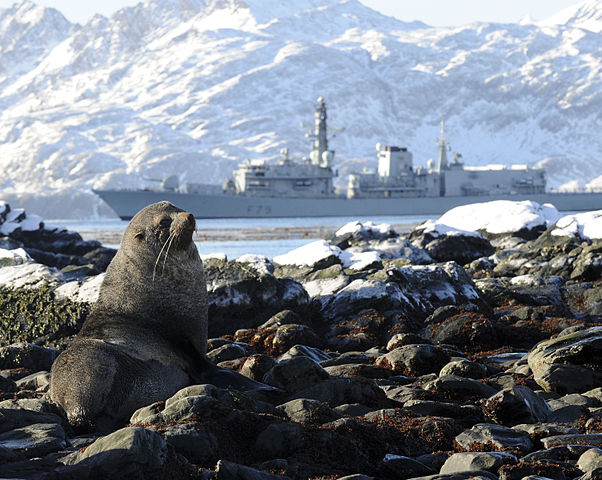
 HMS Portland comes face to face with the remarkable size of the Nordenskjold Glacier in South Georgia and local wildlife. Antarctica

While no one was paying attention, a Russian ship exploring Antarctica claims it has found oil and gas deposits that are ten times larger than the North Sea. Presumably quite a lot of countries would find this very interesting. At the moment Antarctica is supposedly protected by a piece of paper, but those who want to keep something so valuable to themselves will be needing more than cellulose.

It could take some fossil fuels to protect these fossil fuels

Hard to see any nation keeping control of this oil and gas field using sailing boats, solar powered ships and missiles running on palm oil.

Johnathon Leake, Telegraph

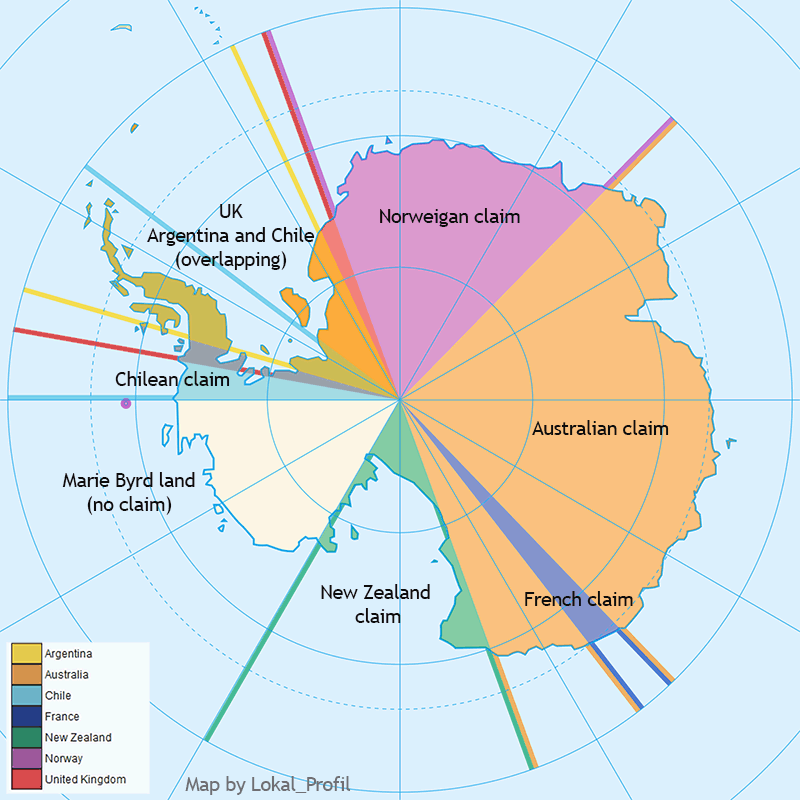
Russia has found vast oil and gas reserves in the Antarctic, much of it in areas claimed by the UK.

The surveys are a prelude to bringing in drilling rigs to exploit the pristine region for fossil fuels, MPs have warned.

Reserves totalling 511bn barrels of oil – about 10 times the North Sea’s entire 50-year output – have been reported to Moscow by Russian research ships, according to evidence given to the Commons Environment Audit Committee (EAC) last week.

It follows a series of surveys by the Alexander Karpinsky vessel, operated by Rosgeo – the Russian agency charged with finding mineral reserves for commercial exploitation.

The total extracted from the North sea up until 2014 was about 42 billion barrels of “oil equivalent”.  Green fanatics would be horrified to think of all the emissions that might be unleashed, but 3 billion cold people in China, Russia, India and Japan might have a different view.

Antarctica, territorial claims
Russia claims that its boat was just doing scientific research (just like those Japanese whalers were).

At least a part of the UK government apparently found out about this when a South African newspaper published a story on it. (Who needs intelligence when you can read the Daily Maverick?)

The EAC [Environment Audit Committee] decided to challenge the Foreign Office’s management of the UK’s Antarctic interests following reports in the Daily Maverick, a South African online journal, which discovered Moscow’s activities after its survey ship docked in Cape Town.

The British government has officially said they believe the Russians, but a few in the British government are skeptical. (From the Daily Maverick)

[Anna McMorrin, a Labour MP on the polar audit sub-committee] asked FCDO Under-Secretary David Rutley…  if he was “aware” of the Rosgeo vessels, under US sanctions since February, and how the UK was to respond at the annual Antarctic Treaty consultative meeting (ATCM) in India from May 20 to 30.

The under-secretary defended Russia’s “repeated assurances” at ATCMs “that these activities are for scientific purposes”.

A sceptical McMorrin asked Rutley if he was “content to believe Russia when they say they’re just undertaking scientific action”. The Labour MP also quoted expert testimony to the committee, stressing that leading polar geopolitician Professor Klaus Dodds had flagged the “current Russian activity” and its possible “prospecting” links as “troubling”.

“There is a worry that Russia is collecting seismic data that could be construed to be prospecting rather than scientific research. And, if such, does this signal a potential threat to the permanent ban on mining,” asked Dodds, of Royal Holloway, University of London, “with knock-on implications for the integrity of the protocol in its entirety?”

Suddenly people might start paying attention to Antarctica.

______________________________________

For the record, the  dispute between the UK and Argentina goes back a long way.

Photo: LA(Phot) Ian Simpson  of the HMS Portland in South Georgia in 2010 on Wikimedia


0 out of 10 based on 0 rating

via JoNova

https://ift.tt/0XGtBqD

May 14, 2024 at 02:34PM

World Bank Launches First Global Framework for Agri-Food Emissions

The recent report from the World Bank, “Recipe for a Livable Planet: Achieving Net Zero Emissions in the Agrifood System,” touts the possibility of making significant cuts to global agrifood emissions through a variety of prescriptive measures. The historical record of such centralized initiatives suggests a high probability of resulting in unintended and often detrimental consequences.

The report asserts:

“The global agrifood system presents a huge opportunity to cut almost a third of the world’s greenhouse gas emissions through affordable and readily available actions, while continuing to feed a growing population.”

https://www.worldbank.org/en/news/press-release/2024/05/07/recipe-for-livable-planet

This sweeping statement masks the complexity and potential dangers of radically altering food production and land use, particularly in the vulnerable regions of the world. The claim that such changes can be implemented without jeopardizing food security is optimistic at best and recklessly naive at worst.

Axel van Trotsenburg of the World Bank further champions these changes:

“While the food on your table may taste good, it is also a hefty slice of the climate change emissions pie. The good news is that the global food system can heal the planet – making soils, ecosystems, and people healthier, while keeping carbon in the ground. This is within reach in our lifetimes, but countries must act now: simply changing how middle-income countries use land, such as forests and ecosystems, for food production can cut agrifood emissions by a third by 2030.”

https://www.worldbank.org/en/news/press-release/2024/05/07/recipe-for-livable-planet

This narrative promotes a troubling confidence in the efficacy of sweeping regulatory changes, disregarding the diverse agricultural practices that have been honed by local farmers over centuries. The assumption that such top-down mandates can lead to positive outcomes without disruptive side effects reflects a misunderstanding of ecological, social, and economic interdependencies.

The World Bank’s plan includes a broad array of actions:

“Action should happen across all countries to get to net zero, through a comprehensive approach to reducing emissions in food systems, including in fertilizers and energy, crop and livestock production, and packaging and distribution across the value chain from farm to table.”

https://www.worldbank.org/en/news/press-release/2024/05/07/recipe-for-livable-planet

This proposal to standardize farming practices across vastly different regions and cultures not only smacks of overreach but also underestimates the complexity of local ecosystems and the adaptability required to manage them effectively.

The framework posits that high investment costs will yield significant returns:

“Annual investments will need to increase to $260 billion a year to cut in half agrifood emissions by 2030 and to reach net zero emissions by 2050. Making these investments would lead to more than $4 trillion in benefits, from improvements in human health, food and nutrition security, better quality jobs and profits for farmers, to more carbon retained in forests and soils.”

https://www.worldbank.org/en/news/press-release/2024/05/07/recipe-for-livable-planet

However, the focus on monetary investment and projected returns overlooks the real-world complexities of agricultural economics. Such massive redirection of funds risks creating new economic imbalances, potentially leading to increased food prices and decreased access to necessary resources for the world’s poorest populations.

Ultimately, the World Bank’s ambitious project to restructure global agriculture underestimates the risks of unintended consequences, including food shortages, economic disruption, and increased hardship for the most vulnerable. History teaches that centralized interventions in complex systems such as global agriculture often lead to outcomes opposite those intended, driven by a failure to account for the organic and evolved nature of these systems. The portrayal of these interventions as low-risk and high-return is not only misleading but potentially dangerous, paving the way for a future where the global food supply is less secure and more susceptible to the whims of bureaucratic mismanagement.

At the very least the pursuit of such grandiose plans should be viewed with skepticism and caution, as history has repeatedly shown that the road to disaster is often paved with well-intentioned global initiatives.

via Watts Up With That?

https://ift.tt/B1vGmpr

May 14, 2024 at 12:07PM