
The country’s coalition government is preparing to invite energy companies to resume exploration in the three major offshore fields that supply most of its gas.
via Watts Up With That?
June 9, 2024 at 08:06PM
The country’s coalition government is preparing to invite energy companies to resume exploration in the three major offshore fields that supply most of its gas.
via Watts Up With That?
June 9, 2024 at 08:06PM
Sea ice experts at the US National Snow and Ice Data Center just confirmed my suspicion that the huge area of open water in eastern Hudson Bay during May this year was caused by winds, not ice melt. In other words, it’s a rare occurrence but not a sign of extra-early sea ice melt caused by global warming.

Money quote: “Unusual strong and persistent winds from the east caused the low extent.”
May sea ice Hudson Bay
From the NSIDC report (June 4), a NASA image of Hudson Bay taken 26 May 2024:

The graph below is from the same report, showing the “unprecedented” (since 1979 only) nature of this wind-driven event:

The Canadian Ice Service shows this in regional context for the first week of June in their stage of development chart (i.e. ice thickness, where medium green is 70-120 cm thick, dark green 120-200 cm or more):

Even pessimistic polar bear specialist Andrew Derocher admitted last week that Western Hudson Bay polar bears are largely unaffected by the open water on the bay since they are concentrated in the western half of the bay. The bears do this most years in late spring, in fact, even when there is more ice available. Derocher’s tracking maps for 31 May 2024 and 1 June 2019 are below:


Even by today, 9 June, there is still ice in the western half of James Bay and Hudson Bay:

May Arctic sea ice
Overall, however, the NSIDC report also showed that sea ice for May was about what it has been since 2004 (with some variation), with the average this year at 12.78 mkm2:

Sea ice extent at 1 June 2024 shown below:

via polarbearscience
June 9, 2024 at 07:22PM

As Joe Oliver explains, national macroeconomics are not that complicated. Good governance means taking care of the five pillars. Regretably, Trudeau has failed Canada in every respect, outdone only by Biden’s performance in the USA. Oliver explains at Financial Post Canada The Trudeau Liberals have eroded all five pillars of prosperity. Excerpts in italics with my bolds.
Economics says the pillars are: spending restraint, low taxes,
minimal regulation, sound money, free trade. Ottawa is oh-for-five.
Canada’s standard of living is in decline, both in absolute terms and compared to our southern neighbour and other wealthy countries. A Fraser Institute analysis shows that real GDP per capita was lower during the pre-recession period 2016-19 than in any similar period since 1985. As of the last quarter of 2023 it was below its value for 2019:Q2. It’s no surprise that 44 per cent of Canadians now say money is their leading source of stress.

What explains Canada’s dreadful performance? As set out by Arthur Laffer, of Laffer Curve fame, prosperity has five pillars: restrained government spending, low taxes, minimal regulation, sound money and free trade. The Liberal government has rejected, undermined or neglected each of the five. Our weak record and disheartening prospects have not been caused by external forces but by dysfunctional government policies.
Canada is blessed by enviable geology and geography — immense natural resources and a friendly superpower next door — which Canadians too frequently take for granted. Because our border is safe and our population well off by world and historical standards, progressive politicians feel free to obsess about issues irrelevant or actually harmful to economic growth, jobs, affordability, a sound currency, security and national unity.

Let’s review the litany of debilitating missteps, starting with the size and role of government. The federal public service reached over 274,000 employees in 2023, an increase of 40.4 % since 2015. A bloated bureaucracy drains resources from the private sector, reducing economic efficiency. In the last eight years, the depletion has been rapid. Federal spending swelled from 12.8 per cent of GDP in 2015 to 16.1 per cent in 2023. Federal debt more than doubled, from $612 billion to a staggering $1.4 trillion — over $143,000 for a family of four. Interest now costs Ottawa $47.2 billion a year, rising to $64.3 billion by 2028-29. This is fiscal profligacy writ large.
Tax increases discourage economic growth. The Laffer curve demonstrates that taxes set too high can actually reduce tax revenue. Out of 61 US jurisdictions and Canadian provinces, the top three personal marginal income tax rates are imposed by Newfoundland and Labrador, Nova Scotia and Ontario. Nine Canadian provinces rank in the top 10, all are in the top 15, and Canada ranks fifth out of 38 OECD countries. Corporate income tax rates are also higher here than in the U.S., the U.K. and the OECD on average. High taxes damage affordability, reduce competitiveness, discourage innovation and entrepreneurship, accelerate capital flight and weaken productivity. The proposed increase in the capital gains inclusion rate for both individuals and companies and the phase-out of accelerated capital depreciation will seriously exacerbate those negatives.

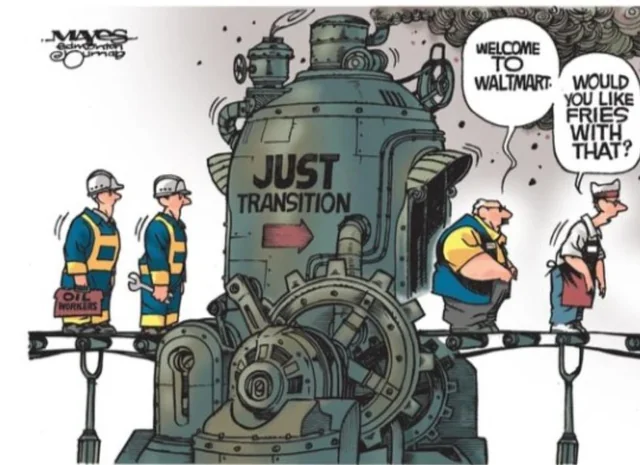
Since 2015, intrusive regulations have proliferated across the economy, imposing burdensome compliance costs that are particularly harmful to small and medium- sized enterprises. The resource industry, which accounts for 19.2 per cent of GDP and 58 per cent of merchandise exports, has been targeted by draconian regulation deliberately designed to block energy projects. The result is an opportunity loss in the hundreds of billions of dollars and mounting.

A stable money supply is critical for economic stability. To cope with out-of- control government spending, the Bank of Canada expanded the money supply dramatically, pushing it to $3.6 trillion, 83 per cent more than when the Liberals took office. As a result, in 2022 inflation hit a 40-year peak of 6.8 per cent. Consumer prices are now 27 per cent higher than in 2015. Rising prices disproportionately affect low- and middle-income Canadians, who are also vulnerable to hikes in interest rates, including mortgage rates up 50 per cent from 2015. In aggregate, total mortgage payments could rise by as much as $4 billion this year.
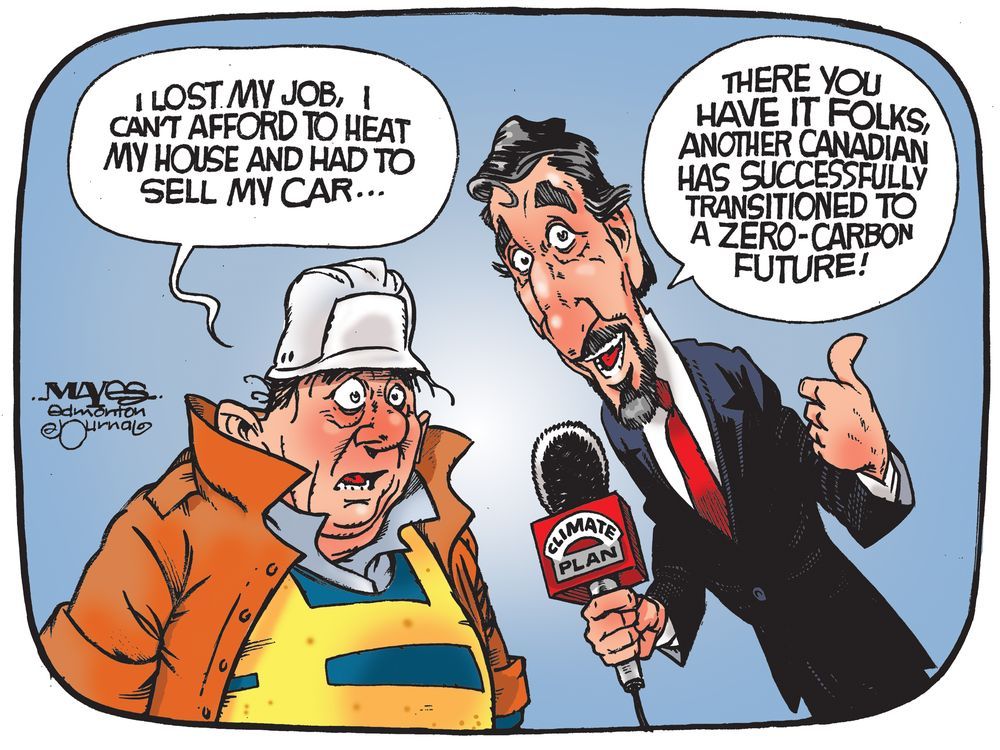
Free trade had been a cornerstone of Canada’s economic policy for decades, promoting growth and prosperity. But last year Canada lost bragging rights as America’s biggest trade partner to Mexico. Instead of pursuing our comparative advantage in natural resources, Liberal policies purposely stymie the development and export of oil and gas. In a memorably inane comment, the prime minister claimed there was never a strong business case for liquified natural gas. The government should leave the assessment of business cases to business.
Barriers to interprovincial trade, a related problem, have continued to elude meaningful progress despite repeated promises. The Montreal Economic Institute estimates that removing those barriers would yield an average increase in Canadians’ incomes by 5.5 per cent, or $1,800. According to the IMF, it could boost GDP by $80 billion.
The government’s score for supporting the mainstays of prosperity is zero for five. Rather than correcting course, Justin Trudeau seems increasingly disconnected from reality and fixated on maintaining a perfect losing streak. Doubling down on big government, high taxes and hostility to resource development will do the trick.

via Science Matters
June 9, 2024 at 07:15PM
Essay by Eric Worrall
Does “there’s no sense in signing up to targets you don’t have any prospect of achieving” translate to a commitment to dump Australia’s Paris obligations?
Dutton to pull Australia out of Paris Agreement if elected
By Mike Foley
June 8, 2024 — 2.27pmOpposition Leader Peter Dutton has signalled he will scrap the nation’s legally binding 2030 climate target and risk Australia’s membership of the Paris Agreement on climate change, following his vow to deploy nuclear energy to reach net zero by 2050.
Dutton declared on Saturday that a Coalition government would not pursue Australia’s legally binding climate target to cut emissions by 43 per cent from 2005 levels by 2030 – a significant escalation of Australia’s long-running climate policy war ahead of the next federal election due by May next year.
Dutton told The Australian on Saturday that the government’s renewable goal was unattainable and “there’s no sense in signing up to targets you don’t have any prospect of achieving”.
The opposition has said if it forms government it would build up to seven emissions-free nuclear power plants to replace the energy supply from Australia’s dirty coal plants, which have begun to shut down across the country. He would also pause the rollout of wind and solar farms.
…
“You can’t have the prime minister saying we aren’t going to have coal, we aren’t going to have gas and were not going to have nuclear power and we are going to keep the lights on – that’s just fantasy. We now have a debate about energy which I think we can win,” he told The Australian.
…
Suggesting Dutton’s statement is a commitment to pull out of the Paris Agreement seems a trifle exaggerated.
WUWT has repeatedly criticising the Aussie opposition’s Frankenstein climate policy. While on the surface Dutton’s nuclear push might seem a good idea, in my opinion it is actually a weak attempt at appeasement politics.
At last year’s Aussie CPAC MP Keith Pitt, formerly a staunch defender of coal, made a bizarre speech about the need to demolish coal plants and build nuclear plants in their place, to take advantage of all the distribution infrastructure which has already been built for the coal plants.
The problem is there is still plenty of coal, mostly brown coal, in the ground in the proposed nuclear sites. Building a nuclear plant on top of a coal field risks sabotaging remaining stocks of coal – even a low level radiation leak which seeped into the coal layer would make burning the coal even more controversial than it already is. Building a coal plant and using the available brown coal would be far cheaper and would offer almost immediate cost relief to business and domestic energy consumers.
Nuclear plants, however desirable in the long term, do not offer short term benefits in most locations. Aside from the high upfront capital costs, and the lack of local expertise, greens would immediately launch a tsunami of well funded lawfare. I have no problem with nuclear plants being built in locations where they offer an economic benefit, but the decision should be based purely on economics, such as installing a nuclear plant to service a remote location and save on fuel deliveries. The decision to go nuclear should not be because mainstream Aussie politicians are too timid to challenge the greens head on and fully exploit Australia’s abundant coal resources.
The one silver lining of the opposition nuclear push is it has sabotaged the renewable plans of the current Aussie administration. It’s hard to get a bank loan when the opposition leader is promising to withdraw the subsidies which are your basis of your business profitability.
What can we conclude from all this? On this issue I believe claims Aussie Conservative leader Peter Dutton is trying to leave the Paris Agreement are exaggerated. As far as I can tell Peter Dutton is just as onboard with Paris as other mainstream Aussie politicians, he just wants a different approach. I’m glad Dutton has taken a stand against absurdly unrealistic emissions reduction targets. But I’m saddened that Dutton still hasn’t found the political courage to do what he is being accused of – ditch all emissions targets and tear up Australia’s participation in the Paris Agreement.
via Watts Up With That?
June 9, 2024 at 04:05PM
 Iowa Climate Science Education