Month: June 2024

Scientific integrity and U.S. “Billion Dollar Disasters”-Roger Pielke

From NOT A LOT OF PEOPLE KNOW THAT

By Paul Homewood

Roger Pielke Jr has long challenged the fraudulent “billion dollar” disaster disinformation campaign.

Now he has gone one step further with this peer reviewed paper:

Abstract

For more than two decades, the U.S. National Oceanic and Atmospheric Administration (NOAA) has published a count of weather-related disasters in the United States that it estimates have exceeded one billion dollars (inflation adjusted) in each calendar year starting in 1980. The dataset is widely cited and applied in research, assessment and invoked to justify policy in federal agencies, Congress and by the U.S. President. This paper performs an evaluation of the dataset under criteria of procedure and substance defined under NOAA’s Information Quality and Scientific Integrity policies. The evaluation finds that the “billion dollar disaster” dataset falls short of meeting these criteria. Thus, public claims promoted by NOAA associated with the dataset and its significance are flawed and at times misleading. Specifically, NOAA incorrectly claims that for some types of extreme weather, the dataset demonstrates detection and attribution of changes on climate timescales. Similarly flawed are NOAA’s claims that increasing annual counts of billion dollar disasters are in part a consequence of human caused climate change. NOAA’s claims to have achieved detection and attribution are not supported by any scientific analysis that it has performed. Given the importance and influence of the dataset in science and policy, NOAA should act quickly to address this scientific integrity shortfall.

https://www.nature.com/articles/s44304-024-00011-0

Roger has also written an explanatory post here.

via Watts Up With That?

https://ift.tt/4yT1pvg

June 7, 2024 at 08:06AM

UAH Upper Tropospheric Temperatures Corroborate LT Temperature Trends

The recent record-setting UAH satellite-based temperatures of the lower troposphere can be compared to a different combination of satellite MSU/AMSU channels which help to corroborate the temperature trends from our “lower tropospheric” (LT) combination of channels.

The three channels we use for LT are MSU channels 2 (“MT”), 3 (“TP”), and 4 (“LS”), (AMSU channels 5, 7, and 9). The primary channel used comes from “MT” (MSU channel 2 or AMSU channel 5), which has the largest weight:

LT = 1.538*MT – 0.548*TP + 0.01*LS

But we have also experimented with a weighted average of MSU channels 3 (“TP”) and 4 (“LS”), (AMSU channels 7 and 9), which produces an averaging kernel in the upper troposphere (nearly insensitive to stratospheric cooling in the tropics, but somewhat sensitive to stratospheric cooling in the extra-tropics where the tropopause [the boundary between troposphere and stratosphere] is lower). This provides an independent check on our LT synthesized channel, keeping in mind one is centered in the lower troposphere and the other is centered in the upper troposphere.

We noticed that last month (May, 2024) produced a record warm global average temperature in the tropopause channel (AMSU channel 7), so I decided to investigate. Combining channel 7 and 9 for an Upper Troposphere (UT) synthesized channel

UT = 1.35*TP – 0.35*LS

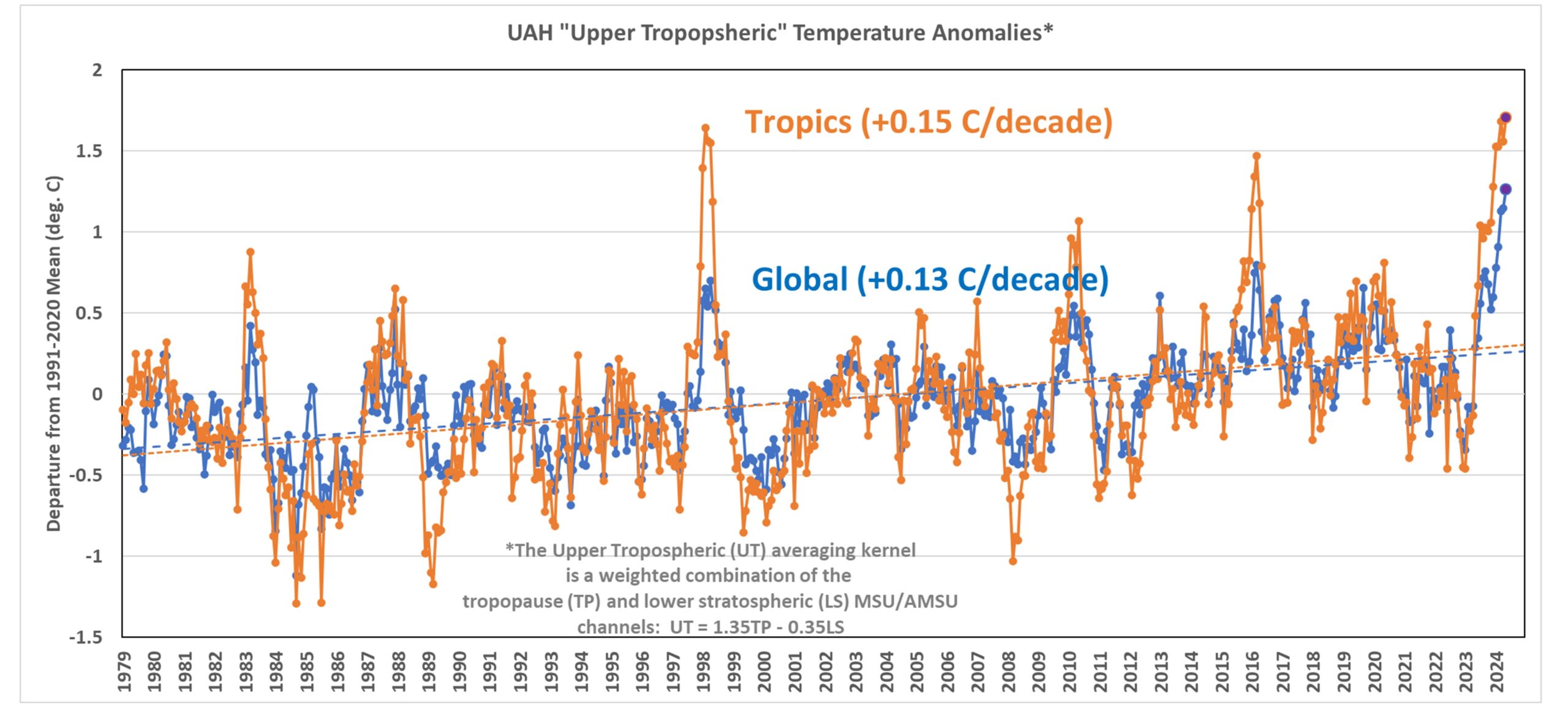
produces the following temperature anomalies:

Note that for the global average, the synthesized UT channel reached record warm values in February, then March, then April, and then May, 2024.

In the tropics, March and then May produced records, but not by much… the 1997/98 El Nino produced upper tropospheric warmth nearly as strong as our recent El Nino.

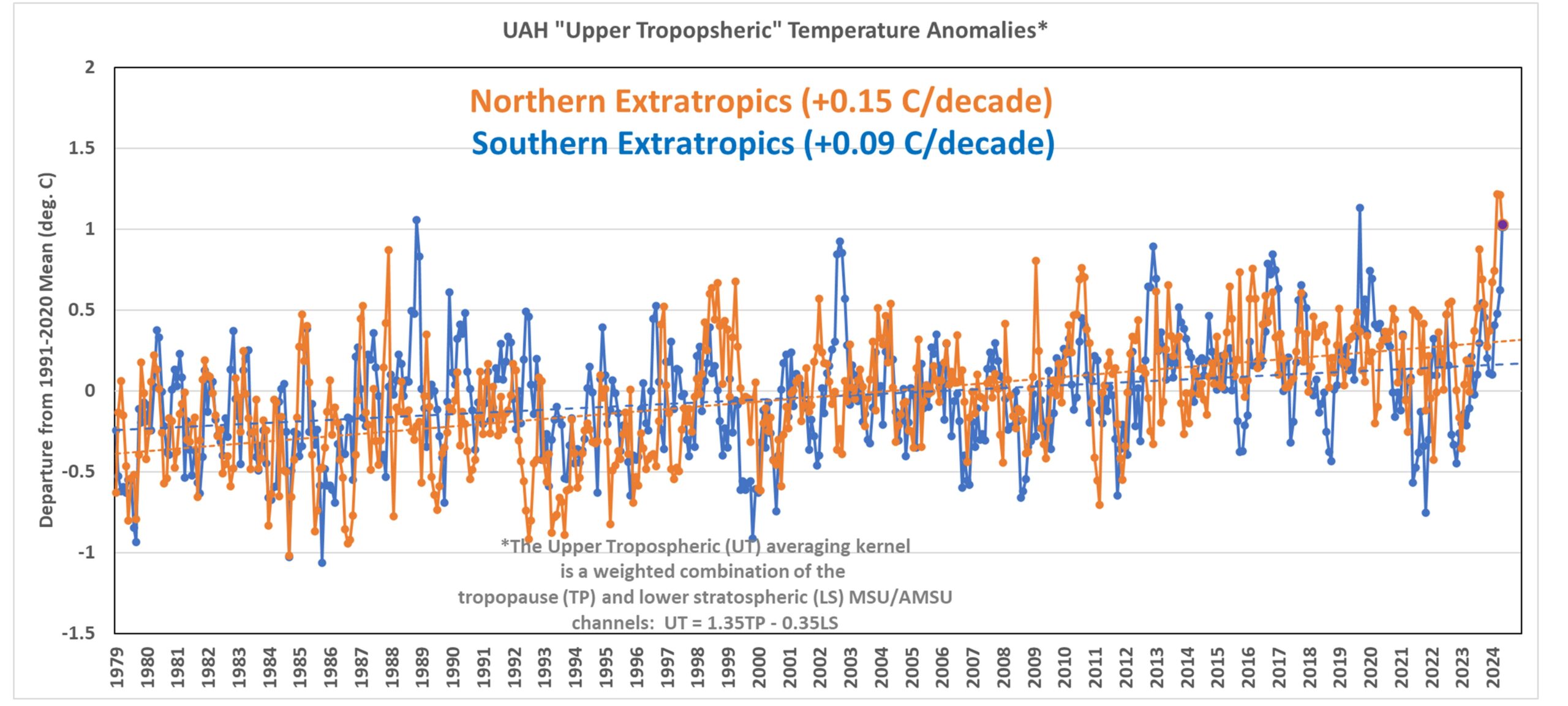
If we look at just the extra-tropics (next chart) we see the northern latitudes has record warmth in March. But the southern latitudes May cam in only 3rd warmest, behind September 2019, and November, 1988.

Note also that the global UT trend is the same as the lower tropospheric (LT) trend, +0.13 C/decade. Since the global UT has some small contamination from lower stratospheric cooling, the “true” UT value (if the stratospheric influence could be removed) would be somewhat warmer. By how much? I’m not sure… maybe +0.15 rather than +0.13 C/decade as an educated guess.

Taken together, I believe this shows that our traditional LT (lower tropospheric) temperature trends are basically corroborated by the other channels of MSU/AMSU.

Keep in mind that when John Christy and I compare these various trends to climate models, it is always apples-to-apples: the climate models’ atmospheric pressure level data are combined and weighted to approximate the same weighting functions as the satellite senses.

via Roy Spencer, PhD.

https://ift.tt/R8YhiQy

June 7, 2024 at 06:38AM

The Met Office is Gaslighting Us With its Claim that Our Damp and Chilly May Was “Warmest on Record”-Ben Pile

By Paul Homewood


A good piece by Ben Pile.

Regardless of the accuracy or otherwise of the Met Office figures, Ben points out that the supposed warming we have been seeing in recent years has little to do with high temperature extremes. Instead it has more to do with the relative of abnormally cold weather and milder nights.

As he points out, why should this be a climate crisis?


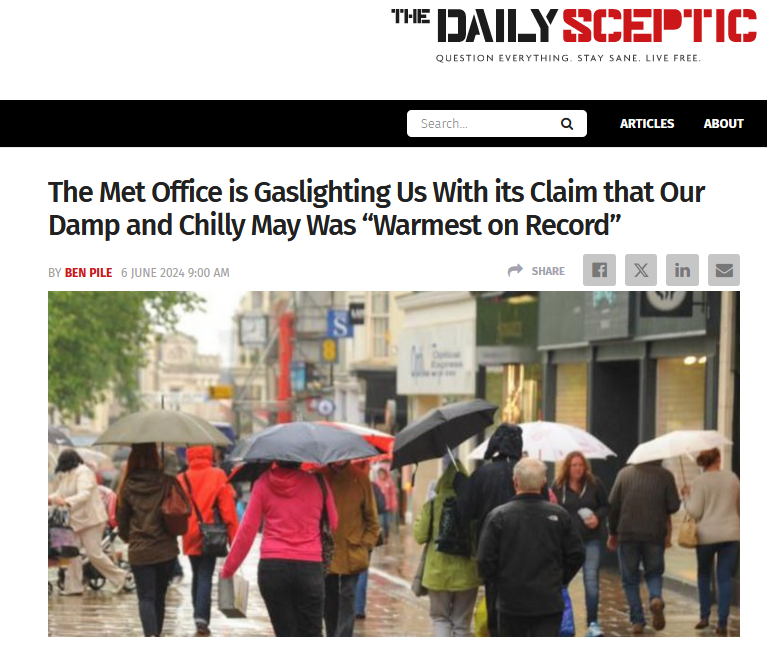
 image

Weatherwise, it has been a rubbish May. And it has been an abysmal spring. It has been cold and wet. And everyone knows it. But according to the Meteorological Office, the U.K. has just experienced its hottest ever May, and its hottest ever spring. As news reports and the Met Office’s own press release have correctly indicated, this “may come as a surprise” to many people who actually live here (rather than on the planet that the Met Office’s scientists inhabit). To those people, many of whom had their heating on for a good part of the month, the Met Office’s statement, as well as the “akshully…” news reports that claim to shed light on the difference between perception and reality, look like actual gaslighting. Even if the claim is true, which remains to be seen, what it reveals is the inadequacy of temperature as a metric on which U.K. climate and energy policy rests.

Read the full story here

Ben’s summing up is very telling:

“I was surprised to discover that data from the weather stations that are used in the Met Office’s analysis are not available to the public at higher than monthly resolution.

That’s a problem because in order to build an estimate of how useful minimum and maximum temperature data are, even in one location, never mind across an entire country, it would need to be compared to hourly data at a minimum. But not even daily data are available.

You might have thought that scientists and institutions that are so keen to tell us that their metric is so significant would be just as keen to make all of that data available to us. But you would be mistaken. The data is jealously guarded. It’s not for public consumption. We are supposed to take the good faith of institutional science for granted and are neither welcome nor even permitted to check for ourselves. ‘Follow the science’, means ‘obey’, not ‘try to understand’. And that’s what makes me – and, I hope, you – a sceptic.”

via NOT A LOT OF PEOPLE KNOW THAT

https://ift.tt/PYw9Hcs

June 7, 2024 at 04:55AM

Meta censors Milloy hurricane season video

The Energy and Environmental Legal Institute tried to post my recent hurricane season video on Facebook and was censored. The video is entirely based on a direct quote from NOAA about hurricane activity not being outside the range of natural variation. Below is the censorship, NOAA statement and video.

via JunkScience.com

https://ift.tt/2FhiAWb

June 7, 2024 at 04:25AM