Month: June 2024

All things Equal

By Andy May

In an interesting linkedin debate between Tinus Pulles and me, two subjects came up that are related to one another and too complicated for a comment. First is Tinus’ question, “Will more atmospheric CO2, all other variables being equal, lead to a higher surface temperature.”

The second question arose when I quoted the following from the IPCC AR6 report:

“As a result, non-condensing GHGs with much longer residence times serve as ‘control knobs’, regulating planetary temperature, with water vapour concentrations as a feedback effect (Lacis et al., 2010, 2013).” (IPCC, 2021, p. 179).

And this comment from AR5:

“Currently, water vapour has the largest greenhouse effect in the Earth’s atmosphere. However, other greenhouse gases, primarily CO2, are necessary to sustain the presence of water vapour in the atmosphere. … So greenhouse gases other than water vapour provide the temperature structure that sustains current levels of atmospheric water vapour. Therefore, although CO2 is the main anthropogenic control knob on climate, water vapour is a strong and fast feedback that amplifies any initial forcing by a typical factor between two and three. Water vapour is not a significant initial forcing, but is nevertheless a fundamental agent of climate change.” (IPCC, 2013, p. 667).

Oddly, Tinus doesn’t think the IPCC is serious about Lacis, et al.’s idea that CO2 is a control knob for surface temperature and he apparently disagrees with it. His excuse is that in the first quote “control knob” is in quotes and in the second is in a colored box, which identifies it as an answer to a “frequently asked question” or FAQ 8.1 (chapter 8, pp 666-667).

But both reports clearly cite Lacis, et al. (2010 & 2013) and use Lacis et al.’s language and agree with them. We can comfortably assume that the IPCC AR5 and AR6 reports agree with Lacis et al., regardless of Tinus’ objections.

The interesting thing is that these two points are intimately related to one another in an interesting way. Tinus’ first question is a leading question with the underlying assumption that CO2 controls the climate. He knows, as everyone does, that if infrared radiation is shined on pure CO2 in a laboratory, it will absorb some of it and warm up. The laboratory experiment is the “all things equal” he is talking about.

Outside the laboratory and in the real world there are a number of other factors that need to be dealt with that can change the result, this is why the question Tinus is asking is leading, the question is framed to get at a particular answer. Often, the way a question is framed can result in an answer that is incorrect, so we need to avoid answering leading questions.

Now we come to the second issue, calling CO2 the climate “control knob.” Lacis et al. explains this idea, which the IPCC clearly supports:

“Ample physical evidence shows that carbon dioxide (CO2) is the single most important climate-relevant greenhouse gas in Earth’s atmosphere. This is because CO2, like ozone, N2O, CH4, and chlorofluorocarbons, does not condense and precipitate from the atmosphere at current climate temperatures, whereas water vapor can and does. Noncondensing greenhouse gases, which account for 25% of the total terrestrial greenhouse effect, thus serve to provide the stable temperature structure that sustains the current levels of atmospheric water vapor and clouds via feedback processes that account for the remaining 75% of the greenhouse effect. Without the radiative forcing supplied by CO2 and the other noncondensing greenhouse gases, the terrestrial greenhouse would collapse, plunging the global climate into an icebound Earth state.” (Lacis, Schmidt, Rind, & Ruedy, 2010)

Lacis et al. estimate that water vapor supplies about 75% of the overall greenhouse effect, which is in the ballpark of other estimates, but no one knows for sure because the effect of clouds is unknown. Clouds have a large positive (warming) greenhouse effect at night, keeping heat in and a large negative (cooling) albedo effect during the day because they are bright white and reflect a lot of incoming sunlight. Further, clouds vary over time and with location (more on clouds here and here).

This means that the greenhouse effect changes both temporally and areally. In the tropics where it is humid all the time the greenhouse effect is very large and in deserts and in the polar regions in the winter it is very small, even negative at the poles over much of the winter. In the polar regions in winter and in deserts the skies are usually cloud free.

As Lacis, et al. say, water vapor condenses, and is unevenly distributed over Earth’s surface. That is the crux of their argument that CO2 and other non-condensing GHGs are the “control knob” for climate and water vapor is a significant, but relatively unimportant, “feedback” that does what the superior GHGs tell it to do.

Does that argument hold water? The pun is fully intended. As Wim Röst has said (in a very good June, 2023 presentation in Hillegom, The Netherlands) water, snow, and water vapor dominate the greenhouse effect, cool the surface through evaporation, release much of their latent heat to space, and determine all weather. The various water-driven processes in the troposphere control the amount of incoming and outgoing radiation by varying both the location and movement of clouds and latent heat.

Wyatt and Curry [ (Wyatt & Curry, 2014), (Wyatt M. G., 2012c), (Wyatt M., 2014)] have shown that numerous ocean and atmospheric oscillations move across Earth’s surface in a coordinated manner, that they call the “stadium wave,” that forms a roughly 65-70-year climate cycle or oscillation. This oscillation can be seen in global average temperature as shown in (May & Crok, 2024) in figure 1 below.

Figure 1. The Atlantic Multidecadal Oscillation (AMO) plotted in its raw form (top) and as a detrended index (bottom plot). The HadCRUT4 global temperature average record has also been detrended and overlain, as a gray dashed line, on the detrended AMO. Data from NOAA. Plot from (May & Crok, 2024), abstract here.

As figure 1 shows the detrended global average surface temperature (HadCRUT4) conforms very well to the detrended AMO index. This correspondence is better, at least visually, than the correspondence between CO2 and temperature. The AMO is not the leading oscillation in the stadium wave, but it is an important component of it. The correspondence of the AMO to the global average surface temperature opens the possibility that water and water vapor are not a “feedback,” but a driver of climate change. CO2 and other noncondensing greenhouse gases probably have some effect on climate change, but by all accounts, it is small, and it is doubtful that they are in the driver’s seat.

Download the bibliography here.

via Watts Up With That?

https://ift.tt/1kpY6Wg

June 4, 2024 at 04:08PM

Stress Testing California’s Grid Batteries

Lots of PR coming out of the golden state regarding great strides in building battery capacity required by the green dream of 100% carbon free electical power.

From Business Insider: 

Batteries briefly became the biggest source of power in California twice in the past week.

The first time — Tuesday last week around 8:10 p.m. PT, according to GridStatus.iobatteries reached a record peak output of 6,177 megawatts. For about two hours, that made electricity generated earlier and stored in batteries the single largest source of power in the Golden state, eclipsing real-time production from natural gas, nuclear, renewable sources like wind and solar, and all other sources of energy.

It happened again on Sunday evening, this time for a few hours around 7:10 p.m. PT, per data from GridStatus.io. In that instance, which broke Tuesday’s record, batteries reached a peak output of 6,458 megawatts.

Battery storage has become a key part of the push to produce more electricity using renewable sources. By connecting huge, rechargeable batteries to power grids, power utilities can store energy generated during the day by solar panels and wind turbines.

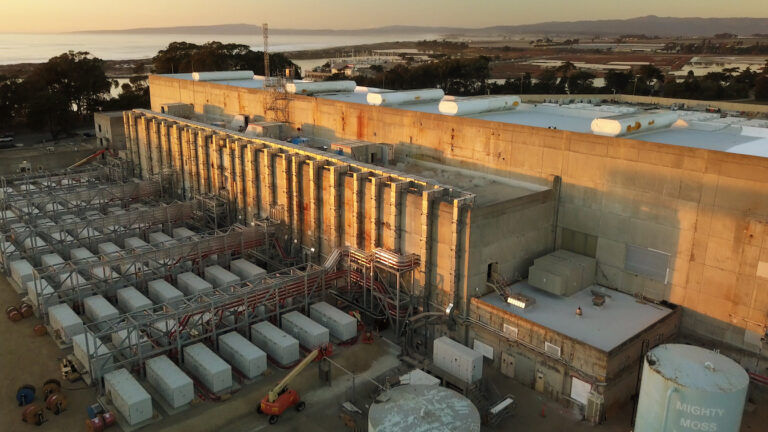
Augmentation at the Vistra Moss Landing Energy Storage Facility in California has been completed, with the world’s biggest battery energy storage system (BESS) now at 400MW / 1,600MWh. The batteries are housed in repurposed gas turbine halls. Image: Vistra Energy.

Then in April we have the news from Gov. Newsome’s office California Achieves Major Clean Energy Victory: 10,000 Megawatts of Battery Storage.  

Let’s Apply Some Context to These Cheerful Reports

The California Energy Commission produced its electricity forecast end of 2022:

Note the graph is projecting hourly electricity demand, which peaks during hour 19.  Output levels approach and then exceed 50,000 MW demand that hour, or 50k MWh.

Cal matters raises concerns about state policy to phase out ICE vehicles in favor of EVs.

Again demand requires from the grid 50k MW per hour in 2022 with less than 1% for charging EVs.  That is projected to go 10 times higher in 13 years.

Summary

The excitement is about batteries supplying  6500 MW for a couple of hours when the peak demand is 50,000 MW.  The glorious achievement is building battery capacity up to 10,000 MW.  It doesn’t add up.


via Science Matters

https://ift.tt/kymBoEO

June 4, 2024 at 12:20PM

Claim: Climate Change is “An intergenerational crime against humanity”

Essay by Eric Worrall

The persistent and damaging academic campaign of climate fearmongering is the “intergenerational crime” which history will remember.

‘An intergenerational crime against humanity’: what will it take for political leaders to start taking climate change seriously?

Published: June 4, 2024 6.08am AEST
Joëlle Gergis
Honorary Climate Research Fellow, School of Geography, Earth and Atmospheric Sciences, The University of Melbourne

In February 2024, I attended the annual conference of the Australian Meteorological and Oceanographic Society – the peak group for scientists working in all branches of weather and climate research. Over the past decade, the mood of our gatherings has become increasingly sombre. Some presenters have taken to apologising in advance for their confronting results, with some attempting to soften the blow by including funny animated gifs or photos of soothing sunsets to comfort the audience. 

It’s not hard to understand why. This year we had a plenary address by a distinguished IPCC veteran. The speaker began by saying that the world has “Buckley’s chance” of achieving the 1.5°C target, and even 2°C is going to be a stretch. If emissions continue at the current rate, the 1.5°C threshold could be breached as soon as 2028.

As global warming continues, Australia’s climate is fast becoming more extreme and unpredictable, edging us closer towards breaching thresholds that will make it very difficult, if not impossible, to adapt to. This is especially the case when there are simultaneous disasters unfolding in different regions, or a rapid succession of back-to-back disasters that undermine the ability of communities to recover. If there is not enough time between destructive events, the damage begins to compound. We see the continued degradation of our natural environment and the weakening of social resilience that will eventually lead to the permanent displacement of people from their homes and ongoing impacts on our economy.

How many disasters does it take to wake people up to the fact that Australia’s climate is becoming more extreme, with today’s destruction set to be dwarfed by things to come? Do people realise that adapting to climate change won’t be possible in some parts of the country? Exactly how much do we need to lose before our political leaders decide to take this seriously?

It makes me wonder if people in decades to come will look back at the world’s collective failure to shut down the fossil fuel industry in time and see it for what it really is: an intergenerational crime against humanity.

Read more: https://theconversation.com/an-intergenerational-crime-against-humanity-what-will-it-take-for-political-leaders-to-start-taking-climate-change-seriously-231383

These sad rants from members of once respected scientific institutions are barely worth publishing.

The reality is there is zero paleo evidence that a warmer world is a less habitable world. Our monkey ancestors’ first appearance in the fossil record was during the Paleocene-Eocene Thermal Maximum, a natural period of global warming so extreme, some scientists have postulated it was caused by a close encounter with another star. Those monkeys spread throughout Eurasia, feasting on the abundant food provided by the hothouse PETM, only retreating when the warm period ended and encroaching cold drove them from their new homes. Fish were more abundant during the hothouse PETM. Greenland was a temperate forest. Antarctica had a thriving ecosystem.

Even if a PETM level of warming occurred (5-8C hotter than today), it is unlikely we would even have to move any of our cities. Sea level rise is no threat to a high tech civilisation. A sizeable part of Singapore is land reclaimed from the ocean. Half of the Netherlands would be under water without their centuries old system of dikes and sea walls. As far back as the mid 1800s our ancestors were performing giant civil engineering works, elevating the cities of Chicago and Seattle an entire floor level to beat the flood risk. Venice in Italy didn’t give up their city when it sank into the mud, they kept building up, and created one of the wonders of the world.

In my opinion, the only intergenerational climate crime today is all the trusted scientists frightening millions of kids with their wild claims, frightening some of them into giving up on life and destroying themselves with hard drugs.

How many of the USA’s horror show annual Fentanyl deaths were kids who got their start in addiction because all their teachers told them they would never have a chance to live a fulfilling adult life, because climate change was going to destroy the world?

Global warming is not an “intergenerational crime against humanity”. The real intergenerational crime against humanity is the constant climate fear mongering, which is convincing young and impressionable minds the future holds no hope for them.

via Watts Up With That?

https://ift.tt/ozuNlaX

June 4, 2024 at 12:08PM

Serious floods in southern Germany – Chancellor beats his climate drum, ignoring history


Flooding like this has been recorded for centuries, e.g. on the Danube at Passau, Bavaria. Politicians are doing the usual bandwagon-jumping trick by trying to invoke human causes as the problem.
– – –
Floods caused by heavy rain in southern Germany have claimed at least four lives, reports BBC News.

The victims include three people found in flooded basements on Monday. On Sunday a firefighter died while trying to rescue trapped residents.

Thousands of people in the states of Bavaria and Baden-Württemberg have fled their homes since torrential rains began on Friday.

German Chancellor Olaf Scholz, who visited affected areas, said the flooding was a reminder of critical environmental challenges.

“We cannot neglect the task of halting man-made climate change,” he said on Monday.
. . .
Bavarian Premier Markus Soeder, who was with Mr Scholz on his visit, said: “Events are happening here that have never happened before.” [Talkshop comment – evidence says they have].

About 20,000 people are involved in rescue operations across the state. A state of emergency has been declared.

The German Weather Service warned of more heavy rain in southern and eastern parts of the country.

Full report here.

via Tallbloke’s Talkshop

https://ift.tt/O0Dgbih

June 4, 2024 at 11:10AM