Month: June 2024

Vauxhall owner threatens to close UK car factories

From NOT A LOT OF PEOPLE KNOW THAT

By Paul Homewood

h/t Doug Brodie

This may be the first crisis Starmer faces, as the real world comes up against Miliband’s fantasy world:

The car giant behind Vauxhall has threatened to mothball its UK factories amid a row over net zero targets for electric vehicle (EV) sales.

Stellantis warned on Tuesday that it would be forced to close plants at Ellesmere Port and Luton, where it makes vans, unless the Government relaxed rules forcing manufacturers to sell a certain proportion of EVs.

It has also threatened to reduce the number of petrol and diesel cars it sells in the UK.

The warning dramatically escalates a dispute with the Government over the so-called zero emission vehicle (ZEV) mandate, which requires car makers to sell rising proportions of electric cars annually.

From this year, at least 22pc of cars they sell must be electric and the figure rises gradually to 80pc by 2030. In 2035 the sale of new petrol and diesel cars will then be banned.

However, Maria Grazia Davino, UK managing director for Stellantis, said the rules were out of step with consumer demand and risked making sales unprofitable.

Stellantis makes electric cars and vans at its Ellesmere Port plant and vans in Luton, employing more than 1,000 workers across both sites.

Speaking at a car industry conference in London, Ms Davino told journalists the mandate would have a big impact and “damage the UK”.

‘Hostile market’

Speaking at a car industry conference, she told journalists the mandate would have a big impact and “damages the UK”.

Ms Davino added: “We have undertaken big investments in Ellesmere Port and in Luton, with more to come.

“But if this market becomes hostile to us, we will enter an evaluation for producing elsewhere.”

Asked how long Stellantis would wait for a decision from the Government, she said: “Less than a year.”

https://www.telegraph.co.uk/business/2024/06/25/vauxhall-stellantis-threatens-stop-making-electric-vans-uk

This was inevitable, and certainly won’t be limited to Vauxhall. As I have repeatedly pointed out, the UK motor industry as a whole cannot afford to pay the hundreds of millions in fines coming their way at the end of the year. The only option open to them is to cut back on production of ICE cars, in order to get back to the 22% target.

Based on current trends, this could mean that factories shut down production for the last three months of the year, or alternatively simply stockpile 3 months of production.

This is not sustainable in the long run, and the likes of Vauxhall would quickly run out of cash to do so. And it would make the problem doubly worse next year – not only would they face even tougher targets next year, but they would start the year with 3 months of ICE cars to sell, impacting output next year.

This is why Ms Davino has stressed the government has a year to sort the problem. They have clearly been hanging on to see what government will do to address the problem after the election. But unless the punitive ZEV mandate is relaxed, expect Stellantis to shut up shop next year, and shift production to Europe instead.

And they won’t be the only ones.

via Watts Up With That?

https://ift.tt/XgRFiGw

June 27, 2024 at 12:03AM

Game Over For The Climate

Another look at the integrity and veracity-free world of the press and #ClimateScam academics.

About Tony Heller

Just having fun

This entry was posted in Uncategorized. Bookmark the permalink.

via Real Climate Science

https://ift.tt/bx4q0RZ

June 26, 2024 at 09:19PM

Ukraine attacks Russia’s oil sector, Canada attacks Canada’s… you sure you want us in NATO?

From the BOE REPORT

Terry Etam

Ukraine adapts against a vastly bigger opponent and illuminates the trap western governments have created for themselves

Recently, Ukraine has been launching massive drone attacks against Russian oil refineries/infrastructure. Seems reasonable, what with the invasion and all. 

Actually, it is more than reasonable, and about as logical as it gets. The Russians know this also; when they really want to rattle chains they go after western Ukraine’s energy infrastructure.

Energy is the lifeblood of everything and at this point in history, hydrocarbons are the blood in the system. Be under no illusions there. No one anywhere is looking to gain strategic military advantage by blowing up a wind turbine or covering a solar field with a tarp.

It’s interesting also how the West is flummoxed by the issue. Western governments are rightfully and fully supportive of Ukraine, and thus should in theory be highly in favour of such Ukrainian bombardments of Russian refineries. But it’s not that simple.

Russia is not the isolated pariah the west hopes for. Wave after wave of sanctions on the country have not achieved what was hoped, because Russia is adapting just as Ukraine is, and Russian oil is finding its way onto the market.

The West is caught in its weird dance whereby it implements policy after policy against hydrocarbons, attacking their own native supplies, while at the same time consuming the same amount as they always have, more or less. The west wants to cancel its own production, or strangle it, and at the same time wants to keep Russian oil off the market, and yet ironically, above all, wants low oil prices, because consumers freak out when they aren’t low.

An alien would look down at the situation and have nothing to say but the intergalactic equivalent of “WTF”.

Russia can cut off strategic oil supplies in a heartbeat, with little consequences to their own production. For example, Kazakhstan produces 1.5 million bbl/d of oil and ships most of it to Europe via a pipeline that crosses Russia. Imagine the impact on global oil prices if that cross-Russia pipeline was to “fall out of a window”, so to speak, as happens to so many Russian irritants. Even if Russian production was harmed to some extent by some policy, as long as that oil is removed from global markets, the Russians can do math as well as anyone: Yes Russia definitely does need the revenue! But 6 mmbbl/d at $80/bbl is the same revenue as 4 million b/d at $120/bbl. 

So the west, particularly in a US election year, is trapped. Anything that hikes oil prices materially will hit the pocketbooks of every consumer on earth, and fuel inflation, and every politician knows that inflation fuels rage. And governments can’t afford a prolonged fight against inflation anyway – imagine having to raise interest rates again in this fragile economic environment. Driving the point home starkly is the fact that the US government now spends more on interest payments than on defense. 

Behind closed doors at the highest levels of power, the tensions must be incredible. Particularly in the West, with the following must-win/highly contradictory ambitions: crush Russia, contain China, win the war against the climate or whatever it’s called these days, keep energy prices low to prevent outraged citizens and, following from the latter, do whatever it takes to keep their pudgy hands firmly on the controls. We can definitely see the bizarre output: attacks on our fuel system with no suitable replacement; attacks on average citizens for holding what are derisively now called ‘populist’ beliefs (even though the history of ‘populist’ beliefs crosses the entire political spectrum), and western foreign policy that seems paralyzed because it is ill-equipped to deal with, for example, the rise of BRICS.

And then, as a final but impressive gasp of inept state control, witness Canada’s frantic flailing to control the situation by…

Send in the goons: Canada cracks down on any speech it doesn’t like, with sweeping rules measured against undefined regulations, and enters the historical pantheon of legendarily badly run states

We’ve all heard about bill C-59 by now, the government of Canada’s crackdown on any comments related to emissions reduction mitigation efforts that do not adhere to “internationally recognized methodology”. It’s a Soviet-style attempt to crack down on any talk about what companies are doing to reduce emissions, or anything they do that is an attempt to reduce “the environmental, social and ecological causes or effects of climate change”.

The apes in charge, and their sycophants, say hey, it’s not censorship at all, you can talk about emissions reduction all day long, so long as it meets some undefined international standard, and the onus of proof is on anyone making the statement to show that they are not violating some “internationally recognized methodology” that does not exist. 

This whole fiasco is of course a one way street; the freedom to say anything that cements the climate emergency narrative remains gloriously unchecked. For example, energy commentator David Blackmon recently catalogued on LinkedIn the number of countries/regions that claim to be warming faster than the global average: Canada, Mexico, Latin America and Caribbean, Arctic, Asia, Africa, the US, Europe, Russia, Australia, China, and Finland all claim to be warming faster than the global average. The high priest of modern politicized science, Scientific American, says that oceans are also warming 40 percent faster than expected, and that oceans absorb up to 90 percent of the warming caused by human carbon emissions, and SA also notes that the South Pole is warming “three times faster than the global average.” So, as the pundits say, everywhere is warming faster than everywhere else.

Extrapolating from this, in keeping with necessary mathematical precedents such as how averages work, then the few remaining regions not mentioned must be plummeting in temperature, because that’s how averages work. And I mean plummeting, if it alone is offsetting the above-average gains in the rest of the world. Strange indeed how not a single headline can be found to that effect.

The speech police have no problem with such math crimes, because the asinine claims are put forth under the banner of ‘science’. It must be concluded then that math is not one of the “internationally recognized methodologies”.

No matter. The point is, as always, to silence discussions and ram through whatever ideological junk they can while still clinging to power like a bee holding onto an accelerating windshield.

Welcome to Canada, where if global embarrassment were an Olympic sport we’d be wearing perma-gold. Joke’s on us though; we elected these people. We should now clearly understand why Canada’s status as an investment haven is plummeting like a shot duck. (Do not point me towards legendary genius Warren Buffett who says he is comfortable investing in Canada; Buffett buys existing businesses, with moats, and the government of Canada is working to build those moats as fast as it can. Remember this investing rule for the foreseeable future: existing infrastructure is getting more valuable, because building anything gets harder by the day.)

It is probably unfair to single out Canada for such withering criticism when other western countries are on similar energy suicide missions. Australia, England, Germany… all under the spell of radicals that will accept nothing other than total nihilistic energy “victory”, a crown that seems to mean de-industrialization and subjugation of citizens in autos they don’t want, doing things they don’t want to, and not being permitted to say what they want to. (New Zealand was in that club as well, but has recently repealed a ban on oil & gas exploration when it dawned on them that fields decline, and do not produce at flat levels in perpetuity without investment. Yes, western governments really have enacted such legislation while simultaneously holding an astonishing ignorance about how energy really works.)

As far as Canada’s hydrocarbon sector goes, the most important thing to do at this stage is to keep our heads [down] and carry on providing the energy the world desperately needs. And that means every single person, right down to Guilbeault’s Greenpeace and the soup throwing fools of Just Stop Oil. If the feds are going to outlaw emissions talk, let them… the rotten foundations of their world can’t stand for much longer.

No one should stand taller than one that provides reliable and affordable energy for the globe’s citizens. Go back to work, and patiently wait until the inevitable happens, the day when governments are no longer able to pretend they can’t see reality. It’s going to be epic.

What the world desperately needs – energy clarity. And a few laughs. Pick up The End of Fossil Fuel Insanity,  available at Amazon.caIndigo.ca, or Amazon.com.

via Watts Up With That?

https://ift.tt/8ovL5ED

June 26, 2024 at 08:03PM

Monitoring to Avoid Cyclone Damage – Denial. Part 3.

It is purportedly the intension of The Australian Institute of Marine Science (AIMS), specifically their Long Term Monitoring program, to detect changes in reef communities at a number of different scales including at the scale of the individual reef, sub-region and between the northern, central and southern Great Barrier Reef.

But.  If this monitoring is not even able to detect the extraordinary damage inflicted by Tropical Cyclone Kirrily on John Brewer Reef  it cannot be considered fit for purpose.

To reiterate, John Brewer reef as an ecosystem was approaching climax, in all its beauty, when it was smashed by TC Kirrily early this year, on 25th January 2024.

This severe category three cyclone sat for two long hours over the top of this spectacular mid-shelf reef unleashing such destruction and yet the AIMS’s monitoring program has no record of it.   According to their monitoring program there is nothing to see, they are in denial of this cyclone.

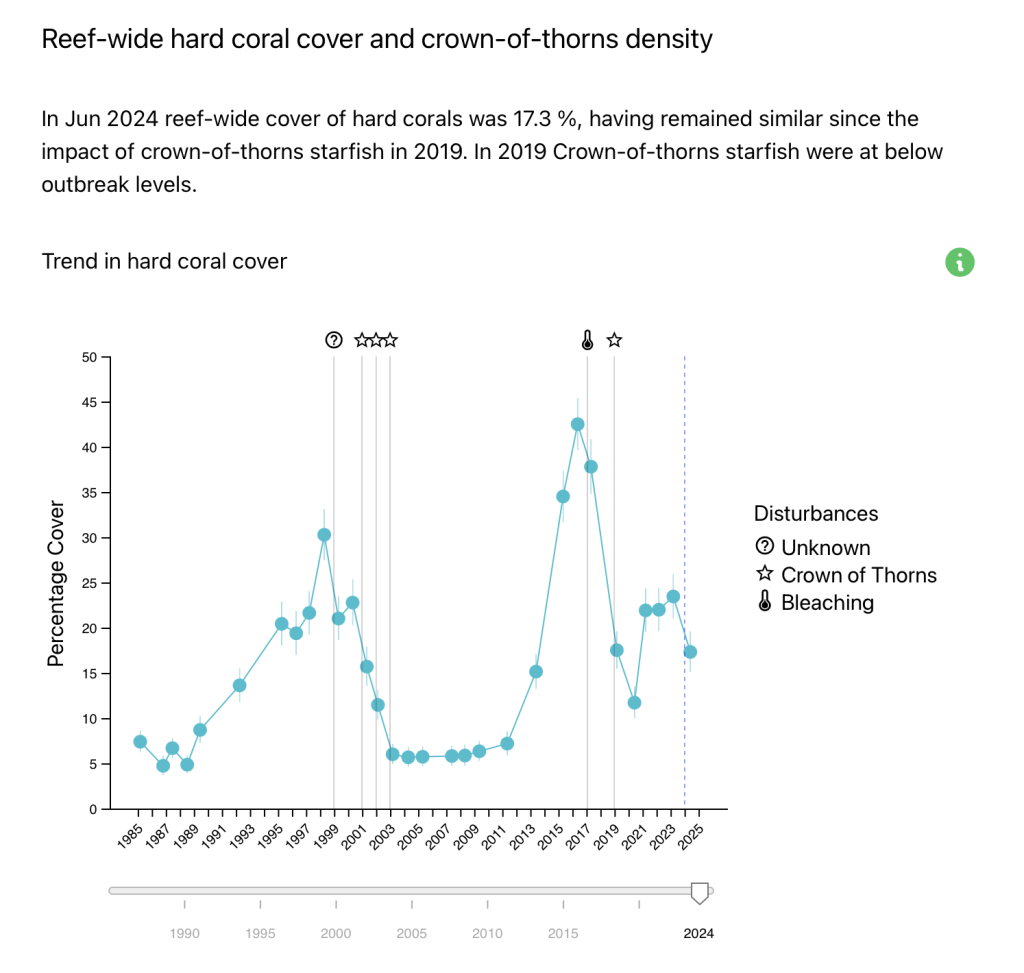
This reef, John Brewer reef, was surveyed in March 2022 and then again in June 2024 – and yet percentage coral cover change is little change: just 23 percent before TC Kirrily to now officially 17 percent in the latest June 2024 survey – and yet so much healthy, hard coral was destroyed in between!

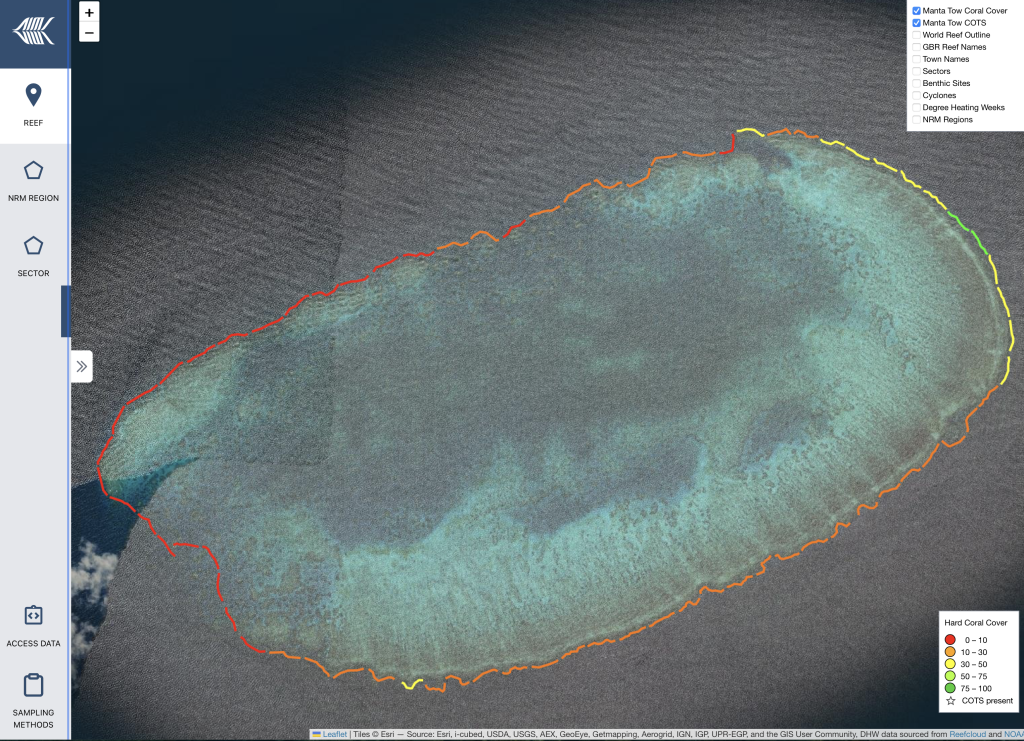
The coloured line shows where the AIMS survey looked for coral, and how much they found in June 2024.

The ‘core survey reef sample’, as explained by AIMS comprises ‘Manta tow surveys, which collect information in a standard reef slope habitat around the perimeter of each reef’.   The technique involves towing a snorkel diver at a constant speed behind a boat around the perimeter of each reef.   Every two minutes the observer records their visual assessment of hard coral cover onto a data sheet into one of five categories that correspond to very low (0-10%), low (10-30%), medium (30-50%), high (50-75%), and very high (75-100%) hard coral cover.

In the AIMS reports, and at the AIMS website that explains this, it is emphasised that ‘the methodology is consistent’, the tow is always ‘clockwise’ around the perimeter of each reef.

But what is the objective?  If it is to be able to report on changes in hard coral cover between reefs and across regions, then the observer needs to be ‘towed’ or otherwise given access to representative reef habitats.  It is pointless if the observer is towed away from the habitat where the fish tend to congregate, which is where there is more coral that is at the reef crest.

TC Kirrily did most damage at John Brewer reef in the shallower sections, including at the reef crest.   Yet the manta tow surveys around the reef perimeter are typically at a depth of 8-9 metres.   By their very design these surveys, that are at the core of the AIMS Long Term Monitoring program, they cannot capture disturbance from the major natural source of catastrophes that regularly befall coral reefs at the Great Barrier Reef – tropical cyclones.

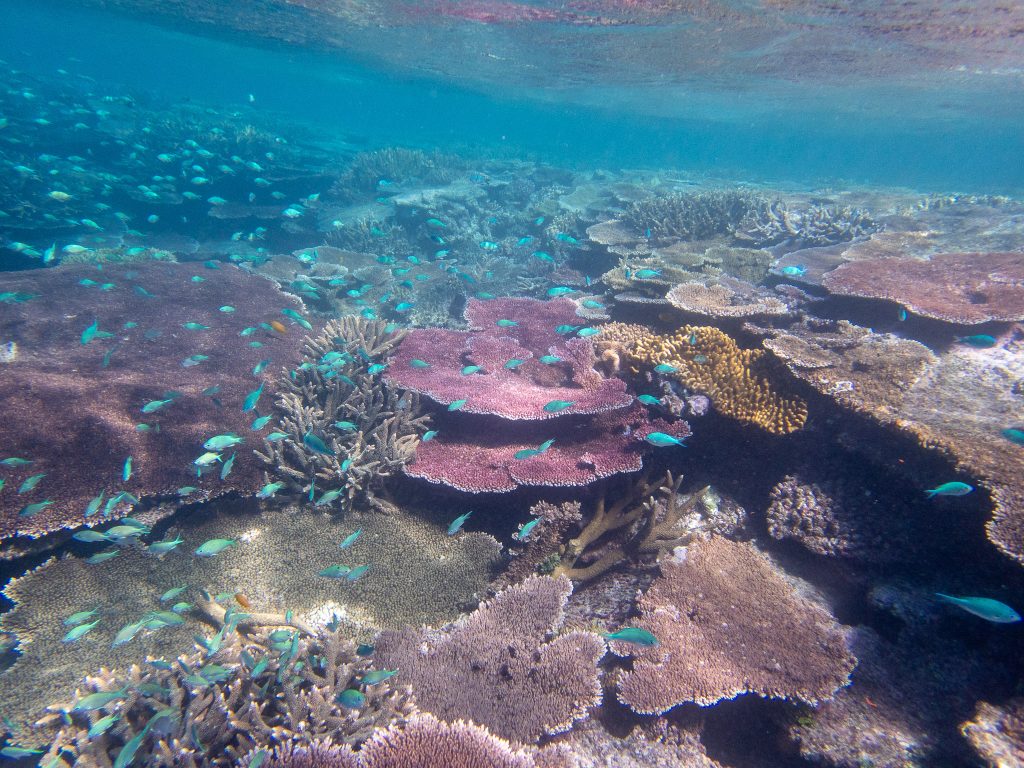
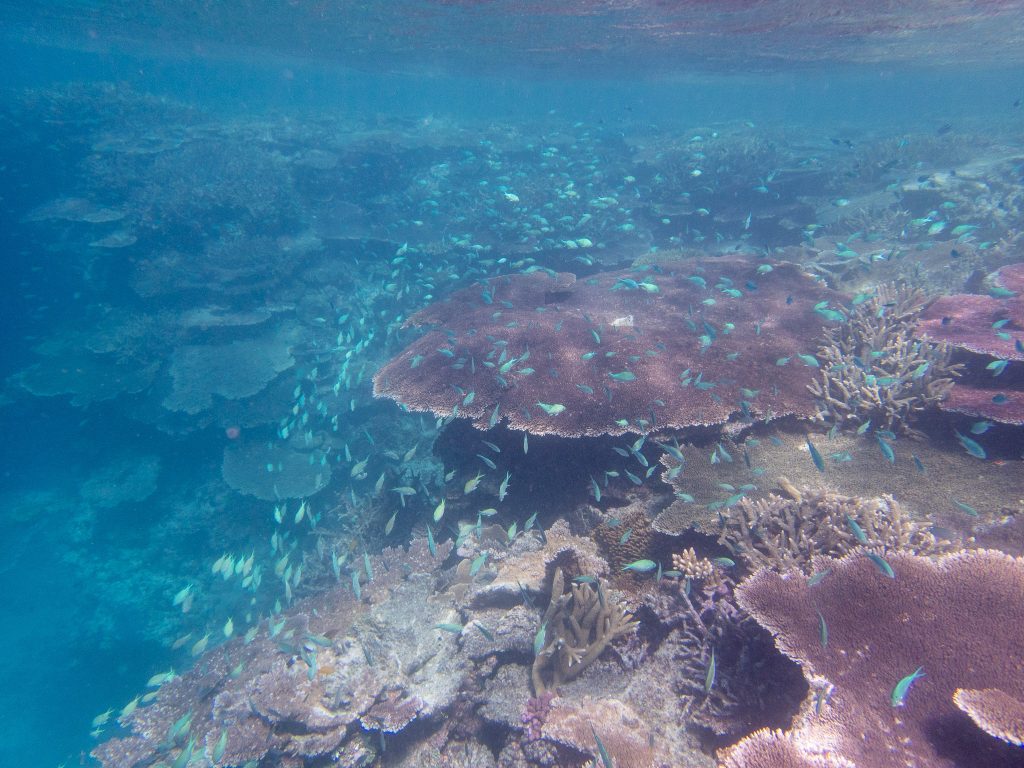
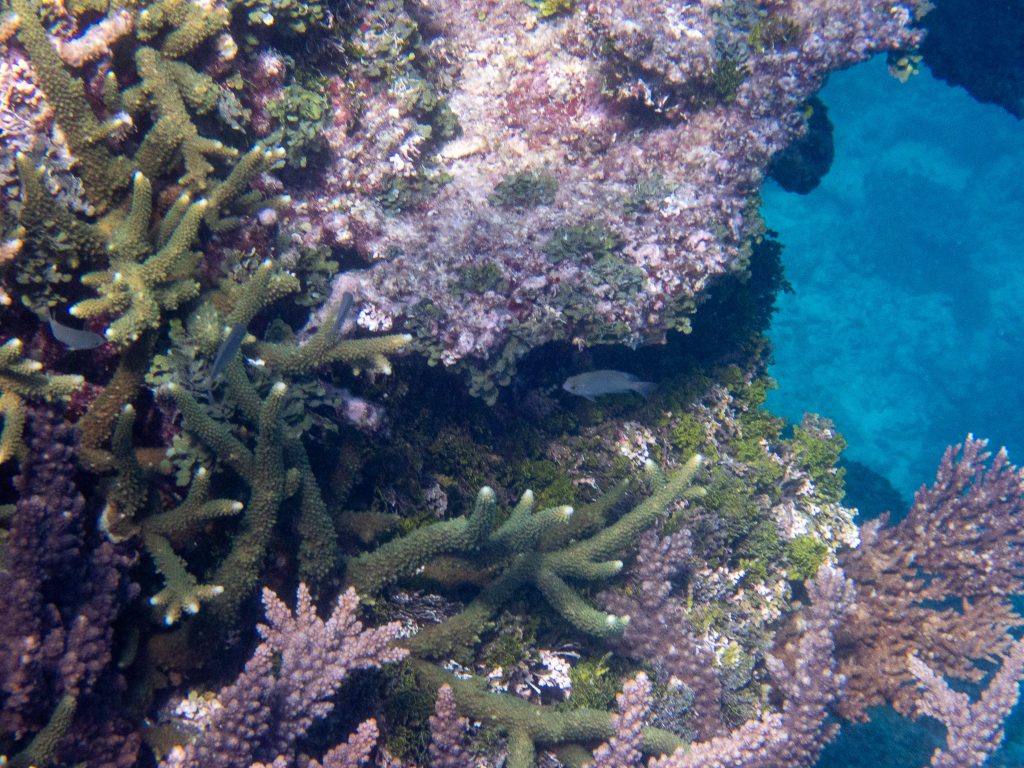
Fish congregate at the reef crest where all the coral is, it is a bit of a way down to the reef slope that is the perimeter that is surveyed by AIMS. I visited that section of John Brewer Reef on July 10th, 2022, and made it down to the perimeter where there was not much coral.  I was on snorkel, holding my breath.

It doesn’t matter that the observer is always towed around the perimeter, and it doesn’t matter that this is always done in a clockwise direction if this is not where all the coral is, particularly the coral at a reef like John Brewer Reef before TC Kirrily – a coral reef approaching climax.

If the objective is to monitor change in coral cover, then habitats where coral is concentrated will need to be monitored as part of any program committed to understanding change.

According to Dr Mike Emslie, the leader of this project:

Information from LTMP has been instrumental in apprising the Great Barrier Reef Marine Park Authority (GBRMPA), government and stakeholders on the status of the GBR and uses web-based reporting products to ensure timely dissemination of information upon completion of each survey cruise. Upon completion of each field season, an online annual update on the status of the GBR is produced, along with substantial media exposure.

LTMP data also feeds directly into the five yearly GBR Outlook Report produced by the GBRMPA under the auspices of the Australian Governments Reef 2050 Sustainability Plan.

The monitoring program at John Brewer reef began in 1985, nearly forty years ago, yet as far as I can tell, never in all this time has any relevant data been consistently gathered about hard coral cover at the reef crest, where the coral and fish are concentrated.

If there is no relevant data, then we can’t know what the cumulative effects of more or fewer cyclones or bleaching events is on coral cover, not in any meaningful way.  Yet this is one of the key tax-payer funded programs, relied upon not just by my colleague Peter Ridd, but also government and the media to know the state of the Great Barrier Reef.

The little fish at the crest, they can look down to the perimeter where the AIMS’s observers are towed about, apparently unaware that most of the coral is above them.   If the AIMS’s surveys are to give an accurate indication of changes in coral cover, they need to consider coral cover in key habitats including at the reef crest.  All the photographs in this post were taken at John Brewer Reef on July 10, 2022 with my Olympus TG6.

And, while there might be 3,000 coral reefs, John Brewer Reef is something of the jewel in the crown considering the central region of the Great Barrier Reef – something of greater value amongst other valuable things?   This coral reef to the north-east of Townsville was once home to a floating hotel, that was back in the 1980s.   More recently, and somewhat more modestly, John Brewer has been given its own Museum of Underwater Art.   It does matter that we know how hard coral cover at John Brewer reef changes, and what the key drivers are, of this change.

via Jennifer Marohasy

https://ift.tt/Y26IjwJ

June 26, 2024 at 06:33PM