Month: June 2024

No, Mainstream Media, “Extreme” Wildfires Are Not on The Rise Due to Climate Change

From ClimateREALISM

This week a new study was published in the Nature journal Ecology and Evolution titled “Increasing frequency and intensity of the most extreme wildfires on Earth.” The study claims that wildfires are on the increase due to climate change. Predictably, the mainstream media jumped all over this with headlines similar to what you see above from CBS News. However, the paper is untrue as it is self-falsifying because it doesn’t even use the minimum 30 year period required for a climatic data comparison. Further, the claims are not supported by science in other sources of data, and other publications.

First, the study itself says it only uses 21 years worth of satellite data, saying:

Climate change is exacerbating wildfire conditions, but evidence is lacking for global trends in extreme fire activity itself. Here we identify energetically extreme wildfire events by calculating daily clusters of summed fire radiative power using 21 years of satellite data…

A minimum of 30 years of data is needed before it can be called a climate comparison. This has been defined for decades. The World Meteorological Organization (WMO) defines climate as “…the average weather conditions for a particular location and over a long period of time.” To create a climate record, 30 years of weather data is averaged to create a “normal” climate expectation for a location or region.

Second, we can turn to the Intergovernmental Panel on Climate Change (IPCC) Who has examined the issue of fire weather as it pertains to increasing wildfire risk. They conclude that had has not even emerged as a signal from climate change and it’s not likely to emerge in the 21st century.

The IPCC also identifies when it expects that the “emergence” of a signal of climate change will be detectable for various impact “climate impact drivers.” Note that table below, with “fire weather” highlighted in yellow. Most people will likely be surprised by the amount of white cells in the table — indicating a lack of signal emergence, even out to 2100. For “fire weather” a signal does not emerge through 2100. It isn’t even seen in the present.

Table 12.12 | on Page 90 – Chapter 12 of the UN IPCC Sixth Assessment Report. Emergence of Climate Impact Drivers (CIDs) in time periods, as assessed in this section. The color corresponds to the confidence of the region with the highest confidence: white colors indicate where evidence of a climate change signal is lacking or the signal is not present, leading to overall low confidence of an emerging signal.

Clearly, the IPCC does not see any connection whatsoever between climate and wildfires, nor does it expect a connection in the coming decades.

Next, we can examine other satellite data, such as this chart below that combines recent satellite data with historical data.

Figure 1. Historical and Satellite data on wildfire acreage burned. Blue curve, global wildfire area burned reconstruction. Orange curve, global wildfire area burned measured by satellites. Graph plotted by Bjorn Lomborg, Ph.D.

Clearly the trend is sharply down for the area burned. However the study cited by CBS News and others also makes the claim that the intensity of fires is on the increase. There is a simple explanation for this; increased fuel load makes bigger fires.

Increasing forest biomass, also known as “fuel load,” has been prevalent due to forest management issues. Fuel loads also figure greatly in wildfire potential, intensity, and spread.

For example, in the Western United States in 1990, the spotted owl was listed as endangered. As a result, the western logging industry and the associated forest management practices essentially evaporated. As seen in the figure below, data suggests the protected owl habitat has directly caused an increase in forest fuel load (and increased acreage burned) in the absence of effective forest management post 1990.

Fire science tells us increasing fuel load directly correlates with greater fire intensity and rate of spread, plus increasing the acreage burned. Fuel loads can increase fire intensity, as more fuel available to burn means more energy is released as heat. A 2013 study in the International Journal of Wildland Fire found that fire intensity increased with fuel loading. In the Figure 2 below, fire burned area increased due to the protectionism of the spotted owl and other forest species in the Western United States.

Figure 2. Graph combining data for Federal lands showing acres harvested vs. acres burned, in millions of acres. Data from U.S. Forest Service and the National Interagency Fire Center. Graph by Anthony Watts.

Unsurprisingly, the study lists the Western United States as the worst are for “most extreme wildfires” in its Figure 1, seen below circled in red:

So, while their data does support that some of the most extreme wildfires have occurred in the Western United States during the last 21 years is a clear case of correlation is not causation. Attempting to blame climate change simply because fire intensity has increased instead of the problem with fuel loads getting bigger in that area is the fatal mistake the researchers made in addition to the 21 years of data falling short of the 30 years needed to make a climate comparison.

Of course, the mainstream media does not have reporters with the science education needed to even question this. But, as illustrated in this article, you don’t have to be a forest scientist to be able to find this contrary data. It simply appears that the mainstream media didn’t bother to look because they prefer to push a scary narrative about climate change rather than do the job they have been charged with. So much for “journalistic integrity.”

via Watts Up With That?

https://ift.tt/G7c1kuB

June 26, 2024 at 04:05PM

Global Excuses: Ship pollution was saving us from global warming, but now we’ve fixed the ships, we’re all going to die

Global shipping pollution.

By Jo Nova

The evil shipping smoke was shielding us from global warming…

You’ll never guess but it’s worse than we thought, and we are more to blame than we thought, kiss my government grant and pray to Gaia.

Wouldn’t you know — shipping smoke was polluting the world, but the smoke also seeded clouds, which cooled the Earth, and undid some of the global warming we caused with CO2. Now that we are finally fixing up the dirty ships, oh no, we’ve accidentally unleashed the global warming which the ship smoke was hiding. So there is about to be another wave of global bad news. And for some reason we didn’t see it coming, even though we’ve known for decades that sulfate aerosols caused cooling (and we had those expert climate models all along, didn’t we?)

Remember all those other times they said disaster would strike, and it didn’t, well, they were right. It would have happened, we just couldn’t see it because of the shipping pollution.

See how perfect this is for The Climate Industrial Complex?

By Shannon Osaka, Washington Post

Tiny particles from the combustion of coal, oil and gas can reflect sunlight and spur the formation of clouds, shading the planet from the sun’s rays. Since the 1980s, those particles have offset between 40 and 80 percent of the warming caused by greenhouse gases.

“We’re starting from an area of deep, deep uncertainty,” said Zeke Hausfather, a climate scientist and research lead for the payments company Stripe. “It could be a full degree of cooling being masked.”

These moves have saved lives — according to estimates, around 200,000 premature deaths have already been avoided in China, and the new shipping regulations could save around 50,000 lives per year. But they have also boosted global temperatures. Scientists estimate that the changes in aerosols from the new shipping rule alone could contribute between 0.05 and 0.2 degrees Celsius of warming over the next few decades.

Some researchers have suggested that the changes to ocean shipping regulations may have been a big contributor to last year’s record heat

All of which begs the question, if shipping-smoke solves global warming, shouldn’t we just go with it then?

I mean, let the ships rip, and skip the whole hair-shirt sacrifice — we could fly in planes, eat meat, and keep the air con on? But ‘no’ say the puritans, the new shipping regulations might save 50,000 people a year. (And heck, it’s not like we face the sixth mass extinction, boiling oceans, or something truly awful is it? ) So onward we go, renewables to the rescue, living the life of the perfect climate apostles.

The fact that the Ecoworriers won’t even consider this to save the world tells us exactly how afraid they are (not) of the man-made climate catastrophe.

And the other problem is “the numbers” — despite climate experts being 99% certain of what controls our climate, scientists estimate the changes in aerosols could have anything from 0.05°C to “a full degree” (so sayth Zeke Hausfather). So aerosols might explain a lot, or nothing at all, but it’s another excuse to parade a climate scientist on the news, and they can pick whatever flavour of “aerosol” cooling fits the theme of the day. Would you like to hide past model failures or scare the horses? Adjust to fit.

Watch the evil shipping smoke fighting off the Global Warming Monster

We are reminded yet again of the primitive belief that humans are really Gods that control the climate…

Two Monsters of the pagan global warming religion battle it out.

Some version of the shipping story keeps doing the rounds every few months for at least the last year, because it has a strong Climate Bingo score, tapping many recurring themes:

  1. It’s worse than we thought. The new bad effect is almost upon us (yet again!)
  2. It’s the perfect excuse to cover the warming that didn’t happen, wasn’t predicted, may not come, or might suddenly appear.
  3. It’s advertising for “Geoengineering Projects” where people throw salt, dust, or particulates in the sky and try to cool the Earth. (See, they say, Geoengineering works, give us your money!)
  4. It fits the religion — mankind controls the climate (not God or the Sun). This feeds a whole new wing of bureaucracy, and briefly distracts people from asking whether recent warming has anything to do with solar activity or space weather.
  5. Ultimately it bestows more power on the high priesthood of lab-coats and climate models — as long as the weather is controlled by man-made things of some sort, the IPCC anointed masters sit at the centre of this Global Warming Control Tower and issue the orders and collect the funds.  They shall have their two-week UN junkets, their Nobel Pizzas, and their moment of fame in the nightly news.

But lift the hood, and this engine is a mass of contradictions. They didn’t see this “shipping” warming coming, and can’t agree on how much warming it does, but they want us to believe their models are accurate. And they don’t think the climate emergency is important enough to let ships keep shipping as they were, just to buy us some time. There are no hard trade-offs in these life and death decisions, only 50 shades of advertising for the renewables industry and the UN.


0 out of 10 based on 0 rating

via JoNova

https://ift.tt/nmPDVq3

June 26, 2024 at 03:58PM

Expert’s Prediction Of “Summer of Hell” For Central Europe Hasn’t Materialized Yet

Summer-of-Hell Check

By 

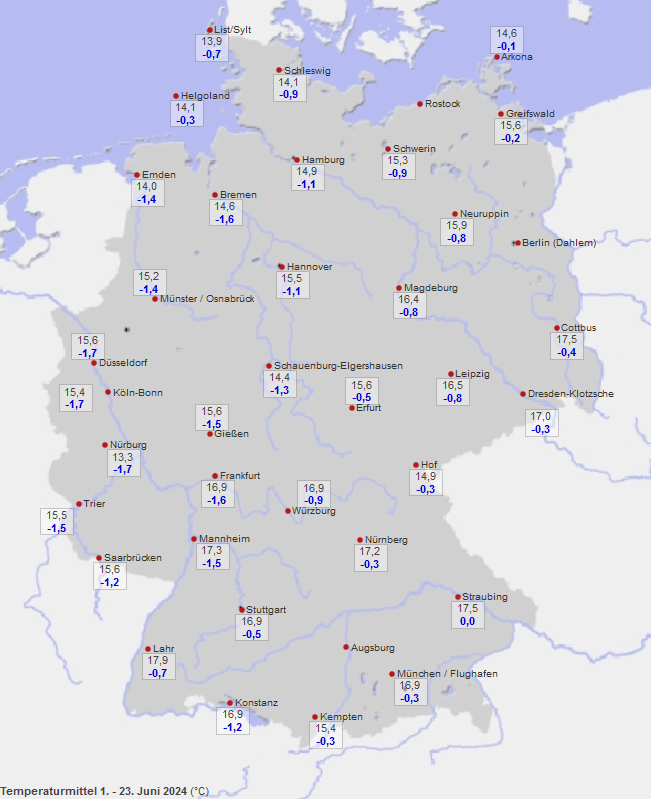
We are almost 1/3 of the way through the meteorological summer. Time to remember the prediction made by suspect biologist Marc Benecke in spring 2024. He had predicted “a summer of hell with almost complete certainty”. We reported. As early as March 2024, some meteorologists raised concerns about this forecast.

Shortly after Benecke gave his lecture, Kachelmannwetter created a video explaining the weather conditions needed for a warm or even hot summer. This is done very calmly and the video is correspondingly cautious with forecasts. However, it is well explained that summers in our latitudes have been getting warmer for years. Germany is indeed in for a warm week, but this could end at the weekend if a cold front pushes through from the north-west.

It is not possible to reliably predict how July and August will turn out. According to Wetterkontor, June 2024 has so far been slightly too cold in Germany compared to the statistical average.

(Image: Screenshot Wetterkonto.de)

Donate – choose an amount

via NoTricksZone

https://ift.tt/EL2pTVw

June 26, 2024 at 12:50PM

Five Questions Congress Should’ve Asked the Climate Cartel

By Matt Cole

My old employer CalPERS just suffered a humiliating defeat in its vote against Exxon’s board of directors. Its losing streak continued last week when the House Judiciary Committee grilled it over the Climate Action 100+ “climate cartel,” which helps pension funds like CalPERS coordinate with asset managers and non-profits to kill fossil fuels. CalPERS is the group’s brains and brawn, founding it and using its $500 billion weight to pressure companies like Exxon to fall in line. Here are five questions I wish Congress had asked it.

  1. What is the investment case that cutting fossil fuel production will increase Exxon shareholders’ returns?

Interim CIO Dan Bienvenue began by asserting “Climate change is an existential risk” and answered questions about CalPERS’ anti-fossil fuel actions by repeating “Climate change is real.” Clearly, CalPERS wants to portray all opposition to its activism as disagreement with science itself. But there’s a long leap between the claim that climate change is real and the conclusion that producing less oil will make an oil company more money.

Scientists don’t say climate change is an existential risk: as one review of the research puts it, “a century of climate change is about as bad as losing a year of economic growth.” Ending fossil fuel use would cost an energy-starved world far more, especially as AI guzzles electricity. The argument that Exxon must destroy its business to save it is political, not financial. Congress could expose that if it pressed the activists for hard evidence instead of ceding them the scientific high ground.

  1. Would CalPERS ever use its ownership in oil companies to artificially boost its green energy investments?

If cutting oil and gas production doesn’t make the Exxons and Chevrons of the world more money, who does it benefit? The green energy industry CalPERS recently pledged to invest $100 billion in.

In early 2023, California released SB 252, which required CalPERS to divest from fossil fuels. The pension opposed it, rightly noting that divesting over social goals would hurt its returns but affirming its “strong commitment to the reduction of GHG emissions.” Half a year later, it made its gigantic climate solutions promise.

The Judiciary Committee focused on Climate Action 100+’s war on fossil fuels, but that goes hand-in-hand with its attempt to artificially drive demand to wind and solar energy, which raises its own issues about fiduciary duty and anticompetitive behavior. I asked CalPERS’ PR chief about this conflict of interest in a public exchange—no answer. Maybe Congress would have better luck.

  1. Where’s that $100 billion in new green investments coming from?

The math is simple: CalPERS has $500 billion, which is already invested in a variety of assets it presumably believes will maximize risk-adjusted returns. It doesn’t have a spare $100 billion for green investments lying around. Asset allocation is a zero-sum game: if it puts 20% of its portfolio into climate solutions, it has to take it from somewhere else. Where, and at what cost? If divesting from an industry hurts portfolio returns, as CalPERS learned when it missed out on almost $4 billion by divesting from tobacco, shifting massive assets from some classes into one politically favored one amounts to the same thing.

  1. If CalPERS’ DEI practices are about ensuring diversity of perspective, why does it only measure diversity of race and gender? Does it believe different races think differently?

Bienvenue repeatedly refused to answer direct questions about whether CalPERS ever votes for or against board directors based on their skin color. Doing so would be, well, obviously racist. This should’ve been a softball.

The Committee can press the question by zeroing in on the fact that the “key highlights” of CalPERS’ DEI investments report only highlights diversity related to race, gender, and “historically underrepresented groups.” It doesn’t identify a single example of voting or engaging to improve diversity of “skill sets” or “competencies,” unless you define those through the lens of race or gender.

Does CalPERS govern its portfolio companies on the theory that men are from Mars and women are from Venus? Does it assume that white people and black people have different skill sets and competencies? Its beneficiaries deserve to know.

  1. If all this ESG investing is about making money, why are your returns so low?

Those beneficiaries, current and would-be retirees, are the ones who ultimately pay for all these wasteful experiments in ESG investing. CalPERS has made a habit of underperformance: it reported a 5.8% return last year, in-line with its 5-year average. That falls far short of the roughly 7% it needs to hit to meet its future obligations—on its current course, it’s on-track to meet only 72% of its retirees’ funding needs.

That chasm was the reality I struggled to defy every day as a CalPERS portfolio manager. The absence of any urgency to close it was why I had to leave to defend our capitalist system elsewhere. ESG investing promises nebulous profits in some far-off future, but my friends and family whose retirements rely on CalPERS need it to perform better today instead of doubling down on its money-losing ways.

Matt Cole is CEO at Strive Asset Management

This article was originally published by RealClearEnergy and made available via RealClearWire.

via Watts Up With That?

https://ift.tt/AuIH1Ew

June 26, 2024 at 12:04PM