
0 out of 10 based on 0 rating
via JoNova
June 30, 2024 at 09:47AM
Essay by Eric Worrall
There is a more plausible explanation for what went wrong.
‘It’s not beautiful, but you can still eat it’: climate crisis leads to more wonky vegetables in Netherlands
Crowdfunding scheme salvages ‘imperfect’ fruit and veg following the country’s wettest autumn, winter and spring on record
Senay Boztas in AmsterdamSun 30 Jun 2024 03.00 AEST
When 31-year-old Dutch farmer Bastiaan Blok dug up his latest crop, the weather had taken a disastrous toll. His onions – 117,000 kilos of them – were the size of shallots.
“We had a very wet spring and a dry, warm summer, so the plants made very small roots,” said Blok, who farms 90 hectares in Swifterbant, in the reclaimed province of Flevoland. “Half of them were less than 40mm and normally at this size they aren’t even processed. We would have probably sold them for very little for biomass, or maybe to Poland for onion oil. It’s either far too wet and cold, or far too warm and dry, and there’s no normal growing period in between.”
Blok is one of a number of farmers in Europe’s largest agricultural exporterlinking the climate crisis to ever more “imperfect” fruit and vegetables, rejected by a food system based on standardisation and cosmetic appearance.
…
The wettest autumn, winter and spring on record have threatened the spinach and potato crops, leading to parliamentary questions and warnings from farming union LTO. Evelien Drenth, LTO agriculture specialist, said 61% of Dutch farmers report lost yields due to extreme weather, diseases are up and sowing is late or sometimes missed. “Consumers and supermarkets need to get used to empty shelves sometimes for short-season crops like spinach … and also irregular-sized Brussels sprouts and broccoli,” she added.
…
I think the Guardian is a little premature calling the problem a climate problem. Unusually wet Spring Time weather happens from time to time. While this year was unusual, some sources suggest the record is still held by the Spring of 1983.
One interesting source of carrot deformation which might explain this year’s wonky vegetables is excessive soil nitrate. According to multiple gardening sites I looked at, exposure to high nitrate levels can cause carrot deformation.
Excessive rain may have complicated the issue. Nitrate is highly mobile, it is easily transported by water. Even if the farmer with the carrot field was applying the correct nitrate levels, their fields could have been affected by runoff from adjacent farms where much higher nitrate levels were applied to different crops. Or maybe some farmers made a mistake, and applied extra nitrate because they were worried the rain had washed the fertiliser out of their field.
There are plenty of crops which require far more nitrates than carrots, which could have been the source of runoff contamination. Cannabis is cultivated in the Netherlands, and Cannabis needs lots of nitrogen. Some fast growing flowering plants also love nitrates, and the Netherlands is a big supplier of decorative flowers. Even some fruit trees love nitrogen fertiliser – my Citrus trees put on an extra foot of growth every time I pour a bucket of leftover cleaning ammonia solution on them, after I mop the pet area.
To me accidental over-fertilisation presents a far more plausible explanation for the wonky carrots, than claiming “climate change” deformed the crops.
If accidental over fertilisation was responsible for a few deformed carrots, farmers already have adequate incentive to get the balance right – no need for bureaucrats to get involved.
WUWT has long defended the right of farmers in the Netherlands to use adequate agricultural chemicals, and will continue to do so. Our view is farmers understand farming better than bureaucrats – just look at the food shortages communist nations habitually experience, if you want proof that bureaucrats make poor farmers.
Some good news on the European War on Agriculture, there has finally been some substantial pushback at the political level. In the Netherlands farmers have really caught a break – the new right wing Geert Wilders government has promised to protect Dutch people from the EU climate crazies.
As for this year’s harvest, the deformed carrots are entirely edible – I’ve grown odd looking carrots, they look just the same diced up in the stew as normal carrots.
In an age where many people in Europe are struggling with their energy bills, I’m surprised farmers in Europe have any difficulties selling edible crops, no matter how weird they look.
via Watts Up With That?
June 30, 2024 at 08:05AM
The most detailed underwater surveys show that corals are more abundant than we have ever seen them.
via CFACT
June 30, 2024 at 06:50AM
Germany’s DWD national weather service just issued the preliminary weather results for the month of June (2024).
June in the Central European region was highly variable with periods of both cool and summery weather. The final phase of June saw the sunniest and warmest days of the year so far.
0.4°C Warmer than the mean
The preliminary results of the country’s approximately 2,000 measuring stations, the June mean temperature was 16.8°C, making the month 0.4°C warmer than the reference period 1991 to 2020. The beginning of the month saw cold, single-digit lows. On June 12th, a minimum of 1.4 °C was recorded in Meßstetten. However, late in the month temüperatures rose to summerlike levels for several days.
20% Wetter
In terms of precipitation, June was wetter than normal. a mean of around 91 liters per square meter (l/m²) fell, making the month 20% wetter than normal compared to 1991 to 2020 reference period (76 l/m²). The month began with heavy rainfall and severe flooding in parts of Baden-Württemberg and Bavaria.
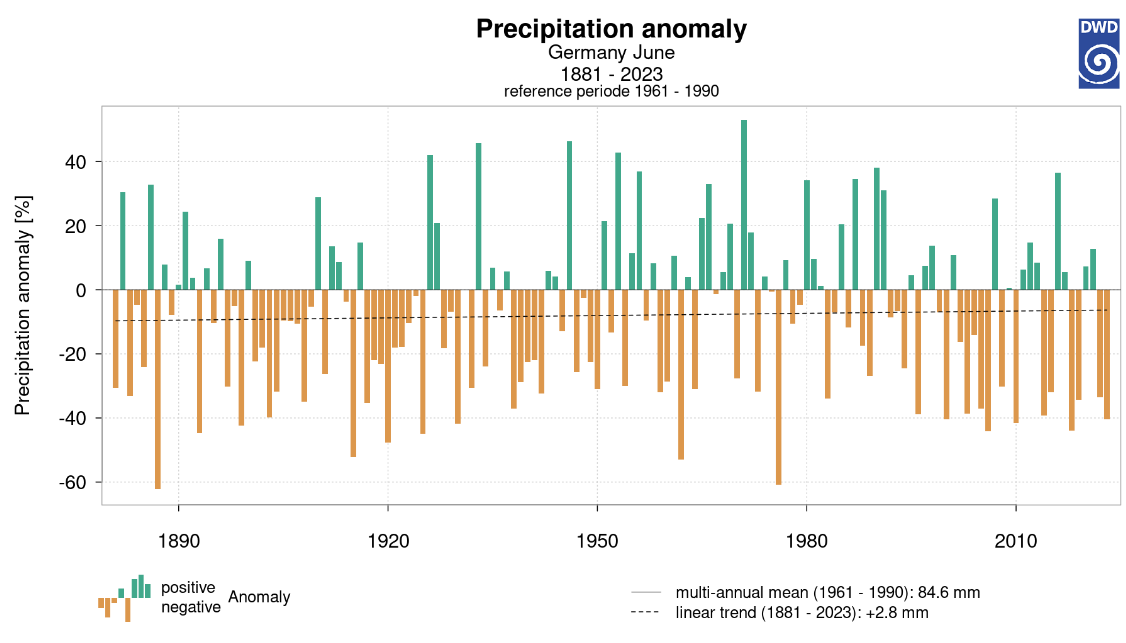
June precipitation, 2023. Source: DWD.
On June 3rd alone, 137 l/m² fell in Raubling-Pfraundorf, Upper Bavaria.
The highest monthly amounts of over 250 l/m² were recorded along the Alps. Heavy rainstorms and, in some areas, supercells with large hailstorms raged across the country. June remained drier in some Eastern regions, especially in northern Brandenburg which saw less than 20 l/m².
Normal Sunshine Hours
Germany also so saw a mean of 210 hours of sunshine in June, thus slightly less than the 1991-2020 mean of 216 hours. The northeast and east saw over 250 hours while the Black Forest and the Alps reported the lowest values, with around 150 hours.
Donate – choose an amount
via NoTricksZone
June 30, 2024 at 06:30AM
 Iowa Climate Science Education