Climate campaigners shamelessly exaggerate natural weather events.
via CFACT
June 26, 2024 at 03:19AM
Climate campaigners shamelessly exaggerate natural weather events.
via CFACT
June 26, 2024 at 03:19AM
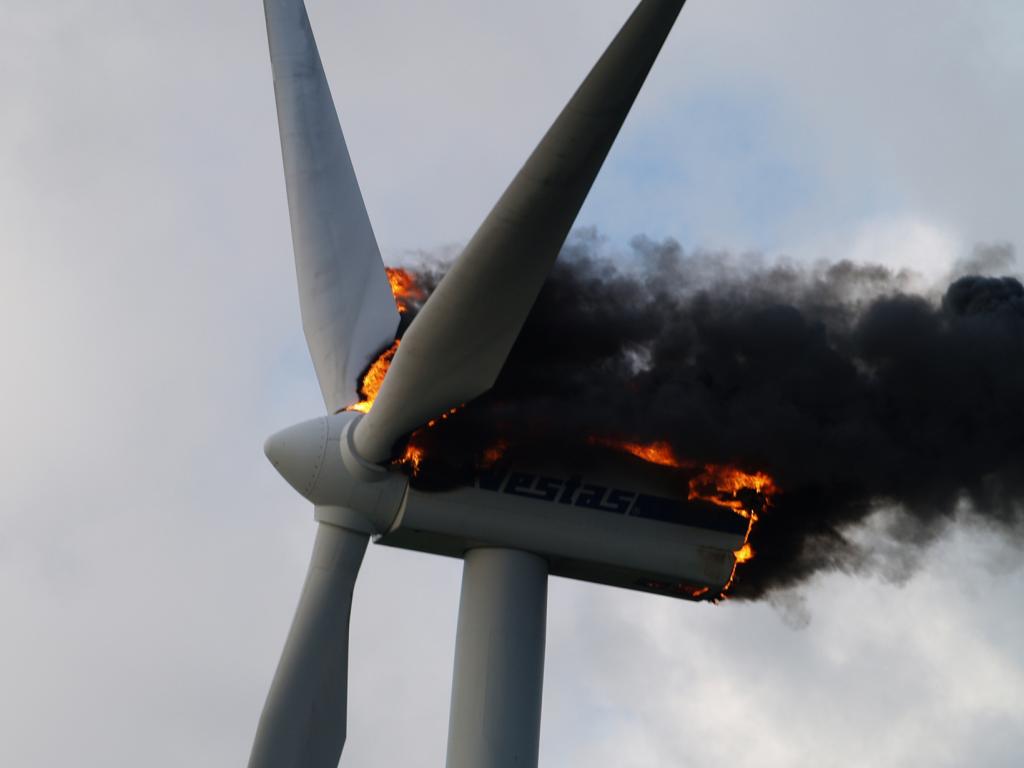
The wind and sun cult’s infantile reaction to nuclear power demonstrates that it’s the generation source for grown-ups. But it’s not so much the reaction of the propagandists and cheer squad that matters, it’s the response from those profiting from the wind and solar scam that determines the political playing field from here on.
Nothing sharpens focus like real competition, even more so when that competitor will crush you every, single time. That’s what wind and solar scammers fear most from always-on, ever-reliable, CO2 emissions-free nuclear power.
The Liberal/National Coalition Leader, Peter Dutton has just announced an all-in nuclear power policy that he will take to the next Federal election, with the majority of voters already signalling their eager approval.
For crony capitalists, as they say in a Hollywood action films, ‘this shit just got real’.
Alan Moran, one of Australia’s leading energy economists, has always promoted coal-fired power on the basis of reliability and cost. And fair enough. However, in this piece Alan starts to warm to the concept of a nuclear-powered future, particularly because it would cost a mere fraction of what the current Labor all wind and solar policy will cost Australian households and businesses.
The nuclear gamble
The Spectator
Alan Moran
20 June 2024
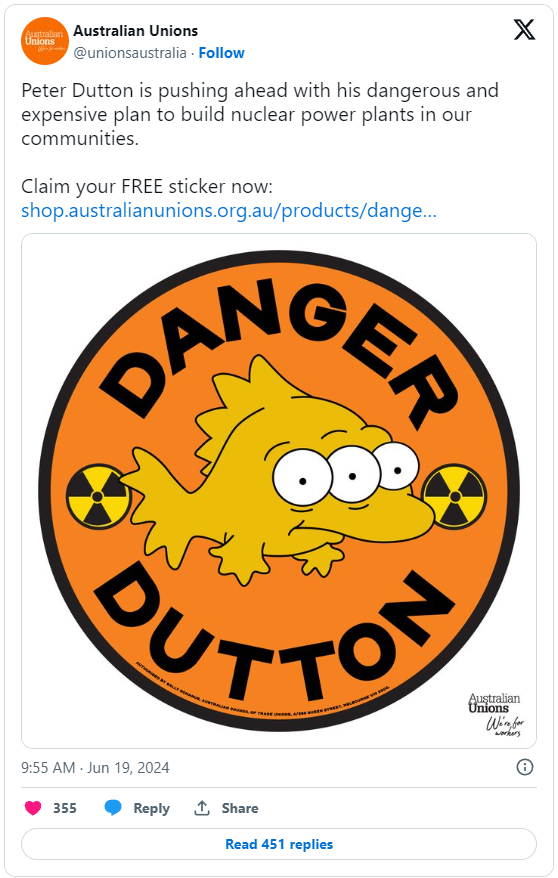
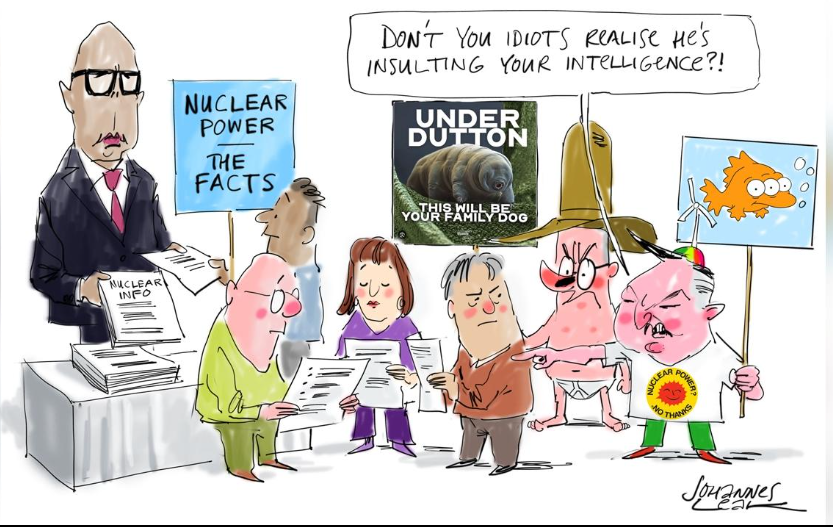
Finally, the Opposition has announced it is going to develop a nuclear power future for Australia. The government, along with the renewables subsidy-fuelled lobby, issued howls of derision. Too expensive. The community won’t accept it. Drawing from no less an authority than a Simpsons cartoon, Energy Minister Bowen declared nuclear energy will cause mutations including three-eyed fish.
Predictably the move was panned by renewable energy investor Malcolm Turnbull, who burnished his own energy credentials in creating Snowy 2 as a $2 billion solution to the intermittency problem of wind and solar that would be up and running by 2022. Snowy 2 will cost over $20 billion, not be ready by 2030 and will only provide a minor part in firming up wind and solar.
With delicious irony on the very same day as the Opposition’s announcement, the United States Senate voted 88-2 in support of a bill to promote new nuclear power by severely reducing the regulatory impediments that have plagued the industry over the past 20 years. The Senate committee’s Chair, Democratic Senator Tom Carper, called it ‘a major victory for our climate and American energy security’.
The Biden Administration’s support for nuclear had previously been foreshadowed by Energy Secretary Jennifer Granholm. Formerly a firebrand pro-renewables politician, Granholm was mugged by reality, learning on the job that renewables mean a disaster for reliable low-cost power. Over the past month, she has called for hundreds of new nuclear power stations (the US has just 94 at present).
Notwithstanding whipped-up hysteria, nuclear generators are actually safer than wind and much safer than coal, hydro and gas (they also entail fewer greenhouse gas emissions).
Combined with its own hypocrisy in opposing nuclear power yet sponsoring floating nuclear power plants in submarines, the government’s propaganda is also coming unstuck with reports of a welcome to nuclear plants in areas where it is envisaged. The Coalition’s plan itself was devised on the basis of internal polling with those same findings.
The Opposition has had a long road to its Damascene conversion on nuclear – it was John Howard who, succumbing to Green pressure, banned it as an Australian power source in 1988.
But Howard and his ministers had an excuse. In 1998, nobody in Australia would have been under any illusion that nuclear generators, with regulatory excesses and activists’ opposition already causing cost escalations, could compete with electricity generated from the nation’s virtually unlimited low-cost coal supplies. New coal plant costs then and now were falling and new private sector power stations were being planned in Queensland (Millmerran commissioned in 2002 and Kogan Creek 2007) that were offering long-term contracts at under $40 per megawatt hour. That’s one-third of the current Australian spot price.
More importantly, in 1988 the global warming psychosis was yet to dominate the political arena.
The Opposition’s nuclear plans were clearly conceived as a means of differentiating their product from that of the ALP. A key motivation was the Coalition’s internal divisions. Dutton and Littleproud represent leftists supporting renewables (who include Littleproud himself) a strong coterie supporting coal and most of its ranks fearful of facing Green, Teal and ALP opponents who have demonstrably been able to marshal electoral support.
Nuclear is safe and, in spite of the CSIRO and Lazzards publications, as attested by the US Administration’s recent moves, is much cheaper than wind/solar. It may be the cheapest source of electricity in areas like Japan, France, and much of China and India which do not share Australia’s fabulous coal reserves. This might also be true of South and Western Australia where cheap coal is less than abundant.
But it is not the cheapest option in eastern Australia. Even with the most draconian regulatory reform nuclear would never come close to the below $50 per megawatt hour price at which new coal could be provided.
Moreover, it is far from ideal as a complementary power source to the intermittent renewables, a role seen for it by the Coalition. Wind and solar are so unreliable that they will need virtually 100 per cent back-up by controllable (dispatchable) supplies: nuclear, coal, hydro (further capacity of which is limited), gas or diesel. Such back-up is cheapest when the ratio of fuel to operating costs is lowest. Nuclear and (Australian) coal generator costs are 95 per cent fixed; they are incurred whether or not they are operating. Gas (and diesel) costs are less than 50 per cent fixed. Minister Bowen, in a rare demonstration of energy rationality, is correct in identifying gas as the complementary power source for his beloved renewables, though vastly underestimating the extent of its need.
Mr Bowen has previously put a cost of $387 billion for a nuclear-fuelled Australia, though Westinghouse Electric Company senior vice president Rita Baranwal quipped, ‘I only have three engineering degrees and that math doesn’t make sense to me,’ and put the cost at $110 billion.
Mr Dutton has said he will release the cost of his proposals before the next election (if it is held in 2025).
Neither the ALP nor previous governments have ever put a cost on the Net Zero policy. Nor have they ever disputed my estimate, currently $15.6 billion per year and growing, which would mean costs well in excess of $500 billion by 2050. The ALP program would cost at least one-third of GDP each year by 2050 – meaning everyone would be at least a third poorer.
Hopefully, if Mr Dutton prevails at the next election, Australia will buy time to come to a sensible energy policy founded on coal with some nuclear.
The Spectator
via STOP THESE THINGS
June 26, 2024 at 02:30AM
There is a lot of desperate stuff being put forward to try and claim that "climate change is happening now", but the problem is that these claims do not agree with the facts. Luckily these facts are published and can be accessed by those who know where to look. (I am sure a lot of climate change extremists would like these data to be removed).
Wildfires Getting Worse, Even When They’re Not! | NOT A LOT OF PEOPLE KNOW THAT (wordpress.com)
via climate science
June 26, 2024 at 01:40AM
“Federal subsidies to support renewable energy formed nearly half of all federal energy-related support between fiscal years 2016 and 2022. Traditional fuels (coal, natural gas, oil and nuclear) received just 15 percent of all subsidies between FY 2016 and FY 2022, while renewables, conservation and end use received a whopping 85 percent.” (Mary Hutzler, below)
A fallacious argument in the energy/climate debate is that wind and solar are cheaper than fossil fuels in electric generation. It must be wrong because government subsidies are front-and-center for on-grid dilute, intermittent energies. And it is wrong if the federal accounting is examined (below).
Actually, the relatively small subsidies for oil, natural gas, and coal turn negative, dramatically, when the Biden Administration anti-fossil-fuel agenda is added, 200 actions worth.
Mary Hutzler of IER (and former acting head of the DOE’s Energy Information Agency) prepared this analysis less than a year ago for the Institute for Energy Research. “Renewable Energy Still Dominates Energy Subsidies in FY 2022” deserves amplification in the buildup for Fiscal Year 2023’s update. Hutzler’s August 9, 2023 post follows.
The Energy Information Administration (EIA), an independent agency of the U.S. Department of Energy, evaluated the amount of subsidies that the federal government provides energy producers for fiscal years 2016 through 2022, in its report Federal Financial Interventions and Subsidies in Energy, updating its previous subsidy reports.
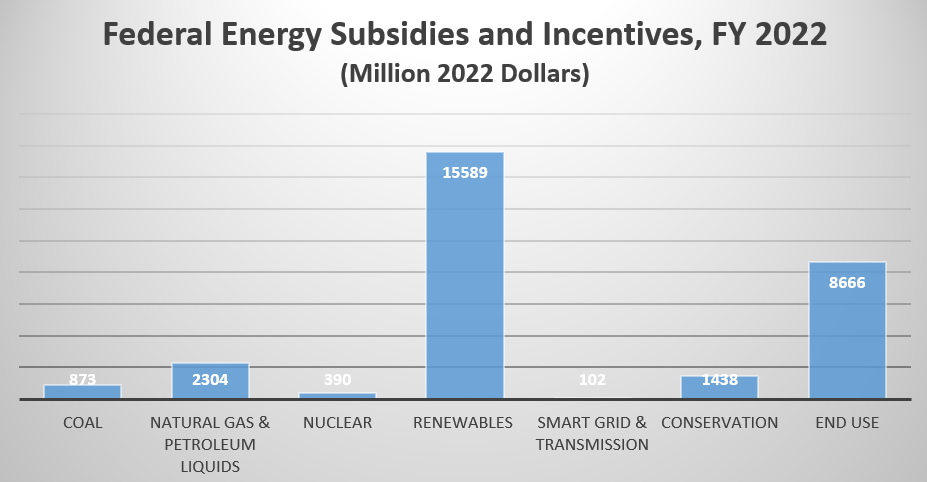
Federal subsidies to support renewable energy formed nearly half of all federal energy-related support between fiscal years 2016 and 2022. Traditional fuels (coal, natural gas, oil and nuclear) received just 15 percent of all subsidies between FY 2016 and FY 2022, while renewables, conservation, and end use received a whopping 85 percent.
Renewable subsidies more than doubled between FY 2016 and FY 2022, increasing to $15.6 billion in fiscal year 2022 from $7.4 billion in fiscal year 2016 (both in 2022 dollars). Federal subsidies and incentives to support renewable energy in fiscal year 2022 were almost 5 times higher than those for fossil energy, which totaled $3.2 billion in subsidies.
The subsidies in EIA’s report do not include state and local subsidies, mandates or incentives that in many cases are quite substantial, especially for renewable energy sources. EIA also did not include the massive subsidies authorized in the Inflation Reduction Act (IRA) since it was passed in August 2022. Goldman Sachs has estimated the costs of that bill at $1.2 trillion.
Source: Energy Information Administration
______
Fast Facts
______
Energy end-use subsidies (Low-Income Heating Assistance and other such programs) were the second highest category after renewable subsidies. Energy end-use subsidies increased from $7.9 billion in FY 2016 to $8.7 billion in FY 2022. The largest program of this category—the Low Income Home Energy Assistance Program (LIHEAP), administered through the U.S. Department of Health and Human Services (HHS)—slightly decreased its funding from $4.0 billion in FY 2016 to $3.9 billion in FY 2022, with a noteworthy one-year increase to nearly $10.0 billion in FY 2021.
In 2021, funding for the Low Income Home Energy Assistance Program, which assists with energy bills and other energy-related costs, saw a one-time doubling to nearly $10 billion, after Congress approved additional funding for the program under its COVID-19 relief plan that resulted in end use subsidies totaling $14.3 billion in FY 2021. The end use subsidy programs help people at the bottom of the economic ladder pay their rising utility bills, but do nothing to aid most taxpayers.
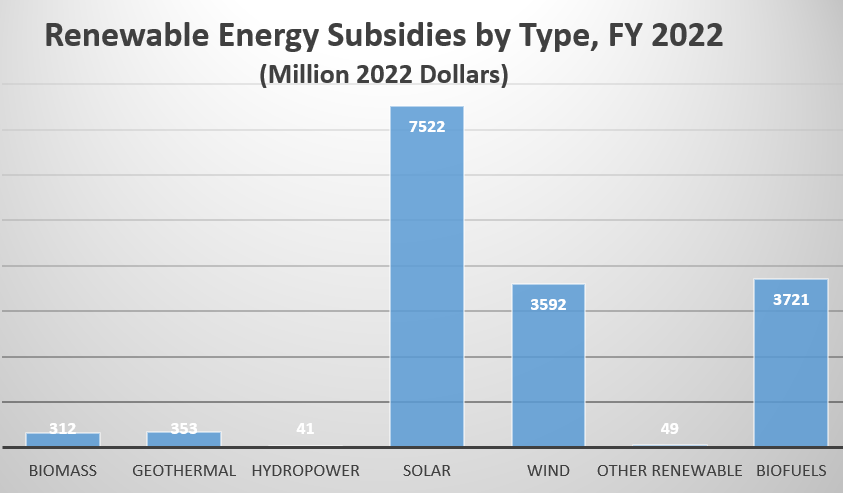
Most of the renewable subsidies were tax incentives, with solar applications making up the largest share of those subsidies. In FY 2022, solar subsidies totaling $7.5 billion overtook biofuel subsidies–the largest beneficiary of tax incentives in FY 2016, having total subsidies of $3.7 billion, with wind a close third at $3.6 billion in total FY 2022 subsidies.
These sources typically receive additional support at the state and local level, including credits in California for biofuels at $3.70 per gallon for its production rather than petroleum refining. Other benefits in some states include “net metering” for solar energy which requires utilities to purchase solar at a retail price rather than wholesale.
Source: Energy Information Administration
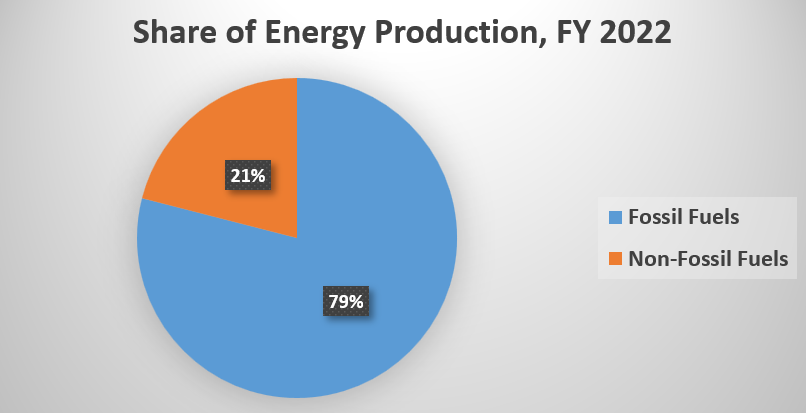
Despite renewable energy receiving over half the federal subsidies in FY 2022, EIA reports that fossil energy in the form of coal, oil, natural gas and natural gas plant liquids made up 79.1 percent of primary energy production in FY 2022. Nuclear power contributed 7.9 percent, followed by biomass at 5.1 percent, wind at 3.7 percent, hydroelectric at 2.3 percent, solar at 1.8 percent, and geothermal at 0.2 percent.
Source: Energy Information Administration
Federal Subsidy and Support for Renewable Energy
Renewable energy (including biofuels) comprised 53 percent of total energy subsidies in FY 2022–up from 41 percent in FY 2016. In FY 2022, tax expenditures accounted for 98 percent of total renewable energy subsidies. Biofuels represented 42 percent of total subsidies for renewable energy in FY 2022 while renewable energy used in electricity production represented the other 58 percent.
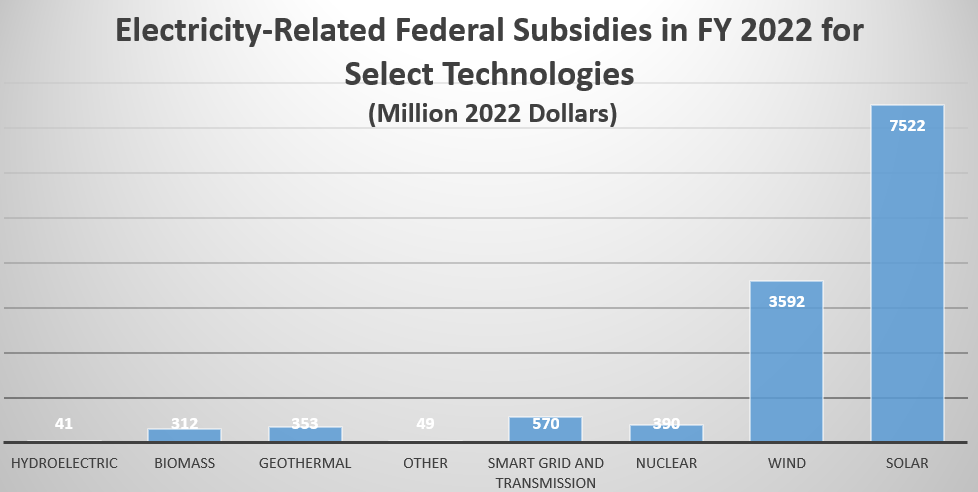
The largest electricity-related federal energy subsidies were for renewable energy since subsidies for wind and solar each exceeded subsidies for coal, natural gas and petroleum, and nuclear. Wind and solar combined represented 94 percent of the federal renewable electricity-related subsidies in FY 2022, while producing a combined 5.5 percent of primary energy.
Source: Energy Information Administration
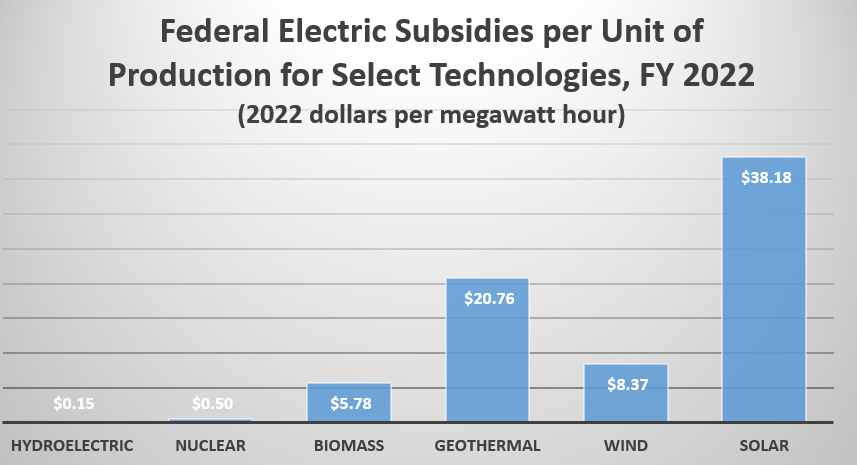
The Institute for Energy Research calculated the federal subsidies and support per unit of electricity production from the information provided in EIA’s report for renewable technologies and nuclear power for FY 2022. Because EIA did not break out the electricity-related subsidies for coal, natural gas and petroleum from their total subsidies, the subsidy per unit of energy produced could not be calculated for these sources of electricity. However, if one assumed that all of coal’s subsidies that EIA calculated were for electricity production in FY 2022, the subsidy cost per unit of production for coal would be $1.06 per megawatt hour.
The figure below provides the subsidy costs per unit of production for those technologies that EIA provided relevant data. On a per-dollar basis, government policies have led to solar generation being subsidized by over 76 times more than nuclear electricity production, and wind being subsidized almost 17 times more than nuclear power on a unit-of-production basis in FY 2022. Nuclear power is the largest source of carbon-free energy in the United States.
Source: Energy Information Administration
Conclusion
From FY 2016 to FY 2022, most federal subsidies were for renewable energy producers (primarily biofuels, wind, and solar), low-income households, and energy-efficiency improvements. From FY 2016 to FY 2022, nearly half (46 percent) of federal energy subsidies were associated with renewable energy, and 35 percent were associated with energy end uses. Federal support for renewable energy of all types more than doubled, from $7.4 billion in FY 2016 to $15.6 billion in FY 2022.
From FY 2016 to FY 2022, provisions in the tax code were the largest source of federal financial support. In FY 2016, the Internal Revenue Code (IRC)—with its 31 energy-specific tax provisions—provided greater financial support to energy than direct expenditures, including R&D expenditures. Total tax expenditures were 70 percent of the total federal financial support. Since FY 2016, tax expenditures have continued to grow, increasing to over 75 percent of total federal support in recent years.
On a total dollar basis and on a unit of production basis, solar energy had the highest federal electricity-related subsidies in FY 2022.
The post ‘Renewable Energy Still Dominates Energy Subsidies in FY 2022’ appeared first on Master Resource.
via Master Resource
June 26, 2024 at 01:01AM
 Iowa Climate Science Education