Labour’splan for a net zero grid by 2030 is unrealistic and will require a “huge sacrifice” by the country, a leading power station builder has warned.
Javier Cavada, European boss of Mitsubishi Power, said the rollout of green energy schemes planned by Sir Keir Starmer and Ed Miliband, the shadow energy secretary, would have to move at an unprecedented speed to stand a chance of success.
He also warned it would be prohibitively expensive and questioned whether completely eliminating emissions from gas-fired power plants, which generated one third of Britain’s electricity last year, was a sensible immediate priority.
Asked whether the 2030 target was feasible, Mr Cavada said: “In my years at Mitsubishi and, frankly, my 48 years on the planet, this would be a speed that I have never seen anywhere else.
“Can you do it? You definitely can. But financially? Well, the cost is very large.
“Can the whole country invest into fully decarbonising and can all the industries invest in that? Is everyone so wealthy and so happy to increase the cost of everything?
“You need to create a path that is realistic, that is affordable and is achievable.”
Higher spending on the energy system raises the prospect of households and businesses shouldering increased costs through taxes or bills.
Mr Cavada is the latest energy industry figure to express scepticism about Labour’s plans, which the Conservatives have claimed would risk blackouts. Sir Jim Ratcliffe, the petrochemicals billionaire, said on Thursday that Labour’s net zero grid target was “absurd”.
Labour has insisted its plans are deliverable and will ultimately bring energy bills down.
The Labour manifesto pledges to retain a strategic reserve of gas power stations “to guarantee security of supply” and says it will partly fund green investments by expanding the windfall tax on oil and gas companies.
Electricity demand is expected to rise from around 300 terawatt hours per year today to about 360 terawatt hours by 2030.
The bulk of Britain’s future supplies are forecast to come from weather-dependent renewables such as wind and solar farms, backed up by batteries and nuclear power, but gas-fired power stations will still be needed at certain times to keep the lights on.
However, instead of seeking to eliminate their emissions completely by 2030, Mr Cavada urged future governments to proceed more gradually by blending hydrogen into their fuel.
Mitsubishi Power believes existing gas turbines could burn gas that is 30pc hydrogen with only minor modifications.
Mr Cavada admitted that supplies of hydrogen were currently small and highly expensive as well, but argued that – as with wind and solar power – costs would fall as production was scaled up.
That view is not shared by all experts. Many argue that the energy-intensive process of making “green” hydrogen via electrolysis – where water is separated into hydrogen and oxygen – makes it unsuitable for large-scale use in power plants or for heating.
However, Mitsubishi Power, which manufactures gas turbines, is working on technology to make power plants hydrogen-compatible.
The company is also a key player in so-called carbon capture and is developing chemical plants that can absorb emissions from power stations and factories, so they can be sequestered later underground.
Both hydrogen and carbon capture, also known as abatement, are expected to play a role in Labour’s plans to decarbonise Britain’s energy system, although the party has not set out detailed proposals.
But Mr Cavada warned carbon capture was an expensive solution and said it should only be used at sites that were most difficult to turn green, for example cement factories.
In fact Cavada still grossly understates the problem.
He talks about the speed of the rollout and cost. But barely touches on the underlying problem of intermittency.
His favoured option appears to be hydrogen, unsurprising given Mitsubishi make the turbines which will be needed to burn the stuff!
But as the Telegraph notes, experts don’t believe green hydrogen is scaleable at this time. Neither id carbon acpture, as Mr Cavada admits.
This leaves us relying on nuclear and batteries, which the Telegraph seems to believe can supply “the bulk of our power”. Apparently the Telegraph’s Industrial Editor is not aware that batteries can only store enough power to last an hour or two.
We use cookies to ensure that we give you the best experience on WUWT. If you continue to use this site we will assume that you are happy with it. This notice is required by recently enacted EU GDPR rules, and since WUWT is a globally read website, we need to keep the bureaucrats off our case!
As the wind and sun cult would have it, the days of ‘dirty fossil fuels’ are done. Never mind that without coal, oil and gas the manufacture and construction of wind turbines and solar panels would be thoroughly impossible.
Moreover, without coal-fired power plants and/or gas and diesel backup plants, we’ll all be sitting boiling or freezing in the dark every time the sun sets and/or calm weather sets in.
The notion that wind and solar can go it alone is utterly delusional. And the markets know it.
Despite a raft of policy interventions designed to destroy the use of hydrocarbons, demand for oil, coal and gas continue to rocket around the globe. Particularly in those countries that are vaguely interested in improving lives and lifestyles by generating wealth and prosperity, rather than leaving their people to suffer in energy-starved misery.
As Greg Sheridan explains below, the death of hydrocarbon use has been greatly exaggerated.
Oil, gas and coal boom shatter decarbonisation myth
The Australian
Greg Sheridan
15 June 2024
Peter Dutton and Ted O’Brien haven’t reignited the climate wars, as Anthony Albanese and Chris Bowen claim. The climate wars never went away and they are being waged all over the world. It’s just that almost everything you hear about climate policy in the official and semi-official discussion in Australia is basically misleading, if not outright wrong.
Let’s take a step back and look at the big picture.
The Kyoto Protocol was adopted, in the serene and beguiling Japanese city of that name, in 1997, 27 years ago. Kyoto itself built on the 1992 UN Framework Convention on Climate Change. So for more than three decades the world has been decarbonising, right?
We’ve had many solemn moments and announcements, especially the 2015 Paris Agreement. Dutton says he would abandon Australia’s 2030 target to reduce greenhouse gas emissions by 43 per cent, but he’s committed to honouring the Paris pledge to reach net-zero emissions by 2050. He wants to do it in part by building nuclear energy.
In truth Australia, whether led by Albanese or Dutton, is a very, very minor player in all this, being responsible for a tick over 1 per cent of global emissions. Every Labor leader since Kyoto, and quite a few Liberal leaders, has told us the world is decarbonising. Deputy Prime Minister Richard Marles, early in the life of the Albanese government, caused a ripple of concern by rejoicing in the fact that coal was being phased out globally.
So after three decades of decarbonising, how is the world going in phasing out fossil fuels, to wit, gas, oil and coal?
Let’s start with gas. Everyone except the Greens understands that gas is, at the very least, a critical transition technology.
Much of the reduction in the carbon intensity of economies – that is, the amount of greenhouse gases emitted per unit of production – has come from substituting gas for coal and oil.
Nonetheless, after 30 years of relentless decarbonisation, you’d expect a pretty severe drop in gas use. Actually, according to the International Energy Agency, consumption of natural gas is at or just near its record high. The rate of growth of demand has slowed but demand is still growing.
Well, that’s a bit of a surprise. What about oil, that must be well down, with fuel efficiency standards, the global campaign for electric vehicles, the decline of oil in power generation?
Guess what. Last year, according to the US government’s Energy Information Administration, world use of oil was at a record high, higher than the peak before the Covid pandemic, at more than 100 million barrels a day. Not only that, the US under pro-green Joe Biden produced more crude oil, more than 13 million barrels a day, than any country has ever done.
Oil production dipped in the global financial crisis of 2008 and again during Covid. But it’s now roaring ahead, stronger than ever.
But surely the US constantly lectures everyone else about climate change, the dangers of fossil fuels etc. How is that consistent with record crude oil production? Bear that thought in mind, for it’s a clue to the wider reality.
OK, so we’ve struck out in looking for global reductions in gas and oil, but obviously coal use must be well down. I have myself caused something near pandemonium by suggesting on the ABC’s Q+A and on Insiders that coal has a future as well as a past. It was as though a leading atheist had infiltrated the Spanish Inquisition. So now I must face the truth about coal. Surely its use has declined?
But what do you know? According to the IEA: “Global coal consumption reached an all-time high in 2022, and the world is heading towards a new record in 2023.”
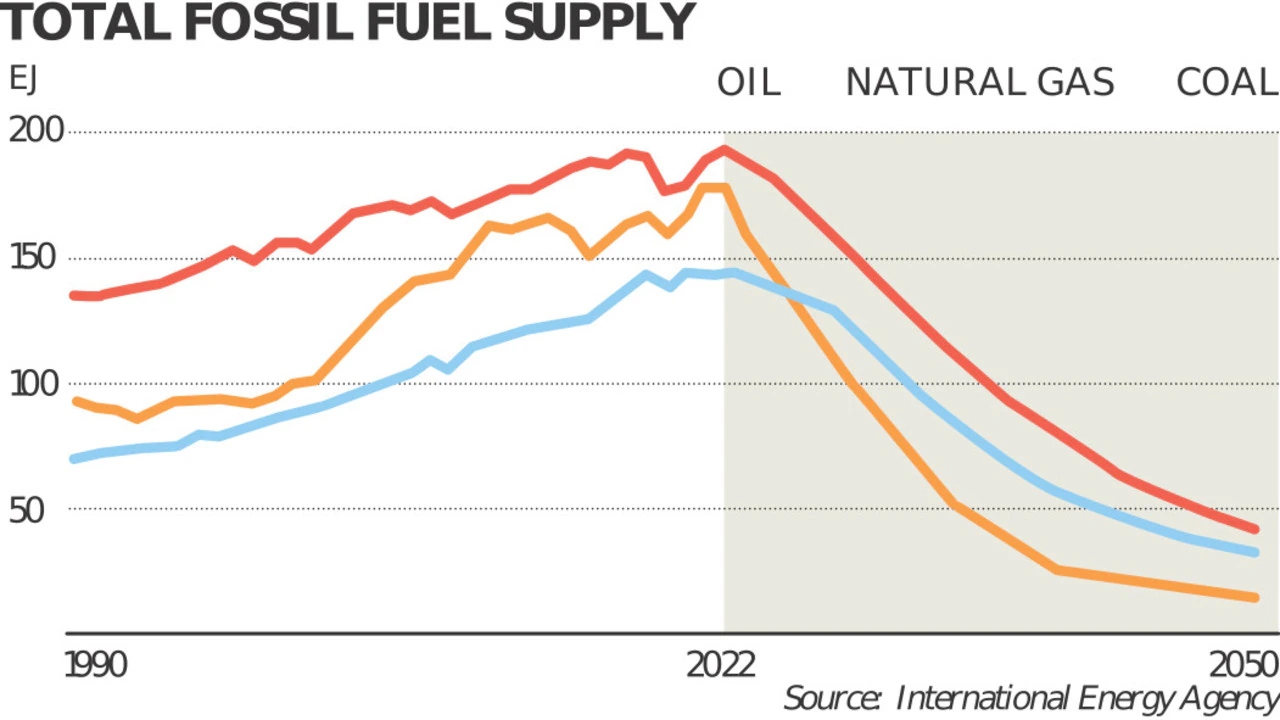
A Climate Graph which mixes fact with prophesy
Advanced economies such as the US and the EU are using less coal but, says the IEA, “the growth in China and India, as well as Indonesia, Vietnam and The Philippines, will more than offset these decreases on a global level”. And the price of coal, at $US140 a tonne, is very healthy.
That’s a good thing because our top three export earners are coal, iron ore and gas. We couldn’t afford any fancy green measures, or Medicare, or the National Disability Insurance Scheme, or anything else, without the minerals industry.
According to the IEA, fossil fuels make up about 80 per cent of global energy, just a tick under their level 10 years ago.
So how has the world been reducing its greenhouse gas emissions for so long, with these fossil fuels all reaching record production and consumption levels? Well, actually, the world hasn’t been reducing its greenhouse gas emissions.
Oops again. Another surprise. According to the US National Oceanic and Atmospheric Administration, greenhouse gas levels are rising again, and reached record levels last year. The IEA’s own figures, and studies from Stanford and other universities, confirm this.
None of the foregoing bears on the question of what should be happening. But our debates ought to start with reality. What is happening in the world is more or less the opposite of what the government and the climate change propaganda agencies tell us is happening.
How often have you heard any of the facts above in the Australian climate debate? The debate is overwhelmingly dominated by people who are so committed to the idea of Australia taking radical action that they insist on pretending radical action is being taken globally.
The developed countries are reducing greenhouse gas emissions, but the developed countries are no longer the big story. China is the biggest greenhouse gas emitter by far. It accounts for more than 29 per cent of global emissions, more than the US and EU put together. The top 10 emitters are: China, the US, India, Russia, Brazil, Indonesia, Japan, Iran, Mexico and Saudi Arabia. Of those only two, the US and Japan, are rich, developed countries. Almost none of the others has binding targets or any commitment to when their emissions will even peak.
Indonesia is a fascinating case. Like China, it has a goal of net zero by 2060. It has nearly 280 million people and is still a poor country. It has more than 250 operational coal-fired power plants. It has an international deal to retire some of them early. Well, that seems to be progress, you might argue.
Except that it also has an out clause that says plants that have already been approved, or “captive” plants that don’t feed directly into the grid but only power an industrial park or a specific project, or are concerned with National Strategic Projects, can go ahead. There are 40 plants under construction and more in pre-approval.
Recently, Indonesia has had huge success expanding its nickel production. In 2020, Jakarta banned the export of unrefined nickel. Like Australia, it has a lot of nickel. It didn’t want to dig it up and ship it overseas. It wanted refining and processing to take place within Indonesia.
This move defied every tenet of orthodox economics and was almost universally criticised by international commentators (including me). Yet as so often, reality doesn’t conform to the textbook.
Indonesia’s move worked. It attracted Chinese partners who also bought the product. Low-grade nickel is used to make steel. High-class nickel is used for very sexy products like lithium-ion batteries. A bit like Eliza Doolittle in My Fair Lady, low-class nickel can be transformed into high-class nickel with enough money. There are industrial processes that will do the trick but they require enormous amounts of power. So Indonesia’s Chinese collaborators built a swag of coal-fired power stations to provide the power to work the magic on the nickel.
In 2017, Indonesia produced 385,000 tonnes of nickel. Last year it produced 1.8 million tonnes. It’s murdering the Australian competition. The Albanese government talks a lot about Australia’s position with rare earths, of which we have a lot in the ground, and how we’re going to become a renewable energy superpower.
By the way, almost every country in the world plans to be a renewable energy superpower (surely now one of the iconic cliches of our time), suggesting many, many of them will be sorely disappointed.
The Indonesian policy has succeeded magnificently from its point of view. Indonesia’s President, Joko Widodo, has genuine environmental ambitions. But he’s also determined to develop his nation. Similarly, anyone with even the vaguest familiarity with Indonesian politics will know just how entrenched and powerful are coalmining and energy interests. Indonesia pays its population fuel subsidies – the exact opposite of a carbon tax – and has typically subsidised coal energy.
But the deeper pattern and perversity of the industrial politics of renewable energy revealed in the Indonesian nickel example occurs more broadly across Asia, especially in China. The production and sale of wind turbines is dominated by China. To make them so cheaply, China typically uses cheap coal-fired power. Coal power is still mostly the cheapest power in the world despite what the Albanese government tells you (more on that below).
So the true carbon cost of even renewable energy ought to take into account the role of coal-fired power in making the renewable energy products. In any event, here’s the paradox of energy politics: to become a renewable energy superpower, you need lots and lots of cheap coal-fired power.
China, India, Indonesia, Vietnam, The Philippines and in due course the poorer nations of Asia, and beyond that lots of African nations, are extremely unlikely to compromise their national development by embracing vastly more expensive and unreliable renewable energy over coal, gas and the like.
Two factors allow some modern, wealthy, industrial nations to run low emissions levels. One is a natural topography that lends itself to hydro-electric power. Hydro power is the only genuinely cost-competitive renewable energy and still the most important renewable energy. The other is already having a lot nuclear power.
None of this, as I say, is to argue what Australian policy should be. But the realities sketched here almost never figure in the Australian debate. How come?
Let me nominate one international factor and one specifically Australian factor.
Accompanying this article is a graph from the IEA showing the rise of the use of gas, oil and coal, measured in exajoules (one joule, a measure of energy, to the power of 18; that is to say, lots of joules, one joule being the equivalent of 107 ergs). The left side of the graph’s curve, up to the peak in 2022, which has been maintained in 2023, describes things that have already happened. That part of the graph is indisputable fact.
The right side of the graph shows a steep decline in the use of coal, oil and gas. But that’s purely speculative. That’s more or less taking an end point of declared policy, the Paris targets, and plotting a line that gets there. But that’s the future, and government predictions of the future have never been reliable. Indeed the Climate Tracker website describes Argentina, South Korea, Russia, Turkey, Canada, Mexico and Indonesia as “critically insufficient” in meeting their greenhouse gas reduction targets, and Australia, China, Brazil, the EU and Britain as “highly insufficient”.
The point about the graph is that huge amounts of climate literature are presented this way. The average reporter, the average citizen, tends to see such graphs as one entity and unconsciously gives the authority of the left-hand side of the graph, which represents factual history, to the right-hand side of the graph, which represents Nostradamus-like prophecy.
Within Australia, governments do this kind of thing very deliberately and with shockingly good effect. I’ve been following the national defence budget pretty closely for some decades. I’ve never seen a defence budget projection, or capability projection, actually come true if it concerns any period of the future longer than about six months. And defence is an area where the Australian government entirely controls what it spends. Australian governments can’t even predict what they themselves are going to do more than five minutes hence.
Yet somehow we are supposed to believe government agencies can forecast exactly what’s going to happen in energy and climate years and years, even decades, ahead. Gimme a break.
Thus the Albanese government has got great mileage from a Climate Change and Energy Department projection that Australia will reach a 42 per cent reduction in greenhouse emissions by 2030, just 1 per cent shy of our target of 43 per cent. Apparently the government now can predict the course of the Ukraine war, the effects of a possible Donald Trump victory in America, greenhouse gas emissions caused perhaps by a sudden spike in migration to Australia, and all the other manifold variables. You think?
Predicting we’ll be just 1 per cent short is a sweet touch. Just try a little harder, Australia! Yet a UN committee examining the issue doesn’t think even one G20 country will meet its target. The government is miles behind in the rollout of renewables. Electric vehicle sales are a small fraction of the forecast sales. But still we are, according to the magic forecast, just 1 per cent off target.
This is the problem, though. Almost every piece of information in this area is designed to produce a political effect. Disinterested information is at a premium.
When like is genuinely compared with like, coal is cheaper than renewables. Because with renewables you have to take account of the fact that most of the time they don’t operate so you need vast extra capacity, sometimes there are wind droughts and long cloudy periods so you need vast back-up systems of gas or coal or something else, the transmission infrastructure is enormous and the costs huge, and after 25 years or so you’ve got to throw away all the renewable stuff and replace it.
Almost everywhere that introduces vast renewable energy, apart from hydro, sees big electricity price rises. It might be that we still want to make the change because of our commitment to lowering our greenhouse gas emissions. But we need to recognise the cost, otherwise there will certainly be a backlash and the policy may well be reversed in time.
On the other hand, perhaps we should have some other conversations as well. Almost everyone wants to make some contribution to reducing our greenhouse gas emissions. But given that whatever we do will have no discernible impact on the global environment, we should think pretty carefully about the cost. Especially given that it’s not happening globally.
Switching to renewables will make us poorer. They say the key policy dilemma for China is: will it grow rich before it grows poor?
For us the question is: do we want to grow richer before we grow poorer? And how poor do we really want to be? The Australian



 Iowa Climate Science Education