Dansgaard–Oeschger (D–O) events do not get mentioned in the mainstream media. The reason is that they show that extreme weather events have occurred naturally over the past 100000 years many times. The temperature variations were much greater than anything dreamt up by a climate scientist. The question is; what is the point of wasting trillions of pounds to stop the current small change, when such large naturally occurring changes cannot even be explained, let alone stopped?
“… the infrastructure is not prepared for new energy feeds …”
Power outage hits Balkan states as heat overloads system, minister says
By Reuters June 22, 20245:43 AM GMT+10 Updated 11 hours ago
PODGORICA, June 21 (Reuters) – A major power outage hit Montenegro, Bosnia, Albania and most of Croatia’s coast on Friday, disrupting businesses, shutting down traffic lights and leaving people sweltering without air conditioning in the middle of a heatwave.
Montenegro’s energy minister said the shutdown was caused by a sudden increase in power consumption brought on by high temperatures, and by the heat itself overloading systems. Power distribution is linked across the Balkans for transfers and trading.
…
Experts were still trying to identify where the malfunction originated, he added.
…
Shifts in the region’s energy supplies have put strains on its transmission systems, industry officials say.
Western Balkan nations have seen a boom in solar energy investment, meant to ease a power crisis that had threatened a shift away from coal.
But the infrastructure is not prepared for new energy feeds, the president of North Macedonia’s Energy Regulatory Commission and other industry figures told Reuters in April last year.
SKOPJE, April 20 (Reuters) – Western Balkan nations are seeing a boom in solar energy investment, which could help ease a power crisis that had threatened a shift away from coal, but industry officials say transmission systems are not prepared for new energy feeds.
North Macedonia’s Economy Minister Kreshnik Bekteshi said investors have started to invest “quite furiously” in solar plants and that his country, which is a power importer, has become a regional hub for renewable energy sources.
…
Certified producers of solar panels in addition warn that poor control of companies that install solar panels without licence amidst rising demand causes technical glitches and may inflict a huge damage to energy system.
Luckily for EU energy consumers, some European governments have reportedly found a face saving way to bust their own sanctions and import Russian gas – the gas is allegedly being laundered through third party nations. European importers and governments pretend they don’t know the gas they are importing was originally produced in Russia. The real losers in this alleged arrangement are European energy consumers, who are paying the cost of maintaining the gas supply fiction through their energy bills.
The true course of human enlightenment has never run smoothly, and has often been characterised by factional rivalries that break out into open hostility. For example, there was the bitter rivalry that existed between the followers of the pre-eminent UCL statisticians Jerzy Neyman and Ronald Fisher, in which mutual enmity was such that neither camp could bring itself to share the faculty tearoom with the other. Neyman’s group would take their tea between 3.30 and 4.15pm and drink only India tea, whilst the Fisherites would turn up at 4.15pm and steadfastly stick to Chinese blend. It would appear that academic groupthink really is a thing.
However, such infighting pales into insignificance when viewed alongside the fisticuffs to be found whenever a hydro-sociologist comes into contact with a socio-hydrologist. And heaven forfend if you were to confuse one with the other — as if that were even remotely possible.
Just to underline how difficult it would be to confuse the two, Wikipedia offers a useful guide:
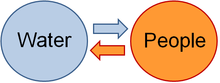
The first approach to socio-hydrology was the term “hydro-sociology”, which arises from a concern about the scale of impact of human activities on the hydrological cycle. Socio-hydrology is defined as the humans-water interaction and later as “the science of people and water”, which introduces bidirectional feedbacks between human–water systems, differentiating it from other related disciplines that deal with water.
So it seems that hydro-sociology came first but it was too limited in scope for some of its followers as it failed to deal with “bidirectional feedbacks between human–water systems”. And if you were wondering what such a feedback might look like, Wikipedia offers a highly educational graphic:
Delve further into this fascinating system diagram and you find that it covers so much more than the concepts of drinking and urination. For example, it is through the efforts of the socio-hydrologists that we have learnt that building levees can give a false sense of security from floods, and flood defences will often just transfer the problem downstream. Also, improving a water supply will only result in an increased demand, and that is surely a bad thing. None of this wisdom was available to the hydro-sociologists because they failed to appreciate the need for a right-pointing arrow. Or so Wikipedia would have you believe.
I think it’s only fair that I now present an account of hydro-sociology that wasn’t obviously written by a socio-hydrologist. According to Dr Asok Kumar Ghoshi of Jadavpur University:
HYDROSOCIOLOGY is that branch of science which deals with interaction of community activities, governance, religious actions, health & hazard risks initiated through pollution, flood & drought, international & national politics and basin economics with climate change, hydro-meteorological factors, hydro-geomorphic parameters and hydrogeological factors keeping in view overall growth plan of the country.
Gulp! So now I really am confused. You can’t deal with all of that without a plentiful supply of arrows. And with climate change added into the mix, you’ll probably need most of them to point to fossil fuels — unless, of course, you don’t care too much about where your next research grant is coming from. So maybe there isn’t such a difference between hydro-sociology and socio-hydrology after all.
Well, that’s not the view of Professors Alexander Ross and Heejun Chang of the Portland State University, although to be fair they do see there being a time when the two camps might be able to see eye-to-eye. In their interrogatorily titled paper, Socio-hydrology with hydrosocial theory: two sides of the same coin?, they suggest that there is a “sophisticated relationship with emergent syntheses”. They continue:
Our review concludes that socio-hydrology and hydrosocial research exist in a complex epistemological relationship, offering fertile grounds for lively discussions from which both will continue to benefit.
Lively discussions, indeed. In fact, as part of their conclusions they call for “the development of more holistic studies that might be seen as an overlapping set in a Venn Diagram”. Whether the overlap could lead to the sharing of the faculty tearoom remains to be seen. However, there is one potential area of epistemic cooperation that I might venture to suggest could be useful. How about if the hydro-sociologists and socio-hydrologists got their heads together to explain to the rest of the world that the recent Pakistani flooding, in which 9 per cent of the country was inundated (the equivalent of one third in climate science arithmetic), was so much greater than it need have been due to massive deforestation of the Himalayan foothills? That’s one huge arrow that doesn’t point to fossil fuels and it would be helpful to see the two camps settle their differences long enough to commission a suitable system diagram that even a school-shirking, erstwhile child activist with anti-Semitic proclivities could understand.

 Iowa Climate Science Education