

The wind and sun cult have no sensible answer to ever-reliable nuclear power and are terrified at the threat nuclear poses to the greatest economic and environmental fraud of all time: hence the fits of rage and apoplexy amongst cultists, carpetbaggers and their political enablers.
The nuclear power embrace across Europe has been sudden, swift, and completely fatal to the wind and solar rollout. Siemens wind turbine division has just sacked 4,100 workers overnight as orders for wind turbines evaporate.
In Australia, the Liberal/National Coalition (presently in Federal opposition) has just announced an all-in nuclear power policy which it will take to the next Federal election. That election is likely to take place sometime later this year (although it could be as late as May 2025). And the nuclear push provides the Coalition with a very plausible path to victory.
The Opposition Leader, Peter Dutton has laid out a path to cheap, reliable and affordable power (the very stuff that gave Australia its economic advantage). The Dutton plan involves large-scale nuclear plants to be located all around the country; built and run by the Federal government.
Much to the horror of the Green/Labor Alliance (currently in charge), the proletariat is ready to embrace nuclear power, too.
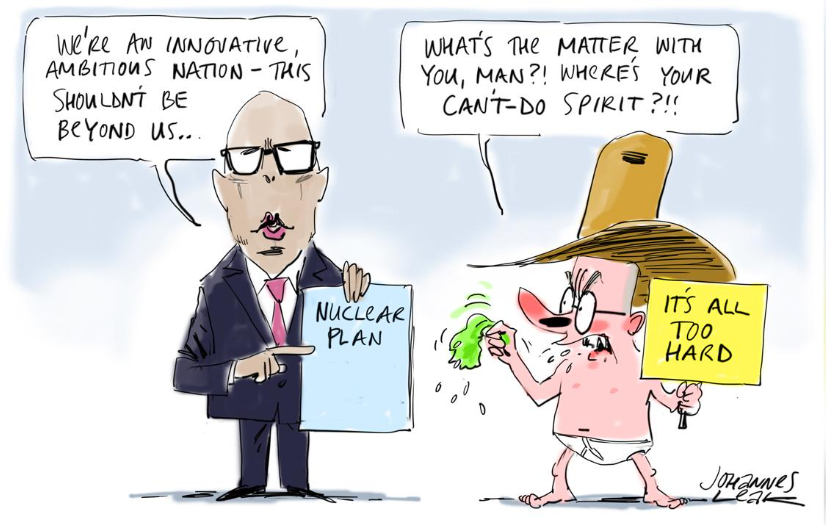
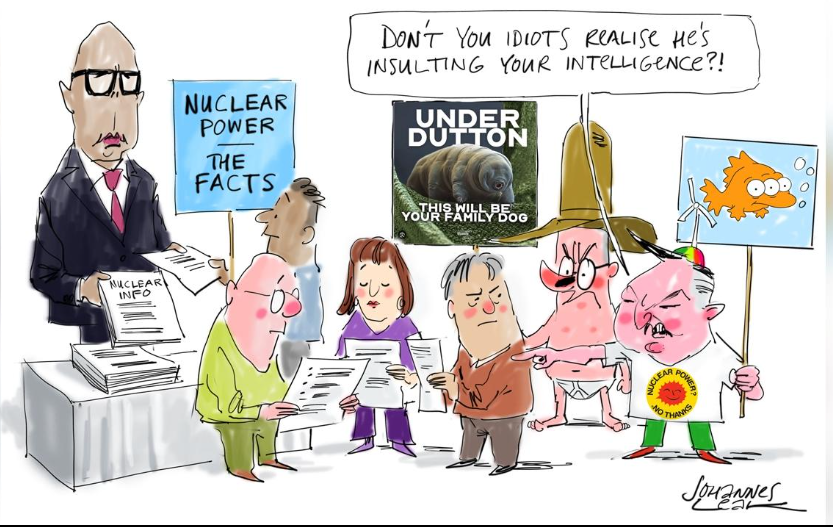
The Labor PM, Anthony Albanese and his apparatchiks and a flat panic, reduced to producing a run of infantile cartoon memes about the purported dangers of nuclear power – notwithstanding Labor’s plan to build nuclear-powered submarines in South Australia (sometime in the future, apparently).
The howls from Labor, its union affiliates (who control union superannuation funds which are heavily invested in the wind and solar scam) and the rent-seeking crowd are perfectly understandable: heavily subsidised, chaotically intermittent and entirely sunshine and/ weather-dependent wind and solar have no hope of competing on cost, reliability or even safety with nuclear power.
While there’s a long way to run, starter’s gun has been fired, as these 3 pieces from The Australian make plain.
Peter Dutton reshapes the election and the path to net zero
The Australian
Simon Benson
20 June 2024
Peter Dutton has taken the courageous path in a debate that history has proven offers no clear political victor.
His approach to leadership is one of refusing to die wondering.
He has now staked his leadership and the Coalition’s election prospects on a contest over nuclear power. This is a deliberate act to fundamentally alter the political contest.
It is more than just a debate on the merits or otherwise of nuclear energy. Dutton is seeking a platform on which to rebrand his image as leader and reshape the Coalition purpose.
The politics of the voice proved that Dutton’s oppositionist approach was right. But it didn’t come without a cost: the re-enforcement of negativity. Dutton now seeks to elevate the contest to one of leadership, using energy and the nuclear option as the demonstration of vision.
This is Dutton now fighting for something, rather than against, and in a space which defines one of the central cost-of-living pressures.
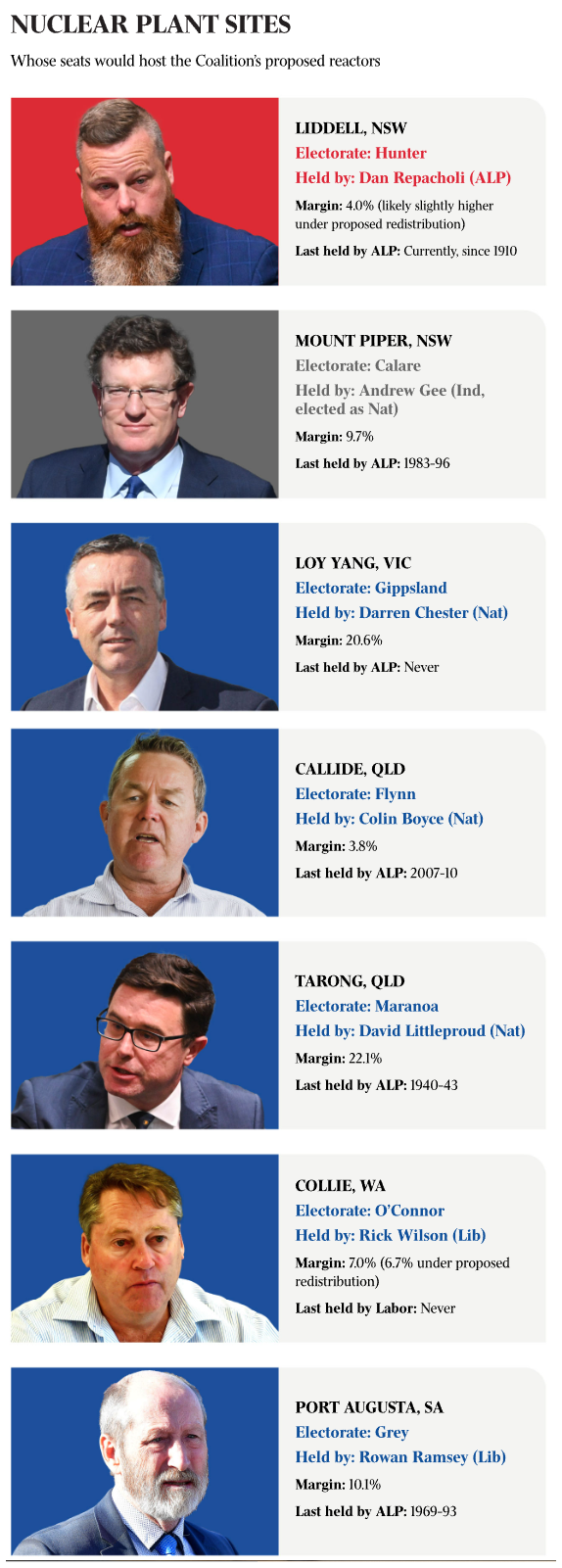
Dutton has split the climate change debate into a dual question for voters. On one hand, he is seeking a revival of the public debate on realism and ambition. Can Labor meet its climate change targets? And at what cost? On the other, he has wedded the Coalition to a nuclear future. This is a stark contrast in policy approach to the energy and climate change problem.
There is no Labor version of what Dutton is offering that Anthony Albanese can adopt. There are now two defined paths, both leading to net zero by 2050.
The central contest is one of cost and credibility. The appeal underlying Dutton’s approach is a cost-of-living argument on energy. There is no doubting the significance of Dutton’s approach, politically and from a policy reformation.
The only comparable energy infrastructure transformation is the Snowy Hydro Scheme.
The nuclear argument, however, requires two fundamental principles to be overturned. The first is the obvious; tearing up Australia’s nuclear ban. The Labor states have already taken up the cudgels. Dutton is right that a federal mandate would ultimately defeat provincial opposition.
The second is the ownership structure. Dutton’s plan for commonwealth ownership challenges the Liberal Party’s broader market-based principles.
This is where Dutton has surprised, in demonstrating pragmatism over orthodoxy. The approach is based on a simple truth that many people believe that it was a mistake by state governments to privatise electricity assets. Much of this was pursued under Labor state governments.
Regarded as an essential service, many consumers often wrongly equate price increases to corporate greed, in the same way they equate inefficiency with government.
This is another important step in Dutton’s socialisation of nuclear power generation as a real option. He will argue that off-budget assets that provide a return on capital is not nationalisation.
Dutton is, however, exposed on the question of cost and his refusal to so far outline the investment required. Again, he is happy to have the argument, but at a time of his choosing. His strategy is to drip feed a low-knowledge electorate when it comes to nuclear.
Wednesday’s announcement was about confining the debate around the kitchen table to locations. A re-assurance that reactors weren’t going to be popping up in suburban backyards. Dutton believes that the broader macro-politics favours him on this issue.
At worst, the politics aren’t as electorally good or bad as either side may argue. While there are obvious political risks for Dutton, Albanese is risk-exposed on how Labor takes this argument on.
The more hysterical the Prime Minister and his colleagues are inclined to become, the more he is lured into presenting as an opposition leader rather than a prime minister. His personal approval ratings, and only marginal favourability over Dutton in the polls, will have alerted him to the danger of this.
The electoral interpretation of the nuclear option is also not as controversial as some may believe.
Voters like visionary leaders, even if they don’t necessarily agree with the vision. And on nuclear, people are nowhere near as hung up about it as they once were.
Political observers may wonder why Dutton’s has chosen to announce this ahead of the final parliamentary sitting fortnight before the winter break, given it lets Albanese off the hook on the immigration disaster that dominated the last sitting fortnight.
Senior Liberals believe that it is the opposition that has been setting the political agenda since the budget, and this needs to be maintained. However, this is a misreading of the politics and reveals the risk that Dutton is now taking on.
It has been events, rather than the Coalition, that have been driving the political agenda. And it has been the mismanagement of those events by Albanese and Labor that has got the government in strife.
Dutton has expertly exploited every opportunity, but then this is more a case of smart politics than defining the national policy agenda. And as Bill Shorten proved in 2019, having an agenda in opposition isn’t always a good thing.
The Australian
Peter Dutton’s public-owned nuclear plants are smart on both the emissions and economic fronts
The Australian
Judith Sloan
20 June 2024
They say there is a silver lining in every cloud and so it is with the case that the renewable energy industry makes for nuclear power.
Working on the basis that low or zero emissions is priority No.1 for generating electricity, then the choice is straightforward: high-density, continuous and centralised power beats low-density, intermittent and decentralised power every time. In other words, nuclear beats RE.
Of course, it must be annoying for RE proponents, including all the rent-seekers and grifters who make a living out of government dictates and subsidies, that the nuclear industry can beat them at their own game, on a field they created. But that’s how the cookie is now crumbling.
The Albanese government unwisely dismissed the importance of the inclusion of nuclear power in the final agreement reached at the last COP climate conference held in the UAE.
Twenty countries formally called for a tripling of nuclear capacity by 2050, including the US, our partner in the AUKUS agreement with its nuclear submarines.
There is no doubt that Peter Dutton is being courageous in promoting the use of zero-emissions nuclear power as a central part of his election strategy. There will be a fierce campaign waged against it, including by those with strong commercial links to the RE industry. At the end of the day, however, nuclear is a much more sensible option to achieve zero-emissions electricity than RE is.
We can see this recognition emerging around the world: in the US, Canada, the UK and a number of European countries, including Finland. Korea has embarked on a successful program of constructing large-scale nuclear plants and China is building multiple plants across the country.
Having turned its back on nuclear, Japan is back in the game and France is investing to refresh and expand its nuclear industry.
The Albanese government will have a difficult argument convincing voters that it’s fine for these countries but not for us.
The reality is that modern nuclear plants operate under strict safety standards and if they are located at existing sites where coal plants have been sited, they carry the advantage of requiring very little additional investment in transmission.
They are also industrial sites that have offered high-paying jobs, often unionised, to the locals living in the area. Nuclear plants would similarly offer this advantage.
Dutton’s idea that the first nuclear plants here should be publicly funded and owned is sensible. It’s how the French nuclear plants were first constructed; it was also the case in other countries. This takes away the regulatory risk that private investment and ownership would entail.
Assuming that Labor hadn’t seen the light by that stage, it would simply be too uncertain for private investors to pony up the large amounts of capital needed to construct the plants. In time, the government can opt to sell down their stakes in the plants, but that would be a consideration for another time.
The reality is that the energy transition is basically in tatters. Investment in RE has stalled as various governments keep changing the rules. The options for storage and its cost are major impediments. It has come to a bizarre point where state governments are subsidising the continuation of coal-fired plants to achieve net zero – go figure. In the meantime, those living in rural and regional areas are understandably arcing up about the environmental damage that RE installations cause.
The nuclear debate is one we should have, and Dutton is showing remarkable pluck in initiating it. At least voters will be in no doubt what the Coalition stands for.
The Australian
What an Aussie nuclear reactor could look like
The Australian
Matthew Denholm
20 June 2024
An estimated two-thirds of the world’s 440 nuclear power plants are pressurised water reactors (PWRs), and Peter Dutton has cited them as a likely starting point for Australian nuclear power.
PWRs use water as a coolant, with the primary cooling water kept at very high pressure. It then goes through a heat exchanger and heat is transferred to a secondary coolant loop, which spins the power-generating turbines.
“The water goes into the reactor and gets hot, but it is not turned into steam and is under high pressure,” says Robert Parker, founder of Nuclear for Climate Australia.
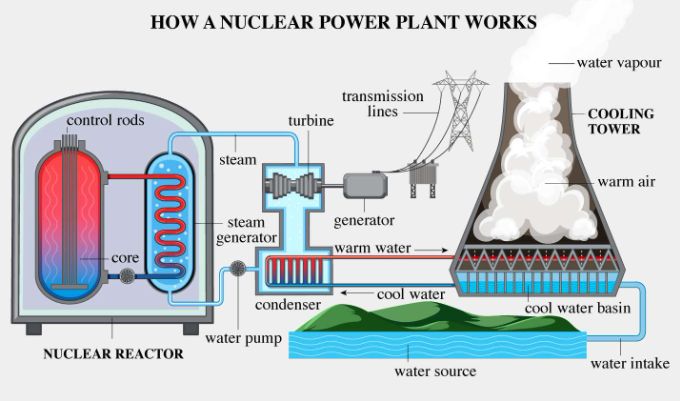
“You can stop it going to steam by keeping the pressure higher, like we do with a pressure cooker on a stove.
“That really hot water then goes into a heat exchanger, where it shares that heat with a secondary circuit. And that’s where you create the hot steam to drive the turbine. That steam is then condensed with environment water and turned back into liquid water.”
The secondary loop system keeps radioactive material away from the turbines, making maintenance less complicated and, some experts believe, providing a greater level of safety.
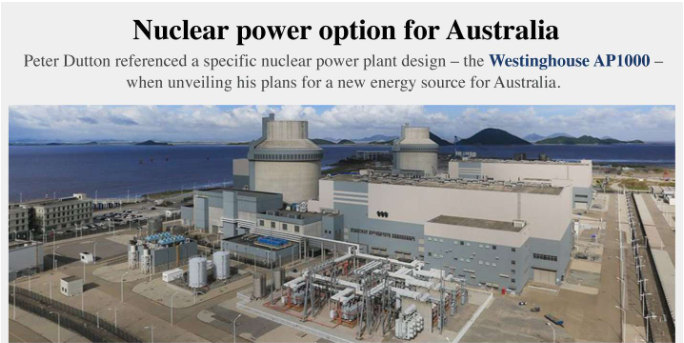
Mr Dutton has flagged two “establishment projects” using either small modular reactors or larger plants, such as AP1000 or APR1400; both PWRs currently licensed by the US Nuclear Regulatory Commission.
AP1000 is regarded as a modern “generation 3+” reactor that uses “passive” safety systems – driven by natural forces such as gravity and convection – to continue cooling for a period after accidents without the need for power or human intervention.
Produced by Westinghouse, 1110-megawatt AP1000 plants are operational around the world, including in China and the US.
APR1400 plants, designed by the Korea Electric Power Corporation, are classified as “generation 3” and are in operation in Korea and the United Arab Emirates.
Experts say Australia could also consider boiling water reactors, which have only one coolant loop, making them simpler.
However, in the event of a fuel rod leak, radioactive material could come into contact with the turbine, complicating maintenance, while BWRs are said to not perform as well in power outages.
Mr Parker said a third type of reactor pioneered by Canada and exported globally, CANDU, could also be considered. These use “heavy water” containing deuterium, an isotope of hydrogen, and – unlike PWRs and BWRs – CANDUs can operate with unenriched uranium.
CANDUs have the added benefit of being able to be refuelled while in operation, but do produce radioactive tritium.
Mr Parker said nuclear power’s high water requirements may prompt consideration of water-saving technology or the citing of plants on the coast, where seawater could be used.
“All reactors use about the same amount of water per unit of energy put out – about 800 US gallons per megawatt hour,” he said.
This could be reduced in small reactors by adopting hybrid cooling systems, such as spritzing, but this came at a cost and some loss of efficiency.
It was less viable for larger reactors. “So wherever we build large reactors, we’re going to need either reliable inland supplies (of water) or … look at seawater cooling,” Mr Parker said.
The Australian

via STOP THESE THINGS
June 22, 2024 at 02:31AM


 Iowa Climate Science Education