Month: June 2024

On fire! Australian opposition throws down the nuclear gauntlet in the Energy Wars: “No more large scale renewables”

renewable Technohell

By Jo Nova

The Renewable Crash Test Dummy hits a fork in the road

Finally the Australian opposition is bravely popping the sacred cow of the Energy Wars. The Dummy nation was aiming for the holy grail “low emission” grid that no other nation had tried. The driest continent on Earth, with small hydro, and no extension cords to any nuclear power, were going to build the perfect grid based on the wind and sun alone. It was always doomed to fail, it was just a question of how much money would be burned at the pyre before the Crash Test Dummy crashed.

Because they didn’t do their homework, and the fan-media didn’t ask them too, the Labor Party set themselves up to fail. They left their left flank wide open, and the Opposition is finally launching the missiles that have been there all along.  The ultimate low emissions generator was always and obviously the unspeakable nuclear power. It’s a fifty year old technology. If anyone actually cared about carbon dioxide, they would have done this instead of the Kyoto scheme in 1997. But it was all a theater of grift and graft for unreliable, fairy energy, or for players who like trips to ski clubs in Davos, or jobs after politics with the UN or “energy companies”. (Not mentioning any names, Matt Kean).

Australia doesn’t need more “large-scale renewables” says the Opposition party, offering nuclear power instead of renewables technohell

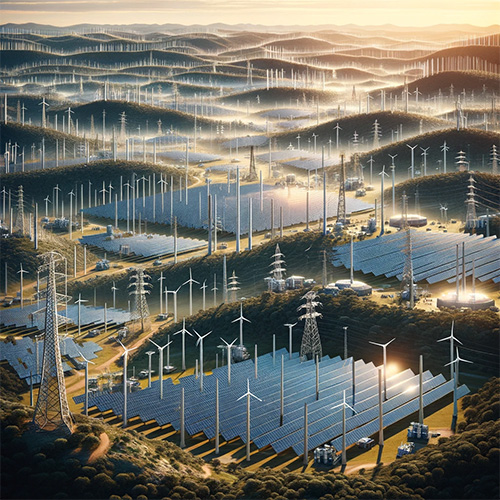
Finally the dirty laundry of renewable power might be hung out to dry in an election. After ten years of rampant renewables growth in Australia, a dawning realization is sweeping the nation that wind and solar are not cheap, and will never be cheap. It’s hard to believe only two years ago Labor won on promises to bring electricity costs down by $275 dollars a household, only for prices to rise by $750 instead. At the same time, the awful reality of collecting low density energy is all too apparent in regional areas where developers are swarming to cover the land in renewables infrastructure. No one wants industrial plants in their backyard, but when we have to build 10,000 kilometers of high voltage towers, 40 million solar panels, and 2,500 bird killing turbines — its in everyone’s backyard.

Suddenly the real environmentalists are the ones who just want to build seven small nuclear plants on old industrial sites. Save the eagles, spare the whales, and don’t club the koalas, OK? The opposition are promising to build nuclear plants on the old coal sites, give cheap electricity to locals and to block major offshore wind projects and oppose large solar plants too. As they so aptly say, the low hanging fruit on this tree are already done.

This is the Deputy Opposition leader saying what was unthinkable only a year ago:

Nationals leader David Littleproud says Coalition* will find energy alternatives ‘so we don’t have to pursue large-scale renewables’

By Rosie Lewis, The Australian

Nationals leader David Littleproud has said a Coalition government will look at alternative energy sources so it doesn’t have to pursue large-scale renewables such as wind and solar, after suggesting he would axe an offshore wind industry if elected.

Amid a pre-election brawl over climate and energy ­policy, Mr Littleproud said the Coalition would send “strong investment signals” that Australia didn’t need large-scale industrial wind farms onshore or offshore or other big renewable projects.

Mr Littleproud also indicated to The Australian that he was opposed to large-scale solar farms, saying: “We’d like to look for whatever option we can so we don’t have to pursue large-scale renew­ables full stop.

“All the low-hanging fruit for large-scale renewables has been done, we’ve now got to go out beyond that.

He had to clarify that one big wind farm offshore would go ahead, but one that was just approved this week in the Illawarra, would not. The Coalition says the Commonwealth will own the nuclear plants. They’ll build them in the Latrobe Valley in Victoria, the Hunter Valley in NSW, Collie in WA, Port Augusta in South Australia, and the ­southwest Queensland electorate of Maranoa.

Nuclear power is the sleeper policy — even half the Greens agree

Last year political number crunchers suddenly realized there is no mass anti nuclear protest movement here, just the ghost of one from forty years ago. Polls came out in May 2023 showing that with virtually no national discussion about it, right out of the starting blocks, fully 56% of Australian voters thought the government should seriously consider small modular reactors (SMRs), and only 12% disagreed. Which is all the more astonishing given that only 24% of Australians even knew about SMRs at the time.

Wait until Australians find out there are 440 nuclear power plants in the world, and that even Armenia has one. And Belarus. Mexico has two, Hungary has four, and the Czech Republic has six. They’re everywhere.
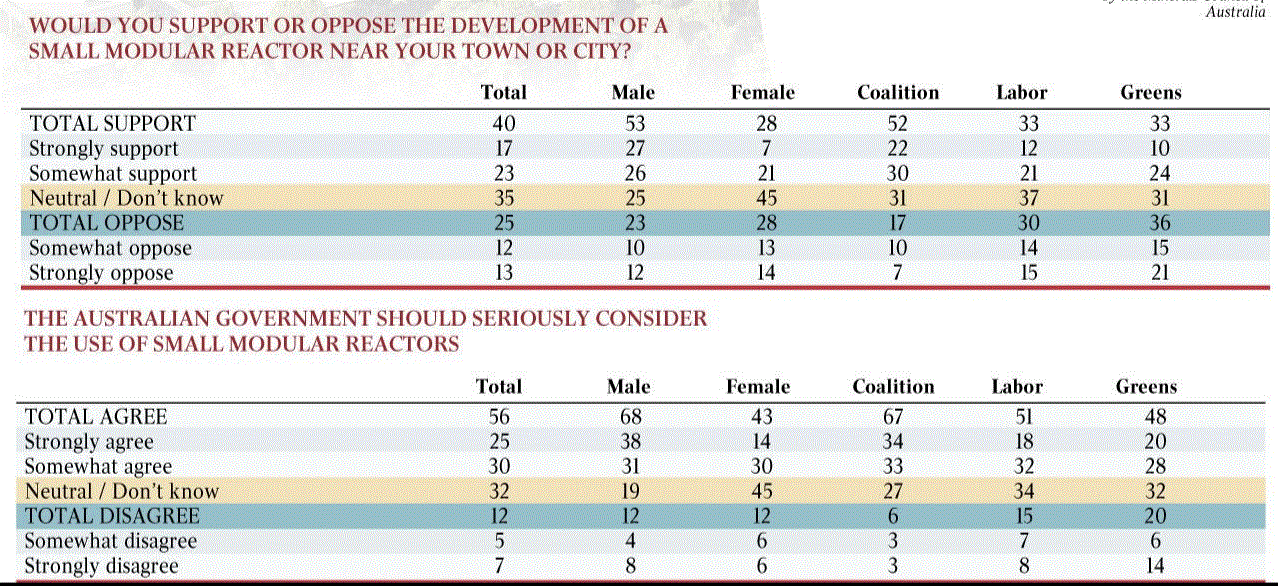
 

Nuclear power poll Australia, May 2023.

The Australian: commissioned by the Minerals Council of Australia | Insightfully polled 2,400 people, May 2023.


When will we get over the adulation of roof top solar?

Not everything about the Coalition plan is smart, Australia already has a glut of solar power at lunchtime, so promising to put more on roofs in capital cities isn’t going to help. It’s just more electricity we can’t store at a time of day when we don’t need it which non-solar households have to subsidize. The duck curve at noon vandalizes the market for reliable generators, which have to recover costs at breakfast and dinner time anyway. And one cloud can cover a million suburban houses.

If a large solar plant doesn’t make sense in Alice Springs where there is no cheap coal fired power, it certainly doesn’t make sense in Sydney where there is. Most new solar panels in capital cities are a waste of glass, metal and labor that someone has to pay. They are a pagan shield against the storms, supposedly protecting coral reefs from Parramatta. But we all had cheaper electricity when no one had solar panels.

The bottom line, which neither party is saying, is that we need to get the science right before we start pretending to change the weather — not after we blow a trillion dollars making technohell temples to fend off the evil spirits. Nuclear plants are good, but coal plants are cheaper, and CO2 is a gift from God. The world should pay Australia to burn all our coal and feed the forests and fields.

Who will audit the foreign committee in Geneva? Which scientists are paid to find holes in the IPCC religious sermons about boiling oceans? None of them. Not one.

*The conservative Coalition is the pairing of the Liberal Party and the Nationals.

0 out of 10 based on 0 rating

via JoNova

https://ift.tt/VEd0B3p

June 18, 2024 at 03:14PM

Reflections on K-12 science education

by Judith Curry

Today I’m participating in a panel on K-12 education, hosted by the National Association of Scholars.

You can watch the event on youtube. The even is launching a new document called the Franklin Standards on K-12 education, which presumably will be available online sometime today (Jun 18)

JC’s remarks

Hello everyone.  I appreciate the opportunity to participate in this panel.

Let me start off by saying that I would be delighted to teach freshman college students that had been taught the content that Franklin proposes.

I strongly endorse Franklin’s recommendations on teaching Scientific Inquiry, History of Science, and Engineering and Technology.

I also abhor the creep of activism and equity into the K-12 curriculum.

That said, I see several broad issues facing the K-12 curriculum, that the Franklin Standards doesn’t directly address.

I would first like to address the motivation of students to study science.  In the spirit of Ben Franklin, the Franklin Standards emphasizes curiosity as a motivator, and I agree that this is particularly important in the earlier grade levels.  However, nurturing curiosity is not sufficient motivation to increase the number of students majoring in STEM subjects in university.  The spirit of Ben Franklin is not just about curiosity, but also about inventions that improve our lives, and political philosophy that provides a societal context for science. These additional dimensions make science more interesting and important to high school students. and help provide motivations to explore a career in STEM fields.   

The Franklin Standards emphasize content, which I agree is important. However, the best content won’t produce good learning outcomes without effective pedagogy.  I’ve seen that many high school students entering university who have taken AP science courses retain little of the material and show essentially no operational ability to draw on the relevant content.  And of course, less motivated students retain even less of the content that they were taught. By contrast, some students have an excellent operational grasp of what they were taught in high school.  Invariably, these students had teachers that challenged them not just with content, but engaged them in active learning. 

The neuroscience of active learning shows that the more we can activate students’ brains in different ways, the more they learn.  I’ve seen this in my own teaching.  I include this topic as a result of discussions with my granddaughter, who just finished 8th grade in an accelerated academic program.  She has an innate interest in science, but said her science classes were the most boring.  The teacher taught a lot of content, but didn’t provide any context for the importance of what they were learning. The labs were pure cookbook, with no opportunity for critical thinking.  Surprisingly, she thought her math teacher did a better job, with less obvious material for engagement.  Pedagogy matters, and inquiry-based learning is important for the strongest science students.

The Franklin Standards recognizes that there are dual objectives of science education.  The first is that of pre-professional education, addressing the needs of students such as my granddaughter.  The second is the citizen-focused need to have an understanding of the complex world that they will confront as citizens over their lifespan. 

I’ve been asked to comment on the importance of Franklin Standards for the public understanding of science and scientific debate, particularly with reference to climate science.

A major concern raised by the Franklin Standards document is the politicization of the science curriculum and activism. I agree that this is a huge problem.  However, apparently strong science content education in the high school curriculum hasn’t inoculated many A students from being convinced that humans face extinction from climate change, and that they can change their sex.  I encountered some of these students in the lawsuit filed by Our Children’s Trust against the State of Montana. Where a number of very bright native American high school students were convinced that human-caused climate change was an existential threat to their future. 

There are several problems here.  Even if schools have a state- or district-adopted curriculum, that doesn’t mean that it’s getting taught.  Further, children are being taught materials at the discretion of the individual teacher that have no official oversight or approval.

The bigger issue is that societally-relevant issues related to health, the environment, and climate change are deeply complex, and fraught with ethical ambiguities.  It’s naïve to think that providing students with fundamental science content will arm them against wrong beliefs. When experts disagree on both the problems and their solutions.

Engaging students with the societal context for science, both current and historical, not only increases their learning potential and motivation for learning science, but it can also support critical thinking about complex issues facing society.

How is this to be accomplished?  We should work to integrate science more broadly across the curriculum. Not just mathematics, but also social studies and English and Language Arts.  Among other things, such integration effectively increases the amount of time in the school day that includes science.   But more importantly, it promotes critical thinking about complex scientific topics and societal issues.   

Instead of endless history courses on wars, why not a course on the History of Science and Discovery?  The Franklin curriculum includes material about famous scientists, which can be motivational.  But there’s opportunity and need for much more, integrating inquiry and discovery with the history and the social context of science.  As an example, Isaac Asimov’s book, Chronology of science and discovery, beautifully describes how science has shaped the world and how it interfaces with technology.  Bill Bryson’s A short history of everything is another good resource, describing the events, conversations, feuds, competitions and necessities that drove science forward. Such a course would be motivational for strong students that are potential STEM majors, as well as providing interesting and accessible material to students who find the math and science curriculum to be difficult.  With suitable examples, such a course could provide societal context for the science and discovery, and help inoculate against politicized science and enforced consensus.

The bottom line is to promote independent thought and critical thinking, about pure science, technology and related societal issues.  This is important for motivating students for the pre-professional track as well as for general education to sensibly think about the increasingly complex science related issues that they will encounter .

Thank you

via Climate Etc.

https://ift.tt/sGUYulh

June 18, 2024 at 12:11PM

Please Explain – Why Green Activists Have No Sense of Humour

Essay by Eric Worrall

The Video is Defamatory? – a hilarious political satire video, legal threats, and a thin skinned rich kid with no sense of humour.

Robert Irwin is the son of Steve Irwin, the famous Aussie TV explorer, who sadly died while filming a documentary in an unlikely marine accident.

Robert Irwin is also the face of a recently launched Queensland state government funded tourism campaign. But the uninspiring tourist campaign videos have been completely overshadowed by Pauline Hanson’s satirical poke at the incompetence of Queensland’s radical green state administration.

Instead of laughing it off, Robert Irwin has sent legal threats to Pauline Hanson, leader of One Nation, demanding she take down the video.

One Nation’s Pauline Hanson responds to defamation threat by Robert Irwin

One Nation leader Pauline Hanson responds to Robert Irwin’s threat of defamation over her latest cartoon episode.

Tileah Dobson Cadet Journalist@TD0bbi
June 17, 2024 – 7:15PM

Pauline Hanson has declared she won’t remove the latest controversial episode of Pauline Hanson’s Please Explain, after Robert Irwin threatened to sue the One Nation leader.

The 20-year-old son of iconic wildlife legend Steve Irwin has claimed a satirical cartoon that features him is defamatory and has requested it be removed.

Senator Hanson shared her response from Gillis Delaney Lawyers, who are acting on her behalf, in a post to X, formerly Twitter.

“I will not be removing the latest episode of Pauline Hanson’s Please Explain,” she wrote on the post.

“I look forward to the day when Robert and I can have a good laugh over this and turn our focus to making Queensland a better state.”

“You are potentially liable to our client in respect of defamation, deceptive use of a person’s image, passing off and misleading and deceptive conduct,” the letter states.

Read more: https://www.news.com.au/national/queensland/politics/one-nations-pauline-hanson-responds-to-defamation-threat-by-robert-irwin/news-story/c4587b94b2b790750dc6680a14c6a460

“It’s being able to laugh at yourself, it’s being able to go ‘that’s the fluff’ and the opinionated stuff — people will always have their point of view,” Irwin said, during the interview. – Robert Irwin in 2022.

Sky News take on the situation (Sky News is a Murdoch Media outlet, like Fox News in the USA);

Every item raised in the “Please Explain” satire represents a real political issue which affects Queensland or the entire nation of Australia. We really are experiencing substantial destruction of protected habitat to make way for green energy, which has driven some greens to team up with conservatives to put a stop of it. We have controversial beach front native title grants in populated areas, roads full of pot holes, a rental crisis caused by a perfect storm of demographics, unbalanced tenants rights laws, and skyrocketing property values. We have a severely underperforming state health system, and youth crime so out of control alleged vigilantes have started taking to the streets in the worst affected areas. Our state premier also sometimes giggles inappropriately.

Let’s hope Robert Irwin grows up and comes to his senses, and has the guts to acknowledge Pauline Hanson made some valid points in her satire video, before he makes even more of a fool of himself in public.

via Watts Up With That?

https://ift.tt/sNaY8tc

June 18, 2024 at 12:01PM

Mike McCulloch’s new book: Quantised Accelerations

I’ll be posting a review of this new book in a week or so. In the meantime, Mike has posted the following intro on his Patreon page:

These are exciting times for Quantised Inertia (QI). I’ve just published a paper, my first in three years, showing that the only dynamical model that can predict the orbit of our closest neighbour in space, Proxima Centauri, is, surprise, surprise QI! This paper was just accepted and published by MNRAS, the Monthly Notices of the Royal Astronomical Society, no less (Open access).

Also, my new book on quantised inertia, entitled ‘Quantised Accelerations’, is available from Amazon next month, on the 15th July (see references below).

I’ve been working on this book for seven years, and it is, I hope, nothing less than an empirical reboot for theoretical physics. Like Gaul, in Caesar’s eyes, the book is divided into three parts:

In the first part I have no mercy on the standard model of physics and I discuss 54 observed anomalies that prove that old physics just can’t cope anymore. These range from the large-scale cosmic acceleration which makes a mockery of conservation of energy in physics, down through the well-known galaxy rotation problem that gave rise to the need for the awfully arbitrary dark matter, the wayward asteroid Oumuamua & GPS satellites, down through laboratory thrust oddities, the Abraham-Minkowski paradox, the long running controversy of cold fusion and the proton radius anomaly. This is a scale range from 10^-15 to 10^26 metres!

Then, just when you are giving up hope that any physics can explain these diverse anomalies, I introduce quantised inertia and show that it predicts what people have been calling the usual property of inertia, but with a slight change that predicts the anomalies as well. It gets rid of the gravitational constant, G, which turns out to be the speed of light squared times the cosmic scale divided by its mass. Happily, one less constant to learn at university (I always found it to be a perfectly acceptable constant but with Frankenstein units).

Just as you are breathing a sign of relief that physics might look up from its invisible entities and untestable strings, I introduce all the applications of QI which include much better satellite thrusters, the ability to get to Proxima Centauri (yes, the same) in less than 15 or so years, self-thrusting materials, FTL comms and a possible way to generate energy from it.

My overall goal is to put physics back into its best mode: first look, then think, then get busy!

References

Paper: McCulloch, M.E., 2024. Testing Quantised inertia on Proxima Centauri. MNRAS, 352, 1, L67-69. https://academic.oup.com/mnrasl/article/532/1/L67/7682393

Book: McCulloch, M.E., 2024. Quantised Accelerations: from anomalies to new physics. Polaris Books. https://www.amazon.co.uk/Quantised-Accelerations-Anomalies-New-Physics/dp/B0D53HLDD3

via Tallbloke’s Talkshop

https://ift.tt/Bvlo7Od

June 18, 2024 at 11:26AM