Month: June 2024

Climate Change Weekly #509: Surveys Show Vast Bulk of Antarctica Is Stable or Growing

From Heartland Daily News

H. Sterling Burnett

YOU SHOULD SUBSCRIBE TO CLIMATE CHANGE WEEKLY.

IN THIS ISSUE:

  • Surveys Show Vast Bulk of Antarctica Is Stable or Growing
  • Video of the Week: Sea Level Rise: A Measly 1.2 Inches Every Decade
  • NOAA’s “Billion Dollar Disaster” Reporting Lacks Scientific Integrity and Rigor
  • Podcast of the Week: Creation of “Chief Heat Officers” in Arizona
  • Climate Comedy
  • Recommended Sites

Watch ALL the Presentations by the ALL-STARS of Climate Realism at the Archive of Heartland’s 15 Climate Conferences


Surveys Show the Vast Bulk of Antarctica Is Stable or Growing

We hear a lot in the mainstream media about massive ice loss in Antarctica and how it may radically increase sea level rise. The West Antarctic ice sheet and ice on the Antarctic peninsula are in decline, with some massive glaciers threatening to break off; however, conditions there are not the same as for the vast bulk of the continent. First, the subsurface geothermal/volcanic activity that is driving much of the melting in West Antarctica is not affecting the vast bulk of the continent. And the shifting ocean oscillations, which affect the continent’s climate as a whole, have a much greater, more direct impact on the Antarctic peninsula, the northern-most part of the continent, a relatively narrow spit of land surrounded by oceans and beset be clashing currents.

The conditions of the sea ice around Antarctica don’t matter in the sea level equation. Sea ice changes dramatically each season, waxing and waning with the seasons and the currents. For the limited period for which we have consistent measurements, Antarctica’s sea ice has set new records for extent and for low levels during the most recent period of climate change. Neither, however, impact sea levels since floating ice doesn’t displace water.

NASA reported in 2015 that because East Antarctica, which makes up the bulk of the continent, was adding ice and snow, Antarctica as whole may, in fact, be gaining ice on net, implying it could be modestly taking away from sea level rise rather than adding to it. At least from 1992 to 2015, when the report was published.

Recent research using updated data lends some credence to NASA’s earlier claims of ice growth across the vast bulk of the continent. An international team of researchers, from universities and research institutes in Denmark, France, and Norway, published a paper in Nature Communications  examining the glacial ice mass balance across East Antarctica.

Part of the research consisted of examining a “large-scale, aerial image archive of Antarctica to provide a unique record of 21 outlet glaciers along the coastline of East Antarctica since the 1930s.” The records consist in part of 300 aerial images run through digital elevation models (DEMs) to reconstruct historic ice thickness and extent.

They found a mix of trends with ice in different glacial outlets thickening, thinning, and remaining relatively constant stasis for long periods of time at different periods of time.

Overall, there was no declining trend in fixed ice on land, and perhaps even net growth across East Antarctica, where “[ice] losses have primarily occurred in some of the marine-based catchments in Wilkes Land, and are largely attributed to the intrusion of modified Circumpolar Deep Water. The terrestrial catchments, where the majority of the ice is grounded above sea level, have recently shown a mass gain caused by increased accumulation.”

Overall, decades-long increases, decreases, and stable trends in ice levels did not correspond at all to carbon dioxide emissions, atmospheric concentrations, or global average temperature trends. Rather:

In all regions, the long-term changes in ice thickness correspond with the trends in snowfall since 1940. Our results demonstrate that the stability and growth in ice elevations observed in terrestrial basins over the past few decades are part of a trend spanning at least a century, and highlight the importance of understanding long-term changes when interpreting current dynamics.

Looking at specific glaciers, they found, for example:

Despite large variations in size and characteristics, all six glaciers in Lützow-Holm Bay experienced a net retreat between 1937 and the 1980s, when they reached an almost simultaneous minimum associated with a complete break-up of fast ice in the bay. Another smaller retreat phase occurred around the mid-2000s, with the exception of Shirase, and again during 2016. By far, the largest fluctuations are observed at Shirase Glacier with a total range of almost 90 km in the ice-front position from its 1963 maximum to its minimum in 1988. In contrast, Langhovde and Hovdebreen Glacier show frontal variations of less than 1 km between 1937 and 2023. Since the retreat in the 1980s, all glaciers except Langhovde and Honnörbrygga have, at some point, advanced to a similar marginal position or even extended beyond their extent recorded in 1937.

Overall, East Antarctica has experienced regional frontal fluctuations along the shore, with some loss, and long-term ice thickening of ice and snow onshore. For example, they write:

Our observations show no regional long-term trend in the frontal positions of the studied glaciers in Kemp Land, Mac Robertson Land, and along Ingrid Christensen Coast between 1937 and 2022. The glaciers fluctuate between periods of frontal advances and retreats of varying distances (<0.1 km to 13.5 km) and intervals (3–50 years). Most noticeable is the 13.5 km advance of Mulebreen Glacier since the 1980s and the retreat of Jelbart Glacier, which is 3.5 km short of its 1937 marginal position.

From the historical DEMs, we observe an overall thickening of the glaciers in Kemp and Mac Robertson Land between 1937 and 2021 and along Ingrid Christensen Coast between 1960 and 2021 (Fig. 2, Fig. S23). In Kemp and Mac Robertson Land, the largest changes are observed at Hoseason and Taylor Glacier, with an annual average surface elevation increase of +0.23 m/yr ± 0.07 m/yr and of +0.11 m/yr ± 0.05 m/yr since 1937, respectively.

Concerning climate change’s impact on East Antarctic’s glaciers, the study reports, “[o]verall, there has been no significant trends in annual or seasonal mean air temperature in East Antarctica since the 1950s, and mean austral summer air temperature (December to February) from stations in all regions rarely exceeds 0 °C.

“While previous research on Antarctic snowfall found no statistically significant changes since the 1950s, recent studies utilizing compiled data on ice core records indicate increased Antarctic-wide snow accumulation during the past 200 years,” the study says.

Anyway you cut it, this research lends no credence to any forecast that Antarctica’s vast store of ice is about to melt and raise sea levels.

Source: Nature Communications


NEW: Get Climate at a Glance on your mobile device!


Video of the Week

Heartland Institute Research Fellow Linnea Lueken looks at sea level rise, and whether or not it poses an existential threat to coastal communities. That data: NASA satellite readings that date back to 1993 show that sea level rising at a pace of just 1.2 inches every decade, and older records from tide gauges show a rate of about 1 foot per century. Hardly an existential threat, let alone one to the world’s coastal cities.


Read the brutal truth about how battery production for electric vehicles cause immense environmental destruction and human tragedy.


NOAA’s “Billion Dollar Disaster” Reporting Lacks Scientific Integrity and Rigor

New research published in the peer-reviewed Nature  journal  Natural Hazards,  debunks the National Oceanic and Atmospheric Administration’s (NOAA) methods for calculating “billion-dollar disasters,” which the agency and other agencies, politicians, and activists cite as evidence of the growing impact of climate change, and the need for carbon dioxide restrictions.

In the paper, Roger Pielke, Jr., Ph.D., demonstrates that NOAA’s tabulation of costs fails to meet the agency’s own standards for information quality and scientific integrity, making it unsuitable for use in the detection and attribution of trends in extreme weather, much less attributing them and costs stemming from them to human-caused climate change.

Pielke explains why addressing NOAA’s billion-dollar disaster claims are important, writing in his Substack site that:

In the late 1990s, the U.S. National Oceanic and Atmospheric Administration (NOAA) began publishing a tally of weather and climate disasters that each resulted in more than $1 billion in damage, noting that the time series had become “one of our more popular web pages.” …

By 2023, the billion-dollar disaster time series had become a fixture in NOAA’s public outreach, was highlighted by the U.S. government’s U.S. Global Change Research Program (USGCRP) as a “climate change indicator,” was cited as evidence in support of a “key message” of the Fifth U.S. National Climate Assessment showing that “extreme events are becoming more frequent and severe.”

The time series is often cited in policy settings as evidence of the effects of human-caused climate change to increase the frequency and intensity of extreme weather events and associated economic damage, including in federal agencies, Congress and by the U.S. President. In addition , . . , as of March, 2024, NOAA’s billion-dollar dataset has been cited in almost 1,000 articles according to Google Scholar. …

[T]he “billion-dollar disaster” list was somehow transformed into “data” used in peer-reviewed research, an official indicator of human-caused climate change featured by the U.S. National Climate Assessment and used by the administration of President Joe Biden to justify a wide range of regulations and policy.

As Pielke describes it, NOAA is concerned that its reports on weather damage be treated as “influential information,” which “means information the agency reasonably can determine will have or does have a clear and substantial impact on important public policies or private sector decisions.” This desire to influence policy takes precedence, indeed, seemingly determines, the extent to which NOAA complies with its own guidelines for quality data, and the transparency and accuracy of the outcomes it produced.

NOAA’s Information Quality Guidelines is composed of three criteria intended to ensure information quality: utility, objectivity, and integrity. Pielke only briefly discusses NOAA’s failings with regard to the integrity of its disaster assessment, noting that the agency’s rules require its work to undergo a transparent, peer-review process with public disclosure of the planning for forthcoming research—a requirement that NOAA has failed to comply with in the rush to put out annual reports using data and methods that have shifted over time. Pielke focuses most of his analysis/critique on the first two criteria, utility and objectivity, finding NOAA’s analysis fails on both counts. Per NOAA’s guidelines:

Utility refers to “the usefulness of research to its intended users, including the public,” with an emphasis on “transparency.” NOAA’s Scientific Integrity Policy provides further guidance: “Transparency, traceability, and integrity at all levels are required” in order for the agency “to achieve” its mission (https://www.noaa.gov/sites/default/files/legacy/document/2021/Feb/202-735-D.pdf).

  • Traceability: “The ability to verify sources, data, information, methodology, results, assessments, research, analysis, conclusions or other evidence to establish the integrity of findings.”
  • Transparency: “Characterized by visibility or accessibility of information.”

Objectivity refers to presentation and substance:

  • Presentation: “includes whether disseminated information is presented in an accurate, clear, complete, and unbiased manner and in a proper context.”
  • Substance: “involves a focus on ensuring accurate, reliable, and unbiased information. In a scientific, financial, or statistical context, the original and supporting data shall be generated, and the analytic results shall be developed, using sound statistical and research methods.”

Sounds good in theory, the problem is NOAA doesn’t follow its own rules in practice. As Pielke writes:

The NOAA billion-dollar disaster dataset is intransparent in many ways, including its sources, input data and methodologies employed to produce results. The intransparency includes elements of event loss estimation, additions to and subtractions of events from the database, and adjustments made to historical loss estimates. There have been an unknown number of versions of the dataset, which have not been documented or made publicly available. Changes are made to the dataset more frequently than annually, suggesting that there have been many dozens of versions of the dataset over the past decades. Replication of the dataset or changes made to it is thus not possible by any independent researcher, as is verification or evaluation of the dataset itself.

For example, NOAA says it utilizes more than a dozen sources of estimates to calculate disaster costs, without detailing how the estimates are tied to specific events or what methodologies and assumptions the sources used to develop their cost estimates. NOAA also says it accounts for indirect losses from extreme weather events without explaining what “indirect” losses are included or how they are calculated.

Aside from the problems with data utility due to a lack of transparency, NOAA’s billion-dollar disaster claims display a lack of objectivity, since it regularly asserts that climate change is causing more extreme weather events, with the proof being rising costs. This commits the logical fallacy of the result proving the cause, post hoc ergo propter hoc  (Latin for: “after this, therefore because of this”). NOAA provides no evidence that weather is getting more extreme, or that any particular weather event has been caused by climate change driven by human greenhouse gas emissions, thus it is fallacious to assume that rising disaster costs are due to climate change. The latter effect can have many causes.

In fact, NOAA billion-dollar disaster time series provide no evidence of detection or attribution of changes in the climate or extreme weather events in the United States, and economic loss data resulting from extreme weather events is not suitable to that purpose because losses involve more than just climatic factors. NOAA does not account for the expanding bullseye effect of populations moving to locations and developing greater infrastructure in areas historically prone to natural disasters.

In fact, Pielke points out that more than 60 studies have examined this issue, and when taken in total and costs from disasters are normalized not just for inflation but for increased exposure, losses per disaster as a percentage of GDP have declined 80 percent since 1980 alone.

Pielke describes multiple other examples of ways NOAA violates its data integrity guidelines, and has proposed eight steps to improve NOAA’s disaster cost reporting, making its reports fit for purpose, and for use in informing policies:

  1. Publish all data, including all versions of the dataset;
  2. Document and publish baseline loss estimates and their provenance;
  3. Clearly describe all methodologies employed to adjust baseline data;
  4. Document every change made to the dataset, give each successive version of the dataset a unique name, and publish all versions of the data;
  5. Maintain all historical versions of the dataset in a publicly accessible archive;
  6. Subject the methods and results to annual peer review by experts, including economists and others with subject matter expertise, who are independent of NOAA. Make the peer-review reports public;
  7. Align NOAA’s practices with federal government policies for disseminating statistical information that are applied to other agencies;
  8. Align claims with IPCC methods and standards for any claims of detection and attribution, or justify why the claims are at odds with those of the IPCC.

Sounds like a good start to me.

Sources: NPJ Natural Hazards (Nature);  Climate Change Dispatch


Heartland’s Must-read Climate Sites


Podcast of the Week

Phoenix is hiring a “Chief Heat Officer,” in response to rising heat related deaths, which the city blames on climate change. The truth is most of those dying are homeless or drug addicts with underlying health conditions, people already in poor health. As far as Phoenix’s heat, that is due, not to climate change but the city’s massive growth and related increased Urban Heat Island effect. Responding to homelessness and drug use will do far more to prevent premature deaths in Phoenix than efforts to fight climate change or control the weather.

Subscribe to the Environment & Climate News podcast on Apple PodcastsiHeartSpotify or wherever you get your podcasts. And be sure to leave a positive review!


Climate Comedy


Recommended Sites

via Watts Up With That?

https://ift.tt/jXM35Oe

June 15, 2024 at 04:01PM

No, ScienceNews, Your “Ocean’s Record-Breaking Hot Streak” Claims Are False

From Climate REALISM

By Anthony Watts

A recent ScienceNews (SN) article claims that ocean temperatures are out of control in a year-long record-breaking hot streak. This is false. Numerous ocean temperature data sets show no such record-breaking values and the source SN cited to support its claims was thoroughly discredited when it made similar “record breaking” claims last year.

The entire claim of the article is based on one data set, which is seen below in the SN article:

The problem is this single source isn’t even an “official” ocean temperature data data set, rather the source is: Source: Climate Reanalyzer/Univ. of Maine • Visualization: C. Crockett. In fact, that isn’t temperature data at all, but climate model output. The data SN cited was not official data, but from a private website run by the University of Maine. Examining actual data sets show that SN claim of record ocean heat is a gross error.

The about page for ClimateReanalyser.org (the source of the SN claim) says this (bold authors):

Climate Reanalyzer began in early 2012 as a platform for visualizing climate and weather forecast models. Site content is organized into three general categories: Weather Forecasts, Climate Data, and Research Tools. Pages within the first two groups are the easiest to use and include maps, map animations, and interactive time series charts (with data export options). Research Tools include pages for generating custom maps, time series, and linear correlations from monthly climate reanalysis, gridded data, and climate models.

In other words, they take in temperature data and use models to “reanalyse” it, producing a new output.

This isn’t the first time a media outlet has been duped by Climate Reanalyzer into using model output presented as data rather than actual data. Last year, The Associated Press (AP), among many other media sources reported that July 4th was the hottest day since records began. Irresponsible fear mongering followed, such as this CNBC article, where reporter Sam Meredith wrote:

The planet’s average daily temperature climbed to 17.18 degrees Celsius (62.9 degrees Fahrenheit) on Tuesday, according to the University of Maine’s Climate Reanalyzer, an unofficial tool that is often used by climate scientists as a reference to the world’s condition.

“Monday, July 3rd was the hottest day ever recorded on Planet Earth. A record that lasted until … Tuesday, July 4th,” said Bill McGuire, professor emeritus of geophysical and climate hazards at University College London, via Twitter.

“Totally unprecedented and terrifying,” he added.

Almost immediately after the claims were published, they were thoroughly debunked by experts citing unreanalyzed data, posted widely on social media. The AP had to run a retraction.

Climate Realism debunked that claim then, noting:

All those media outlets missed the fact that they were looking at the output of a climate model, not actually measured temperatures. Only one news outlet, The Associated Press, bothered to print a sensible caveat. In the July 5th story “Earth hit an unofficial record high temperature this week – and stayed there” reporting:

On Thursday, the National Oceanic and Atmospheric Administration (NOAA) distanced itself from the designation, compiled by the University of Maine’s Climate Reanalyzer, which uses satellite data and computer simulations to measure the world’s condition. That metric showed that Earth’s average temperature on Wednesday remained at an unofficial record high, 62.9 degrees Fahrenheit (17.18 degrees Celsius), set the day before.

Bowing to pressure for corrections, the AP updated its story on July 7th to include this single yet very important paragraph:

NOAA, whose figures are considered the gold standard in climate data, said in a statement Thursday that it cannot validate the unofficial numbers. It noted that the reanalyzer uses model output data, which it called “not suitable” as substitutes for actual temperatures and climate records. The agency monitors global temperatures and records on a monthly and an annual basis, not daily.

So, in the space of two days, the media claims went from temperature data that was “[t]otally unprecedented and terrifying,” to temperature data that was not suitable for purpose.

Similarly, the computer generated reanalysis of ocean temperatures cited by SN isn’t suitable for purpose in claiming a “year-long record-breaking hot streak.” The SN data isn’t even complete, going back only to 1979.

NOAA reports that although the world’s oceans did have a warm year, the actual temperatures were significantly cooler than SN claimed. NOAA attributes the warmer temperatures to major ocean circulation patterns, rather than climate change, writing:

The year 2023 was the warmest year since global records began in 1850 at 1.18°C (2.12°F) above the 20th century average of 13.9°C (57.0°F). This value is 0.15°C (0.27°F) more than the previous record set in 2016.

Unlike the previous two years (2021 and 2022), which were squarely entrenched in a cold phase El Niño Southern Oscillation (ENSO) episode, also known as La Niña, 2023 quickly moved into ENSO neutral territory, transitioning to a warm phase episode, El Niño, by June. ENSO not only affects global weather patterns, but it also affects global temperatures. … [D]uring the warm phase of ENSO (El Niño), global temperatures tend to be warmer than ENSO-neutral or La Niña years, while global temperatures tend to be slightly cooler during cold phase ENSO episodes (La Niña). … 2021 and 2022 [did] not ranking among the five warmest years on record ….

In other words, we had one warm year in the oceans during 2023, but 2021 and 2022 weren’t abnormally warm at all. 2023 was, but it was driven by a phase shift from La Niña to El Niño conditions in the Pacific Ocean. Nature was doing what it has naturally done throughout history.

ScienceNews should stick to reporting actual science based on actual data, rather than using computer model outputs to fearmonger, making claims which aren’t true, but which do correspond to the climate crisis narrative. This SN story was neither news, nor science.

via Watts Up With That?

https://ift.tt/Bai4E2A

June 15, 2024 at 12:07PM

Oceans Cooling May 2024

The best context for understanding decadal temperature changes comes from the world’s sea surface temperatures (SST), for several reasons:

  • The ocean covers 71% of the globe and drives average temperatures;
  • SSTs have a constant water content, (unlike air temperatures), so give a better reading of heat content variations;
  • Major El Ninos have been the dominant climate feature in recent years.

HadSST is generally regarded as the best of the global SST data sets, and so the temperature story here comes from that source. Previously I used HadSST3 for these reports, but Hadley Centre has made HadSST4 the priority, and v.3 will no longer be updated.  HadSST4 is the same as v.3, except that the older data from ship water intake was re-estimated to be generally lower temperatures than shown in v.3.  The effect is that v.4 has lower average anomalies for the baseline period 1961-1990, thereby showing higher current anomalies than v.3. This analysis concerns more recent time periods and depends on very similar differentials as those from v.3 despite higher absolute anomaly values in v.4.  More on what distinguishes HadSST3 and 4 from other SST products at the end. The user guide for HadSST4 is here.

The Current Context

The chart below shows SST monthly anomalies as reported in HadSST4 starting in 2015 through May 2024.  A global cooling pattern is seen clearly in the Tropics since its peak in 2016, joined by NH and SH cycling downward since 2016.

Note that in 2015-2016 the Tropics and SH peaked in between two summer NH spikes.  That pattern repeated in 2019-2020 with a lesser Tropics peak and SH bump, but with higher NH spikes. By end of 2020, cooler SSTs in all regions took the Global anomaly well below the mean for this period.  

Then in 2022, another strong NH summer spike peaked in August, but this time both the Tropic and SH were countervailing, resulting in only slight Global warming, later receding to the mean.   Oct./Nov. temps dropped  in NH and the Tropics took the Global anomaly below the average for this period. After an uptick in December, temps in January 2023 dropped everywhere, strongest in NH, with the Global anomaly further below the mean since 2015.

Then came El Nino as shown by the upward spike in the Tropics since January 2023, the anomaly nearly tripling from 0.38C to 1.09C.  In September 2023, all regions rose, especially NH up from 0.70C to 1.41C, pulling up the global anomaly to a new high for this period. By December, NH cooled to 1.1C and the Global anomaly down to 0.94C from its peak of 1.10C, despite slight warming in SH and Tropics.

Then in January 2024 both Tropics and SH rose, resulting in Global Anomaly going higher. Tropics anomaly reached a new peak of 1.29C and all ocean regions were higher than 01/2016, the previous peak. Since then in February and March all regions cooled bringing the Global anomaly back down 0.18C from its September peak. In April and now May Tropics cooled further, SH dropped down, so the Global anomaly declined despite NH rising.  The next months will reveal the strength of 2024 NH warming spike, which could resemble summer 2020, or could rise to the 2023 level.

Comment:

The climatists have seized on this unusual warming as proof their Zero Carbon agenda is needed, without addressing how impossible it would be for CO2 warming the air to raise ocean temperatures.  It is the ocean that warms the air, not the other way around.  Recently Steven Koonin had this to say about the phonomenon confirmed in the graph above:

El Nino is a phenomenon in the climate system that happens once every four or five years.  Heat builds up in the equatorial Pacific to the west of Indonesia and so on.  Then when enough of it builds up it surges across the Pacific and changes the currents and the winds.  As it surges toward South America it was discovered and named in the 19th century  It is well understood at this point that the phenomenon has nothing to do with CO2.

Now people talk about changes in that phenomena as a result of CO2 but it’s there in the climate system already and when it happens it influences weather all over the world.   We feel it when it gets rainier in Southern California for example.  So for the last 3 years we have been in the opposite of an El Nino, a La Nina, part of the reason people think the West Coast has been in drought.

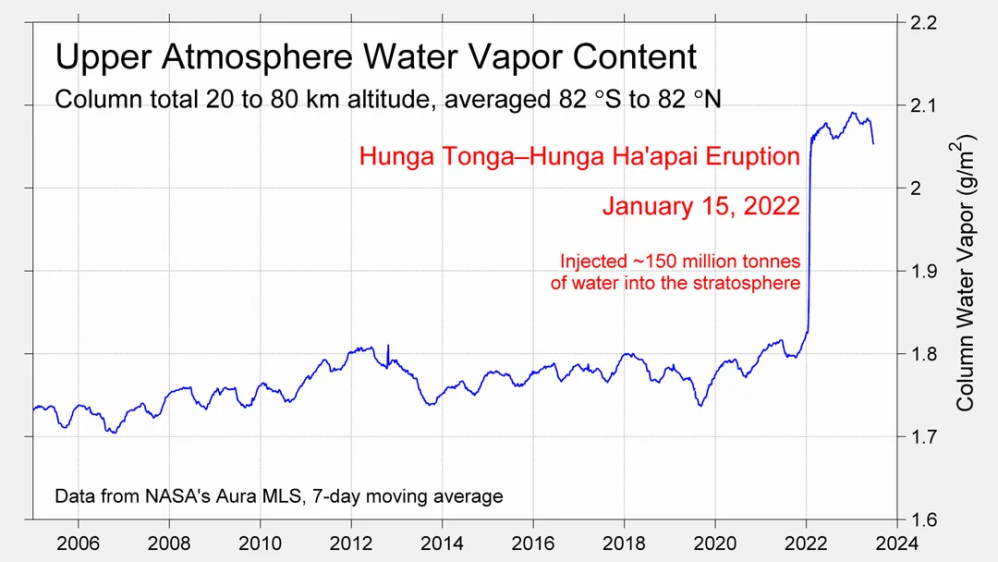
It has now shifted in the last months to an El Nino condition that warms the globe and is thought to contribute to this Spike we have seen. But there are other contributions as well.  One of the most surprising ones is that back in January of 2022 an enormous underwater volcano went off in Tonga and it put up a lot of water vapor into the upper atmosphere. It increased the upper atmosphere of water vapor by about 10 percent, and that’s a warming effect, and it may be that is contributing to why the spike is so high.

A longer view of SSTs

To enlarge, open image in new tab.

The graph above is noisy, but the density is needed to see the seasonal patterns in the oceanic fluctuations.  Previous posts focused on the rise and fall of the last El Nino starting in 2015.  This post adds a longer view, encompassing the significant 1998 El Nino and since.  The color schemes are retained for Global, Tropics, NH and SH anomalies.  Despite the longer time frame, I have kept the monthly data (rather than yearly averages) because of interesting shifts between January and July. 1995 is a reasonable (ENSO neutral) starting point prior to the first El Nino. 

The sharp Tropical rise peaking in 1998 is dominant in the record, starting Jan. ’97 to pull up SSTs uniformly before returning to the same level Jan. ’99. There were strong cool periods before and after the 1998 El Nino event. Then SSTs in all regions returned to the mean in 2001-2. 

SSTS fluctuate around the mean until 2007, when another, smaller ENSO event occurs. There is cooling 2007-8,  a lower peak warming in 2009-10, following by cooling in 2011-12.  Again SSTs are average 2013-14.

Now a different pattern appears.  The Tropics cooled sharply to Jan 11, then rise steadily for 4 years to Jan 15, at which point the most recent major El Nino takes off.  But this time in contrast to ’97-’99, the Northern Hemisphere produces peaks every summer pulling up the Global average.  In fact, these NH peaks appear every July starting in 2003, growing stronger to produce 3 massive highs in 2014, 15 and 16.  NH July 2017 was only slightly lower, and a fifth NH peak still lower in Sept. 2018.

The highest summer NH peaks came in 2019 and 2020, only this time the Tropics and SH were offsetting rather adding to the warming. (Note: these are high anomalies on top of the highest absolute temps in the NH.)  Since 2014 SH has played a moderating role, offsetting the NH warming pulses. After September 2020 temps dropped off down until February 2021.  In 2021-22 there were again summer NH spikes, but in 2022 moderated first by cooling Tropics and SH SSTs, then in October to January 2023 by deeper cooling in NH and Tropics.  

Then in 2023 the Tropics flipped from below to well above average, while NH produced a summer peak extending into September higher than any previous year.  Despite El Nino driving the Tropics January 2024 anomaly higher than 1998 and 2016 peaks, the last two months cooled in all regions, and the Tropics continued cooling in April and May, along with SH dropping, suggesting that the peak likely has been reached.

What to make of all this? The patterns suggest that in addition to El Ninos in the Pacific driving the Tropic SSTs, something else is going on in the NH.  The obvious culprit is the North Atlantic, since I have seen this sort of pulsing before.  After reading some papers by David Dilley, I confirmed his observation of Atlantic pulses into the Arctic every 8 to 10 years.

Contemporary AMO Observations

Through January 2023 I depended on the Kaplan AMO Index (not smoothed, not detrended) for N. Atlantic observations. But it is no longer being updated, and NOAA says they don’t know its future.  So I find that ERSSTv5 AMO dataset has data through October.  It differs from Kaplan, which reported average absolute temps measured in N. Atlantic.  “ERSST5 AMO  follows Trenberth and Shea (2006) proposal to use the NA region EQ-60°N, 0°-80°W and subtract the global rise of SST 60°S-60°N to obtain a measure of the internal variability, arguing that the effect of external forcing on the North Atlantic should be similar to the effect on the other oceans.”  So the values represent sst anomaly differences between the N. Atlantic and the Global ocean.

The chart above confirms what Kaplan also showed.  As August is the hottest month for the N. Atlantic, its varibility, high and low, drives the annual results for this basin.  Note also the peaks in 2010, lows after 2014, and a rise in 2021. Now in 2023 the peak was holding at 1.4C before declining.  An annual chart below is informative:

Note the difference between blue/green years, beige/brown, and purple/red years.  2010, 2021, 2022 all peaked strongly in August or September.  1998 and 2007 were mildly warm.  2016 and 2018 were matching or cooler than the global average.  2023 started out slightly warm, then rose steadily to an  extraordinary peak in July.  August to October were only slightly lower, but by December cooled by ~0.4C.

Now in 2024 the AMO anomaly started higher than any previous year, then leveled off for two months declining slightly into April.  Remarkably, May shows an upward leap putting this on a higher track than 2023.  The next months will show us if that warming strengthens or levels off.

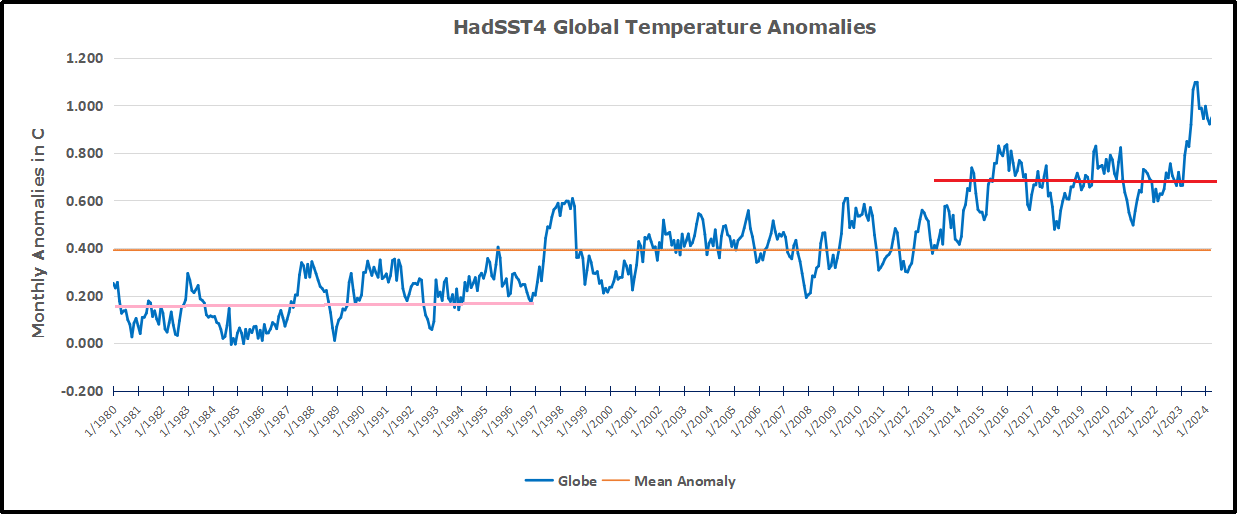
The pattern suggests the ocean may be demonstrating a stairstep pattern like that we have also seen in HadCRUT4. 

The purple line is the average anomaly 1980-1996 inclusive, value 0.18.  The orange line the average 1980-202404, value 0.39, also for the period 1997-2012. The red line is 2013-202404, value 0.66. As noted above, these rising stages are driven by the combined warming in the Tropics and NH, including both Pacific and Atlantic basins.

See Also:

2024 El Nino Collapsing

Curiosity:  Solar Coincidence?

The news about our current solar cycle 25 is that the solar activity is hitting peak numbers now and higher  than expected 1-2 years in the future.  As livescience put it:  Solar maximum could hit us harder and sooner than we thought. How dangerous will the sun’s chaotic peak be?  Some charts from spaceweatherlive look familar to these sea surface temperature charts.

Summary

The oceans are driving the warming this century.  SSTs took a step up with the 1998 El Nino and have stayed there with help from the North Atlantic, and more recently the Pacific northern “Blob.”  The ocean surfaces are releasing a lot of energy, warming the air, but eventually will have a cooling effect.  The decline after 1937 was rapid by comparison, so one wonders: How long can the oceans keep this up? And is the sun adding forcing to this process?

Space weather impacts the ionosphere in this animation. Credits: NASA/GSFC/CIL/Krystofer Kim

Footnote: Why Rely on HadSST4

HadSST is distinguished from other SST products because HadCRU (Hadley Climatic Research Unit) does not engage in SST interpolation, i.e. infilling estimated anomalies into grid cells lacking sufficient sampling in a given month. From reading the documentation and from queries to Met Office, this is their procedure.

HadSST4 imports data from gridcells containing ocean, excluding land cells. From past records, they have calculated daily and monthly average readings for each grid cell for the period 1961 to 1990. Those temperatures form the baseline from which anomalies are calculated.

In a given month, each gridcell with sufficient sampling is averaged for the month and then the baseline value for that cell and that month is subtracted, resulting in the monthly anomaly for that cell. All cells with monthly anomalies are averaged to produce global, hemispheric and tropical anomalies for the month, based on the cells in those locations. For example, Tropics averages include ocean grid cells lying between latitudes 20N and 20S.

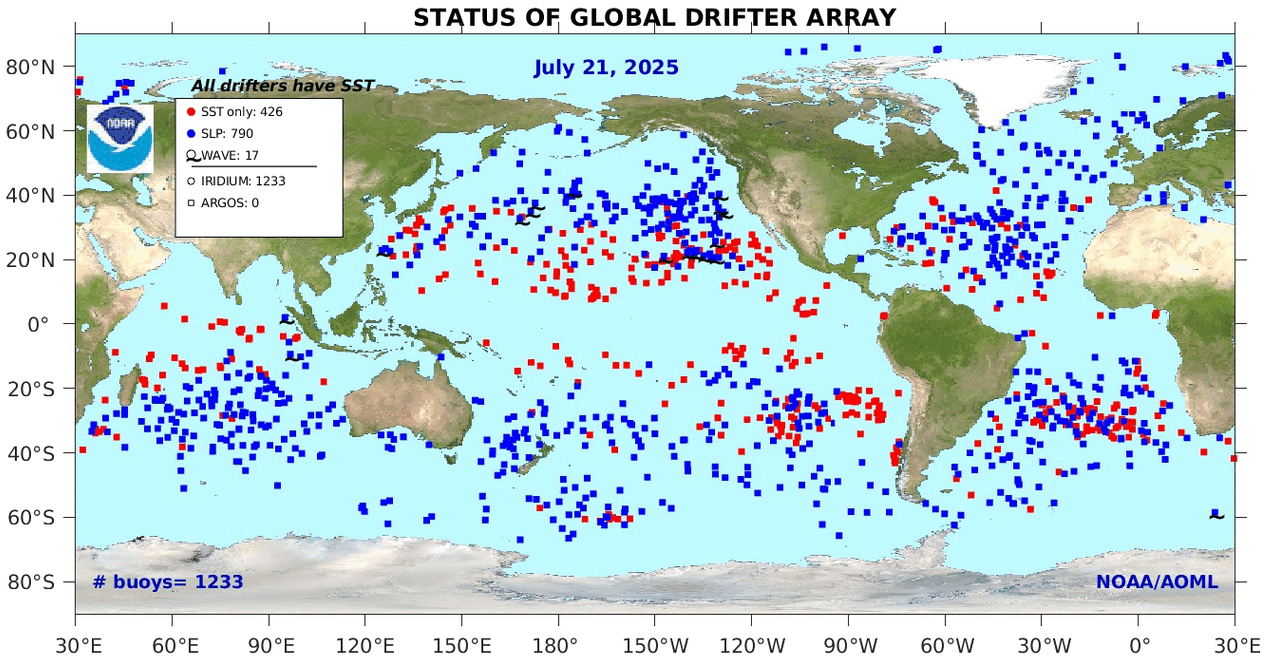
Gridcells lacking sufficient sampling that month are left out of the averaging, and the uncertainty from such missing data is estimated. IMO that is more reasonable than inventing data to infill. And it seems that the Global Drifter Array displayed in the top image is providing more uniform coverage of the oceans than in the past.

uss-pearl-harbor-deploys-global-drifter-buoys-in-pacific-ocean

USS Pearl Harbor deploys Global Drifter Buoys in Pacific Ocean


via Science Matters

https://ift.tt/OFXVHU9

June 15, 2024 at 10:27AM

Sunday

0 out of 10 based on 0 rating

via JoNova

https://ift.tt/9yAs3HW

June 15, 2024 at 10:11AM