
By Jo Nova
Climate fatigue is upon us
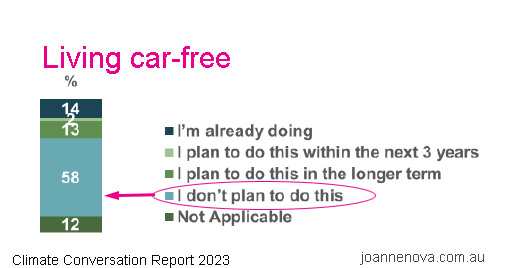
Yet another survey shows most people know what to say when asked banal questions of climate dogma — “Yes they are “very worried”. But more than half the population don’t believe climate change is going to harm them and they have “no intention” of giving up meat, or their cars or their pets. And for people who only fly once a year, the idea of flying less was very unappealing. Worse, the under 35s like taking a series of flights each year is so normal now it’s “part of their identity”.
After years of this tedious preachy non-debate the report authors even had to acknowledge that “virtue signaling” was a thing, and it was turning off middle and lower class people. Rather than being seen as heroes, those who did a lot to prevent climate change were seen as boring and earnest, and either miserable martyrs or people who are “intentionally vocal” about their actions, partly as a way to show off. The working poor didn’t like being talked down to, and it reinforced the idea that “climate action” was something for people who could afford it.
By Sorcha Pollak, The Irish Times
A study on Irish attitudes toward climate change has found more than half of respondents did not believe it is harming people in Ireland, and that a significant gap exists between people’s climate-related intentions and actions.
Older homeowners, particularly those in rural locations, often believe their way of life is “under threat” as a result of climate initiatives and the report recommends the impact of this change on the “identity of people” be further considered.
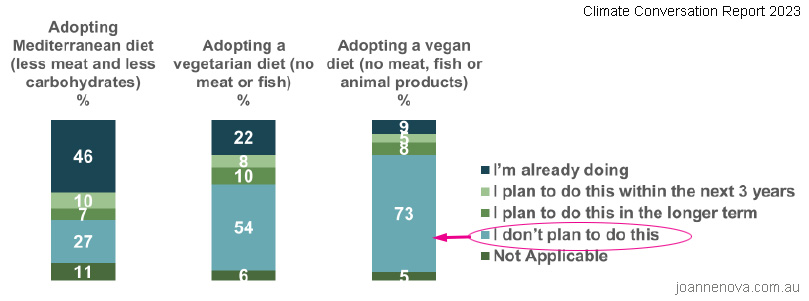
The report found many people, males in particular, had no intention of reducing their meat consumption and following a diet seen as more climate friendly.
54% of people said they have no intention to be vegetarian, and when asked about being vegan, 73% said “No”.
People think they’re already taking enough climate action (like recycling and catching more buses) while the report writers said this was a misunderstanding and people actually needed to “do a lot more”.
Indeed, nearly 60% of the population says they are already walking and cycling more frequently instead of driving and they’re flying less too. Yet there are obviously just as many cars on the road and planes in the sky as ever before, proving researchers need to ask better questions.
If I catch a bus one time this year that’s more frequent than last year, right?
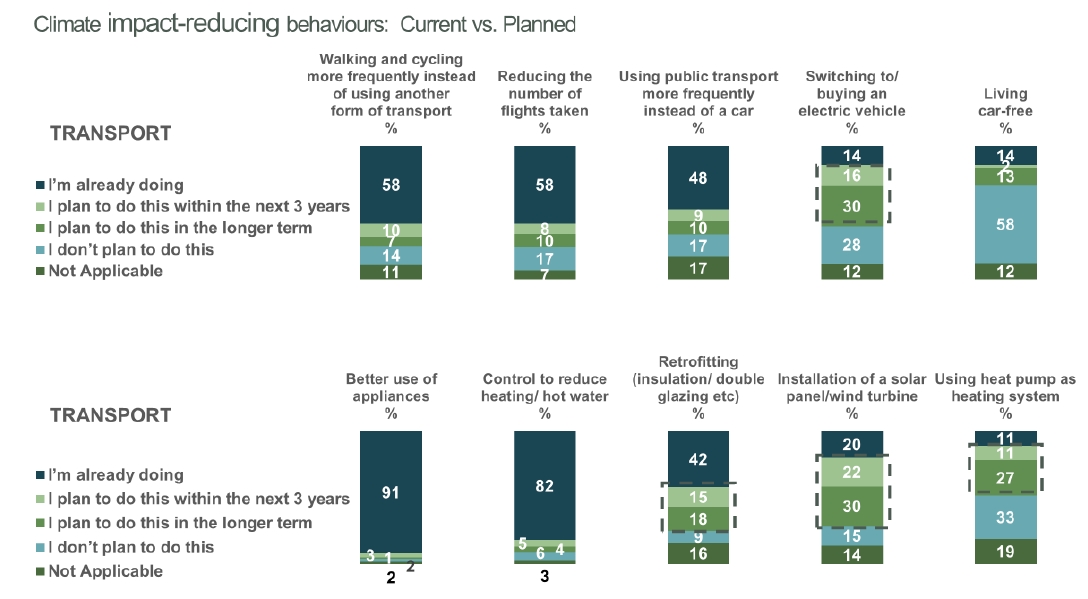
Click to enlarge the graph.
Likewise, are 82% of people really choosing foods with less packaging?
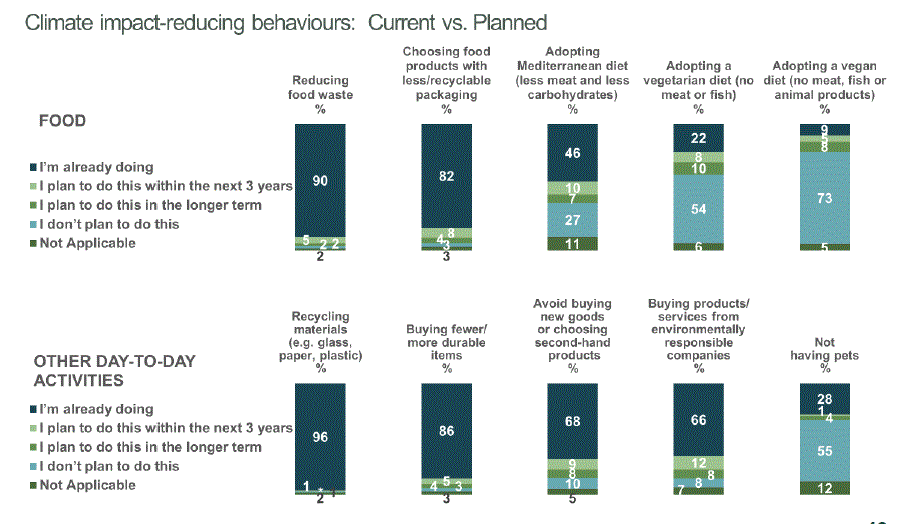
Click to enlarge the graph.
The report authors admit that the unwashed masses are not buying the “fly less” message while celebrities and politicians were flying more:
Across the workshops, individuals didn’t routinely make the connection between the numerous holidays they had booked abroad and the damage to the climate. Numerous arguments were made to justify this travel which point to challenges in communicating the benefits of flying less. Arguments included the fact that the flights were departing whether they were on-board or not and that their impact was minimal when compared with people in the public eye travelling on private jets. These responses point to a sensitivity to people in the public eye (particularly international celebrities) continually flying in private jets frequently whilst the broader population is being asked to not take a holiday and city break abroad.
And finally, there is the realization that “virtue signaling” is its own liability:
They are perceived to be potentially quite boring and earnest as they sacrifice activities such as foreign travel to align with their values. At an extreme, they are viewed as miserable martyrs. They are intentionally vocal about their actions. It was believed that this was intended as an attempt to promote positive actions in others but also to demonstrate their virtuous behaviour. Unfortunately, this active promotion to others less well-placed to act risked being viewed as an attempt to talk down to others, further reinforcing the view of climate action being for those who can afford it.
The full report:
Department of Environment surveyed 4,000 people across the country, for the “”Climate Conversation 2023” report “.
0 out of 10 based on 0 rating
via JoNova
July 5, 2024 at 03:01PM
 Iowa Climate Science Education