

Abandoning perfectly habitable homes to escape neighbouring industrial wind turbine aggregations is a serious response aimed at avoiding a perpetually miserable future. Being deprived of the opportunity to live, sleep in and otherwise enjoy one’s own home is bad enough. Losing that fundamental proprietary (indeed human) right without compensation is criminal – the perpetrators are easily identified and known to their countless victims.
The Canadian Province of Ontario provides just one (tragic) example of the destructive consequence of spearing hundreds of these things into once peaceful and productive rural communities.
The debilitating effects of the grinding, thumping low-frequency turbine noise on neighbours are well-known. Less well-known, is the contamination of water drawn from aquifers caused by wind turbine construction, which turns once potable water into a stinking black ooze – unfit for human and even animal consumption, as detailed in the study below.
Wind turbines: Vacated/abandoned homes study – Exploring research participants’ descriptions of observed effects on their pets, animals, and well water
Environmental Disease
Krogh, Carmen Marie; McMurtry, Robert Y.; Johnson, W. Ben; Punch, Jerry L.; Dumbrille, Anne; Alves-Pereira, Mariana; Hughes, Debra; Rogers, Linda; Rand, Robert W.; Gillis, Lorrie
9(1):p 1-12, Jan–Mar 2024. DOI: https://doi.org/10.4103/ed.ed_2_23
Abstract
Background:
Neighbors living within 10 km of industrial wind turbines have reported occurrences of adverse health effects and contemplated vacating their homes. Some participants described concerns for wildlife and effects on their pets, animals, and well water. While sources such as the scientific literature, social media, and Internet websites have reported these effects, research is limited.
Methods:
This ethics-reviewed study used the qualitative grounded theory methodology and interviewed 67 consenting participants, 18 years or older who had previously lived, or were currently living within 10 km of wind turbines. Audio files were transcribed to text, and the data were coded and analyzed using NVivo Pro (version 12.6) software.
Objectives:
The objectives of this study were to explore participants’ descriptions of effects related to their pets, animals, and well water and to generate a theory.
Results:
Data analysis revealed primary themes of environmental interference and altered living conditions and associated sub-themes of effects on animals and well water.
Discussion:
Internationally and in Ontario neighbors have reported effects on their pets and domestic animals, concerns for wildlife, and a loss of potable well water. It is recommended that members of the public, government authorities, policy-makers, researchers, health practitioners and social scientists with an interest in health policy acknowledge the potential for these effects and seek resolution for those negatively affected.
Introduction
The risk of adverse health effects (AHEs) associated with living within 10 km of industrial wind turbines (IWTs) is unresolved and continues to be debated globally. Descriptions of these effects are reported to have occurred in neighbors and workers who live or work in proximity to these facilities.[1-4]
Participants describe concerns for wildlife, occurrences of AHEs, and effects on their well water and pets and animals. In some instances, unusual animal behavior included aggressiveness, birthing problems, and a decline in fertility of their farm animals.
This ethics-reviewed study used the qualitative grounded theory (GT) methodology to conduct a study in Ontario, Canada. It explored the events that motivated individuals and families living within 10 km of a wind power plant (WPP) to contemplate vacating/abandoning their homes. In addition to this manuscript five others manuscripts have been published: preliminary findings[1], an overview of findings[2], an exploration of the study’s use of a qualitative methodology, specifically the Grounded Theory[3], the effects of a government policy that resulted in participants becoming informed and taking action[4], and AHEs and medical diagnoses provided by participants’ physicians and physician specialists.[5]
Methodology
Reproduced from[4] a pilot study was conducted prior to initiating this research. Its results supported that this study’s approach was suitable for the vacated home study. Our study methodology conformed to the COnsolidated criteria for REporting Qualitative research (COREQ) checklist. Two additional processes that are not identified in COREQ were included in our methodology to further strengthen study rigor – a process controller and a scrutinizer. The process controller documented schedules, the interview process, and data records. The scrutineer maintained the integrity of the data collected.
Government hearings and legal proceedings, media, and international citations had reported AHEs and that some had vacated their homes. To gain an understanding of why some families living in proximity to a WPP/IWT facility contemplated vacating their homes, several research questions were identified:
- What are the particular circumstances which influenced whether to vacate or not vacate a family home?
- How did families arrive at their decision?
- Were there consequences related to their decision?
- Did these circumstances influence physical, mental, and social well-being?
Participants were required to be 18 years of age or older, proficient in the English language and to have lived or were currently living within 10 km of a WPP. Invitations were distributed to key informants such as community leaders and neighbors as these individuals were likely to generate rich data.[6] There were no restrictions on the distribution of the invitation. The purpose of the study was summarized and participants were advised that there would be an opportunity to describe the circumstances that may have influenced “whether to vacate or remain in their home.”
The intention was to explore the “extent of these occurrences and the impact or lack of impact” of living within 10 km of a WPP. Prior to consent, all participants were advised that even if they had signed the consent form, they could decline to answer any question and decline to continue with the interview. If this occurred, all their information would be immediately destroyed. There were no participant withdrawals and the individual interviews were conducted as scheduled.
With the informed consent of all participants, trained interviewers began each interview with a single, nonleading question, i.e., to discuss the events that led them to contemplate vacating their home. Face-to-face interviews were held with each participant in their homes with few exceptions. In some cases due to travel issues such as distances or inclement weather, some interviews were conducted by telephone. Participants were advised that the interviews would last 1 h; however, the interviewers did not limit this and some interviews exceeded an hour. All 67 participants agreed to have their interviews recorded and were offered an audio copy at its conclusion. The audio files were converted to text and NVivo Pro (version 12.6, QSR International [Americas] Inc., Burlington, MA, USA) software was used to analyze and code the data. The GT’s iterative methodology was followed, and the interviews concluded with the 67th participant when saturation occurred and no new information was forthcoming.[1-4] Statistical and demographic information and the home status of participants are available at Krogh et al., 2020.[2]
Clinical trial registry
No clinical trials were involved.
Themes: Sub-themes and the 5 Elements
Rose et al. comment that Strauss and Corbin proposed a “coding paradigm intended to help with data analysis by suggesting what to look for when coding” and provided a version of this approach, i.e., the 5 Elements.[7]
Krogh et al. found that this approach and the use of a systematic method to transcribe, code, and analyze the data acquired during the interviews were applicable to the vacated/abandoned home study.[3]
The application of the 5 Elements is illustrated in Figure 1: themes and sub-themes and their relationship to the 5 Elements.
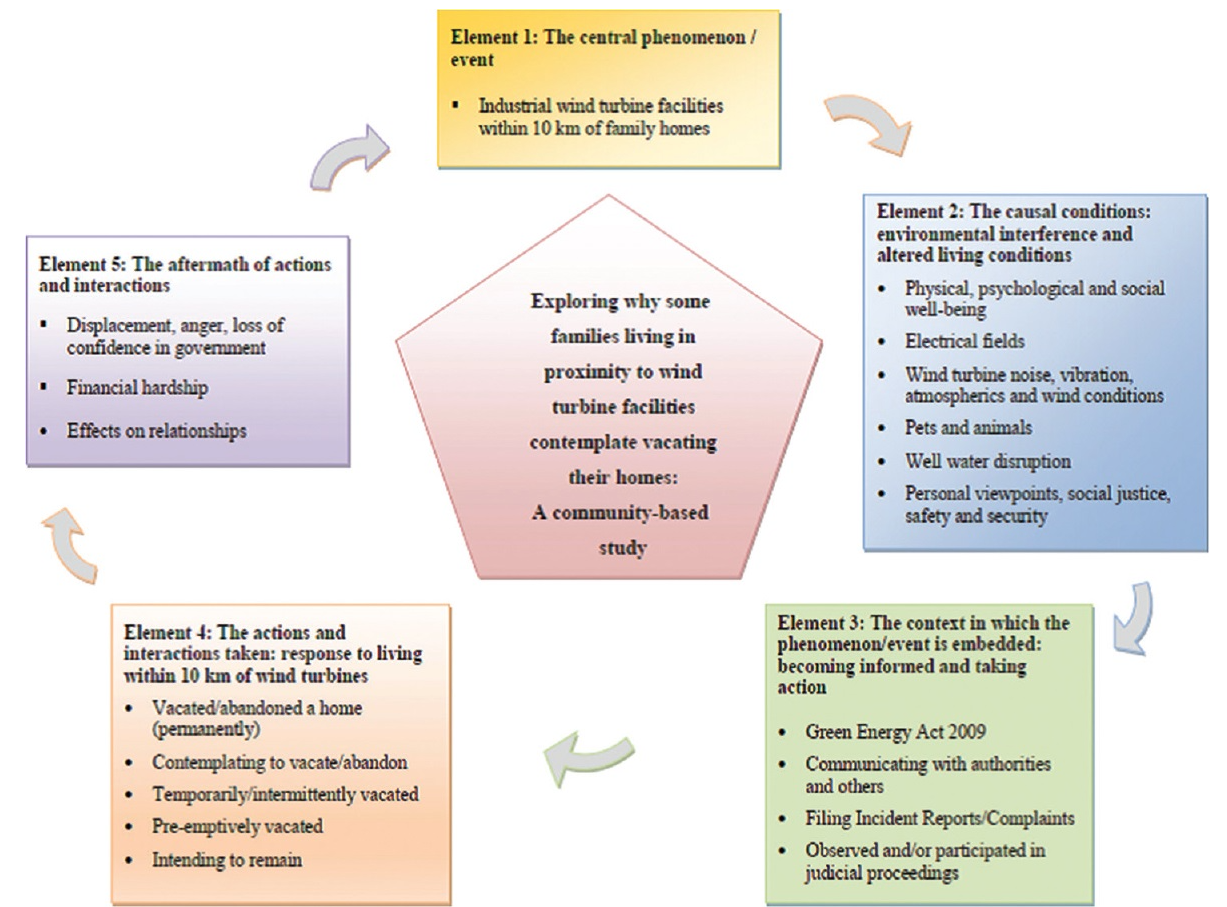
Within the context of this study, the 5 Elements proposed by Rose et al. were associated with the analyzed data.
- Element 1: The “central phenomenon” – The focus of the study is the siting of IWTs within 10 km of participants’ homes.
- Element 2: The “causal conditions that contributed to the phenomenon” include findings of the primary and sub-themes of the effects of environmental interference and altered living conditions, as described in Figure 1, Element 2.
- Element 3: The “context in which the phenomenon is embedded” is associated with a government policy. Participants became informed and took action through governmental and other processes, as described in Figure 1, Element 3.
- Element 4: The “actions and interactions taken by people in response to the phenomenon” resulted in participants contemplating housing decisions, as described in Figure 1, Element 4.
- Element 5: The “consequences of those actions and interactions taken in Element 4” include an “aftermath,” as described in Figure 1, Element 5.
This report analyses the sub-theme of effects on pets, animals, and well water as described in Element 2. The results of Elements 4 and 5 will be addressed in separate manuscripts.
As proposed by Castillo-Montoya, every effort was made to accurately represent the voices of participants by the use of verbatim quotations throughout this manuscript.[8]
To maintain participant confidentiality, the authors have intentionally avoided reporting details that could identify specific individuals, geographical locations, sitting distances, or the details of the WPP/IWT projects.
Results and Discussion
Effects on wildlife, pets, and animals
Table 1 provides participants’ descriptions of concerns for wildlife and effects on their pets and animals.
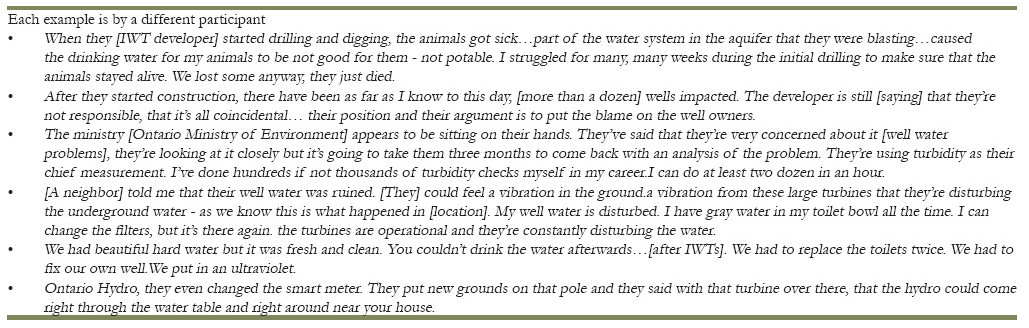
Well water disruption in Ontario, Canada, and internationally
In 2019, groundwater Canada advised that many rural Ontario families are “completely dependent on groundwater.”[34] Study participants described IWT-related water issues that are similar to the adverse effects being described by Ontario neighbors.[35-38] For example, in 2018, Clarke commented that in Ontario:
There are 19 families who have registered a well interference complaint with the MOECC. Each of these families has experienced distinct, observable changes in their well water, which expresses itself as cloudy and often includes dark particulates.[38]
In another case, it was reported that to avoid possible contamination of groundwater, the Ontario Ministry of Environment requested that the IWT developer seals the foundations of more than “300 utility poles” associated with a transmission line.[39]
Ontario’s “protection framework” includes testing procedures, and promises “swift, strong action on Adverse Water Quality Incidents.”[40] The Ontario Ministry of the Environment stresses that:
Protecting water at its source is a crucial first step in Ontario’s approach to delivering safe drinking water. When you turn on your tap, you can be confident that your drinking water is among the best protected in the world.[41]
Achieving timely acknowledgment and resolution of their well water issues has been challenging for affected Ontario families. It was reported that in 2016, some Ontario neighbors believed that IWT construction-related pile driving resulted in black shale and hazardous materials leaching into their well water. The local Medical Officer of Health (MOH) assured concerned neighbors by explaining that since “sediments are not soluble in water, they cannot be absorbed by the body and pose no health hazard.”[37] Subsequently, during a 2019 IWT noise conference presentation, the MOH concluded that:
There is no evidence that wind turbine construction or operation results in the contamination of groundwater and no scientifically plausible mechanism has been offered by which groundwater contamination with translocated sediments or associated health hazards could theoretically occur.[42]
Baseline testing conducted prior to IWT construction, and testing during construction reported that at least one local well had a “14,000 times increase in black shale particles.”[43] Several years after black shale had appeared in well water, analyses found that sediments were raising more concerns than before including “excessive sediment, problematic gases and potentially infection-causing biofilm,” and that these were among the problems “plaguing water-well owners” in the area.[34] Findings included that:
The sediments that have been continuously discharging into a number of water wells since wind farms were constructed in North Chatham-Kent have been found to contain Kettle Point Black Shale.
Furthermore:
Kettle point black shale is a material considered an Environmental Hazard in Canada because it has been shown the material contains heavy metals such as arsenic, mercury, lead, and uranium.[34]
In 2019, the Ontario Government launched a “Health Hazard” investigation during which an independent panel of scientists was charged with the investigation of approximately 200 privately owned water wells across the affected area.[44] However, concerns were raised by some of the affected neighbors that there were several “serious shortcomings” and a need to include members from the disciplines of “hydrogeology, seismology, and geochemistry for black shale.”[45]
The local Ontario Member of Provincial Parliament (MPP) commented that “clean energy technology is contaminating farmers’ wells” by the leaching of black shale into well water. The bedrock is made of “kettle point black shale” and pile-driving contaminates the groundwater by breaking up the “toxic shale.” As a result, residents are unable to “drink, bathe, or wash their clothes.” MPP Nicholls noted that the water wells are being “poisoned as the government continues to allow the pile driving.” He asked whether the government would do the right thing by stopping the groundwater contamination and placing a moratorium on IWTs until scientific evidence disproves the claim that IWTs are “polluting the environment.”[46]
A professional opinion advised that regarding IWT-related complaints of well water disruption, there was:
A distinct relationship between the wind tower project and the impaired wells. This is the time to suspend the project until we know more. Otherwise, blindly barging ahead will result in more damage.[38]
Additional testing was conducted in late 2022 by a former member of the Expert Panel who had provided advice during the Ontario all-hazard investigation of well water. A summary indicated there was an apparent deterioration of the general quality of private wells in the affected area occurring between 2017 (prior to IWT construction) and 2021 when sampling was completed. It was recommended that more sampling and analysis of sediment was warranted and that:
Whatever might be responsible for the decrease in water quality apparently did not affect wells outside of the industrial wind complex.[47]
An Ontario neighbor advised Ontario’s Ministry of Health (MOH) that people were angry and had “little trust in almost any government agency.” This mistrust resulted in numerous homeowners refusing to participate in further water testing. While there were valid questions about the process, there was a “complete lack” of communication and an inability to obtain answers. The neighbor proposed that in order to encourage participation in future testing, the Ministry communicates on the process and provides an avenue for questions and answers.[48]
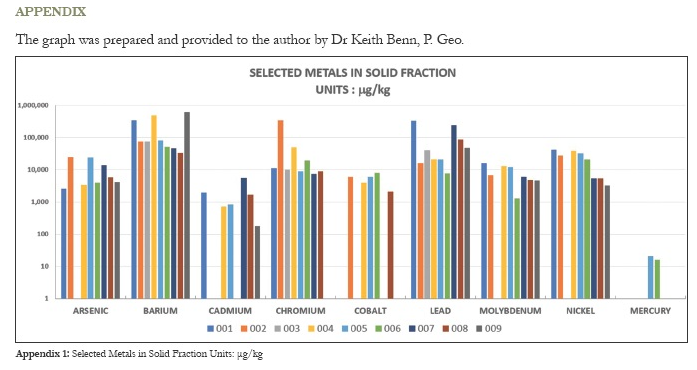
Following Ontario’s all-hazard investigation of well water,[47] additional testing raised toxicity concerns.[49] A deputation includes a bar chart that represents a plot of metal concentrations as determined for the solid particulates (“sediments”) extracted from water samples collected from 9 private wells in northern Chatham-Kent. The wells are located within the footprints of three industrial wind turbine complexes where residents have reported increased turbidity of their domestic water during and following wind turbine construction. Previous analyses have shown that the grain sizes of sediments sampled from several wells are mostly 10 ∞ or less. The concentrations of metals within the sediments are similar to those documented for the Kettle Point black shale geological formation that forms the bedrock beneath the aquifer and that is also known to be present within the aquifer.[50] Should the metals in the fine-grained sediments prove to be bio-accessible the risk of toxicity associated with consumption of the well water could be quite high.[50]Appendix 1 provides the bar chart of selected Metals in solid fraction units: μg/kg.
Internationally similar concerns relating to WPP/IWT disruption of well water have also been expressed, For example, in Scotland, neighbors living near a WPP reported suffering from severe vomiting and diarrhoea. Testing revealed that the water supply was bacterially contaminated.[51] It was also reported that the “biggest windfarm” in Scotland contaminated the public water a supply with cancer-causing chemicals[52] and that a report indicated WWPs had contaminated water supplies.[53] Another report claimed that well water had deteriorated with the onset of construction of the WPP.[54] Another report from Europe claimed that the power company knew about the polluted water supply.[55] In another case, it was reported a development of a WWP was stopped due to complaints by residents that the “work was polluting” their water supply.[56] In California, it was believed that an IWT project may have changed the “hydrology of the desert”[57] and in Vermont concerns were raised on how to “maintain and protect water quality” of the Lowell Mountains.[58]
The Northern Ireland Environment Agency comments that:
The development of a wind farm has the potential to impact on groundwater quality, groundwater quantity, and/or the established groundwater flow regime.[59]
The Agency also presents in Figure 1 that the:
Scale and extent of the foundation of a single wind turbine which could potentially impact on the aquatic environment. Changes to the local water environment can affect receptors such as wells/boreholes, springs, wetlands, and waterways, and can also have implications for groundwater-dependent ecology and/or land stability.[59]
The United States Bureau of Land Management advises that there is a potential for IWTs to affect surface and groundwater and that:
Soil erosion can be aggravated locally through ground surface disturbance. The impact of soil erosion includes soil nutrient loss and degradation of water quality in nearby surface water bodies. The magnitude of the impact depends on the project size, erosion potential of the soil, local terrain, vegetation covers, and the distance from a site to nearby surface water bodies.[60]
Furthermore:
A wind energy project can impact surface water and groundwater in several different ways, including the use of water resources, changes in water quality, alteration of the natural flow system, and the alteration of interactions between the groundwater and surface water.[60]
Dodds, a Ph. D. and licensed professional geologist provided an opinion regarding the risk of effects on groundwater and residential well water associated with IWT construction. It stated that one of the best management practice advances is “controlled drainage” and the proposed construction will cause cumulative adverse impacts on forests, habitat, and water resources such as “increased stormwater discharge to receiving streams.” In addition, installation of electrical collection lines will result in “uncontrolled drainage of intercepted groundwater to receiving streams.”[61] Dodds also provided direct and rebuttal testimony stating that:
If the route to seeps and springs or to residential wells is changed, then the groundwater may not be sufficient to continue providing water to specific seeps, springs, or residential wells.[62]
The importance of clean water is acknowledged by the United States Environmental Protection Agency: clean water is “vital to our health, communities, and economy.”[63] Clean water is also considered the “most important thing you take into your body.”[64] The World Health Organization also acknowledges the importance of safe water:
Safe and readily available water is important for public health, whether it is used for drinking, domestic use, food production or recreational purposes. Improved water supply and sanitation, and better management of water resources, can boost countries’ economic growth and can contribute greatly to poverty reduction.[65]
An Australian Senate Committee cites the Australian National Health and Medical Research Council that states:
Consumers are the ultimate assessors of water quality. Consumers may not be able to detect trace concentrations of individual contaminants, but their ability to recognize change should not be discounted. In some cases, consumer complaints may provide valuable information on potential problems not detected by testing water quality or monitoring treatment processes. Water quality testing has limitations and there are many possibilities for contamination of water in reticulation systems after treatment. All consumer complaints should be investigated to ensure that otherwise undetected problems that might compromise drinking water safety have not occurred. Meeting reasonable consumer expectations and maintaining confidence in the water supply is vitally important.[66]
Conclusions
Participants living within 10 km of IWTs described concerns for wildlife and the effects they observed on their pets, animals, and well water. These descriptions are similar to those by international neighbors. Some authorities and researchers have expressed concerns regarding the potential risks of these effects that have been associated with WPPs/IWTs.
It is recommended that members of the public, authorities, policy-makers, decision-makers, and WPP/IWT developers respond to the potential risks to animals and humans to disturbances of groundwater, streams, aquifers, and residential wells associated during the construction and onset of WPP/IWT operations. Priority should be given to restore clean well water and resolve the issues to the satisfaction of those neighbors who have been affected.
The GT methodology was used to develop a substantive theory regarding the housing decisions of participants living within 10 km of a WPP. Results from the participant’s interviews support the theory that these decisions were motivated by the potential for, or the experience of adverse effects including those related to pets, animals, and well water that participants attributed to living in proximity to the WPPs.
Author contributions
All authors have contributed to this manuscript by providing their input, comments, support and agreement to this manuscript’s publication.
Ethics review
Chesapeake Research Review, LLC (“Chesapeake IRB”), Pro00022827, dated on September 25, 2017.
Note: Chesapeake Research Review, LLC (“Chesapeake IRB”) and Schulman Associates Institutional Review Board, Inc. (“Schulman IRB”) have merged to create Advarra, Inc. (“Advarra IRB”).
Data availability statement
The data generated and/or analyzed during this study are included in this published article.
Financial support and sponsorship
Magentica Research Group Not for Profit (Corporations Canada) is partially funded by private donation.
Conflicts of interest
There are no conflicts of interest.
Acknowledgments
This article is dedicated to those who participated in this vacated home study. The study would not have taken place without their willingness to share the events that took place during the contemplation of vacating their homes when living within 10 km of IWTs. Their observations and candid insights led to an understanding of the effects associated with their pets, animals, and well water. We thank our interviewers, who volunteered their time and traveled considerable distances in order to conduct the interviews. Finally, we thank those who encouraged us to conduct the vacated home study and who provided the funding for the Ethics Review, the coding software, and costs associated with Open Access publishing that enabled the conduct of this study and its publication. We also dedicate this manuscript to two of our co-authors who have recently died. We wish to acknowledge their contribution to this research. Mr. James was a respected acoustician whose numerous contributions are valued nationally and internationally. On behalf of Appellants, he testified under oath during numerous judicial proceedings. He was a consummate professional and a beloved friend to many of his colleagues, authors, and others who were fortunate enough to know him personally. Mr. Ambrose had a long and successful career as a principal investigator in acoustics and held paramount the safety, health and welfare of the public. He co-authored two ground-breaking peer-reviewed acoustic papers and for the next decade provided professional consulting to numerous communities on the effects of wind turbine noise. Both gentlemen are deeply missed.
References
1. Krogh CM, McMurtry RY, Dumbrille A, Hughes D, Gillis L. Preliminary results: Exploring why some families living in proximity to wind turbine facilities contemplate vacating their homes –A community-based study. Open Access Libr J 2018;7:1–8. Available from doi: https://doi.org/10.4236/oalib.1106118. [Last accessed 2023 Dec 09].
2. Krogh CM, McMurtry RY, Johnson BW, Dumbrille A, Alves-Pereira M, Punch JL, et al. Wind turbines: Why some families living in proximity to wind energy facilities contemplate vacating their homes: An overview of findings. Open Access Libr J 2020;7:1–17. Available from doi:10.4236/oalib.1106443. [Last accessed 2023 Dec 09].
3. Krogh CM, McMurtry RY, Johnson BW, Dumbrille A, Alves-Pereira M, Punch JL, et al. Grounded theory as an analytical tool to explore housing decisions related to living in the vicinity of industrial wind turbines. Open Access Libr J 2021;8:1–22. Available from “https://doi.org/10.4236/oalib.1107233. [Last accessed 2023 Dec 09].
4. Krogh CM, McMurtry RY, Johnson BW, Dumbrille A, Alves-Pereira M, Punch JL, et al. Wind turbines: An exploration of research participants’living experiences as a consequence of Ontario’s green energy act. Open Access Libr J 2023;10:1–32. Available from “https://doi.org/10.4236/oalib.1110043. [Last accessed 2023 Dec 09].
5. Krogh CM, McMurtry RY, Johnson WB, Alves-Pereira M, Punch JL, Dumbrille A, et al. Wind turbines: Vacated/abandoned homes –Exploring research participants’descriptions of adverse health effects and medical diagnoses provided by their physicians and physician specialists. Environ Dis 2023;8:51–70. Available from: https://journals.lww.com/endi/fulltext/2023/08030/wind_turbines__vacated_abandoned_homes___exploring.2.aspx. [Last accessed on 2023 Dec 09].
6. Bricki N, Green J. A Guide to Using Qualitative Research Methodology. Geneva, Switzerland:Médecins Sans Frontières;2007. Available from: https://scienceportal.msf.org/assets/6984. [Last accessed on 2023 Dec 09].
7. Rose S, Spinks N, Canhoto A. Chapter 6: Figure 2 Coding paradigm (adapted from Corbin and Strauss 1990. Strauss and Corbin 1998, Taylor and Francis Group. Registered in England &Wales No. 30990675). In: Management Research: Applying the Principles. 1st ed. Howick Place, London: SW1P1WG; 2015. Available from: https://www.taylorfrancis.com/books/mono/10.4324/9781315819198/management-research-ana-isabel-canhoto-nigel-spinks-susan-rose. [Last accessed on 2023 Dec 09].
8. Castillo-Montoya M. Preparing for interview research: The interview protocol refinement framework. Qual Rep 2016;21:811–31. Available from doi: https://doi.org/10.46743/2160-3715/2016.2337. [Last accessed 2023 Dec 09].
9. O’Shea TJ, Cryan PM, Hayman DT, Plowright RK, Streicker DG. Multiple mortality events in bats: A global review. Mamm Rev 2016;46:175–90. Available from doi: https://doi.org/10.1111/mam.12064. [Last accessed 2023 Dec 09].
10. Ortega CP. Effects of noise pollution on birds: A brief review of our knowledge. In: Ornithological Monographs Ch. 2 Vol. 74 Washington, U. S. A:The American Ornithologists’Union;2012. 6–22. Available from: https://doi.org/10.1525/om.2012.74.1.6. [Last accessed on 2023 Dec 09].
11. Shannon G, McKenna MF, Angeloni LM, Crooks KR, Fristrup KM, Brown E, et al. A synthesis of two decades of research documenting the effects of noise on wildlife. Biol Rev Camb Philos Soc 2016;91:982–1005. Available from doi https://doi.org/10.1111/brv.12207. [Last accessed 2023 Dec 09].
12. Jerem P, Mathews F. Trends and knowledge gaps in field research investigating effects of anthropogenic noise. Conserv Biol 2021;35:115–29. Available from doi: https://doi.org/10.1111/cobi.13510. Last accessed 2023 Dec 09].
13. National Park Service. Effects of Noise on Wildlife. Natural Sounds; 2018. Available from: https://www.nps.gov/subjects/sound/effects_wildlife.htm. [Last accessed on 2023 Jul 19].
14. Kunk, HP, Schmidt R. Meta-Analysis. The effects of anthropogenic noise on animals:a meta-analysis. Biol Lett 2019;15 (s11). Available from doi: https://doi.org/10.1098/rsbl.2019.0649. [Last accessed 2023 Dec 09].
15. Buxton RT, McKenna MF, Mennitt D, Fristrup K, Crooks K, Angeloni L, et al. Noise pollution is pervasive in U. S. protected areas. Science 2017;356:531–3. Available from https://doi.org/10.1126/science.aah4783 [Last accessed 2023 Dec 09].
16. Barber JR, Crooks KR, Fristrup KM. The costs of chronic noise exposure for terrestrial organisms. Trends Ecol Evol 2010;25:180–9. Available from https://doi.org/10.1016/j.tree.2009.08.002 [Last accessed 2023 Dec 09]
17. Sabet SS, Neo YY, Slabbekoorn H. Impact of anthropogenic noise on aquatic animals: From single species to community-level effects. Adv Exp Med Biol 2016;875:957–61. Springer, New York, NY. Available from doi:https://doi.org/10.1007/978-1-4939-2981-8_118. [Last accessed 2023 Dec 09].
18. Solan M, Whiteley N. Stressors in the Marine Environment: Physiological and Ecological Responses;Societal Implications. Oxford, GB:Oxford University Press;2016. 384. Available from: https://doi.org/10.1093/acprof:oso/9780198718826.001.0001. [Last accessed on 2023 Dec 09].
19. Park JK, Do Y. Wind turbine noise behaviorally and physiologically changes male frogs. Biology (Basel) 2022;11:516. Available from doi: https://doi.org/10.3390/biology11040516. [Last accessed 2023 Dec 09].
20. Richmond J. Mink Miscarriages, Birth Defects and Stillbirths Heighten Concerns Over Wind Turbines. East Country Magazine; 2014. Available from: https://www.eastcountymagazine.org/mink-miscarriages-birth-defects-and-stillbirths-heighten-concerns-over-wind-turbines. [Last accessed on 2023 Dec 09].
21. Baerwald EF, D’Amours GH, Klug BJ, Barclay RM. Barotrauma is a significant cause of bat fatalities at wind turbines. Curr Biol 2008;18:R695–6.6. Available from doi: https://doi.org/10.1016/j.cub.2008.06.029. [Last accessed 2023 Dec 09].
22. Arnett EB, Inkley DB, Johnson DH, Larkin RP, Manes S, Manville AM, et al. Impacts of wind energy facilities on wildlife and wildlife habitat. In: Wildlife Society Technical Review 07-2. Bethesda, Maryland, USA:The Wildlife Society;2007. Available from: https://wildlife.org/wp-content/uploads/2014/05/Wind07-2.pdf. [Last accessed on 2023 Dec 09].
23. Sprague T, Harrington ME, Krogh CM. Birds and bird habitat: What are the risks from industrial wind turbine exposure?. Bull Sci Technol Soc 2011;31:377–88. Available from https://doi.org/10.1177/0270467611417844. [Last accessed 2023 Dec 09].
24. Castelo Branco NA, Costa e Curto T, Mendes Jorge L, Cavaco Faísca J, Amaral Dias L, Oliveira P, et al. Family with Wind Turbines in Close Proximity to Home: Follow-up of the Case Presented in 2007. Proceedings of the 14th International Meeting on Low Frequency Noise, Vibration and Its Control. Aalborg, Denmark; 2010. 31–40. Available from: https://www.researchgate.net/publication/290444702_Family_with_wind_turbines_in_close_proximity_to_home_follow-up_of_the_case_presented_in_2007. [Last accessed on 2023 Dec 09].
25. Dumbrille A, McMurtry RY, Krogh CM. Wind turbines and adverse health effects: Applying Bradford Hill’s criteria for causation. Environ Dis 2021;6:65–87. Available from doi:10.4103/ed.ed_16_21. [Last accessed 2023 Dec 09].
26. Parker G. IWT Negatively Affect People, Birds, Bats, Ground Water and Perhaps Even Fish? Parker Gallant Energy Perspectives; 2022. Available from: https://parkergallantenergyperspectivesblog.wordpress.com/2022/04/10/iwt-negatively-affect-people-birds-bats-ground-water-and-perhaps-even-fish/. [Last accessed on 2023 Dec 09].
27. Cuff D. Altamont Wind Energy Company to Pay $2.5 Million and Replace Turbines to Reduce Raptor Deaths. East Bay Times; 2010. Available from: https://www.eastbaytimes.com/2010/12/06/altamont-wind-energy-company-to-pay-2-5-million-and-replace-turbines-to-reduce-raptor-deaths/. [Last accessed on 2023 Dec 09].
28. Prince Edward County Field Naturalists, ERT (Environmental Review Tribunal). CASE NO: 13-003. Prince Edward County Field Naturalists, Director, Ministry of the Environment and Climate Change, and Ostrander Point GP Inc. As General Partner for and on Behalf of Ostrander Point Wind Energy LP Decision Delivered by Heather I. Gibbs and Robert V. Wright; 2016. [PDF copy available on request].
29. Brown M. Wind Energy Company Kills 150 Eagles in U. S., Pleads Guilty. The Associated Press. CTV News; 2022. Available from: https://www.ctvnews.ca/world/wind-energy-company-kills-150-eagles-in-u-s-pleads-guilty-1.5851982. [Last accessed on 2023 Dec 09].
30. Pal S, Shuff C. Oregan Citizens Utility Board. What is Clean Energy? 2022. Available from: https://oregoncub.org/news/blog/what-is-clean-energy/2603/. [Last accessed on 2023 Dec 09].
31. Myklebust M, Raftery M. Do Wind Turbines Harm Animals? East County Magazine; 2012. Available from: https://www.eastcountymagazine.org/do-wind-turbines-harm-animals. [Last accessed on 2023 Dec 09].
32. USGS (U. S. Geological Survey). (n.d.). Frequently asked Questions. Can Wind Turbines Harm Wildlife?. Available from: https://www.usgs.gov/faqs/can-wind-turbines-harm-wildlife. [Last accessed on 2023 Dec 09].
33. Agnew RC, Smith VJ, Fowkes RC. Wind turbines cause chronic stress in badgers (Meles Meles) in Great Britain. J Wildl Dis 2016;52:459–67. Available from: http://dx.doi.org/10.7589/2015-09-231. [Last accessed on 2023 Dec 09].
34. Ground Water Canada. MPP (Member of Provincial Parliament). Water Wells First and OGWA (Ontario Ground Water Association) Call on Ontario Government to Keep Well Water Testing Promises; 2019. Available from: https://www.groundwatercanada.com/news/water-wells-first-lobbies-ontario-government-for-action-on-chatham-kent-issues-4702?jjj=1559859914142. [Last accessed on 2023 Dec 09].
35. Gunn E. Planning/Building/Environmental Committee Meeting. Township of West Lincoln, Ontario. Youtube Channel. Deputation Starts at 6 Minutes; 2016. Available from: https://www.youtube.com/watch?v=O1QhAwXkXCs. [Last accessed on 2023 Dec 09].
36. Nicholls R. Concern that wind Turbines are Polluting Ground Water. Special to the Toronto Sun; 2017. Available from: https://torontosun.com/2017/09/11/concern-that-wind-turbines-are-polluting-ground-water. [Last accessed on 2023 Dec 09].
37. Côté-Paulette C. “I Believe that Chatham-Kent is in a Water War”: Wind Turbine Experts Hear at Public Meeting. Community Members Booed the Area’s Public Health Officer at Open Meeting. CBC News; 2017. Available from: https://www.cbc.ca/news/canada/windsor/i-believe-that-chatham-kent-is-in-a-water-war-wind-turbine-experts-hear-at-public-meeting-1.4302360. [Last assessed on 2023 Dec 09].
38. Clarke B. Wind Turbines and Water Wells: Opinion. Features Contamination Water Issues. Ground Water Canada; 2018. Available from: https://www.groundwatercanada.com/wind-turbines-and-water-wells-opinion-4260/. [Last accessed on 2023 Dec 09].
39. Halliday C. Ministry of Environment asks Dufferin Wind to Guard against “Potential”Water Threat. The Ministry of the Environment (MOE) is asking Dufferin Wind Power to Seal the Foundations of More than 300 Utility Poles to Guard against Possible Groundwater Contamination in Melancthon and Amaranth. Orangeville Banner; 2014. Available from: https://www.orangeville.com/news/ministry-of-the-environment-asks-dufferin-wind-to-guard-against-potential-water-threat/article_90b80996-629a-5032-8097-041f21fb8144.html. [Last accessed on 2023 Dec 09].
40. Ontario Ministry of the Environment, Conservation and Parks. Drinking Water Protection Framework. Source Protection. Learn about the Importance of Protecting the Sources of Our Drinking Water; 2014. Available from: https://www.ontario.ca/page/source-protection#section-01. [Last accessed on 2023 Dec 09, Last updated on 2021 Oct 13].
41. Ontario Ministry of the Environment, Conservation and Parks. Drinking Water Queen’s Printer for Ontario; 2012 to 2022. Available from: https://www.ontario.ca/page/drinking-water. [Last accessed on 2023 Dec 09].
42. Colby WD. Wind Turbines and Groundwater Contamination: An Analysis. INCE Europe. 8th International Conference on Wind Turbine Noise. Lisbon; 2019. Available from: https://www.windconcernsontario.ca/wp-content/uploads/2019/06/WTN2019-groundwater.pdf. [Last accessed on 2023 Dec 09].
43. Cowan S. Well Testing Reveals Large Increase in Particles. Chatham Kent News Today; 2018. Available from: https://blackburnnews.com/chatham/chatham-news/2018/01/24/well-testing-reveals-large-increase-particles/. [Last accessed on 2023 Dec 09].
44. Hugall M. The Ontario Government is Launching a Health Hazard Investigation on Roughly 200 Privately-Owned Water Wells across Chatham-Kent. Chatham Kent News Today; 2019. Available from: https://blackburnnews.com/chatham/chatham-news/2019/07/19/ck-well-water-reviewed/. [Last accessed on 2023 Dec 09].
45. Pinto J. “Serious shortcomings”: C-K Residents Wary about PC’s New Water Well Investigation. CBC News; 2019. Available from: https://www.cbc.ca/news/canada/windsor/serious-shortcomings-wells-consultations-1.5225681?fbclid=IwAR0kqby6tLsI7NU8CimZjGbmjAzG9ULsUH6Q2zT5VaB3-KeG5XlG8Kv968w. [Last accessed on 2023 Dec 09].
46. Nicholls R. Concern that Wind Turbines are Polluting Ground Water. Special to the Toronto Sun. Nicholls is the Progressive Conservative MPP (Member of Provincial Parliament for Chatham-Kent-Essex; 2017. Available from: https://torontosun.com/2017/09/11/concern-that-wind-turbines-are-polluting-ground-water. [Last accessed on 2023 Dec 09].
47. Benn K. Review of the All-Hazard Investigation of Well Water in Chatham-Kent: Results and Recommendations; 2022. Prepared and presented by Dr Keith Benn, P. Geo. [PDF copy Available on request].
48. Leveille A. Expert Panel Report –All-Hazard Investigation of Well Water in Chatham-Kent. Correspondence: Ministry of Health; 2022. [PDF copy Available on request].
49. Wright P. Latest Well Water Testing Raises Toxicity Concerns. The Chatham Voice; 2023. Available from: https://chathamvoice.com/2023/05/10/latest-well-water-testing-raises-toxicity-concerns/. [Last accessed on ??? Dec 09].
50. Benn K, Geo P. Deputation Regarding Water Wells in Northern Chatham-Kent; 2023. [PDF copy Available on request].
51. Special Investigation: Toxic wind Turbines. The Sunday Post. Scottish News; 2014. Available from: https://www.sundaypost.com/news/scottish-news/special-investigation-toxic-wind-turbines/. [Last accessed on 2023 Dec 09].
52. McDonald C. Doctor claims Scotland’s Biggest Windfarm Responsible for High Levels of Cancer-Causing Chemical in Public Water-Supply. Rachel Connor Says Samples Taken from near the windfarm on Eaglesham Moor, Renfrewshire, Were up to almost 70 Per Cent above the Recommended Maximum. Daily Record. Available from: https://www.dailyrecord.co.uk/news/scottish-news/doctor-claims-scotlands-biggest-windfarm-4881760. [Last accessed on 2023 Dec 09, Last updated on 2015 Jan 07].
53. ENB (Energy News Bulletin). Wind Farms Contamination Link. Wind Farms Have Contaminated Water Supplies in Scotland, According to a Recently Released Report; 2015. Available from: https://www.energynewsbulletin.net/news-archive/news/1098088/wind-farms-contamination-link. [Last accessed on 2023 Dec 09].
54. McDonald C. The £120 Million Question: Did Britain’s Biggest Windfarm Contaminate Water? Dr Rachel Connor Claims the Water has Deteriorated Since CONSTRUCTION WORK STARTED on the Windfarm. Daily Record; 2016. Available from: https://www.dailyrecord.co.uk/news/scottish-news/120million-question-britains-biggest-windfarm-7322029. [Last accessed on 2023 Dec 09].
55. Mega M. Power Company Knew Residents’Water Supply was Heavily Polluted. UK:The Times. Posted by National Wind Watch;2013. Available from: https://www.wind-watch.org/news/2013/09/21/power-company-knew-residents-water-supply-was-heavily-polluted/. [Last accessed on 2023 Dec 09].
56. Harrison J. A multi-Million Pound Windfarm Development has been Halted in its Tracks by Law Lords after People Living nearby Complained the Work was Polluting the Water Supplies to their Homes. ‘A first for Scotland’: Sneddon’s Law Windfarm Blocked Over Safe Water Fears. The Herald; 2017. Available from: https://www.heraldscotland.com/news/15666380.a-first-scotland-sneddons-law-windfarm-blocked-safe-water-fears/. [Last accessed on 2023 Dec 09].
57. Video. Flash flood in Ocotillo Surprises Photographer: Ocotillo Residents say they Warned the BLM (Bureau of Land Management). ABC 10 News; 2013. Available from: https://www.youtube.com/watch?v=29WzNLqUJX8. [Last accessed on 2023 Dec 09].
58. Vermonters for a Clean Environment’s Blog. How Does GMP Propose to Maintain and Protect Water Quality on the Lowell Mountains? 2011. Available from: http://vermontersforacleanenvironment.wordpress.com/2011/07/18/how-does-gmp-propose-to-maintain-and-protect-water-quality-on-the-lowell-mountains/. [Last accessed on 2023 Dec 09].
59. Northern Ireland Environment Agency. Department of Environment. Version 1.1. What Impact can a Wind Farm have on Ground Water? Wind Farms and Groundwater Impacts: A guide to EIA and Planning Considerations; 2015. Available from: https://niopa.qub.ac.uk/bitstream/NIOPA/7351/1/Wind%20farms%20and%20groundwater%20impacts.pdf. [Last accessed on 2023 Dec 09].
60. Bureau of Land Management [n d.]. Wind Energy Final PEIS: Vol. 1, Ch. 5. Potential Impacts of Wind Energy Development and Analysis of Mitigation Measures. 5–1, 5-122. [PDF copy Available on request].
61. Dodds PC. Hydrogeological Assessment of the Proposed Apex Wind Facility Project Area in Perquimans County, North Carolina. Water Contamination. The Prattsburgh Voice; 2016. Available from: https://wiseenergy.org/Energy/Timbermill/Hydrogeological_Assessment.pdf. [Last accessed on 2023 Dec 09].
62. Public Service Commission of West Virginia Charleston. [n. d.] Direct and Rebuttal Testimony of Pamela Dodds, Ph. D. Case. No. 08-0109-E-CS. AES Laurel Mountain, LLC. Application for a Siting Certificate to Authorize the Construction and Operation of an Electric Wholesale Generating Facility and Associated Interconnection Facilities in Barbour and Randolph Counties, West Virginia. National Wind Watch. Available from: https://duckduckgo.com/?t=ffab&q=Surrebuttal+Testimony+of+Pamela+Dodds+%2B+Dan%E2%80%99s+Mountain+Wind+Force&atb=v209-1&ia=web. [Last accessed on 2023 Dec 09].
63. U. S. EPA (United States Environmental Protection Agency). [n. d.] Factsheet. Clean Water Rule. Why Clean Water is Important. Available from: https://19january2017snapshot.epa.gov/sites/production/files/2015-05/documents/fact_sheet_agriculture_final.pdf. [Last accessed on 2023 Dec 09].
64. Templeton J. The Importance of Clean Water. The Epoch Times; 2022. Available from: https://www.theepochtimes.com›the-importance-of-clean-water_4319441.html. [Last accessed on 2023 Jul 21].
65. WHO (World Health Organization). Key Facts. Drinking-Water; 2023. Available from: https://www.who.int/news-room/fact-sheets/detail/drinking-water. [Last accessed on 2023 Dec 09].
66. Parliament of Australia. Senate Committee. Chapter 2. The Need for More Evidence-Based Health Advice on the Impact of Wind Turbines on Human Health. Introduction and Context; 2015. Available from: https://www.aph.gov.au/parliamentary_business/committees/senate/wind_turbines/wind_turbines/Final%20Report/c02. [Last accessed on 2023 Dec 09].
Environmental Disease

via STOP THESE THINGS
August 1, 2024 at 02:34AM
 Iowa Climate Science Education