
A couple of weeks ago, I was sent a link to a story on ITV.com.
‘It made me cry’: Viral photos of Swiss glacier taken 15 years apart show impact of climate change
It was somewhat surprising to see that a melting glacier had the power to wring tears from someone’s eyes. Landscapes around the world have been trashed on epic and far more emotionally-wrenching scales [insert your own examples here]. At least once a glacier recedes, it leaves behind a landscape that is still wonderful to behold.
I found myself wondering whether the recession of this particular glacier needed to be put in the proper context. And so here we are.
The glacier in question is the Rhonegletscher, or Rhone glacier if you like. Luckily for the seeker after context, there is plenty of history recorded for this particular river of ice. From the evidence of the photographs, the glacier has receded. To find out how much, we need to know the vantage point. I place it at the entrance to the ice grotto (now defunct) just outside the hairpin where the Hotel Belvédère sits. [I could be a little off.] [According to the text at the link, the hotel closed permanently in 2016, “one of the first Swiss victims of climate change.”]
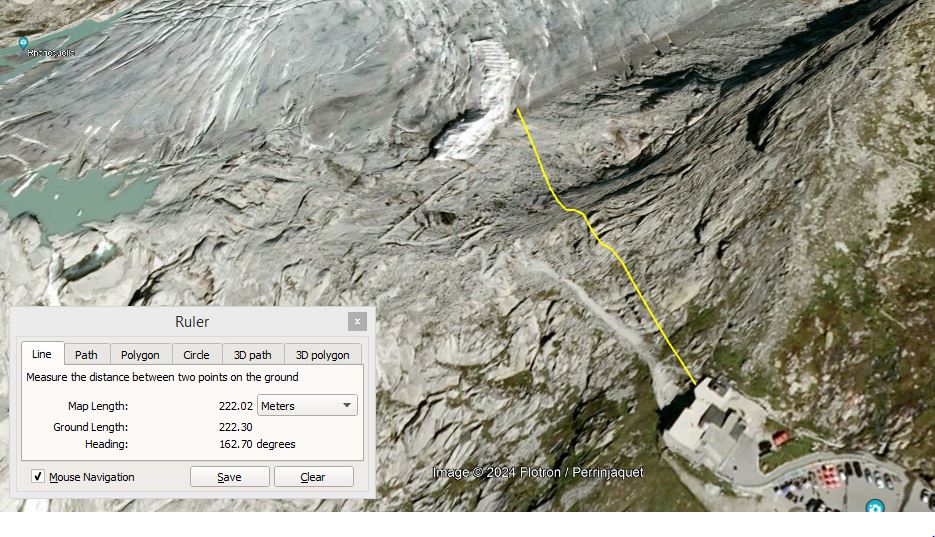
Unfortunately, the most recent Google Earth image is from 2009. Fortunately, that year is also the date of the first photograph of the pair. The glacier’s tongue looks to be about 200 m from the viewpoint, and the glacial lake has hardly begun.
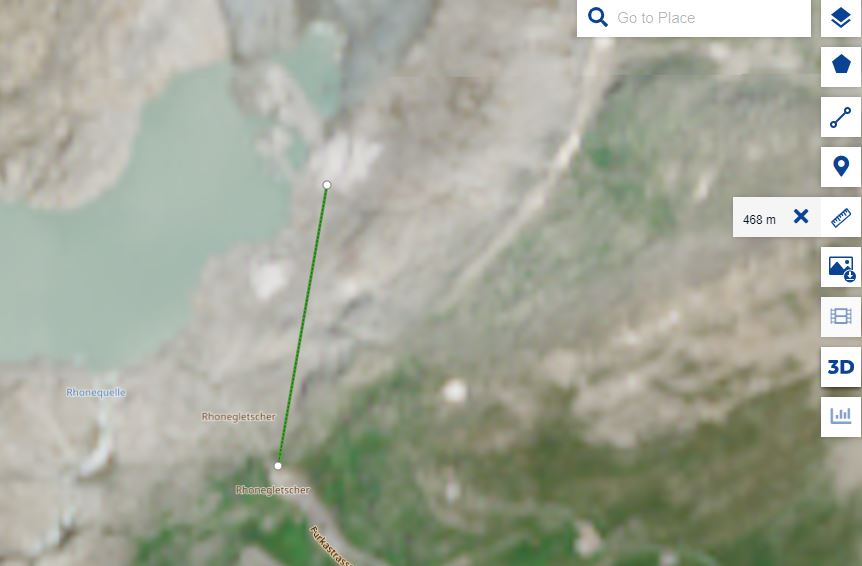
For 2024, I had to resort to the EU’s Copernicus website to get a measurement. Don’t adjust your set! The resolution is now only 20 m, so things are a little foggy. But there’s enough detail to see that the glacier has gone back quite a way, perhaps 300 m. In 15 years, that makes about 20 m per year. The tarn is now quite sizeable.
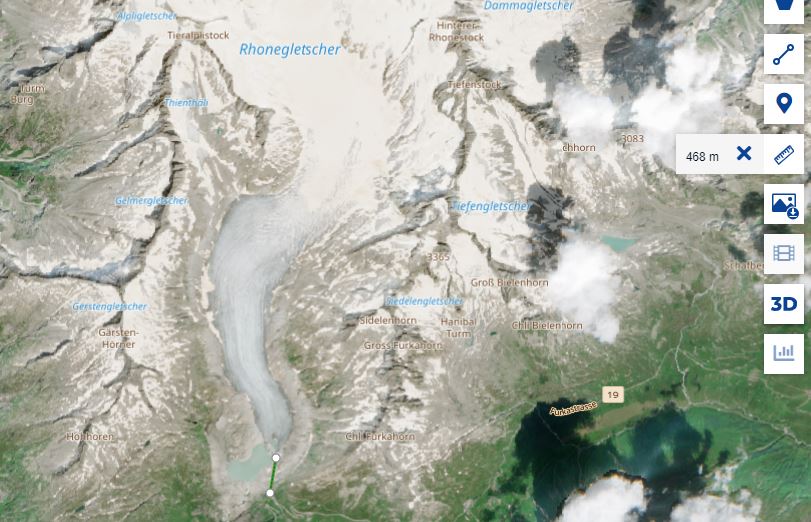
As you can see from this snip, there is a large chunk of the Rhonegletscher left. (Same scale bar at the bottom.)
Now for the context.
There is good data on the Rhonegletscher since the late 1880s, and plenty of intermittent observations prior to that. And naturally, there is further context pre-dating the direct record.
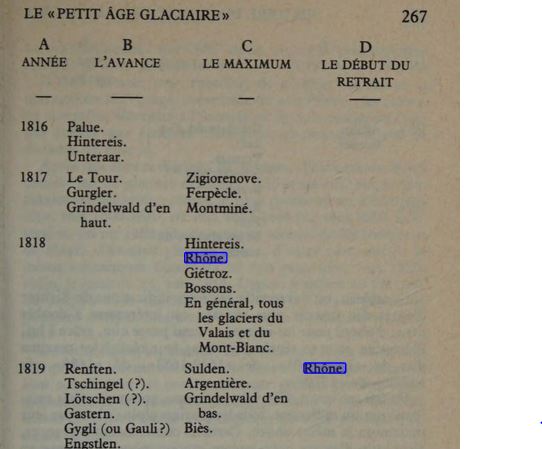
According to Le Roy Madurie [you can read his excellent book on climate since the year 1000 on Archive.org], the Rhonegletscher reached a recent maximum in 1818, & began to recede after that.
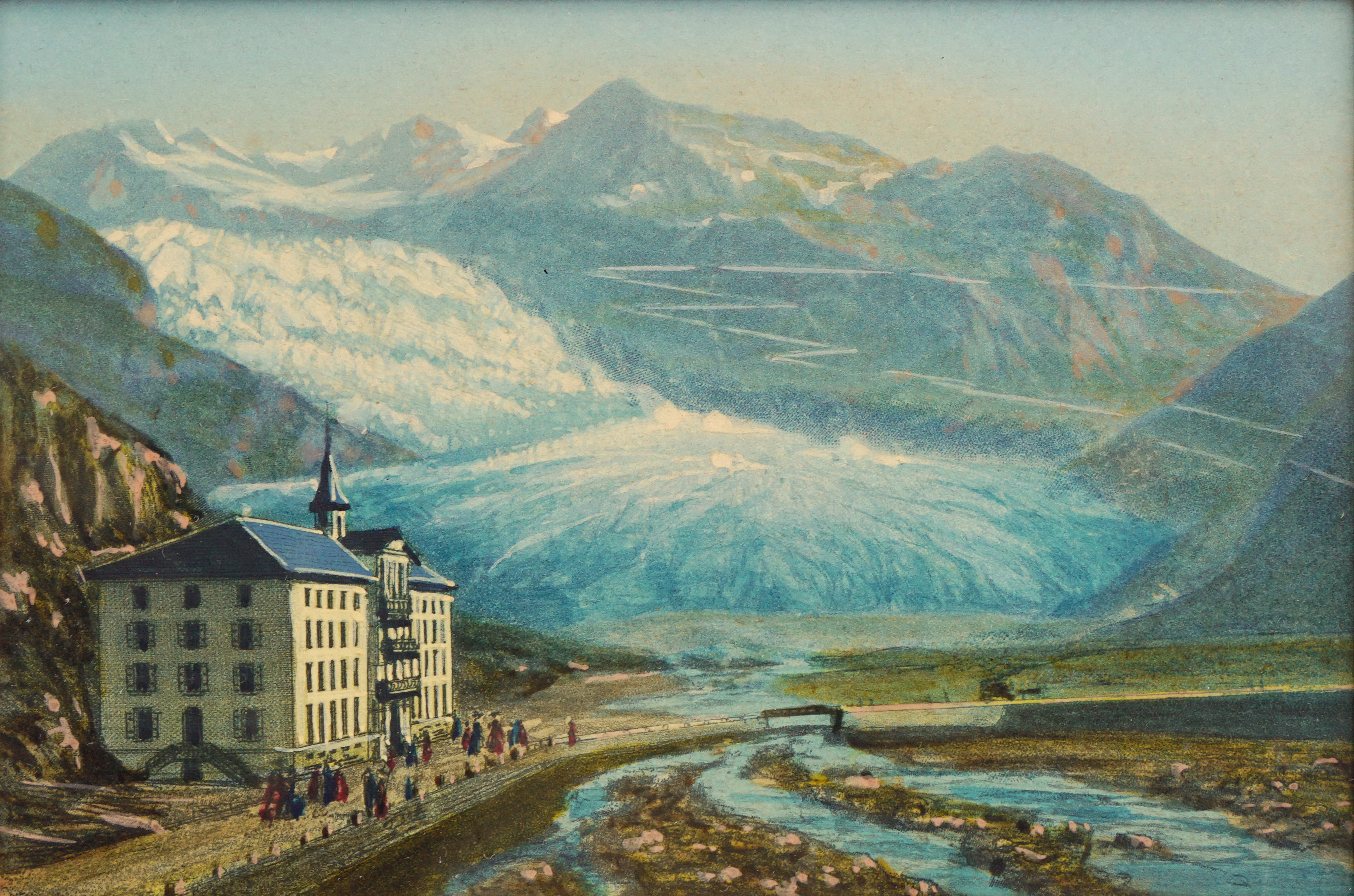
Wiki provides this landscape by Müller in about 1880. In the background, you can see the road leading over the Furka Pass (the Hotel Belvédère, and the modern photographs’ location is at about the third zigzag – the hotel’s construction and the landscape are close to contemporaneous). The location of Müller’s work is a place called Gletsch, which back when consisted of a chapel and the Hotel du Glacier du Rhone.
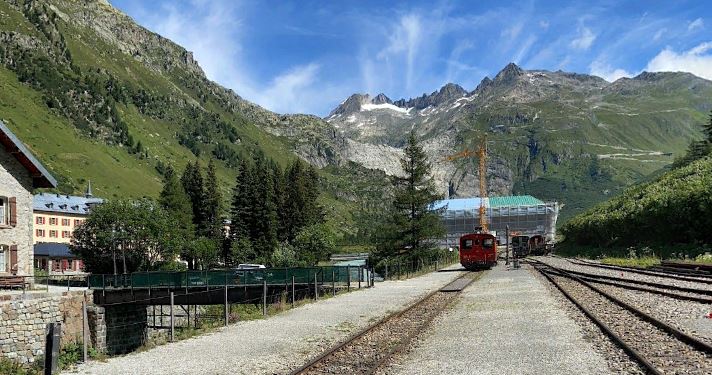
Several helpful souls have uploaded panoramas from modern Gletsch onto Google Earth. From this one by Laurin Eberhard you can still see the hotel, but it no longer has rooms with a view of the glacier. The tongue of the glacier and the tarn is behind the rock sill.
Le Roy Madurie also helpfully provides old maps showing the front of the glacier – the first from about the same time as Müller’s painting, and the second from 1955. By the second map, the glacier’s tongue has rolled back almost to the level of the Hotel Belvédère, as marked.
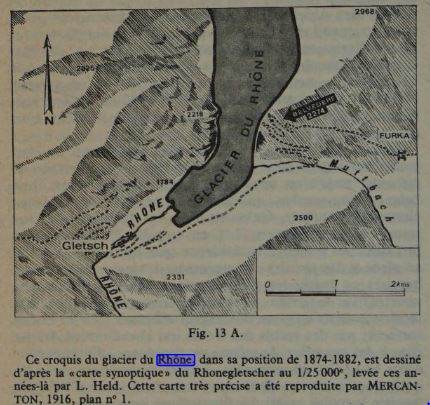
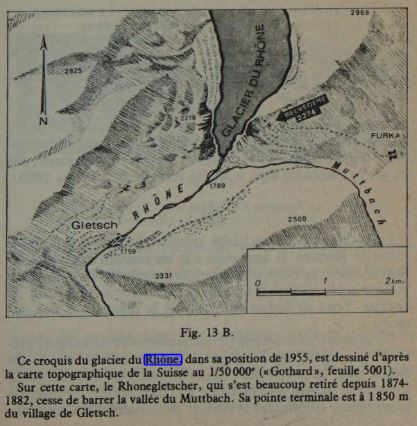
So far, the context we have is of not 15 years of recession, but two centuries.
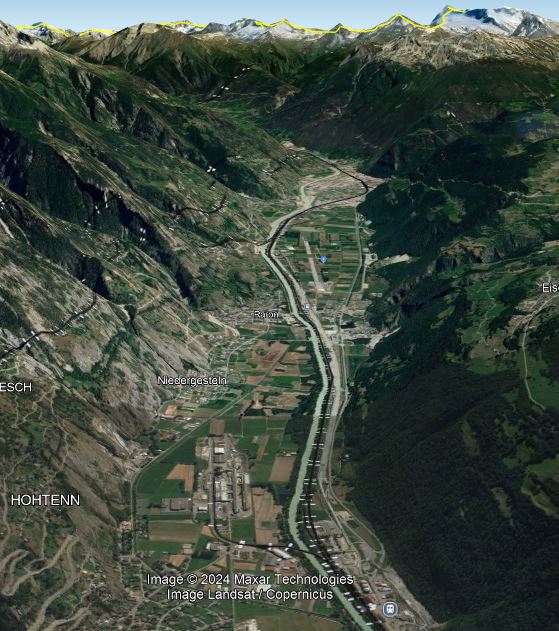
Next, if we zoom out, away from Gletsch and the Hotel Belvédère, we can see the rather impressive Upper Rhone valley in its entirety [Google Earth again]. Students of geography will recognise the landscape. The valley is >100 km long, descending westwards away from the glacier before turning right & opening out into Lake Geneva.

It should not need spelling out, but the settlements and farms that fill the bottom of this rather marvellous U-shaped valley depend for their existence on glacial retreat. Woe betide them if the ice began to advance.
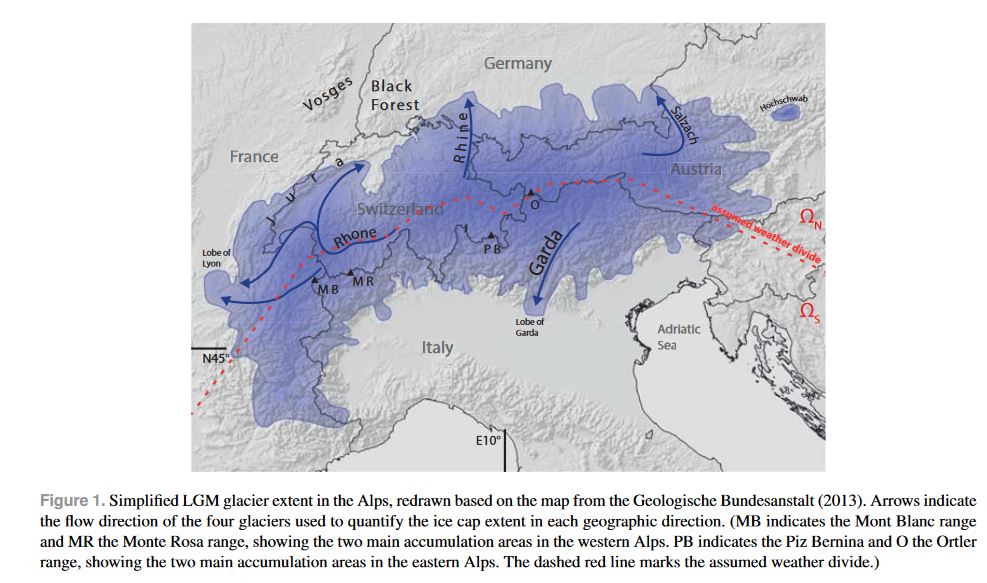
Zooming back still further, and deeper into time, we reach the scale of thousands of years and hundreds of kilometres. 20,000 years ago, the entire Alps was a single vast block of ice. Of course the Upper Rhone valley is filled, and Lake Geneva, Montreux and Geneva itself (where the little isthmus of Switzerland pokes into France under the J of Jura) are under the ice. Smoke on the Water? Not so much. (Figure from Becker et al, 2016.)
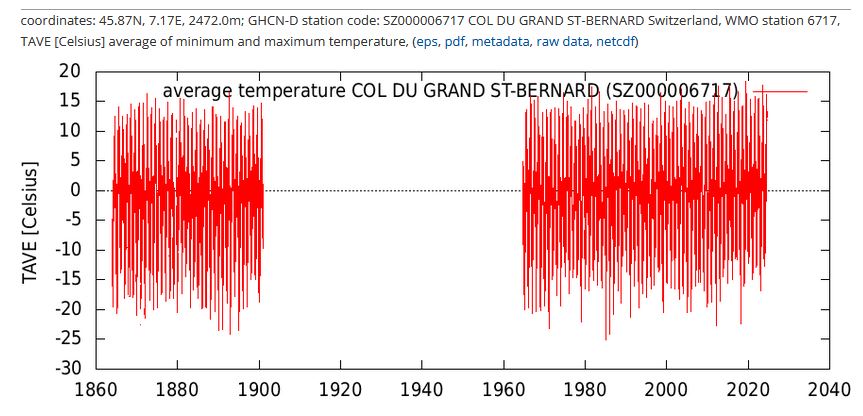
What has caused the recession of the Rhonegletscher? The beginning of its retreat in 1820 could not have been due to a surfeit of SUVs. And yes, temperatures have risen in the last 40 years, but not necessarily everywhere – the below image from KNMI shows the temperature record for the Col du Grand St-Bernard, at the other end of the Rhone valley and to its south, and at about the same elevation as Hotel Belvédère.
Then what? The old glaciologist’s answer is precipitation. The glacier is a conveyor belt loaded with ice at one end, and ablated and melted as it goes before dwindling to nothing. Naturally, storm tracks from the Atlantic vary in their average latitude, determining how much snow falls where. But I cannot help but wonder whether downslope land-use changes have a role to play in reducing the available precipitation: speculation, and something to investigate another day.
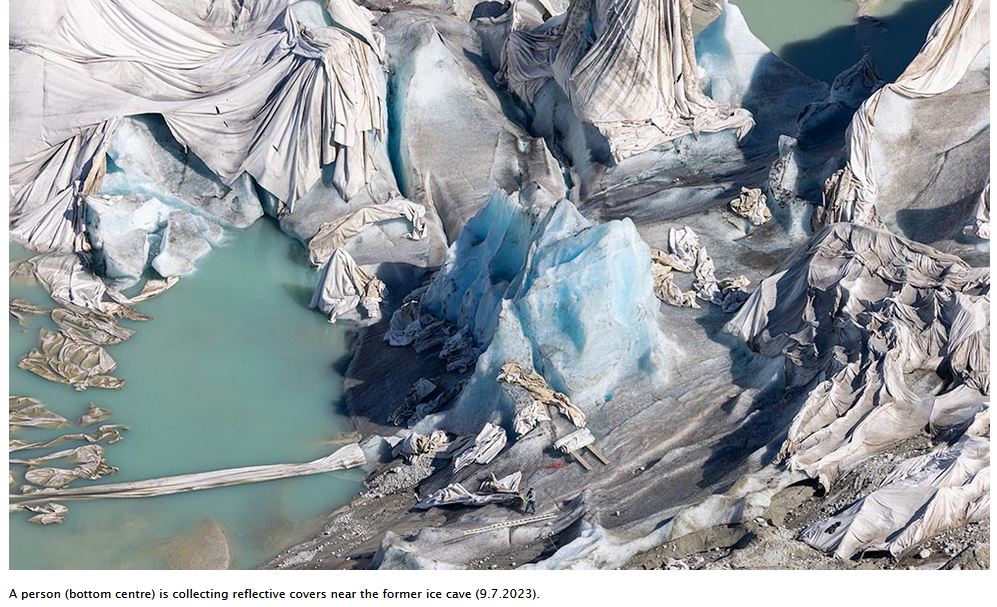
Finally on this topic, I present a futile attempt to wrap the Rhonegletscher in blankets to keep it cold. File under “trashing the planet to save it.” No doubt the proprietor of the ice grotto was upset that the ice receded and ruined their tourist attraction. But in general, few people lose out when the ice retreats.
The owners of the Hotel du Glacier du Rhone may be cheerful should the glacier once again peek over into their part of the valley. But we should be careful what we wish for.
Changes on human timescales can be dramatic, but they are dwarfed by what has gone on before we appeared on the landscape, and what will go on once we have departed it. Our perspective may be that Nature is static, or ought to be. But it never is. Change is the norm, and if the ice isn’t going…
…it’s coming.
via Climate Scepticism
August 28, 2024 at 03:42PM
 Iowa Climate Science Education