Month: August 2024

EV Explosion: Lithium Battery Fires Provide New & Exciting Firefighting Opportunities

Electric Vehicles running on wind and solar power captured and stored in lithium-ion batteries is all part of the grand ‘transition’, or so we’re told.

Except when those batteries self-immolate, burn for days and spew out a deadly toxic plume that threatens anything but breaths for miles around.

Not that the pyrotechnic mayhem attracts much coverage from the legacy media. No, that’s down to sites like this one and people like John Hinderaker on his Powerline Blog.

As John outlines below, firefighters must be delighted at the new and exciting opportunities to exhibit their skills when lithium-ion batteries to what they do best.

Should Electric Vehicles be Illegal?
Powerline Blog
John Hinderaker
27 June 2024

From ESPN: “Randall Cobb, family ‘lucky to be alive’ after house fire.”

Wide receiver Randall Cobb and his family escaped a fire at their Nashville, Tennessee, home this week, with his wife, Aiyda, posting, “we are lucky to be alive.”

Aiyda Cobb posted to her Instagram story this week that a Tesla charger “caught fire in the garage late last night and quickly spread” through their home.

“We got out of the house with nothing but the clothes on our back and no shoes on our feet,” she wrote.

The Cobbs have three young sons.

Electric vehicle batteries, like the large batteries used to store electricity from inept sources like wind and solar, are prone to burst into flame. And those fires are hard to extinguish. Out of curiosity, I googled “battery fire.” Here is a sampling of news headlines from the last 36 hours:

Driver sustained major injuries after colliding with a tree in an EV vehicle that caught fire.

Fiery Tesla Crash Poses Unique Challenges for Firefighters Near Anderson Valley.

Crews respond to battery fire at East Penn facility.

Man critically hurt in Brooklyn fire, e-bike battery probed as cause.

U.S. safety board probes fatal Tesla accident in Florida.

Baseus power banks recalled after dozens of fires, 13 burn injuries.

E-bike catches fire after being left in the sun in West Valley.

Route 35 closed in Naples due to fatal electric vehicle crash, battery fire.

This former Detroit firefighter is tackling the EV battery fire problem.

Lithium Batteries Are Set to Power the World—and Pose New Fire Risks.

Lithium-ion batteries, suspected in Keene fires, fuel widespread concern.

Three rescued from apparent lithium-ion battery fire in Midwood.

Fire breaks out in Tesla Megapack unit in Australia during testing.

Lithium-ion battery found at Brooklyn apartment fire: FDNY.

And, if we go back just 72 hours: Lithium battery factory fire kills 22 in South Korea.

Where is the Consumer Products Safety Commission? Where is the Congressional investigation? In what other context are products that spontaneously burst into flames legally marketed? If electric vehicles, e-bikes and batteries for wind and solar installations were not darlings of the “green” scam that controls government at most levels, would they even be legal?

These are serious questions.
Powerline
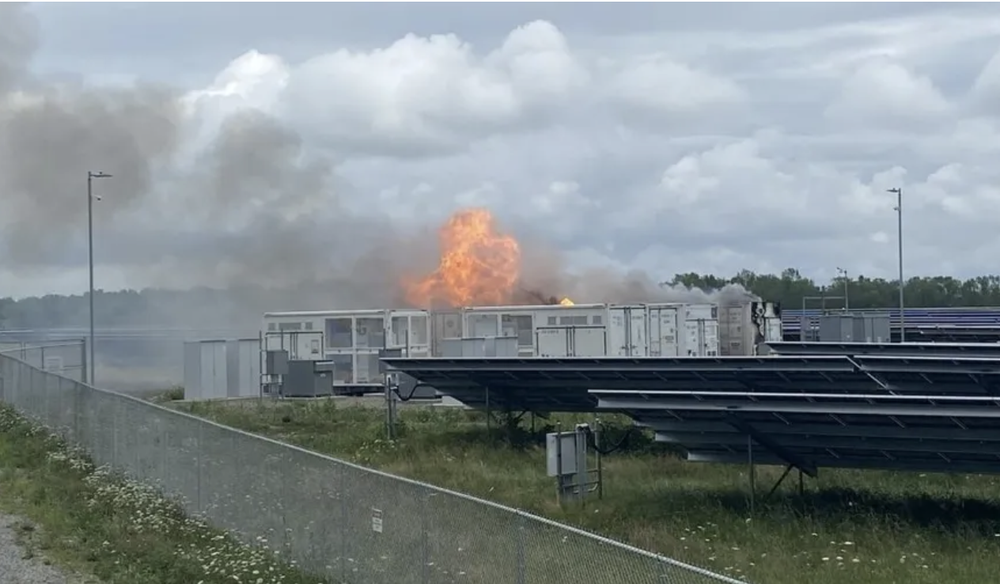
via STOP THESE THINGS

https://ift.tt/0XyiMVx

August 10, 2024 at 02:30AM

CARBON CAPTURE AND STORAGE

A lot of small scale experimental projects are being tested, as can be seen in the lengthy report, linked below, which was written in 2019, so more work will have been done since. The one thing that is not mentioned is the cost of this and how much it will increase the cost of electricity and other manufacturing processes, and that is a crucial question. Not to mention who is going to pay for it, as the answer is obviously us.

A scheme is being proposed here in the Solent by Exxon. This can be seen here: Solent CO2 Pipeline Project  There is currently a consultation out for public comment, focusing on the route of the pipeline, but some people may want to ask questions about safety, particularly as there is at least some similarity between injecting gas into rock under high pressure and the process of fracking.

 A review of CO2 storage in geological formations emphasizing modeling, monitoring and capacity estimation approaches | Petroleum Science (springer.com)

via climate science

https://ift.tt/eFA7W1u

August 10, 2024 at 01:55AM

What The Met Office Did Not Tell You About Extreme Temperatures

From NOT A LOT OF PEOPLE KNOW THAT

By Paul Homewood

Climate change is causing a dramatic increase in the frequency of temperature extremes and number of temperature records the UK experiences.

New analysis of observations shows that extremes of temperature in the UK are most affected by human induced climate change. This means the UK is seeing, on average, more frequent periods of hot weather, bringing challenges for infrastructure, health and wellbeing.

https://www.metoffice.gov.uk/about-us/news-and-media/media-centre/weather-and-climate-news/2024/temperature-extremes-and-records-most-affected-by-uks-changing-climate

Remember the Met Office’s recent claim that we seeing a dramatic increase in the frequency of temperature extremes?

As I pointed out at the time, while we might be experiencing an increasing number of hot days, we are also having fewer extreme cold days. The Met Office’s claim is therefore simply not true.

I have now had a chance to do a full analysis, which will be included in my GWPF State of the Climate report due out shortly.

I have taken the CET daily mean temperature data since 1961, and extracted the coldest and hottest 5% – ie days below the 5th percentile and above the 95th percentile.

As suspected, there has been an increase in the number of the hottest days, though interestingly, apart from 2018, years such as 1975, 1976, 1995 and 2006 were at similar levels to recent years. The last decade does not appear to be much different to the 1990s and 2000s, suggesting we won’t see any further significant increase. Ultimately hot days are the result of anti-cyclonic weather, and the UK’s variable, temperate climate tends to mitigate against summer long heatwaves.

But as well getting more hot days, we are also seeing a drastic reduction in the number of extreme cold days:

.

When we combine hot and cold together, there is no trend at all, either up or down:

The most extreme years were 1963, 1976, 1983, 1995, 2010 and 2018.

This analysis was easy to do, so why did the Met Office do something similar in their State of the UK Climate Report this year?

Instead they chose to deliberately deceive the public into believing that UK weather is becoming more extreme.

via Watts Up With That?

https://ift.tt/CbHmxht

August 10, 2024 at 12:00AM

Debunking the media’s July climate exaggerations

Global temperature, Olympic Seine swimming, hot day in the U.K., California’s Park Fire, Lightning, Rainfall, Sunlight, Key Largo tree cactus, ocean temperature and more.

via CFACT

https://ift.tt/8iX6KLv

August 9, 2024 at 11:10PM