Month: August 2024

No Farms, No Food

From THE DAILY SCEPTIC

We live in a world where oligarchs accumulate land, use their media assets to denigrate natural foods and invest in fake alternatives. On the other ‘side’, wealthy professionals calling themselves freedom fighters travel the world and the internet insisting we should eat organic and local. Meanwhile, the food security of many of the eight billion-plus of us remains at the mercy of the weather, diseases and insects. Neither side offers a viable solution or much benefit for many beyond themselves.

An increasing realisation of the corruption and greed that drives much of our New Normal is motivating a growing movement for self-sufficiency. Local sourcing of natural-grown foods is coupled with denigration of big agribusiness and industrialised food production. Incoherently, it is also often coupled with claims that those backing the big agribusiness enemy are aiming for depopulation, while the way in which small-scale agriculture will feed the world’s growing population is left unexplained.

From the comfort of big jet planes made in huge factories, it is now possible to gain likes by posting photos of the organic and rather cute livestock we left back home. These can be supplemented with pictures of the Thai rice, Costa Rican coffee and Mexican avocados from our favorite brunch spot. This approach to food and agriculture is a hobby, and a good one. But the world cannot support eight billion such hobbies.

The other side of the agriculture coin has also been doing us harm: an obese population in rich countries with declining life expectancy, fat on industrial corn syrup, seed oils and other unnatural metabolism adulterators, coupled with declining physical activity. Nor are we benefiting from unevidenced claims that diets including meat or raw milk will somehow restart an age of plagues. Or that humans should transform themselves into insectivores.

Regulating independent family farmers out of business, with their generations of knowledge, is not a step forward either but a decimation of rural society and human dignity – of the reason for living in the first place. Replacing them with centralised fake food factories funded by wealthy investors and their pet celebrities will concentrate wealth rather than food security. To survive and thrive – all of us – we need to face the realities of growing and delivering huge quantities of healthy human food.

We feed far more, and live far better, than past Malthusians predicted because we grow more food and store and transport it more effectively than they thought we could. That is not an ‘elitist’ thing, it is quite the opposite. Like the rest of life, we need to continue to progress, but keep that progress in all our hands rather than a greed-driven few – which is the unavoidable challenge of all human progress, and a challenge our agencies are now failing. But in fighting for food freedom, we must still feed over eight billion. This means investing in large-scale farm machinery and supply and food management infrastructure – in large agricultural enterprises.

Living the rural dream

I live on a few acres, and this produces about 70% of my family’s food thanks to a lot of trudging through mud. We eat mostly our own meat, our own eggs (chickens, ducks, geese, turkeys), vegetables, and in season our own fruit and milk. If you have a good external income, and a few acres of well-watered fertile land, you can do this and still go to restaurants, drive a car, and travel for conferences and holidays. We are very fortunate. By the standard of most people on earth, highly privileged. It is hard work and stinks after rain, but it’s rewarding. It feel good to eat the fruit of your own labour.

We grow most of our own food partly for health reasons, partly to have something to rely on if things get really bad. We also do it because it is, at times, fun. In good months we also save money. Recently, a hurricane came through followed by three weeks of near continuous heavy rain. The cost of recovery just for the little land and fences we have is going to be well above the total market value of all our livestock, and probably negate two years of savings on groceries. We will recover because, in keeping with a minority of humanity, we have good external resources to draw on.

Hurricane aside, we have lost two breeding stock and one intended for the table in the past two months due to parasitic worm infestations (a curse of warm humid environments). We would have lost more without modern pharmaceuticals and supplementary (i.e., externally-purchased) stockfeed. If we could not afford the fence repairs, we would have no livestock at all. Our in-soil veggies and two fruit trees are also rotting due to the exceptionally wet weather. Last week another tree fell onto a fence, adrift in the hyper-saturated soil.

If we were really subsistence farmers, like most small-scale farmers are globally, we would now face starvation or the loss of our land and future income – like people in the West also did before the industrial revolution transformed agriculture, and as hundreds of millions in other countries still do. This is why we now have large farms with a lot of equipment: so that they can be resilient.

A friend nearby farms 6,000 acres of cereals. They plant out genetically modified seed, treat them with herbicides and pesticides at certain intervals and harvest when they are ripe and dry. This farming is extremely fossil fuel and labour intensive – ploughing, seeding, spraying, harvesting. Even with this, corn can grow fungus in the cobs or large acreages can be lost due to rain. They are completely at the mercy of the weather. Enough but not too much rain, and sun at the right time. With 6,000 acres owned or leased, a couple of families make a modest living. None, if it rains at harvest time.

Last year, they lost about $20,000 of crops simply to blackbirds. This year, with the hurricane, they lost an entire crop of sorghum. Unpredicted rain this week wiped out the entire rice crop, just as it was drying enough from the three weeks of rain to be fit for harvest. But they still have to pay for the seed, the fuel, the installments on their machinery and everything else a family needs. They will not have an income this year, which is something most salaried people ─ fed through the farmers’ precarious efforts ─ will never experience. If they can muster the resources, the farmers will buy seed, fertiliser and thousands of gallons of fuel, to try again next year. Or they will lose it all. They will probably never get rich and are always in debt. A combine harvester costs almost half a million dollars. Modern cereal croppers must live on debt. There is no prospect of the windfall farming boom that software and biotech engineers hope for.

Surviving the urban dream

An hour north, there is a city of over three million people. Most live on small suburban blocks or in apartments and work much of the day in an office or factory, or even a shop selling food. To eat, they rely on a huge network they are barely aware of. This network drills the oil, builds the machinery, acquires the harvest or livestock, processes it and preserves it, and transports it close enough, at a low enough price, for them to buy. They can supplement it with backyard or hydroponic vegetables or a few eggs, but without this vast network the city could not exist.

Without this and other vast cities, organic hobby farmers could not fly to conferences on freedom and self-sufficiency, drive cars or post on the internet. There would be no fuel, no smartphones and no colleges for their kids. None of the medicines that sometimes stop kids dying and adults going blind, as they often used to. This is why, over hundreds of years, we have expanded cities and increasingly differentiated occupations. Because we can only have these things if most of us don’t have to spend most of our time growing food, and if we don’t have mass human die-offs when the weather turns bad.

New York and Greater London are roughly three times the size of our nearest city, and the world has a dozen of more cities of over 20 million people. They are packed – more than half of humanity lives in urban areas – and they all need feeding, or they will die. They cannot grow their own food – at least nowhere near enough to live on. They are busy doing those things the rest of us rely on, and they have almost no space. They can dabble for fun and health, but their survival hinges on a massive industry of growing, transporting, preserving and delivering vast quantities of food.

Long ago, most people in the West subsisted off the land. Life was generally confined to the local village, women commonly died in childbirth and children before their fifth birthday. Many never left the vicinity of their village, as they had no savings, means of transport or free time in which to do so. Consecutive bad seasons often meant mass starvation. Over the past couple of hundred years our population has massively increased, and we have, despite the predictions of Malthusians, actually managed not only to feed ourselves, but increasingly to over-feed ourselves.

Today, in many African and Asian economies, small-scale low-tech farming still remains the norm. It uses low levels of fertiliser, minimal machinery or fossil fuel and few anti-parasitic medications or pesticides. The families that run them lose children to easily preventable diseases, mothers to childbirth and daughters to child marriage. Walking through mud all day bent over under the hot sun, with your child lying with fever in the two-room hovel, is not a good life. Watching stunted children crouched on a floor eating white rice and few leaves for their main meal causes the rural ideal to lose its romance. It is why so many young people leave at the first opportunity. Otherwise, they can never, on their meager small-holdings, get out of poverty.

Cars, air conditioning, overseas holidays and cancer surgery may be things traditional small-holder farmers read about, but the technology revolution that gave them to us remains inaccessible. They will need fewer people farming per acre, as small farms simply cannot provide the capital with which to purchase such things that we, writing and reading articles such as this in the West, consider quite basic to our lives.

Serving more than eight billion

Tens of millions of people receive external food aid to prevent them starving to death in normal years and with 350 million in acute food insecurity, this goes up when there are bad seasons. The Green Revolution – the increase in agricultural output over the past several decades – has kept this relatively constant as the total population increased massively, confounding the Malthusians. But it remains precarious as long as the technologies and fertilisers driving it are concentrated in few hands, as long as genetically-modified crops can be owned by a few companies. Much of the Green Revolution remains poorly accessible where populations are increasing most rapidly – in sub-Saharan Africa and parts of South Asia. These growing populations need high yield agriculture to be expanded, rather than hobbled by distant and wealthy idealists.

This is not an argument for corporate takeover of farming – farmers should have the right to kill and sell their own stock (obviously) and local sourcing should be encouraged. We will continue drinking raw milk and eating red meat and a natural human diet. Our society has done well because our food industry was generally diverse and competitive, and fossil fuels keep our food safe and accessible. The five-year plans of Mao, Stalin and Khrushchev, like the centralised madness proposed by the UN and WEF today, served only the few whilst bringing famine, and the promise of future famine, to the many.

But, if we are to live as most would like, and not die unnecessarily young, and feed our massive cities, we will need to expand most of the trappings and innovations that have proven former Malthusians wrong. Local sourcing by itself brings local starvation when things get bad, unless there is an alternative to come to the rescue that is able to preserve and transport food from elsewhere. The people who make our aeroplanes and maintain our internet also have to eat – cheaply enough that they too can fly and surf the web as we do. If we believe in basic equality and freedom, then we need to also support the aspirations of struggling semi-subsistence farmers in poorer countries who dream of doing the same.

Embrace reality

The two approaches are not mutually exclusive – a competitive market can support local sourcing for those where food is grown, feed cities and disseminate wealth. Destruction of big agriculture is starvation for many, while centralised control by the rich WEF oligarchs who currently seek to destroy smaller farmers and force us onto highly processed factory food will eventually do the same. To steer a middle and rational approach, we first need to keep our feet on the ground.

Otherwise, natural food advocates will look like the Malthusians they seek to oppose. We can all try self-sustainability if we only have a billion or so on the planet, as our forebears did. Life will be rather feudal, but the rich and the big landowners, who will rapidly accumulate others’ land during droughts and floods, will be happy. However, if we value the lives of all of us here and now, we had better be serious about feeding all of us.

Food freedom should mean open markets, farmer rights and ensuring this absolutely vital part of supporting humanity remains in the hands of many, not a few. We need big productive farms, and we need them run by people who understand the land rather than distant investment funds, software entrepreneurs or sycophants of the latest Davos-fascist group-think.

Hobby farming will continue to be a viable and good alternative for those fortunate and wealthy, but aiming to dismantle the agricultural ‘Green Revolution’ is dangerously close to willful depopulation . We should fight to reduce its environmental harms, wherever we can show this will not leave millions hungry. But the fight should primarily be for a path out of poverty and the freedom to choose, not a fight for the utopia of a privileged few.

Dr. David Bell is a clinical and public health physician with a PhD in population health and background in internal medicine, modelling and epidemiology of infectious disease. Previously, he was Director of the Global Health Technologies at Intellectual Ventures Global Good Fund in the USA, Programme Head for Malaria and Acute Febrile Disease at FIND in Geneva, and coordinating malaria diagnostics strategy with the World Health Organisation. He is a Senior Scholar at the Brownstone Institute.

via Watts Up With That?

https://ift.tt/KUNW74E

August 8, 2024 at 04:06PM

Lost for 30 years in a freezer: The whole of Greenland melted away when CO2 was perfect — consensus broken

By Jo Nova

The Experts thought Greenland’s ice has been there for the whole Pleistoscene era, or the last 2.6 million years. It was just another useless consensus, stultifying science — feeding the myth that the climate was perfect until Big Coal screwed it up.

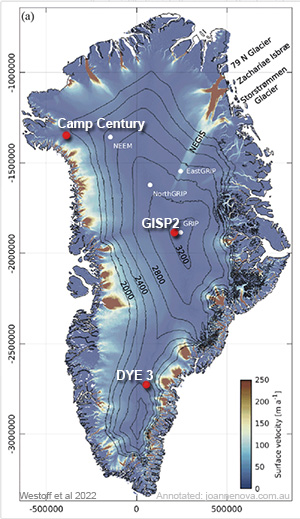
Map of Greenland ice core sites. GISP, DYE 3, Camp Century.

From Westoff et al 2022 https://ift.tt/RlZYnEQ

Finally, 30 years after the famous GISP ice core was hauled out of the Greenland summit, someone has bothered to study the dirt at the bottom and found poppy seeds, willow twigs and insects there, where they were not supposed to be. They discovered a vibrant tundra ecosystem where there was supposed to be an ice-cap. The obvious conclusion is that cavemen didn’t cause it, and that there must be some huge other natural forces at work that we have no clue about. Our climate models didn’t predict this, because CO2 was low then and clearly, the models are hopelessly incomplete. We are babes in the wood on the third rock from the sun.

The captive science PR writers don’t tell us that CO2 might be irrelevant compared to the big mystery forces we don’t understand. Instead they tell us that this means that the Greenland icesheet is more fragile than we realized and could melt again (send us your money!)

No matter what we discover it’s always worse than we thought:

Scientists have discovered plant and insect remains under a two-mile-deep (three km) ice core extracted from the center of the island, providing the clearest proof yet that nearly all of this vast territory was green within the past million years, when atmospheric carbon levels were much lower than today.

Their research, published Monday in the Proceedings of the National Academy of Sciences, indicates even greater potential for global sea level rise due to human-caused climate than previously thought.

The stranglehold of government funded science meant it took 30 years to do  “half an hour” of research:

The ice core, named GISP2, was drilled in 1993 and although its rock and ice had been studied extensively, nobody had thought to look for fossils in the ’till,’ or the mixed sediment at the bottom.

That’s because until recently the idea that Greenland was ice-free in the recent geologic past seemed too far-fetched.

“Literally, we saw the fossils within the first hour, maybe half hour, of working on it,” lead author Paul Bierman, a professor of environmental science at the University of Vermont, told AFP.

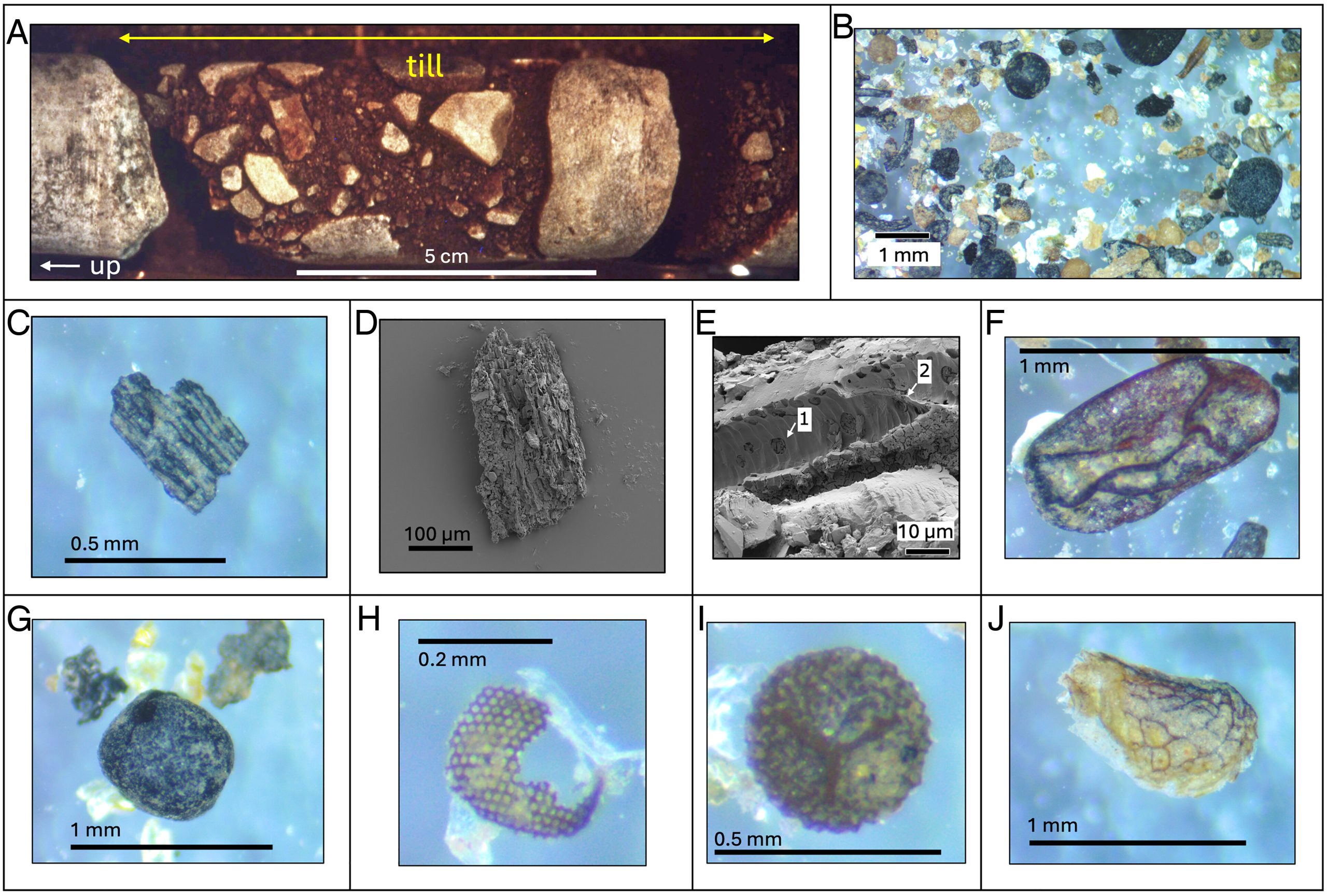
To their amazement, researchers found within this three-inch-layer soil willow wood, spores from spikemoss, fungi, the compound eye of an insect, and a poppy seed – together suggesting a vibrant tundra ecosystem.

The GISP2 site is about as high and central as you can get in Greenland. If the ice was gone there, it was probably gone everywhere.  But the same experts who want us to spend $1,000 billion dollars every year, thought that Greenland was an impenetrable ice-fortress.

In 2016 some scientists figured out the bedrock under the GISP core was only 1.1 million years old, which was considered “controversial” since the ice was supposed to have been solid for 2.6 million years. In 2019 Bierman et al were shocked to find that Camp Century (in the far north) had melted totally around 416,000 years ago.  (That frozen soil was first dug up in the 1960s, so it sat in a Danish freezer for fifty years.) Another ice core at DYE 3 contained the DNA of spruce trees. Obviously Greenland melts, we just don’t know why, when or how often. The researchers best guess is that the ice melted at the summit probably more than 250,000 years ago and probably less than 1.1 million. Maybe it was 416,000 years ago too.

If the whole ice cap melted, the world’s oceans presumably rose the 7 odd meters they are theoretically supposed to rise. There is no denying that  this would be seriously inconvenient today, especially for coastal real estate, but it’s also true to say corals reefs didn’t vanish,  there was no mass extinction or runaway Greenhouse apocalypse either. The Earth didn’t turn into Venus.

The important message here should be that natural climate change could smack us over the head, but we don’t understand the big forces at all. If Greenland’s ice-cap melts again, we need a few decades to prepare. So we need climate models that can actually predict things, not ones that suit politicians and strangle real research for decades.

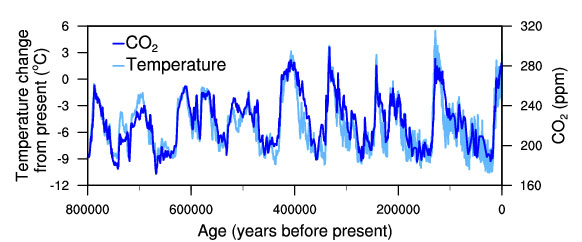
If Greenland melted 416,000 years ago, why didn’t it melt during the other three warm spikes below? (Graph from the EPICA ice core in Antarctica).

Epica ice core Antarctica. NOAA

Epica ice core Antarctica. NOAA

Photos of the spores, wood and insect eyes that are not supposed to live at the summit of Greenland during an ice age period.

Greenland soil, plants.

GISP2 till and macrofossils found in it: (A) Photo of the angular-clast-rich till section of the GISP2 subglacial core, taken 1994, up core to left (Credit: T. Gow, supplied by D. Meese). (B) Overview of sediment, mostly quartz and fossils. (C) Wood fragment. (D) Vertical orientation typical of GISP2 wood. (E) Wood at higher magnification showing simple pits in lateral vessel wall (1) and distinct simple perforation plate (2), along with the helical thickening typical of GISP2 wood. (F) Bud scale of Salix (willow). (G) Sclerotium of the soil fungus C. geophilum* (H) Insect eye, possibly from a fly*. (I) S. rupestris megaspore. (J) Seed of Papaver sect. Scapiflora. The asterisk shows macrofossil types also found in Camp Century sediment by ref. 5. Wood fragment images are same specimen. https://ift.tt/MkLDlxR

REFERENCE

Bierman, et al (2024) Plant, insect, and fungi fossils under the center of Greenland’s ice sheet are evidence of ice-free times, PNAS, August 5, 2024, 121 (33) e2407465121, https://doi.org/10.1073/pnas.2407465121


10 out of 10 based on 1 rating

via JoNova

https://ift.tt/i8sxhpW

August 8, 2024 at 03:47PM

The Case Against Net Zero – a Fourth Update

In October 2008, Parliament passed the Climate Change Act requiring the UK Government to ensure that by 2050 ‘the net UK carbon account’ was reduced to a level at least 80% lower than that of 1990. (‘carbon account’ refers to CO2 emissions and ‘other targeted greenhouse gas emissions’.) Only five MPs voted against it. Then in 2019, by secondary legislation and without serious debate, Parliament increased the 80% reduction requirement to 100% – thereby creating the Net Zero policy.i

Unfortunately, it’s a policy that’s unachievable, potentially disastrous and in any case pointless – and, importantly, that’s the case irrespective of whether or not human caused greenhouse gas emissions are contributing to a rise in global temperature.

1. It’s unachievable.

Many vehicles and machines (used for example in agriculture, mining, mineral processing, building, heavy transportation, commercial shipping and aviation, the military and emergency services) and products (for example cement (and concrete), high-grade steel, plastics – all needed incidentally for the construction of renewables – nitrogen fertilisers, insecticides, pharmaceuticals, anaesthetics, lubricants, solvents, paints, adhesives, insulation, tyres and asphalt) essential to life and wellbeing require the combustion of fossil fuels or are made from oil derivatives; there are no easily deployable, commercially viable alternatives. Our civilisation is based on fossil fuels; something that’s unlikely to change for a long time.ii

Wind is the most effective source of renewable electricity in the U.K., but: (i) the substantial and increasing costs of building the huge numbers of turbines needed for Net Zero, (ii) the complex engineering and cost challenges of establishing a stable, reliable non-fossil fuel grid by 2030 – not least the need to cope with a vast increase in high voltage grid capacity and local distribution, (iii) the enormous scale of what’s involved (immense amounts of space iii and of increasingly unavailable and expensive raw materials, such as so-called ‘rare earths’) required because, unlike fossil fuels, the ‘energy density’ of wind is so low and (iv) the intermittency of renewable energy (see 2 below) make it unlikely that the UK will be able to generate sufficient electricity for current needs let alone for the mandated EVs (electric vehicles) and heat pumps and for the energy requirements of industry, rapidly expanding AI (artificial intelligence) and huge new data centres.iv

In any case, the UK doesn’t have nearly enough skilled technical managers, electrical, heating and other engineers, electricians, plumbers, welders, mechanics and other skilled tradespeople required to do the multitude of tasks essential to achieve Net Zero – a problem worsened by the Government’s plans for massively increased house building.v

‘Net Zero’ means that there has to be a balance between the amount of any greenhouse gas emissions produced and the amount removed from the atmosphere. That there’s no detailed, costed (or indeed any) plan for such removal, threatens the credibility of the project.

2. It would be socially and economically disastrous.

The Government aims for 100% renewable electricity by 2030 but has yet to publish a fully costed engineering plan for the provision of comprehensive grid-scale back-up when there’s little or no wind or sun; a problem that’s exacerbated by the pending retirement of elderly fossil fuel and nuclear power plants. The Government has indicated that back-up may be provided by new gas-fired power plants vi but it hasn’t published any detail. This of course would not be a ‘clean’ solution and it seems the Government’s solution is to fit them with controversial carbon capture and underground storage (CCS) systems (commercially unproven at scale).vii This issue is desperately important: without full back-up, electricity blackouts would be inevitable – ruining many businesses and causing dreadful problems for millions of people, including health consequences threatening everyone and in particular the poor and vulnerable.viii

Even more serious is the fact that, because there’s no coherent plan for the project’s delivery, little attention has been given to its overall cost. All that’s clear is that it would almost certainly be unaffordable: for example, a recent Office for Budget Responsibility projection of £1.4 trillion ix is probably too low and several trillion seems likely to be more accurate.x The borrowing and taxes required for costs at this scale would destroy Britain’s already weak credit standing and put an impossible burden onto millions of households and businesses.

Net Zero would have two other dire consequences:

(i) As China essentially controls the supply of key materials (for example, lithium, cobalt, aluminium, processed graphite and so-called rare earths) without which renewables cannot be manufactured, the UK would greatly increase its already damaging dependence on it, putting its energy and overall security at most serious risk.xi Moreover, while impoverishing Britain, Net Zero is enriching China.xii

(ii) The vast mining and mineral processing operations required for renewables are already causing appalling environmental damage and dreadful human suffering throughout the world, affecting in particular fragile, unspoilt ecosystems and many of the world’s poorest and most vulnerable people; the continued pursuit of Net Zero would make all this far worse.xiii

3. In any case it’s pointless.

For two reasons:

(i) It’s absurd to regard the closure of greenhouse gas (GHG) emitting plants in the UK and their ‘export’ mainly to SE Asian countries, commonly with poor environmental regulation and often powered by coal-fired electricity, as a positive step towards Net Zero; such action will increase global emissions. Yet efforts to ‘decarbonise’ the UK mean that’s what’s happening and it’s why we are foolishly closing our last oil refinery and are no longer able to produce for example key chemicals, nitrogen fertiliser and high quality steel.

(ii) Most major non-Western countries – the source of over 75% of GHG emissions and home to 84% of humanity – don’t regard emission reduction as a priority and, either exempt (by international agreement) from or ignoring any obligation to reduce their emissions, are focused instead on economic and social development, poverty eradication and energy security. As a result, global emissions are increasing (by 62% since 1990) and are set to continue to increase for the foreseeable future. The UK is the source of less than 1% of global emissions – so any further emission reduction it may achieve cannot have any impact on the global position.xiv

In other words, Net Zero means the UK is legally obliged to pursue an unachievable, potentially disastrous and pointless policy – a policy that could well result in Britain’s economic destruction.

Robin Guenier August 2024

Guenier is a retired, writer, speaker and business consultant. He has a degree in law from Oxford, is qualified as a barrister and for twenty years was chief executive of various high-tech companies, including the Central Computing and Telecommunications Agency reporting to the UK Cabinet Office. A Freeman of the City of London, he was Executive Director of Taskforce 2000, founder chair of the medical online research company MedixGlobal and a regular contributor to TV and radio.

End notes:

ihttp://www.legislation.gov.uk/ukpga/2008/27/part/1/crossheading/the-target-for-2050

ii See Vaclav Smil’s important book, How the World Really Works: https://time.com/6175734/reliance-on-fossil-fuels/.

iii See Andrews & Jelley, “Energy Science”, 3rd ed., Oxford, page 16: http://tiny.cc/4jhezz

iv For a view of wind power’s many problems, see this: https://watt-logic.com/2023/06/14/wind-farm-costs/ This is also relevant: https://davidturver.substack.com/p/debunking-cheap-renewables-myth

v A detailed Government report: https://assets.publishing.service.gov.uk/media/65855506fc07f3000d8d46bd/Employer_skills_survey_2022_research_report.pdf See also pages 10 and 11 of the Royal Academy of Engineering report (Note 5 below).

vi See this report by the Royal Academy of Engineering: https://nepc.raeng.org.uk/media/uoqclnri/electricity-decarbonisation-report.pdf (Go to section 2.4.3 on page 22.) This interesting report contains a lot of valuable information.

vii In this report the Institute for Energy Economics and Financial Analysis indicates serious uncertainties and shortcomings regarding CCS: https://ieefa.org/wp-content/uploads/2022/03/Gorgon-Carbon-Capture-and-Storage_The-Sting-in-the-Tail_April-2022.pdf Also see this: https://www.telegraph.co.uk/business/2024/07/24/how-failure-carbon-capture-risks-net-zero-nightmare-labour/

viii This article reviews why more renewables could result in blackouts: http://tiny.cc/lnhezz

ixhttps://www.cityam.com/uk-fiscal-watchdog-puts-cost-of-reaching-net-zero-at-1-4trn/

x The National Grid ESO has said net zero will cost £3 trillion: https://www.current-news.co.uk/reaching-net-zero-to-cost-3bn-says-national-grid-eso/. And in this presentation Michael Kelly, Emeritus Professor of Technology at Cambridge, shows how the cost would amount to several trillion pounds: https://www.youtube.com/watch?v=NkImqOxMqvU

xihttps://www.dw.com/en/the-eus-risky-dependency-on-critical-chinese-metals/a-61462687

xii See for example this article by environmentalist Bjorn Lomborg: https://dailysceptic.org/2024/07/24/net-zero-is-impoverishing-the-west-and-enriching-china/

xiii See this for example: http://tiny.cc/3lhezz. Arguably the most compelling and harrowing evidence is found in Siddharth Kara’s book Cobalt Red – about the horrors of cobalt mining in the Congo: https://us.macmillan.com/books/9781250284297/cobaltred

xiv This comprehensive analysis, based on an EU database, provides – re global greenhouse gas and CO2 emissions – detailed information by country from 1990 to 2022: https://edgar.jrc.ec.europa.eu/report_2023?vis=ghgtot#emissions_table

via Climate Scepticism

https://ift.tt/ziq1XIb

August 8, 2024 at 01:57PM

Scottish Wind Power from Diesel Generators

John Gideon Hartnett writes at Spectator Australia Another climate myth busted  explaining how the Scottish public was scammed about their virtuous green wind power.by the public authority  Excerpts in italics with my bolds and added images from post by John Ray at his blog.

What I like to call ‘climate cult’ wind farms expose the myth that wind can replace hydrocarbon fuels for power generation. The following story is typical of the problems associated with using wind turbines to generate electricity in a cold environment.

Apparently, diesel-fuelled generators are being used to power some wind turbines as a way of de-icing them in cold weather, that is, to keep them rotating. Also, it appears that the wind turbines have been drawing electric power directly from the grid instead of supplying it to the grid.

Scotland’s wind turbines have been secretly using fossil fuels.

The revelation is now fueling environmental, health and safety concerns, especially since the diesel-generated turbines were running for up to six hours a day.

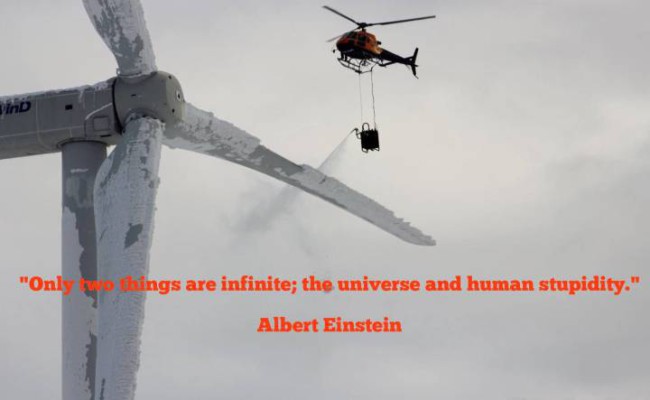
Scottish Power said the company was forced to hook up 71 windmills to the fossil fuel supply after a fault on its grid. The move was an attempt to keep the turbines warm and working during the cold month of December.

South Scotland Labor MSP Colin Smyth said regardless of the reasons, using diesel to deice faulty turbines is “environmental madness”.  Source: Straight Arrow News

Charging system for Teslas at Davos WEF meeting.

Nevertheless, those pushing these technologies are so blind to the physical realities of the world that they are prepared to ignore failures while pretending to efficiently generate electricity. I say ‘failures’ because wind energy was put out of service the day the Industrial Revolution was fired up (pun intended) with carbon-based fuels, from petroleum and coal. And in the case of modern wind turbines, they do not always generate electricity; they sometimes consume it from the grid.

Green energy needs the hydrocarbon-based fuel it claims to replace.

Hydrocarbon-based fuels were provided providentially by the Creator of this planet for our use. That includes coal, which has been demonised in the Western press as some sort of evil. But those who run that line must have forgotten to tell China, because they build two coal-fired power stations every other week. No other source of non-nuclear power is as reliable for baseload generation.

How will wind turbines work in a globally cooling climate as Earth heads into a grand solar minimum and temperatures plummet? This case from Scotland may give us a hint. As cloud cover increases with cooler weather, and more precipitation occurs, how will solar perform? It won’t.
The two worst choices for electricity generation in cold, wet, and stormy environments are solar and wind. Solar is obvious. No sun means no power generation. But you might think wind is a much better choice under those conditions.

However, wind turbine rotors have to be shut down if the wind becomes too strong and/or rapidly changes in strength. They are shut down when too much ice forms or when there is insufficient wind. And now we have learned in Scotland they just turn on the diesel generators when that happens or they draw power directly from the grid.

Where are all the real engineers? Were they fired?

In regards to wind turbines going forward, once their presence in the market has destroyed all the coal or natural gas electricity generators, how are they going to keep the rotors turning and the lights on?

These devices are based on a rotating shaft with a massive bearing, that suffers massive frictional forces. In this case, only a high-quality heavy-duty oil can lubricate this system and I am sure it would need to be regularly replaced.

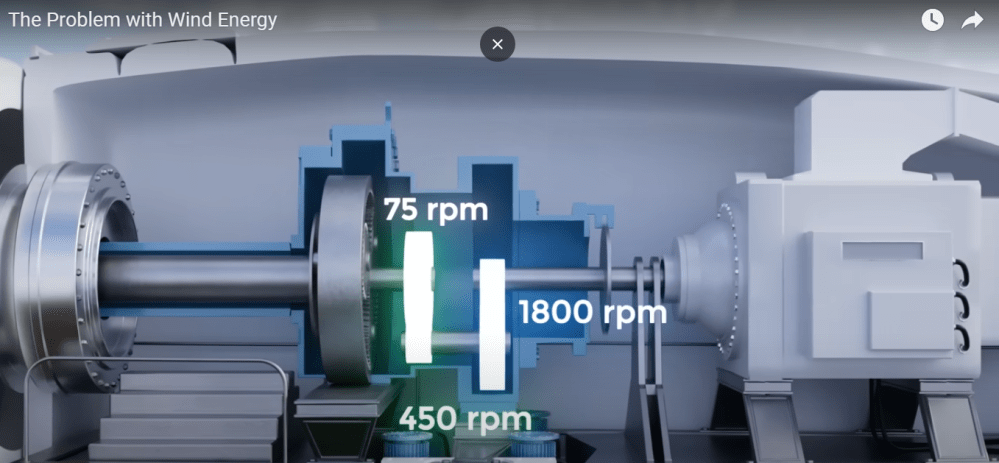
Wind turbine gearbox accelerates blade rotor (left) up to 1800 rpm output to electical generator (right)

Massive amounts of carbon-based oil are needed for the lubrication of all gears and bearings in a wind turbine system, which is mechanical in its nature. In 2019, wind turbine applications were estimated to consume around 80 per cent of the total supply of synthetic lubricants. Synthetic lubricants are manufactured using chemically modified petroleum components rather than whole crude oil. These are used in the wind turbine gearboxes, generator bearings, and open gear systems such as pitch and yaw gears.

Now we also know that icing causes the rotors to stop turning so diesel power has to be used to keep the bearings warm during cold weather. The diesel generator is needed to get the blades turning on start-up to overcome the limiting friction of the bearing or when the speed of the rotor drops too low.

In this case in Scotland, 71 windmills on the farm were supplied with diesel power. Each windmill has its own diesel generator. Just think of that.

What about the manufacturing of these windmills?

The blades are made from tons of fibreglass. Manufacturing fibreglass requires the mining of silica sand, limestone, kaolin clay, dolomite, and other minerals, which requires diesel-driven machines. These minerals are melted in a furnace at high temperatures (around 1,400°C) to produce the glass. Where does that heat come from? Not solar or wind power, that is for sure. The resin in the fibreglass comes from alcohol or petroleum-based manufacturing processes.

The metal structure is made from steel that requires tons of coking coal (carbon) essential to make pig iron, which is made from iron ore in a blast furnace at temperatures up to 2,200°C. The coal and iron ore is mined from the ground with giant diesel-powered machines and trucks. The steel is made with pig iron and added carbon in another furnace powered by massive electric currents. Carbon is a critical element in steel making, as it reacts with iron to form the desired steel alloy. None of this comes from wind and solar power.

Wind turbine power generation is inherently intermittent and unreliable.
It can hardly called green as the wind turbines require enormous
amounts of hydrocarbons in their manufacture and continued operation.


via Science Matters

https://ift.tt/VY64az8

August 8, 2024 at 01:48PM