Month: August 2024

What Wind Turbines Are Made Of: Endless Mountains of Minerals and Energy

The way the wind cult tells it, you’d think these things were made in heaven using moonbeams and fairy dust. The reality is altogether more industrial.

Every wind turbine is the product of a myriad of minerals consumed in enormous quantities, along with staggering amounts of energy needed to combine them all into a machine that – weather permitting – might occasionally generate electricity in return.

As Keith Henley-Smith outlines below, there is absolutely nothing clean or green about giant industrial wind turbines.

Wind turbines? What they want to put in your backyard
The Spectator
Keith Henley-Smith
25 June 2024

It appears that wind turbines are the best thing since people started tilting at windmills.

Have you ever wondered how wind turbines are manufactured?

If we start with the tower itself…

This is the structure that holds everything up.

It is typically made out of rolled steel. At the moment the cheapest supply is from China and we have all heard anecdotes about the ‘quality’ of Chinese products.

The steel is made in two ways. Firstly, by the integrated method which is where the metal, known as cast iron, is made from iron ore in blast furnaces.

Blast furnaces use massive amounts of coke in the process which in turn is made in large ovens by roasting coal, all the time churning out vast amounts of carbon dioxide.

The coke supplies the carbon element in the cast iron product.

The liquid iron is transferred to a converter which is a vessel into which oxygen is forced to react with carbon to form carbon dioxide thus reducing the carbon level in the metal and thereby creating steel.

The other steelmaking system that is used is the electric arc method which is a steel scrap-based method.

The electric arc method produces molten steel in enormous furnaces by the use of electrical energy in vast amounts combined with oxygen gas and a great deal of cooling water.

It has been said that it requires approximately 25 tonnes of water to make 1 tonne of steel and this applies to most forms of electric steel-making.

In many operations, water is chemically treated to inhibit corrosion within the cooling systems and only be used for that purpose, thus making reclamation very difficult.

Once the steel is made it is transferred by ladles in a molten state to a casting machine to form up the required shapes for processing in rolling mills and forging operations. All of which are massive users of electrical energy and cooling water.

At the top of the wind turbine towers are huge cones and gearboxes which house the turbine blades and electrical generating units. The generators are made from tonnes of copper and steel.

One of the major gearbox manufacturers is a Belgian company and all their material is made within a 1,500 km radius of their operation. This includes some former Soviet Bloc operations with minimal pollution control requirements, but all desperate for foreign currency.

The cones and gearboxes casting made from a material called Spheroidal Graphite iron a type of cast iron.

These castings can weigh over 60 tonnes each depending on the size of the turbine and at the moment the majority are made in foundries in Poland.

In Poland they are made by two methods. One is the Cupola system, which is a process like a blast furnace which uses steel scrap and coke to produce iron which is converted into SG iron.

SG Iron is a metal produced when Magnesium is introduced into molten iron to create the product by affecting the shape of the carbon at a molecular level. This type of metal has properties similar to steel.

The other method of iron production is the electrical induction system where the melting is carried out in induction furnaces that are electrically powered.

Pollution controls in Polish melting operations leaves a lot to be desired.

In Poland, a large proportion of electrical energy is supplied from the largest Lignite burning power station on the planet with one of the poorest reputations for pollution outputs.

All of these castings have to be further machined to fit the relevant requirements carried out in massive machine shops using enormous amounts of electrical energy.

The turbine blades are made from carbon fibre and plastic compounds which come directly out of the petrochemical industry with all the associated H&S issues associated with some of the toxic compounds used in the production.

All of this material has to be located on site with enormous transportation and fuel bills and generally these areas are fairly remote.

The added costs of electric welding on site and in fabrication are phenomenally expensive.

The wind turbines can weigh hundreds of tonnes when fully assembled.

As you will appreciate, the amount of resources and energy that goes into manufacturing is incredible.

The accepted life span of a wind turbine is about 25 years so there is a constant replacement system in operation.

[Note to Keith: the economic lifespan for a wind turbine is less than 15 years and large numbers of them are being replaced after 12 years – in a scam known as ‘repowering’]

Should the wind speed reach 85km/h then they will automatically shut down because of stability problems associated with the height.

[Note to Keith: the automatic shutdown of turbines is explained on German turbine maker, Siemen’s  website – which has this to say about the automatic shutdown of wind turbines when wind speeds hit 25m/s (90km/h):

Nature presents us with different kinds of challenges. High wind can create extremely high loads, and as a result wind turbines are normally programmed to shut down if the 10-minute mean wind speed exceeds 25 m/s. This may pose a significant challenge for the grid system – for example, if turbines in large wind farms shut down simultaneously.

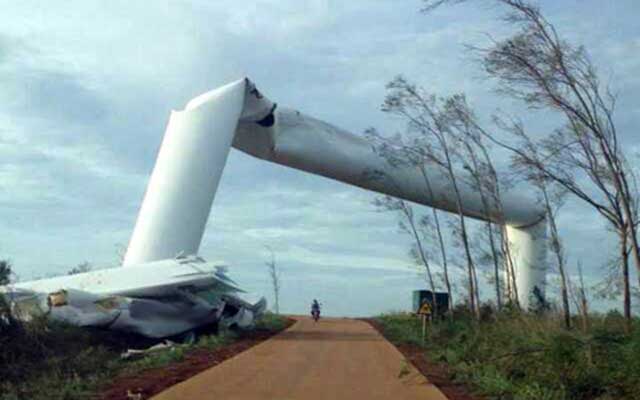
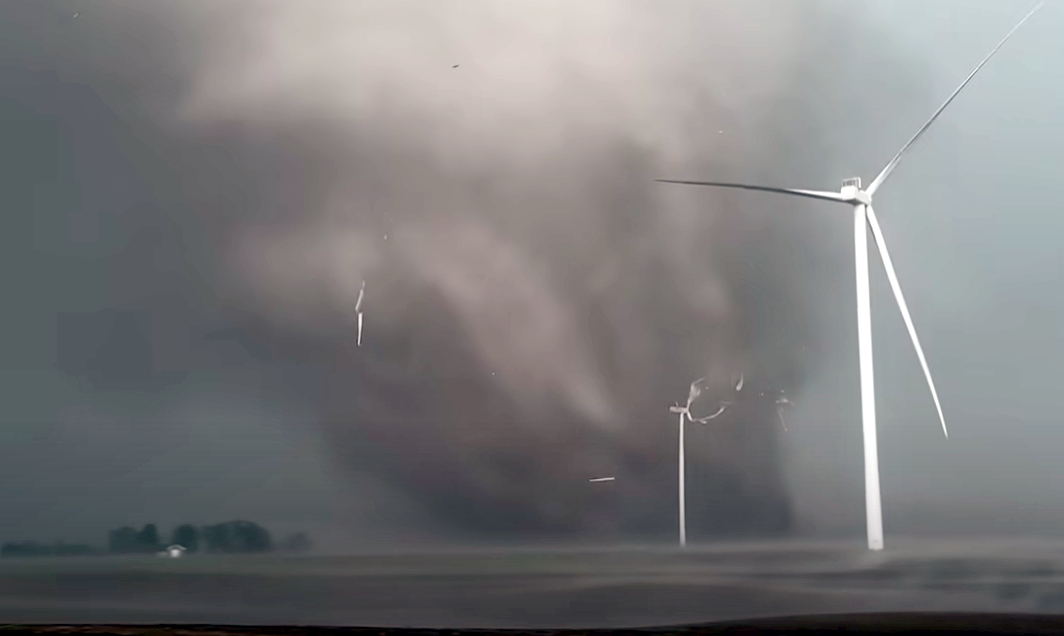
It’s a means of self-preservation, partly because in high winds the turbine is at risk of losing ‘yaw control’ which results in the turbine’s inability to face directly into the wind. If yaw control is lost, the nacelle will turns to be at right angles to the wind direction, at which point the machine’s brakes are incapable of slowing the turbine rotor and the machine will self-destruct – as in this video:

If the wind does not blow then there is no power generation.

What about all the wind turbines that are out at out at sea?

One of the main problems is the corrosive effect of salt water this dramatically affects the lifespan of equipment made from of iron and steel.

To get around this problem, stainless steel may be considered, but at ten times the cost I don’t think that this would be much of a practical or economic solution.

The wind turbines in maritime locations need regular maintenance which is very expensive.

Perhaps it would be best to let them corrode and fall into the sea. That’s what happens now.

How many wind turbines would be needed to replace a Hydro-electric power station?

You remember Hydro?

That is the only true base load green power system that actually works.

Wind turbines and solar systems do not supply a base load that can be utilised by industry or even major hospitals in urban locations.

I dare not even mention nuclear fission or atomic fusion!

Re-tuning to wind turbine technology, none of this equipment is actually made in Denmark, but most of it is made in the Northern Hemisphere with all the environmental problems that go with the manufacturing processes.

As they say, that’s all right and someone has to make them, so long as it’s not in my backyard.

I thought that this Green movement was worldwide, apparently not, if you want a wind turbine.
The Spectator
via STOP THESE THINGS

https://ift.tt/7Cqf6tL

August 8, 2024 at 02:30AM

1-Minute Junking: Emissions slowing tropical storms, causing more rainfall?

Related links: Bloomberg article | Nature study

via JunkScience.com

https://ift.tt/0Kd3YCU

August 8, 2024 at 02:25AM

Houston: Oil and Gas Capital (‘energy transition’ hyperbole falls flat)

“City leaders should stop pretending Houston will, or should, transition away from oil and gas anytime soon…. Houston should embrace its role in sustaining and improving the lives of literally billions of people globally each day. It’s a legacy worth standing up for… and even celebrating.” (Doug Sheridan, below)

Hyperbole and government subsidies (bribes, to critics) is the lifeline for inferior energies (think dilute, intermittent, resource-intensive wind and solar). Such as been the case since the 1990s in Houston, Texas when Ken Lay of Enron Corp. empowered executive Robert Kelly to create a new renewables business, a story told here.

And shame-on-shame that some Houston business leaders that should know better have embraced low-density, political energies. I am thinking of Bobby Tutor, chair of the Houston Energy Transition Initiative, and Steve Kean of the Greater Houston Partnership. [1] There are others to be sure, but these two certainly head the list.

Tomlinson Hate

On the media front, there is the business editorialist Chris Tomlinson, who is a climate alarmist through-and-through who refuses to consider the weaknesses in his position from the science, economics, and public policy sides. Terribly conflicted, his wife, Shalini Ramanathan, is a multi-millionaire renewable energy rainmaker. Tomlinson himself snidely denounced Chevron’s decision this week in the Houston Chronicle:

“Oil giant’s relocation to Houston skirts climate accountability,” conflicted Chris wrote.

Yippee, another world-class polluter is moving its global headquarters to Houston, bringing a few hundred employees and a fossil fuel business plan unable to adapt to climate change….

Every serious scientist and government recognizes we must reduce carbon emissions to slow global warming and protect life as we know it. Consumers will need to stop burning so much oil and natural gas to produce energy, which means we will need a lot less of them. The oil and gas industry must shrink to prevent the worst of climate change.

What? Climategate to climate models, the climate alarm has a half-century of bad optics and bad predictions. To say that “every serious scientist” knows that reducing CO2 emissions is necessary to “protect life as we know it” is dead-on-arrival argumentation. Little wonder why “climate change” is bad politics in the current election cycle. [2]

Energy Exceptionalism

The story of oil and gas in Houston’s development and growth is both fascinating and compelling. “The wildcatters showed their gratitude to their city through their philanthropy,” University of Houston history professor Joseph Pratt wrote. “They were not the only ones who supported good causes in our region, but many of the foundations in Houston had their beginning in the oil and gas industries.” A century later, with much more oil and gas today that existed a century ago (the story of resourceship), the story is the same.

Sheridan on Chevron

With Chevron relocating its headquarters to Houston, escaping the termite aspirations of Governor Gavin Newson and state agencies in California, Doug Sheridan of EnergyPoint Research wrote this comment that is worth amplifying.

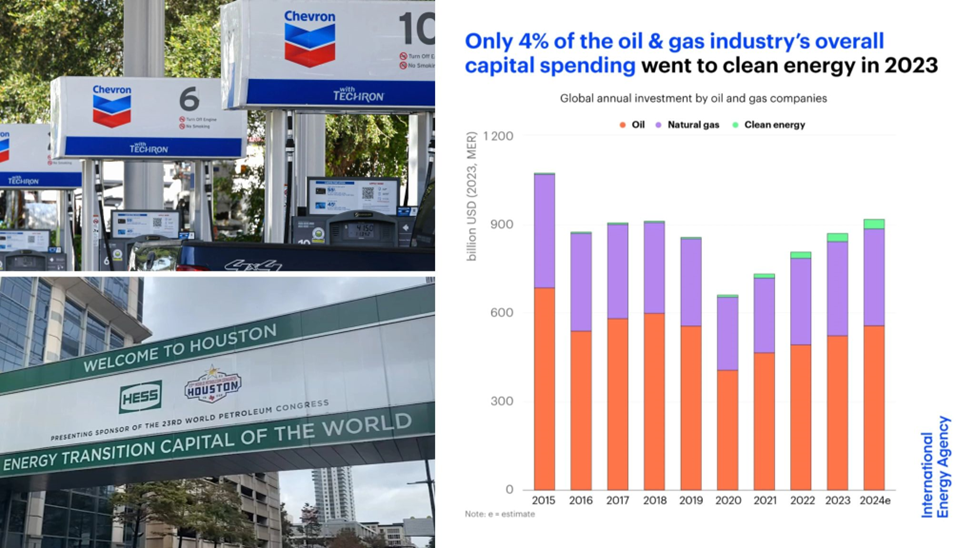
Back in 2021, when virtually everyone became an overnight expert on energy and simply “knew” oil was going to be replaced by renewables, the great minds at the City of Houston, Greater Houston Partnership and other civic organizations got behind the slogan, “Houston—The Energy Transition Capital of the World.”

Of course, there was no factual basis for the claim. It was just easy to say, so they said it. In reality, nothing could have been farther from the truth—no city in the world had more to lose from a transition away from oil and gas than Houston. Anyone who stopped to think had to have known this. But stopping and thinking wasn’t in vogue in 2021.

Even today, there’s an effort to position Houston as some clean energy innovation mecca. We doubt the claim would stand up to scrutiny. For one, we’d wager half the investments labeled “clean energy” are just typical energy technology investments, the kind companies in Houston have been making for decades. Of the other half, we’d guess a material proportion won’t be commercially viable in the end.

Contrast that with what’s going on with oil and gas in the city. By 2025, both of America’s two largest oil and gas companies, ExxonMobil and Chevron, will have moved their headquarters to Houston. And virtually every other petroleum entity in the world of any consequence has a presence in the city, including supermajors Shell, BP, and TotalEnergies, as well as leading NOCs like aramco. Houston today is as much an oil town as ever.

No doubt city leaders, many of them liberal, will attempt to pitch the presence of these oil and gas majors as just more money and expertise to invest in what they habitually like to claim is some big shift to clean and green energy. But that’s not true either. None other than the International Energy Agency (IEA) recently posted a chart showing just how little oil and gas firms are investing in clean energy. For once, the IEA hits on the truth.

So why aren’t oil and gas companies investing in clean energy? The official line is green energy and innovation isn’t a core competency. And that’s true, in so far as firms like to stick to their knitting. But the real reason, and don’t say it out loud, is that these companies understand green forms of energy, especially renewables, are for the most part so inferior they can’t cover their cost of capital. And for real managers, investments that can’t cover their cost of capital are to be avoided—not pursued.

Houstonians should welcome with open arms the arrival of ExxonMobil, Chevron and other oil and gas companies. And city leaders should stop pretending Houston will, or should, transition away from oil and gas anytime soon. As Alex Epstein stresses, oil and gas are essential to human flourishing. Houston should embrace its role in sustaining and improving the lives of literally billions of people globally each day. It’s a legacy worth standing up for… and even celebrating.

——————-

[1] Bobby Tutor was a principal of Goldman Sachs global energy practice and founding head of Tudor, Pickering, Holt & Co., a major energy investment banker. Steve Kean, former CEO of Kinder-Morgan, one of the nation’s leading energy infrastructure companies, heads the Greater Houston Partnership.

Both Tutor and Kean know energy very well, well enough to not buy into climate alarmism and forced energy transformation. Their shift to political energy can only be described as pragmatic and amoral. Go with the political flow, get your share of kudos and government favor for personal and professional gain.

[2] For my long-standing criticisms of the fossil-fuel-misanthropist Tomlinson, see here.

The post Houston: Oil and Gas Capital (‘energy transition’ hyperbole falls flat) appeared first on Master Resource.

via Master Resource

https://ift.tt/8XQ2nxK

August 8, 2024 at 01:10AM

Carbon Dioxide Pipeline Battle—Seize Land for Green Energy

By Steve Goreham

Originally published in RealClear Energy.

A battle is underway in five Midwest states over construction of carbon dioxide pipelines as part of the green energy transition. Opposition to wide-area pipeline networks is rising from farms and communities. But utilities and state governments intend to seize land over landowner protests.

On June 25, the Iowa Utilities Board (IUB) granted the petition of Summit Carbon Solutions (Summit) for a permit to build a carbon dioxide (CO2) pipeline across Iowa. The IUB determined that the pipeline was for “public use,” and granted Summit the right to seize land from Iowa landowners using eminent domain. Eminent domain has typically been used to take private land for government projects that serve a public good, but not for private industry.

Summit plans to build pipelines across Iowa, Minnesota, Nebraska, North Dakota, and South Dakota to transport captured CO2 to deep underground storage sites in North Dakota. The cost of the 2,500-mile project is about $5.5 billion.

Summit seeks billions of dollars from the federal government. If the pipeline network becomes operational, the company will receive up to $85 per metric ton in tax credits under Section 45Q of the Internal Revenue Code. The firm intends to sequester up to 18 million tons of CO2 each year, to annually receive tax credits of over $1.5 billion. Summit claims to have signed agreements with over 2,700 landowners to build the pipeline.

Ethanol producers in the five states are interested in participating in the project. Captured carbon dioxide from 57 ethanol plants would be sold to Summit, providing a revenue stream for producers. Billions in federal funds may also be available to ethanol plants that capture CO2. In addition, reducing CO2 emissions may allow ethanol producers to qualify their product as Sustainable Aviation Fuel for commercial airlines.

Supporters claim the project will deliver environmental benefits in the fight against climate change. Summit says the annual CO2 emissions savings will be equal to removing 3.9 million vehicles from our roads. But the project is fraught with feasibility and cost, environmental, and safety problems.

The feasibility and cost track record of CO2 capture is poor. There are 47 major carbon dioxide capture and storage (CCS) plants operating in the world today, and most are money losers even with heavy subsidies. Ethanol plants that pursue CCS will likely lose money, along with the taxpayers who provide the subsidies.

For example, the Quest CCS project operated by Shell in Alberta, Canada captures only 35% of the CO2 emitted from a chemical process to upgrade bitumen from oil sands. The capital cost of the project is $811 million, entirely paid for with C$865 million in grants from the Canadian and Alberta governments. The Quest CCS operation will cost $41 million a year to run with only $27 million per year offset in payments from carbon credit subsidies.

The environmental benefits from the Summit project will be tiny. CO2 captured from Midwest ethanol plants will do little to affect global temperatures. Today, all of the world’s operating CCS facilities capture only 0.1 percent of industrial emissions. Even the Sierra Club opposes the Summit pipeline and calls CCS efforts “false climate solutions.”

Carbon dioxide pipelines come with huge safety issues. Only about 5,000 miles of CO2 pipelines exist in the US, compared to 84,000 miles of crude oil pipelines and three million miles for natural gas. Most CO2 pipelines transport liquified CO2 short distances to oil fields where it is pumped underground to force oil and gas to the surface.

Carbon dioxide in pipelines is a liquid under high pressure. If it leaks, it turns to gas as it rushes out. Since it is heavier than air, it stays close to the ground and can cover wide areas. Carbon dioxide is harmless in small quantities, but in large amounts, it is an asphyxiate, can force oxygen out of people’s lungs, and can cause headaches, dizziness, serious injuries, and death.

On February 22, 2020, a carbon dioxide pipeline ruptured in Sartaria, Mississippi. The rupture occurred on a Saturday and spewed CO2 for about four hours. An invisible cloud of CO2 moved through the rural community forcing more than 200 people to evacuate and at least 45 to be hospitalized. Victims were unable to breathe and suffered unconsciousness and fits of shaking. No one died during the incident, but some victims continue to suffer ongoing physical problems.

As a result of feasibility and safety concerns, opposition to the pipeline is growing.  Proponents and opponents battle in state legislatures and at public utility meetings. Counties in all five states have recently passed bans or restrictions on CO2 pipelines.

North Dakota regulators denied Summit’s application last August but have agreed to reconsider. Last month, Illinois passed a bill putting CO2 pipeline construction on hold until 2026. South Dakota regulators denied Summit’s application last September, but the legislature passed a package of regulations earlier this year that may aid approval of the pipeline network. South Dakota voters will have an opportunity to reject that package of regulations on this year’s November 5 ballot.

The Summit pipeline project would not exist without vast federal subsidies for CCS. We have plenty of CO2 for soft drinks and other uses. Huge subsidies, driven by the fear of human-caused global warming, are the only reason to try to seize land from farmers in Midwest states.

Even if this huge pipeline system is built and CO2 is captured at 57 ethanol plants, the effect on global emissions will be insignificant and the effect on global temperatures will not be measurable.

Land for pipelines is not the only case where land is being seized to promote green energy. The US Department of Energy recently announced plans to use eminent domain to seize land across wide areas to build transmission towers for new wind and solar systems. Illinois and Michigan passed laws blocking restrictions and outright bans by local communities on deployment of wind and solar systems. Governments consider the fight against human-caused climate change more important than the property rights of citizens.

Steve Goreham is a speaker on energy, the environment, and public policy and the author of the bestselling book Green Breakdown: The Coming Renewable Energy Failure.

via Watts Up With That?

https://ift.tt/HybgVQd

August 8, 2024 at 12:07AM