Month: August 2024

Aussie Climate Scientists: Winter Heatwaves are Bad

Essay by Eric Worrall

A “record breaking” winter heatwave gripping Australia has likely saved householders millions of dollars in home heating costs. But apparently we shouldn’t look on the abrupt end of winter as a good thing.

Heatwave brings Australia’s winter weather to an abrupt end as climate change up-ends the seasons

By climate reporter Jess Davis

On Sunday afternoon, Australians across the country basked in the glorious winter sunshine.

The blossoms had sprung early, in Melbourne the footy was played in 24 degrees, and the ski fields mourned as heavy rain killed the remainder of another poor snow season.

And despite the start of winter feeling quite cold to many, that’s partly because our memories are short.

“It did feel quite cold to us because a lot of our other winters have been warm in the last 20 or so years,” Professor Perkins-Kirkpatrick said.

“The human experience, we generally only remember weather events or seasonal events up to eight years ago.

“To be honest, for most of us, it’s quite pleasant, a really nice change from cooler conditions,” Dr King said.

“But for spring or summer, if we get heat waves, of a similar kind of strength to what we’ve seen over the last week or so, or similar kind of level of unusualness, we would be really worried about those heat events.”

More than a thousand people died during the annual hajj in Saudi Arabia when temperatures reached 51.8 degrees Celsius.

Read more: https://www.abc.net.au/news/2024-08-29/winter-ends-with-heatwave-as-climate-change-upends-seasons/104279250

The old and infirm do suffer in heatwaves, just as they suffer in periods of extreme cold. But affordable coal or gas energy to power air-conditioning, or increasing winter fuel subsidies for retirees, would do far more to help infirm and elderly people on limited incomes, than wasting billions of dollars of government cash on wild schemes to nudge future temperatures by a fraction of a degree.

Home heating (and cooling) costs are a huge problem in Australia, especially in the colder, more climate obsessed southern states.

Almost half of Australians have gone cold this winter over power bill fears

By Emily McPherson • Senior Journalist 8:56am Aug 12, 2024

Millions of Australians have been shivering through this winter, avoiding using their heater over fears of how much it will cost, a new survey has revealed.

The new research, from comparison site Finder, found 1 in 8 Australians go without heating “all the time”, while a further 36 percent said they avoid using the heater as often as they can.

The findings, based on a survey of 1,049 respondents, mean almost half of Australians – or the equivalent of 4.9 million households – are living without adequate heating.

Read more: https://www.9news.com.au/national/almost-half-of-australians-have-gone-cold-this-winter-over-power-bill-fears/adbbac4e-301b-459f-8f37-a20500b050d8

An extreme heatwave or cold wave is only a problem for the infirm if you are forced to endure its effects, say because you can’t afford to switch on the air conditioner.

For those who are not infirm, the kind of heat they are talking about is not a challenge, providing people stay properly hydrated.

When I was young, for a time I worked in a poorly ventilated plastics factory in Melbourne, Australia. The chemical process and leaky hydraulic hot presses released huge clouds of steam, so the environment was dripping wet. On the hottest days the thermometer on the factory floor reached 55C / 130F. Management patrolled the floor every 5 minutes, offering hydration drinks.

My grandpa told me he worked in similar conditions in a metal foundry in Melbourne in WW2, 18 hours per day building Artillery pieces for the war effort. His factory featured large molten pots of lead, continuously maintained at 660F for heat treating steel, so I’m guessing his factory floor was likely hotter than what I experienced.

The human body is adaptable. When my work day finished at 3pm, it was a memorable experience stepping out into blazing sunlight on a 110F day, and shivering uncontrollably with cold for 2 minutes as my body adjusted to the abrupt drop in temperature.

I’m sure people who work in bakeries and mines have similar experiences.

But you wouldn’t expect climate scientists who spend most of their lives in comfortable air conditioned offices to know any of this.

via Watts Up With That?

https://ift.tt/aDdrwvi

August 29, 2024 at 08:08PM

Soundings, Weather Balloons, and Vapor Pressure Deficit

By Charles Blaisdell, PhD ChE                                                

Abstract

Yes, it is about hot air, hot lower humidity air from any parcel of land that has lower annual evaporation of water with time (many years).  Due to lack of cooling from evaporation this type of parcel has a higher temperature and lower specific humidity, SH, than in its virgin state and can produce a plume of cloud retarding higher “vapor pressure deficit”, VPD, air.  Urban Heat Islands, UHI’s, forest to cropland, forest fires, and mining are good examples of this type of parcel.  The size of this plume is an amplification factor in cloud retardation.  The high VPD air mixes with passing air in the lower cloud zone (cumulus clouds altitude) and retards cloud formation somewhere.

Data from weather balloons “Soundings” suggest that a plume of higher VPD air is created over cloud free UHI’s and can be 1 to 4 time greater than the area of the UHI, agreeing with models.  The plume is created by the lower density of the hot-lower specific humidity, SH, air (lower ET, EvapoTranspiration) rising from the UHI and forcing turbulence (mixing) with the much low SH air in the upper atmosphere.  On cloudy days the cooler higher SH air has higher density and specific humidity and does not rise as fast or not at all.  The cloud free soundings data also suggest that the cloud retarding VPD is retained as the air rises from this parcel.

The plume amplifies the size of high VPD air from special parcels and can be a factor in climate change if the size, water evaporation, or albedo of the special parcel changes.  Urban areas are getting bigger, forested land is decreasing, and mining has increased.  The amount of change in all the earth’s special parcels is not known but could be significant.  Plume size will amplify the special parcel effect on cloud cover (or reflectivity) in climate change.

Introduction

              Scientist have long known that cloud cover, CC, (fraction) of the earth is a key part of seasonal and yearly climate change (1). WUWT’s Willis Eschenbach (2)  has proposed a theory on how increasing cloud fraction cools the earth (or decreasing cloud fraction heats the earth).  This author is in full agreement with Willis theory,  and has proposed a theory on what can causes cloud cover to change.  The Cloud Reduction Global Warming, CRGW, theory is: The sum total of the earth’s special parcels of land had deceased water evaporation over time (UHI’s, deforestation, mining, etc.) which results in higher VPD air rising in a plume to retard cloud cover or thinner clouds. Less clouds, more sun and higher temperature and more evaporation of water which can be seen as higher global specific humidity.  CRGW theory is most applicable in the 1970 to today period of time.   The subject of this paper is the plume part of this theory.

Figure 1. A visual of a plume is provided by Ann Cosgrove & Max Berkelhammer (3)

An important variable in the CRGW model is the size of the plume of hot-dry air that rises from local land change, see Figure 1 for visual. The plume size increases the area of the earth that high VPD air can retard (or thin) cloud formation. For example, if a UHI has an area of X and produces a plume of twice the size of the UHI then the area of the earth that is influence by that UHI is 2X.   Ann Cosgrove & Max Berkelhammer (2021) (3) modeled a plume over Chiago as being 2-4 time the size of the UHI it came from.  Yifan Fan et al. (2017)  (4) also modeled with about the same results.   This plume is warmer and dryer than surrounding air, giving this plume a higher VPD (potential less clouds). 

VPD and cloud cover (fraction)

              VPD, vapor pressure deficit, is defined as the difference between the saturated vapor pressure, Psw, and the actual vapor pressure, Pw, (VPD = Psw – Pw).  VPD is a logical relationship between atmospheric temperature and moisture, (specific humidity, SH) that may predict the probability of cloud formation.  As VPD approaches 0 the atmosphere becomes saturated clouds are likely to form.  (Although, super saturation can happen (no clouds) or particles in air can cause clouds before 0).  On a single point basis VPD is very nonlinear: clouds at 0, no clouds > 0.  The global average VPD has been increasing since 1970 indicating that there are less 0 VPD (less clouds) in the average than > 0 VPDs.  See Blaisdell (2024) (10)  for more information on VPD and clouds.

Sounding and Plume size

            To better understand the rising air over UHIs weather ballons “soundings” were analyzed for some hint of plume size.   Weather ballon soundings are released around the world twice a day at 12pm and 12am Greenwich time (Zulu time).  For plume size, the data needs to be when the sun is shining and no clouds.  The site picked was a group of cities called the Quad Cities Ia.-Il.  (Davenport Ia. Bettendorf Ia, Moline Il. Rock Island Il). The area has grown to include other cities including the airport at Coal Valley for land-based weather data).   The ballon is released in the middle of the Quad Cities (Davenport, Ia) not far from the airport at 6:00 am and 6:00 pm local time.  The 6:00 pm time works for the summer but not the winter (no sun light at 6:00 pm in the winter).  Sounding for the month of July 2022 from University of Wyoming College of Engineering (5) and daily weather data from Weather Underground (6) was sorted for cloud free days in order to get a representative sample of days with a high probably of a plume.

Meteorologists plot sounding data on a strange graph call a “Skewed T log P” (the x axis (temperature) is skewed right at 45⁰ and the y axis (pressure) is a log scale (this method of plotting is probably used to keep all the data on a single piece of paper).  Added to the graph are iso lines of mixing ratio (specific humidity), dew point, and more.  Meteorologists are mainly interested in weather change and have many terms (and abbreviations) for these graphs.  Calm clear sky data boors them; but for climate change, clear sky data has some insight into the UHI’s rising air that creates an invisible plume.  See the web site (7) for a good summary of Skew T Log P diagrams.

Figure 2 Skewed T Log P diagram from (7).

The only part of Figure 2 data of interest to understanding plumes from UHIs. Is the part below cumulus cloud forming area about  600-800 mb (4000m – 2000m).  At the surface radiation is reflected as short wave radiation or absorbed and reflected as long wave radiation (heats the land and air and evaporates water) or is used by plants and transpires water.  The air from these processes can rise, stay put, or sink depending on its density vs the surrounding air. Hot air rises cold air sinks. Water added to air decreases its density at the same temperature, but the process of evaporating water causes the air temp to decrease making it denser.  A buoyancy calculation is needed to determine which way the air is going.  Rising air will mix with the very dry (and cold) air from the upper atmosphere.  The initial speed (if rising) of this air (in the 0 to about 3000m) should be related to plume size.  The specific humidity SH, profile (Figure 3-a) shows this dilution from low SH air from the upper atmosphere (above 4000m).  The slope and height of the SH profile in the lower atmosphere is an indication of ground moisture availability (Denissen (2021) (8)), the higher to more vertical the slope suggest lower soil moisture.  Likewise, the shorter the rise (cooler air does not rise as fast as hot air), suggest higher ground moisture.

 Figure 3b shows VPD, Pws-Pw, and Figure 3c the rising air velocity data from one sounding.  Above the initial rise (about 1600m in this example) of hot air the passing weather fronts mix with this ground air and form a plume of higher VPD (or T-Td) air that mixes with the total atmosphere’s air and may reduce the cloud fraction some place in the atmosphere.  Each one of these UHIs is a very very small contribution to the total global increase in VPD but the sum total of all UHIs (and other similar phenomena like deforestation and mining) over years may be significant.

From the sounding temperature data, the buoyancy can then be calculated.  From the buoyancy the speed of the rising air can be estimated, assuming the air rises to an average of 3000m.   The data for 38 days in July-August of 2022 was screened for cloud free daylight (higher probability of a plume with more than 3 sounding data points in the stable region).  Table 1 is the surviving 12 days.

The velocity of rising air is calculated from the buoyancy equation (see (9) for derivation):

 B = (Ti – Ts)/Ts * 9.8

Where:

B = buoyancy in m/sec^2 or N/kg

Ti = laps rate temp of sounding data point = Tii – 9.8 * (Hi – Hii)/1000 in K

Tii = dry laps rate of initial sounding temperature in K

Hii = initial altitude in meters

Hi = altitude of data point from sounding in meters

Ts = Temperature of data point from sounding in K

Rising air velocity from buoyance:

V = incremental distance traveled/time to travel that distance, d/t in m/sec

d = sounding incremental distance between data points

t = (d * 2 / B)^(1/2)  in sec

The initial average velocity (see Table 1) from clear sky soundings is not directly related to plume size but is a very simple estimate:

Plume size, P = D / V * Hr

Where :

V = average velocity m/sec

D = distance from ground to cloud level (assume 3000m)

Hr = time during the day this velocity is maintained.  (assume 8 hr)

The conclusion for Tabe 1: there is a lot of variability in the buoyant velocity (and thus the plume size).  The plume size factor, Pf, is calculated by:

Pf =  3000 m to cloud height / v(m/sec) * 3600 sec/hr * 8 hr/day

Pf = How much more area is added to the area of the special parcel.

Table 1 is by no means a rigorous calculation of plume size but it does compare well with models (4) (3).  It also implies that the plume size is variable at each site and probably different averages at other locations.  Locations with less evaporation are expected to have hotter air rising thus higher velocities and larger plumes; like wise, locations with high evaporation should have smaller or no plumes. 

Table 1.  Clear sky data from one month in July 2022.

The actual plume may be smaller than this due to the turbulent mixing in the 2000m 4000m range indicated by the sounding rapid decrease in SH in this area.  The clear sky sounding data does indicate that the high cloud killing VPD (> 0) is maintained in the 2000m to 4000m range.

Plume size is important multiplying factor in the CRGW model.  A literature search indicates the study of UHI or other land change plume size is very much understudied leaving opportunity for other researchers.  No physical measurement of plume size could be found.

Discussion

Balloon soundings showed there are clear sky plumes that agree with the models and the cloud killing high VPD air generated from low ET surface air reaches cloud level.  Plume size will remain a wide range (1-4x) variable in the CRGW model.   More work is needed on the global variability and size of the plumes.  Could satellites help?  Satellites can see large smoke plumes from forest fires.  This short study of soundings data gave me a high respect for meteorology and is as far as I go in Meteorology!

Bibliography

  1. “Clouds and relative humidity in climate models; or what really regulates cloud cover?”  by Walcek, C. (1996)  web link Clouds and relative humidity in climate models; or what really regulates cloud cover? (Technical Report) | OSTI.GOV

via Watts Up With That?

https://ift.tt/0Zpoe5b

August 29, 2024 at 04:07PM

The oceans are overflowing, give us a trillion, says UN witchdoctor Guterres

By Jo Nova

And where was the ABC, the BBC, the CBC…

This week UN was scaring the kiddies again in order to increase the river of funds that it feeds from. Harder to understand,  science journalists were rushing to sell-out their homelands and repeat their incantations. We’re worrying about a 3mm annual rise (at most) but while Grok was inventing the wheel circa 5,000 BC, oceans were 2,000 millimeters higher. That surging water left clues like piles of giant oyster shells that are still 20 kilometers inland at Taiwan.

In the frozen depths of the last ice age, the water piled up at the poles in the ice caps and the oceans shrank 125 unthinkable meters below where they are today. We’re getting precious about losing a sand dune, but Mesolithic people lost entire continental shelves.

Only a poorly educated high schooler, or a UN Secretary-General, might be silly enough to think that the oceans had stayed the same for a million years and just jumped up 20 centimeters…

The prophesy reads like a new Bible:

UN Secretary-General António Guterres warned Tuesday that rising sea levels will “soon swell to an almost unimaginable scale with no lifeboat to take us back to safety,” highlighting the dire threat the crisis poses to Pacific Island nations.

The UN wants to be your God and they need your money:

A coalition of NGOs used the forum’s backdrop on Tuesday to release a report claiming at least $US1 trillion in climate finance is needed to support low-income countries.

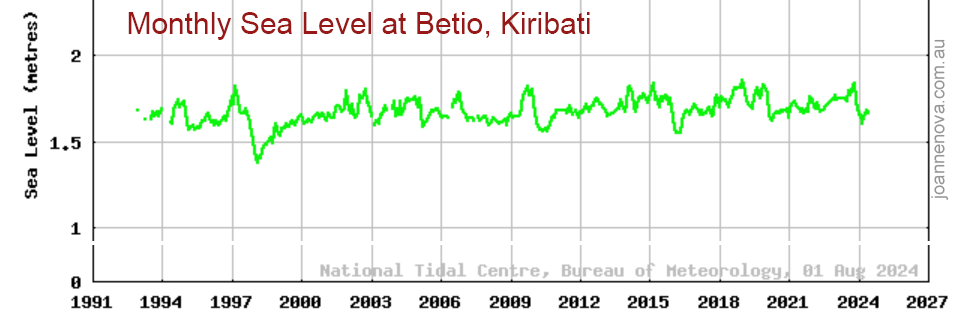
While seas have risen in Tonga they have barely shifted in places like Kiribati, Fiji or Tuvalu. Does the money follow “the tide gauges”?

According to 1000 tide gauges,spread all over the globe, sea levels are rising slowly at around 1mm a year. The rise started long before human CO2 output increased, and there is no sign of acceleration with rapidly increasing human emissions of CO2. Careful analysis of 60 beaches in Northern Europe to find one of the most stable gauges in the world agrees.  The Topex/Poseidon satellite sea-level data set also showed similar rates until they were adjusted up to fit climate models (or one sinking gauge in Hong Kong). Likewise the Envisat sea-level satellite data was also adjusted up. Vincent Gray graphed sea level around many South Pacific Islands. There is no CO2 induced disaster.

And for the record, below is the latest data on all the South Pacific Islands monitored by the Bureau of Meteorology. Natural variability surges according to it’s own beat. The Pacific Ocean slops back and forth, and the ground beneath the islands shifts too.

10 out of 10 based on 2 ratings

via JoNova

https://ift.tt/QspzYNd

August 29, 2024 at 04:05PM

How Clouds Affect The Seasons

Guest Post by Willis Eschenbach (@weschenbach on eX-Twitter)

I love science because of the surprises. Today I had several. My first surprise today was evidence of strong negative feedback in surface temperature. Let me note that I’m not claiming I’m the first person to make these observations. I’m simply saying, it was surprising to me.

My method of scientific investigation is graphics-based. I take chunks of numbers, sometimes tens of thousands of them, and display them graphically. And at times the result is what I expected, or even hoped for.

Other times, though, my latest graph comes up on the silver screen and I say “Whaaa?” … those are the surprises that make it all worthwhile. And those are where interesting meandering paths start. Come amble with me along one of those paths.

As the result of a series of misunderstandings and coincidences, I ended up taking a look at the month-by-month changes in the net effect of clouds on radiation. “Net effect” refers to the fact that clouds both warm and cool the surface.

Cooling occurs as a result of clouds blocking the sunlight from hitting the ground by reflecting sunlight back out to space or by absorbing the sunlight. Either way cools the surface.

Warming occurs from that part of the thermal radiation emitted by the clouds that hits and is absorbed by the ground.

“Net effect” is the difference between the two opposing effects—including both effects, are the clouds warming or cooling the surface, and by how much?

Unsurprisingly, this is known as the “surface net cloud radiative effect”, or the “surface net CRE”, hereinafter “CRE”. When the CRE is negative, it means the net radiative effect of the clouds iscooling the surface. Correspondingly, a positive CRE means clouds are warming the surface via radiation changes. Figure 1 shows the 24-year average of the CERES satellite record of the net surface CRE.

Figure 1. The effect of clouds on the net total of radiation (longwave and shortwave) absorbed by the earth’s surface. The horizontal dashed lines near the equator mark the edges of the tropics (23.5° N/S). The horizontal dashed lines near the poles are two polar circles (66.5° N/S). Units are watts per square meter (W/m2).

There are some interesting things about Figure 1.

• Overall, clouds cool the surface by about -19 watts per square meter (W/m2)

• The ocean is cooled almost three times as much as the land.

• The areas polewards of the two polar circles are warmed by clouds.

• The only areas warmed on average by the clouds are those polar regions and the deserts.

• The greatest cooling is at the inter-tropical convergence zones just above the Equator and the Pacific Warm Pool north of Australia.

What I’d never looked at, though, is the month-by-month record of the surface net CRE. Of course, to look at that we need to look at the hemispheres separately, to avoid the effects of the opposing seasons in the two hemispheres. Figure 2 below, showing northern hemisphere variation by month, was my first surprise.

Figure 2. Monthly net surface cloud radiative effect, northern hemisphere.

I did NOT expect the effect to vary from slight warming in the winter to -40 W/m2 cooling in the summer. That is a giant swing in the effect of the clouds.

It was also interesting to see the net cooling effect of -0.2 W/m2 per decade. The decadal increase in CO2 forcing was +0.27 W/m2 (95% CI: 0.22 W/m2 – 0.32 W/m2). So over the period of record, the small change in surface CRE is of the same order of magnitude and is acting in opposition (cooling) to any warming effects of the CO2 forcing.

Of course, that got me to wondering how much difference not having the radiative effect of clouds would make in the summer and winter temperatures … which led me to create Figure 3.

Figure 3. Current northern hemisphere summer temperatures (black), and theoretical temperatures without the clouds’ radiative effect (other things being equal, which of course they never are). Values in all instances were done in units of W/m2, and then converted to temperature using the Stefan-Bolzman equation with an assumed emissivity of 0.95.

So instead of northern hemisphere peak average summer temperatures being around 72°F (22°C), without the varying radiative effects of the clouds they would be about 84°F (29°C). Yikes! And winters would be slightly colder as well.

(And yes, I’m aware that without clouds a bunch of other things would change, so my graph is pure theory. I’m just trying to give folks a sense of just how huge a swing of cloud cooling from +5 W/m2 in winter to -40 W/m2 in summer actually is.)

Intrigued, I decided to take another look at the whole globe as in Figure 1, but this time for the northern hemisphere midwinter (December) and midsummer (June) separately. Here are those two graphics.

Figure 4. As in FIgure 1, but showing midsummer and midwinter surface net cloud radiative effect. December and June averages. The horizontal dashed lines mark the edges of the tropics (23.5° N/S), and the two polar circles (66.5° N/S).

Again, more things of interest. In the NH midwinter (December), clouds warm almost all of the area north of about 35°N or so. In the southern hemisphere midwinter (June), the same is true. The clouds warm areas south of about 35°S.

Another oddity. In many cases, the white/ black contour lines outline desert areas where according to CERES, clouds are warming regardless of the season. Why?

Next, I looked at scatterplots of the surface temperature versus the surface cloud radiative effect, utilizing 1° latitude by 1° longitude gridcell data. For each hemisphere there are 32,400 data points. I graphed the data by season and by hemisphere. And in doing so, I noticed a most curious oddity. This was my second surprise.

The graph of the relationship between the midwinter temperature and midwinter cloud radiative effect is very similar in the two hemispheres.

And the same is true of the relationship between midsummer cloud radiative effect and midsummer temperatures. The two hemispheres have similar summer relationships. Here are those comparisons.

Figure 5. Gridcell scatterplots. Upper panel shows midwinters—northern hemisphere midwinter (December) and southern hemisphere midwinter (June). Lower panel shows midsummers—northern hemisphere midsummer (June) and southern hemisphere midsummer (December).

There are some interesting points here. First, the correspondence between the two winters (upper frame) and between the two summers (lower frame) is surprisingly close.

The main difference is in the summers in the low-temperature gridcells. The southern hemisphere has open ocean almost all the way to the ice-covered high Antarctic Plateau. In both winter and summer, the clouds warm Antarctica. So in the summer, the change in the cloud radiative effect at Antarctica’s shoreline area is a sudden and almost vertical change to warming (left end of orange/black line, lower frame). In the Arctic, because the pole is covered with water rather than the high-elevation land of the South Pole, the change to the polar warming is slower and more gradual (left end of blue/black line, lower frame)

Other than that, however, the two hemispheres are quite similar. Most importantly, in both summer and winter, as temperatures go above about 26°C or so, the cloud cooling rapidly strengthens and increases faster with each additional degree of surface warming.

The seasonal similarity of the oceans of the two hemispheres is important to me for a curious reason. I’ve used a gridcell-based scatterplot analysis of the type in Figure 5 above for things like the following look at how temperature and CRE are related over the entire globe. See my post Observational and theoretical evidence that cloud feedback decreases global warming for a discussion of the implications of Figure 6 below.

Figure 6. Scatterplot, net surface cloud radiative effect versus surface temperature, all 1° latitude by 1° longitude surface gridcells.

The main objection that people have raised to my using a gridcell-based scatterplot analysis of the type in Figures 5 and 6 above is their claim that it’s investigating location-based relationships, and thus it does not demonstrate any direct relationships between the two variables.

Another way to state the objection is to say that of course certain locations have some given relationship between temperature and CRE—the relationship is ruled by the location-based characteristics of the gridcells in question. Maybe there are ocean currents or nearby mountains that are ruling both the temperature and the CRE.

Now, that didn’t seem logical to me, because in Figure 6, the CRE values are grouped by the average gridcell surface temperature. And there are lots of gridcells around the planet with very similar average temperatures. But I hadn’t figured out how to counter that objection, to show that it’s not location-based.

However, the similarity of the hemispheric ocean midwinters, and of the hemispheric ocean midsummers, shows that the relationship between temperature and cloud radiative effect is not due to some location-specific characteristics.

It can’t be location-specific, since there are no locations that are common to both hemispheres. These are entirely different gridcells in entirely different oceans in different hemispheres, with different currents, different depths, different adjacent landmasses … and yet the relationship between temperature and surface cloud radiation is surprisingly similar.

So by chance, to my third and greatest surprise of the day, after starting down a totally different path I stumbled across a way to counter the main objection I’ve gotten to my gridcell-based scatterplot analyses.

Funny how life works when I follow random byways with no guide star except my endless curiosity about the wonders of this world.

===

Moon rising up above the redwood trees. Must be time for me to go moon viewing. I just need someone with a uniform and a Glock to come by every few hours and say “Step back from the computer, sir, keep your hands away from the keyboard and nobody gets hurt!”

Onwards, my friends, and my best to you all—may your lives be full of marvels, adventures, and surprises of all kinds.

w.

As Usual: I politely request that when you comment you quote the exact words you’re discussing. Avoids endless misunderstandings.

via Watts Up With That?

https://ift.tt/F60r4Du

August 29, 2024 at 12:03PM