
It’s a challenge to distill any sensible narrative from the grand wind and solar transition. The subtext is always and everywhere about deflecting attention from their natural incapacity to deliver power as and when it’s needed. Also known as the ‘hopeless intermittency problem’. The ‘answers’ pitched up seem only limited by the rather fertile (albeit unhinged) imaginations of ideologues armed with nothing more than arts degrees and political ambitions.
Ideas like pumped hydro, thousands of giant lithium-ion batteries, ‘green’ hydrogen gas and using the batteries in EVs while garaged at home to store and release electricity, presumably at times when it’s needed, come with all of the enthusiasm you’d expect from bratty teenagers charged with making an altogether ‘better world’.
Heavy on hubris and always light on cost and detail, the wind and solar transition narrative has descended into little more than high farce, as detailed in this helpful roundup from the Jo Nova team and Viv Forbes.
You will buy the batteries that unreliable wind and solar need, but the government will own them…
Jo Nova Blog
Jo Nova
11 July 2024
They want you in an EV so they can use your battery to rescue the unreliable grid they built
There is a desperate need to add billions of dollars worth of batteries to smooth out our volatile grids. As I said last year:
The hapless homeowners will buy the back up battery for the grid and install it in their garage. (Sometimes they might drive it too.)
It’s so much the better if the unwashed masses pay for the batteries themselves, and so it has come to pass. Some academics in Canberra are excited that they finally proved the point and sucked some electricity out of 16 cars at a tight moment in February.
During a major storm event that eventually cut power to tens of thousands of homes, a fleet of electric vehicles (EVs) were able to feed power back into Australia’s electricity grid, according to a new report from The Australian National University (ANU).
These 16 cars provided all of 107 kilowatts for an unspecified length of time.
They let slip just what a drain EV’s will be on the average household.
“Stopping just 6,000 EVs charging would have kept the power on for those 90,000 customers whose power was cut on February 13.
So one EV consumes as much electricity as 15 houses, and we want to add a million to an unreliable grid? Where is all that electricity coming from?
And as Andrew Bolt points out, you might have been charging your car for a reason…
There’s huge bushfires, say. They knock out electricity lines, like the ones that went down and triggered Victoria’s big blackout. Your EV, which you were charging at home, is suddenly drained to save the electricity system. And then the fires approach. Or the floods.
So after they subsidize your EV purchase, and you think you have a good deal, they’ll raise the price of electricity. Then they’ll offer their hostages discounts if they join the scheme and plug in the car every day. But when your car battery depreciates “to landfill”, or your house burns to the ground, you’ll be the one paying the bill.
UPDATE: To clarify — It will be voluntary but only the wealthy will really have the choice… Like air conditioners that the government switches off in our homes on hot days, the unwashed masses will find the “discounts” offered to keep their car plugged in at peak hour will be hard to refuse.
Expensive electricity is not a bug, it’s a feature. Cheap electricity gives power to the people. Expensive electricity gives power to the bureaucrats who control the complicated pricing schemes. The bureaucrats give discounts to encourage certain “patterns of behaviour”. The wealthy do what they want.
REFERENCE
Bjorn C. P. Sturmberg et al, Vehicle-to-grid response to a frequency contingency in a national grid – successes and shortcomings (2024). DOI: 10.21203/rs.3.rs-4445838/v1
Jo Nova Blog

Battery baloney, hydrogen hype, and green fairy tales
The Spectator
Viv Forbes
30 June 2024
How low Australia has fallen… Our once-great BHP now has a ‘Vice President for Sustainability and Climate Change’, the number of Australian students choosing physics at high school is collapsing, and our government opposes nuclear energy while pretending we can build and operate nuclear submarines.
Our Green politicians want: ‘No Coal, No Gas, No Nuclear!’ while Our ABC, Our CSIRO, and Our Australian Energy Market Operator (AEMO) are telling us that wind and solar energy (plus a bit of standby gas, heaps of batteries, and new power lines) can power our homes, industries and the mass electrification of our vehicle fleet. This sounds like Australia’s very own great leap backwards.
There are two troublesome Green Energy Unions: the Solar Workers down tools every night and cloudy day, and the Turbine Crews stop work if winds are too weak or too strong. And wind droughts can last for days. The reliable Coal and Gas Crews spend sunny days playing cards, but are expected to keep their turbines revving up and down to keep stable power in the lines.
Magical things are also expected from more rooftop solar. But panel-power has four huge problems:
Zero solar energy is generated to meet peak demand at breakfast and dinner times.
Piddling solar power is produced from many poorly oriented roof panels or from the weak sunshine anywhere south of Sydney.
If too much solar energy pours into the network (say at noon on a quiet sunny Sunday), the grid becomes unstable. Our green engineers have the solution – be ready to charge people for unwanted power they export to the grid, or just use ‘smart meters’ to turn them off
More rooftop solar means less income and more instability for power utilities so they have to raise electricity charges. This cost falls heaviest on those with no solar panels, or no homes.
Magical things are also expected from batteries.
When I was a kid on a dairy farm in Queensland, I saw our kerosene lamps and beeswax candles replaced by electric lights. We had 16 X 2 volt batteries on the verandah and a big thumping diesel generator in the dairy.
It was a huge relief, years later, when power poles bringing reliable electricity marched up the lane to our house. All those batteries disappeared with the introduction of 24/7 coal power.
Batteries are never a net generator of power – they store energy generated elsewhere, incurring losses on charging and discharging.
There has to be sufficient generating capacity to meet current demand while also recharging those batteries. What provides electricity to power homes, lifts, hospitals, and trains and to recharge all those vehicle batteries after sundown on a still winter night? (Hint: Call the reliable coal/gas/nuclear crews.)
The same remorseless equations apply to all the pumped hydro schemes being dreamed up – everyone is a net consumer of power once losses are covered and the water is pumped back up the hill.
Yet AEMO hopes we will install 16 times our current capacity of batteries and pumped hydro by 2050 – sounds like the backyard steel plans of Chairman Mao or the Soviet Gosplan that constipated initiative in USSR for 70 years. Who needs several Snowy 2 fiascos running simultaneously?
Mother Nature has created the perfect solar battery which holds the energy of sunlight for millions of years. When it releases that energy for enterprising humans, it returns CO2 for plants to the atmosphere from whence it came. It is called ‘Coal’.
‘Hydrogen’ gets a lot of hype, but it is an elusive and dangerous gas that is rarely found naturally. To use solar energy to generate hydrogen and to then use that hydrogen as a power source is just another silly scheme to waste water and solar energy. It always takes more energy to produce hydrogen than it gives back. Let green billionaires, not taxpayers, spend their money on this merry-go-round.
Who is counting the energy and capital consumed, and the emissions generated, to manufacture, transport, and install a continent being covered by ugly solar panels, bird slicers, high voltage power lines, access roads, and hydro schemes? Now they want to invade our shallow seas. Who is going to clean up this mess in a few years’ time?
As Jo Nova says:
‘No one wants industrial plants in their backyard, but when we have to build 10,000 km of high voltage towers, 40 million solar panels, and 2,500 bird-killing turbines – it’s in everyone’s backyard.’
With all of this planned and managed by the same people who gave us Pink Batts, Snowy 2 hydro, and the NBN/NDIS fiascos, what could possibly go wrong?
Another big problem is emerging – country people don’t want power lines across their paddocks, whining wind turbines on their hills, and glittering solar panels smothering their flats. And seaside dwellers don’t want to hear or see wind turbines off their beaches. Even whales are confused.
The solution is obvious – build all wind and solar facilities in electorates that vote Green, Teal, and Labor. Those good citizens can then listen to the turbines turning in the night breezes and look out their windows to see shiny solar panels on every roof. This will make them feel good that they are preventing man-made global warming. Those electorates who oppose this silly green agenda should get their electricity from local coal, gas or nuclear plants.
What about the Net Zero targets?
At the same time as Australia struggles to generate enough reliable power for today, governments keep welcoming more migrants, more tourists, more foreign students and planning yet more stadiums, games, and circuses. None of this is compatible with their demand for Net Zero emissions.
Unlike Europe, the Americas, and Asia, Australia has no extension cords to neighbours with reliable power from nuclear, hydro, coal, or gas – we are on our own.
Australia has abundant resources of coal and uranium – we mine and export these energy minerals but Mr Bowen, our Minister for Blackouts, says we may not use our own coal and uranium to generate future electricity here. Someone needs to tell him that no country in the world relies solely on wind, solar, and pumped hydro. Germany tried but soon found they needed French nuclear, Scandinavian hydro, imported gas, and at least 20 coal-fired German power plants are being resurrected or extended past their closing dates to ensure Germans have enough energy to get through the winter.
Australia is the only G20 country in which nuclear power is illegal (maybe no one has told green regulators that we have had a nuclear reactor at Lucas Heights in Sydney since 1958). Australia is prepared to lock navy personnel beside nuclear power plants in our new nuclear-powered submarines but our politicians forbid nuclear power stations in our wide open countryside.
More CO2 in the atmosphere brings great benefits to life on Earth. If man adds to it, the oceans dissolve a swag of it, and what stays in the atmosphere is gratefully welcomed by all plant life.
In 2023, Australia added just 0.025 ppm to the 420 ppm in today’s atmosphere. Most of this probably dissolved in the oceans. If we in Australia turned everything off tomorrow, the climate wouldn’t notice, but our plant life would, especially those growing near power stations burning coal or gas and spreading plant food.
Climate has always changed and a warm climate has never been a problem on Earth.
It is cold that kills. Especially during blackouts.
The Spectator

Big batteries bring big problems
The Spectator
Viv Forbes
13 July 2024
Wind and solar energy have a fatal flaw – intermittency.
Solar generators won’t run on moon-beams – they fade out as the sun goes down and stop whenever clouds block the sun. This happens at least once every day. But then at mid-day on most days, millions of solar panels pour so much electricity into the grid that the price plummets and no one makes any money. And after a good hail storm they never work again.
Turbine generators are also intermittent – they stop whenever there is too little, or too much wind. In a wide flat land like Australia, wind droughts may affect huge areas for days at a time. This often happens when a mass of cold air moves over Australia, winds drop and power demand rises in the cold weather. All of this makes our power grid more variable, more fragile, and more volatile. What do we do if we have a cloudy windless week?
Our green energy bureaucrats have the solution to green power failures – ‘Big Batteries’.
But big batteries bring more big problems – they have to be recharged by the same intermittent green generators needed to keep the lights on, the trains running, and the batteries charged in all those electric cars, trucks, and dozers. And if anyone has been silly enough to build some power-hungry green hydrogen generators, they too will need more generation capacity and more battery backups. How long do we allow them to keep throwing our dollars into this green whirlpool?
Collecting dilute intermittent wind and solar energy from all over a big continent like Australia and moving it to coastal cities and factories brings another ‘green’ energy nightmare – an expensive and intrusive spider-web of powerlines that are detested by landowners, degrade the environment, cause bushfires, and are susceptible to damage from lightning, cyclones and sabotage.
They call them solar ‘farms’ and wind ‘parks’ – they are neither farms nor parks – they are monstrous and messy wind and solar power plants. And these very expensive ‘green’ assets are idle, generating nothing, for most of most days.
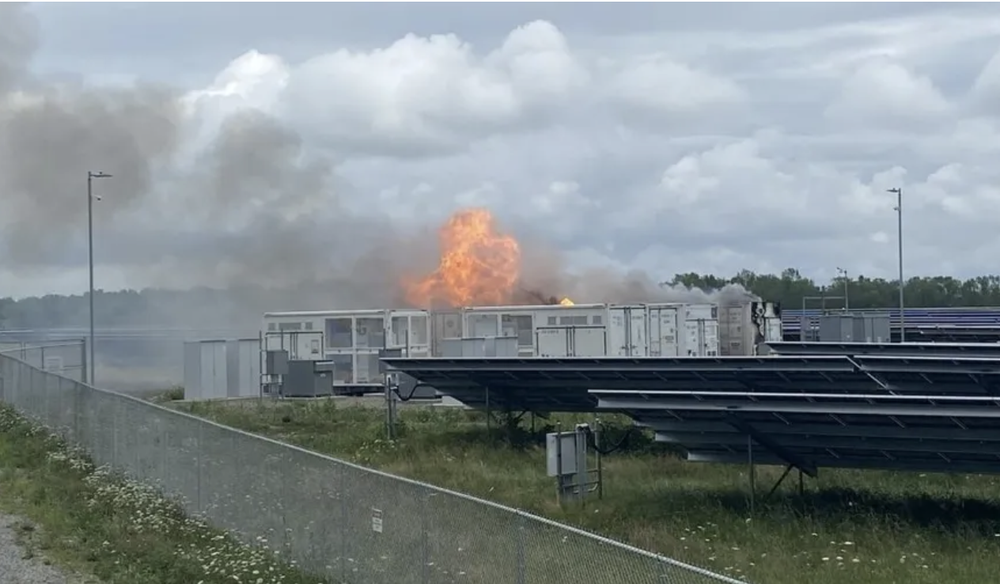
Big batteries sitting in cities have proved a big fire risk and no one wants them next door. So our green ‘engineers’ have another solution to these problems caused by their earlier ‘solutions’ – ‘Mobile Batteries’. (This is a worry – no one knows where they are – maybe they will be disguised as Mr Whippy ice cream vans?)
Train entrepreneurs want to build ‘batteries on tracks’ – a train loaded with batteries, which parks beside a wind/solar energy factory until the batteries are full. Then the battery train trundles off to the nearest city to unload its electricity, preferably at a profit. They can also play the arbitrage market – buy top-up power around midday and sell into peak prices at breakfast and dinner times when the unreliable twins usually produce nothing useful. This will have the added advantage of sending coal and gas generators broke sooner by depressing peak prices. Once coal and gas are decimated, then the battery trains can make a real killing.
But battery trains may be the perfect answer to supplying those energy-hungry AI data centres. Let’s start a pilot project and park a battery train beside the National AI Centre near the CSIRO in Canberra…
A more ambitious idea is the BBB Plan – ‘Big Batteries on Boats’.
It would work like this:
The Australian government places an order with China to build a fleet of electric boats (sail-assisted of course) that are filled with batteries (and lots of fire extinguishers). The batteries are charged with cheap coal-fired electricity at ports in China. They then sail to ports in Australia where the electricity is unloaded into the grid whenever prices are high or blackouts loom.
Australian mines can profit from the iron ore used to make the boats, the rare minerals used to build the batteries, and any Australian coal used by the Chinese power plants to charge the batteries.
This solution allows Australian politicians to go to world conferences boasting that Australia’s electricity is ‘Net Zero’, and more tourists can be enticed to visit our endangered industrial relics – coal mining and steam generator museums.
Of course, there is another danger in the BBB solution – some entrepreneurs may load their boats with nuclear generators plus enough fuel on board for several decades of operation. Or they may even site a small nuclear reactor beside a closed coal power station and make use of all the ready-to-go power lines already in place.
This sort of dangerous thinking could well demolish another Queensland green dream – ‘CopperString’ – a $5 billion speculation to build 840 km of new transmission line from Townsville to Mt Isa. We are not sure which way the power is expected to flow. They will probably not get there before the great copper mine at Mt Isa closes.
Why not just send a small nuke-on-a-train to Mt Isa?
The Spectator


 Iowa Climate Science Education