Month: August 2024

“EV-phobia spreads” in South Korea after a Mercedes EV spontaneously combusts in the basement

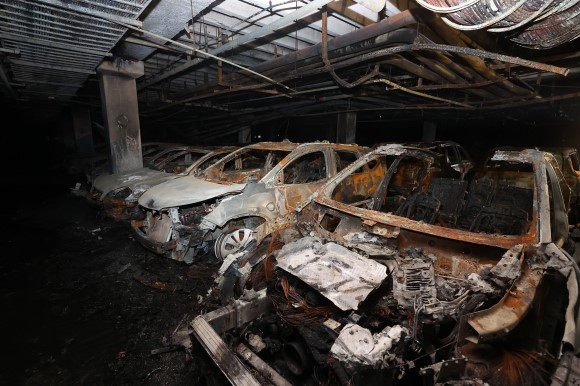
Mercedes Benz fire, burnt cars. South Korea.

By Jo Nova

It could have been so much worse

A Mercedes Benz EV started smoking in an underground carpark in Incheon, South Korea last Thursday at 6:15am. After the immolation, 40 other cars were burnt and another hundred suffered some damage.  At least 16 people were taken to hospital for smoke inhalation. Some 48o households lost electricity, and later 121 people had to be relocated.  It apparently burned for eight hours. Allegedly, eighty fire engines (or pieces of equipment) turned up with 177 firefighters.  Some 209 residents were in the apartment at the time, and “nearly half” were rescued by firefighters from stairs and balconies.

The investigation is ongoing… but there are many puzzles. It wasn’t a cheap car, it wasn’t charging and had been sitting in that spot for 59 hours and nothing apparently triggered the blaze.

Not surprisingly, there are reports that residents in other Seoul apartment blocks are moving to ban electric vehicles from their basement carparks.

The Nation

Incheon police on Tuesday said it is investigating what caused the mysterious explosion of an electric car last week, but some apartment residents in the greater Seoul area are already moving to ban electric vehicles from their underground parking lots.

Insurance companies will be watching on warily. Who pays when your car crash destroys 40 cars, and damages another hundred?

There are perhaps some clues though:

Michael Herh, Business Korea

According to the Ministry of Land, Infrastructure and Transport and the battery industry, the battery cell of the Mercedes-Benz EQE sedan that caught fire was a product of China’s Farasis. This battery is of the Nickel-Cobalt-Manganese (NCM) type, though the exact model name has not been disclosed.

Founded in 2009, Farasis achieved sales of $2.32 billion last year, ranking 10th globally in terms of sales and shipment volume. In 2018, Farasis signed a 10-year battery supply contract with Daimler, the parent company of Mercedes-Benz, and in 2020, Mercedes-Benz acquired about a 3% stake in Farasis to jointly develop batteries.  In March 2021, China’s state-owned Beijing Automotive Group (BAIC) recalled 31,963 electric vehicles equipped with Farasis batteries, citing “the possibility of battery fires …”

Pick your carpark carefully (and your apartment block.)


0 out of 10 based on 0 rating

via JoNova

https://ift.tt/Zor76hV

August 6, 2024 at 02:30PM

Guardian: “Climate Deniers” make up Nearly a Quarter of US Congress

Essay by Eric Worrall

Climate believers claim climate skepticism is in decline, that a growing number of people are concerned about climate change. But if this is the case, why are there so many elected climate skeptics?

Climate change deniers make up nearly a quarter of US Congress

Climate denialists – 23 in Senate and 100 in House – are all Republicans and make US an outlier internationally

Oliver Milman and Dharna Noor
Mon 5 Aug 2024 20.00 AESTLast modified on Tue 6 Aug 2024 00.51 AEST

US politics is an outlier bastion of climate denial with nearly one in four members of Congress dismissing the reality of climate change, even as alarm has grown among the American public over dangerous global heating, an analysis has found.

A total of 123 elected federal representatives – 100 in the House of Representatives and 23 US senators – deny the existence of human-caused climate change, all of them Republicans, according to a recent study of statements made by current members.

“It’s definitely concerning,” said Kat So, campaign manager for energy and environment campaigns at the Center for American Progress, who wrote the report.

“Of course the climate is changing,” the Texas senator Ted Cruz said in 2018. “The climate has been changing from the dawn of time. The climate will change as long as we have a planet Earth.”

“We’ve had freezing periods in the 1970s. They said it was going to be a new cooling period,” the Louisiana representative Steve Scalise said in a 2021 interview, referencing long-debunked research that is often still cited by climate deniers. “And now it gets warmer and gets colder, and that’s called Mother Nature. But the idea that hurricanes or wildfires were caused just in the last few years is just fallacy.”

“The amount of people at each end of the spectrum – alarmed and dismissive – were essentially tied back in 2013 but today there are three alarmed people for every one dismissive, so there’s been a fundamental shift in how people see climate change in the US,” said Anthony Leiserowitz, an expert in climate public opinion at Yale.

Naomi Oreskes, a history of science professor at Harvard University who has long studied anti-climate rhetoric, said it was “unsurprising” that the report found old-school climate denial is on the decline.

“It’s harder to deny the science when it’s so much more apparent that the climate is warming, that extreme weather is getting worse and happening constantly,” she said. “Nobody can deny the science with a straight face, given everything.”

Read more: https://www.theguardian.com/us-news/article/2024/aug/05/climate-change-denial-congress

Activists like Oreskes claims climate skepticism is in decline, and climate concern is rising. But if this is the case, why are there so many elected climate skeptics in US politics? Why would people who are majorly concerned about climate change keep voting for representatives who oppose climate action?

I know this might be a difficult concept for climate activists and some climate scientists to grasp, but if your model disagrees with observations, you should keep the observations and discard the model.

via Watts Up With That?

https://ift.tt/9yDm4zr

August 6, 2024 at 12:06PM

Biden Climate Policies the Greatest Financial Risk

Will Hild writes at Real Clear Policy The Biden Administration Proves Itself Wrong on ‘Climate Risk’.  The report shows how the feds’ own numbers prove their net zero policies pose a far greater financial risk than the climate itself. Excerpts in italics with my bolds and added images.

Environmental activists and left-leaning political bodies have long argued that climate risk is a form of financial risk, constantly pressuring blue states and the Biden Administration to make the issue a central part of their agendas. Recently, a group of those states has started suing oil and gas companies directly in their state courts. California, for example, claims that oil companies have colluded for decades to keep clean energy unavailable. Such lawsuits are ludicrous, and my organization, Consumers’ Research, filed an amicus brief at the Supreme Court supporting an effort to stop this litigation abuse that drives up consumer costs.

These harmful suits are driven in part by the idea that climate risks are inherently financial risks. However, evidence from the Biden Administration’s own study on climate risk shows that these risks are grossly exaggerated and immaterial. In an attempt to justify its radical and onerous climate policies, the Administration inadvertently exposed the fraud behind the environmental movement.
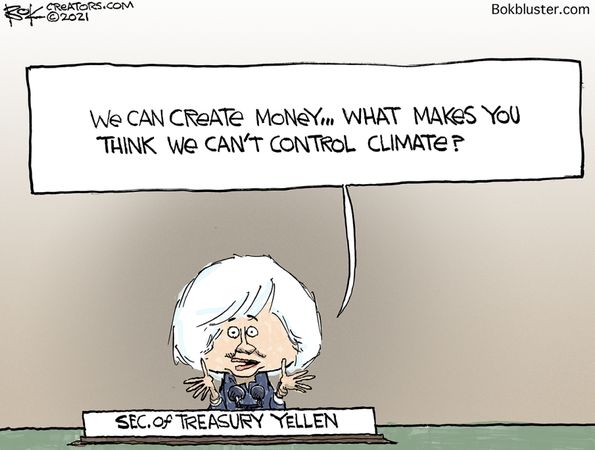
Soon after taking office, President Biden issued an executive order asking executive agencies to assess “the climate-related financial risk, including both physical and transition risks, to … the stability of the U.S. financial system.” Agency officials quickly responded to the order. Treasury Secretary Yellen announced that “climate change is an emerging and increasing threat to U.S. financial stability.” The FDIC declared that climate risk endangered the banking system. The SEC issued controversial climate risk disclosure rules, which impose massive regulatory burdens on Americans.

The problem with these new rules is that the Administration lacked
sufficient evidence to show that “climate-related financial risk” existed.

The SEC and Secretary Yellen relied on a Biden Administration report issued in 2021 by the Financial Stability Oversight Council. However, the report itself admitted that there were “gaps” in the evidence needed to support its speculative assertion that climate change would “likely” present shocks to the financial system. 

John H. Cochrane, a respected Stanford professor, slammed the Biden Administration’s “climate-related financial risk” assertions and highlighted that the Administration has not shown any serious threat to the financial system. “Financial regulators may only act if they think financial stability is at risk,” but “there is absolutely nothing in even the most extreme scientific speculations” to support the type of risk that would allow financial regulators to intervene. [See my synopsis Financial Systems Have Little Risk from Climate]

In response to criticism, the Biden Administration came up with an idea to manufacture its own evidence.  If the Federal Reserve created scenarios in which banks must simulate extreme “physical” and “transition” climate risks, these custom-designed scenarios could show a large impact to the financial system just like federal “stress tests” for banks.

To ensure that the “stresses” were sufficiently severe,
the Biden Administration manipulated the scenarios
to ensure as much stress as possible. 

For example, for “physical risk,” major banks had to simulate the effect of a storm-of-two-centuries-sized hurricane smashing into the heavily populated Northeast United States with no insurance coverage available to pay for the damage.  For “transition risk,” the government demanded a simulation in which “stringent climate policies are introduced immediately,” without any chance for banks to prepare for such policies, along with rapidly rising carbon prices. 
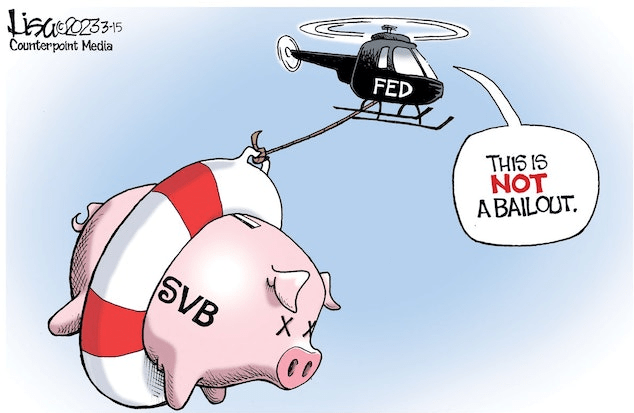
Despite these attempts to make the climate risk as extreme as possible, the tests utterly failed to demonstrate any significant effect.  The Administration’s study demonstrated that even under some of the most extreme climate scenarios imaginable, the probability of default on loans only increased by half a percentage point or less.   In contrast, federal bank stress tests involving true financial stresses, such as a severe recession, have resulted in probabilities of default jumping by 20 to 40 times that amount or more, leading to hundreds of billions in losses. 

The climate analyses also revealed the expected costs
of the Biden Administration’s quixotic net zero quest. 

The Biden Administration employed scenarios from the Network of Central Banks and Supervisors for Greening the Financial System (NGFS). Those climate scenarios envision the cost of carbon emissions steadily rising and reaching over $400 per ton by 2050.  Given that the average American emits about 16 tons of carbon a year, the Biden Administration’s hand-picked climate scenarios would cost the average American around $125k between now and 2050 in government mandated carbon fees.

Thus, the Biden Administration’s own bank stress test proved that climate risk is not a material financial risk, and that the biggest financial risk at issue is that the Administration’s net-zero policies would result in massive financial losses for everyday Americans. The Biden Administration should stop using lies to support their burdensome policies, and blue states should drop their punitive lawsuits against oil and gas companies.  Otherwise, the result of both efforts will be to inflict high costs on everyday Americans without any benefit.


via Science Matters

https://ift.tt/kIs1dEe

August 6, 2024 at 09:43AM

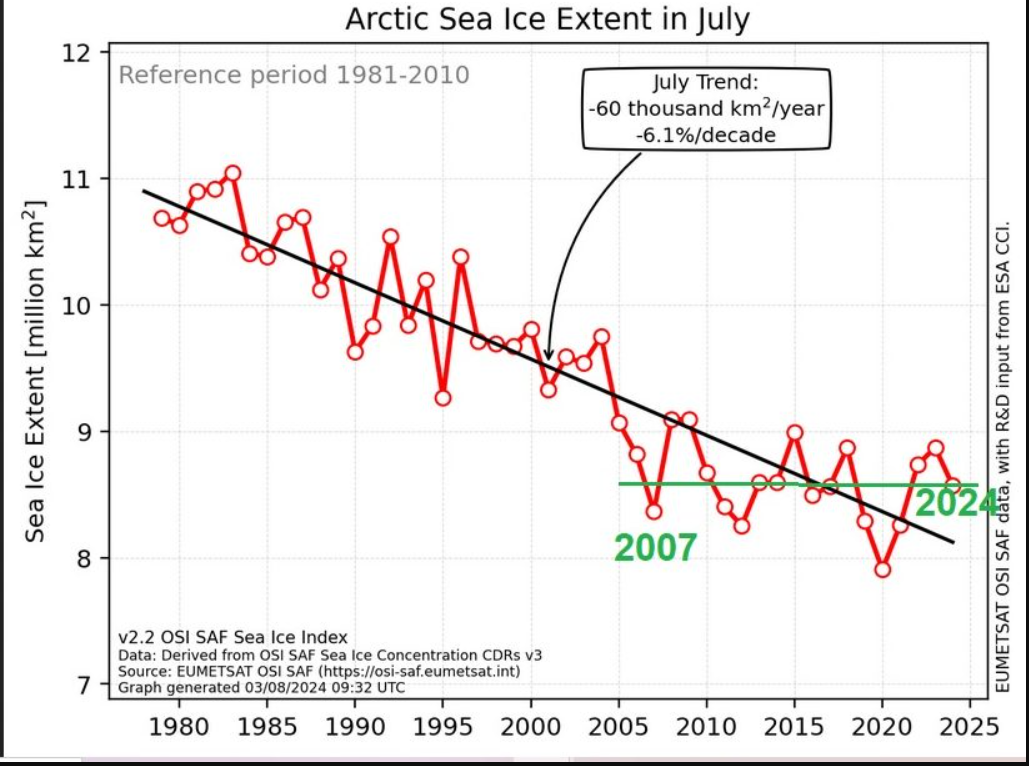
Summer Melting Has Plateaued: July Arctic Sea Ice Extent Hasn’t Fallen In 17 Years!

July Arctic sea ice area has been stable for 17 years. Nothing is melting anymore. 

Hat-tip: Snowfan here.

Image: DMI Arctic Plots Sea Ice Extent

The National Snow And Ice Data center (NSIDC) analysis of August 4, 2024 shows that the Arctic sea ice extent in July 2024 has been stable for 17 years, without any downward trend: there is no additional melting even in early summer.

Recall that leading experts say trend statements can be made with 17 years of data.

Moreover, the ice masses on Greenland show an unusual summer growth of more than 2 billion tons (2 Gt) at the end of July 2024 in the middle of the melting season, see here: polarportal.dk.

Donate – choose an amount

via NoTricksZone

https://ift.tt/eibcZD3

August 6, 2024 at 09:04AM