
Month: August 2024

Is Sea Level Rise Accelerating?

By Andy May

We are constantly told that the rate of global mean sea level (GMSL) rise is accelerating. Is it? How definitive is the evidence? If it is accelerating, why? Is the acceleration dangerous?

The usual assumption is that it is rising mostly because of man-made global warming and the melting of glaciers and the polar icecaps. Is that true? We will examine the evidence and see what we can figure out.

Dangendorf, et al. report that:

“We find a persistent acceleration in GMSL since the 1960s and demonstrate that this is largely (~76%) associated with sea-level changes in the Indo-Pacific and South Atlantic. We show that the initiation of the acceleration in the 1960s is tightly linked to an intensification and a basin-scale equatorward shift of Southern Hemispheric westerlies, leading to increased ocean heat uptake, and hence greater rates of GMSL rise, through changes in the circulation of the Southern Ocean.”

In absolute elevation, sea level is not the same in every ocean basin, this is due to the shape of the ocean basins, the individual ocean basin temperature, and in the strength and direction of the prevailing winds over the basin. Thus, the acceleration of sea level change in each basin is different, the global mean sea level is a combination of all the changes in each basin and just reporting (or discussing) GMSL masks a lot of complexity.

Dangendorf, et al. observe a persistent acceleration in global mean sea level since the 1960s and conclude that the acceleration is due to a shift in the prevailing Southern Hemisphere winds, not melting ice. In fact, they find that melting ice significantly contributed to the high rate of sea level rise in the 1930s, when greenhouse gas emissions were much lower than today, but had “zero to negative contributions to the acceleration coefficients between the 1940s and the early 1990s.”

They also report that the modern (1968-2015) acceleration in “global” sea level is not global at all, it is largely a rise in the acceleration of sea level rise in specific regions. No acceleration is detected in the eastern Pacific or the Arctic Ocean, and deceleration was detected in the Southern Ocean. Thus, the regions that should be most affected by melting ice, the Arctic and the Southern Ocean, show no acceleration.

This suggests that the currently observed acceleration is due to atmospheric circulation changes and not due to global warming or greenhouse gases. Major global wind circulation changes occur with a period of about 65 years and these cause changes in global temperatures as shown in figure 1.

Figure 1. The Atlantic Multidecadal Oscillation (AMO) Index and HadCRUT4 detrended global surface temperature record. Source: (May & Crok, 2024).

While the AMO Index is not exactly the same as the 60-70-year global climate oscillation, usually called the climate stadium wave, it is similar and the AMO is an important component of the stadium wave (Wyatt M. G., 2012c) and (Wyatt & Curry, 2014). Notice that the AMO shows a minimum between 1910 and 1925 and between 1970 and 1980 and that these minima approximately coincide with lows in the HadCRUT4 global average surface temperature after it is detrended.

Various estimates of sea level rise are shown in figure 2, including the Dangendorf et al. estimate.

Figure 2. A Comparison of various estimates of the rate of global sea level rise. The Jevrejeva and Church & White estimates are from tide gauges, the NASA estimate (Beckley, Callahan, Hancock, Mitchum, & Ray, 2017) is from satellite measurements, and the Dangendorf record is a complex hybrid.

The first thing we notice in figure two is that from 1900 to 2000 all the long-term rates of sea level rise are reasonably linear with rates between 1.4 and 2.0 mm/year or 5 to 8 inches per century. The second thing we notice is there is a similar cyclical pattern of increasing and decreasing acceleration of sea level rise in all the reconstructions. All show acceleration from about 1920 to around 1950-1960, followed by deceleration to the early 1990s, then acceleration again after the 1990s. Coincidentally, the satellite record begins as the cyclical acceleration starts up in the early 1990s.

According to Dangendorf et al., the acceleration in the rate of sea level rise observed since the 1960s (near the peak of the cycle) is not significantly larger than the acceleration noticed in 1920s and 1930s. It seems likely that the natural climate pattern seen in figure 1 is heavily influencing the sea level rise acceleration in both periods of acceleration. A comparison of the acceleration from 1960-2016 to that observed from 1920 to 1950 is shown in figure 3 for the Dangendorf hybrid model and the Jevrejeva tide gauge reconstruction.

Figure 3. A comparison of the rate of sea level rise acceleration from 1960 to 2016 (left) to the acceleration observed from 1920-1950 (right) for both the Dangendorf and Jevrejeva sea level rise records. The computed acceleration from a 2nd order polynomial fit is given for each plot.

In figure 3 it is clear that the Jevrejeva sea level rise record is much more detailed and less processed than the complex hybrid Dangendorf reconstruction, but both show similar rates of acceleration for the respective periods. The largest rate of acceleration is the Jevrejeva rate for 1920 to 1950 and the smallest is the Dangendorf rate for the same period. The modern Dangendorf rate of acceleration is modest and smaller than the modern Jevrejeva rate.

As noted in Dangendorf, et al. the rate of acceleration in the 1920 to 1950 period is similar to the rate in the modern period and the Jevrejeva data from 1920 to 1950 suggests the acceleration in that period was higher than the modern period. Since the early 20th century rate of acceleration was probably unaffected by greenhouse gas emissions there is no reason to believe the modern period of acceleration is any different.

Greenhouse gas emissions from 1950 to 1990 were higher than from 1920 to 1950, yet the acceleration of the rate of sea level rise was lower then and possibly negative, as shown in figure 4.

Figure 4. Dangendorf and Jevrejeva acceleration from 1950 to 1991.

The very heavily processed Dangendorf et al. sea level record shows a low rate of acceleration from 1950 to 1991, but the Jevrejeva tide gauge record actually shows deceleration over the period.

Discussion and Conclusions

There are specific breakpoints in climatic trends at around 1912 and 1972 as seen in the AMO Index in figure 1, these breakpoints can also be seen in the detrended HadCRUT4 global mean surface temperature record. For more information on climate breakpoints, aka climate shifts see here, here, and here.

Breaks also occur in the rate of sea level rise as shown in figure 2, but they are shifted slightly to about ±1928 and ±1991. All the sea level rise records in figure 2 show these breakpoints, with varying degrees of clarity.

It is unclear why the climate changes at these times, or if the changes are related to the changes in the rate of sea level rise. This is an area that needs more research. But these plots suggest that the acceleration of sea level rise changes on a cycle of 60-70 years. The changes follow a similar pattern to the rate of changes in the global surface temperature and the Atlantic Multidecadal Oscillation.

Dangendorf et al. believe that the 20th century changes in the acceleration of sea level rise are tightly linked to changes in atmospheric circulation, especially circulation in the Pacific and Southern Oceans. We see no reason to disagree with this opinion. Changes in the acceleration of sea level rise do not appear to be related to greenhouse gas emissions or human activities.

What if there are no periods of slowing acceleration, or any actual deceleration in sea level rise in this century? In other words, what if the current naturally “juiced” rate of acceleration since 1960 continues to 2100? How high would global mean sea level rise? Table 1 does that calculation using the data for each global sea level reconstruction discussed in this post. The functions used in the Jevrejeva and Dangendorf calculations are given in figure 3 on the left side. For the other functions used see the supplementary spreadsheet linked at the end of this post.

Table 1. The expected sea level rise at 2100 using the acceleration since 1960 (or the first estimate) to the final estimate.

As Table 1 shows, if the observed acceleration since the most recent upswing around 1960, in each reconstruction, is extrapolated to 2100 the sea level rise is only 16 to 33 inches. This is less than the global average daily tide and not a problem for anyone. The naturally juiced acceleration since 1960 is very unlikely to continue to 2100, it should swing back to a slower acceleration soon, just as it did sometime between 1955 and 1965.

A spreadsheet with the data used to make the figures and table can be downloaded here.

Download the bibliography here.

via Watts Up With That?

https://ift.tt/Cksbp5j

August 4, 2024 at 08:04PM

‘A disaster’: Paris Olympics’ lack of ‘meat-based protein’ to lower ‘carbon footprint’ creates havoc: ‘Athletes complain about the lack of animal protein-rich diet’

From CLIMATE DEPOT

Euro News: The German men’s hockey team has panned the food served at the Olympic Village, calling it “a disaster”, while British athletes flew an additional chef out to Paris to bridge a shortfall of supply. Andy Anson, CEO of the UK Olympic Association, lamented the lack of protein – especially chicken and eggs – on menus in the village…
The Paris 2024 Food Vision document aimed for…reduced animal protein to lower the Games’ carbon footprint…
The European Vegetarian Union (EVU) welcomed the Food Vision’s emphasis on plant-based options and local sourcing. “This is an opportunity to showcase to millions of people that plant proteins are a better alternative for the planet and can also support athletic performance,” EVU policy manager Rafael Pinto told Euronews. … 

“Athletes requiring high animal protein diets is a myth that has been busted a long time ago. Those perpetuating it in these Games aren’t basing their arguments on science,” he argued.

By Marc Morano

https://www.euronews.com/my-europe/2024/07/30/olympics-stir-eu-debate-on-need-for-meat-based-protein

By Gerardo Fortuna

An alleged ‘Last Supper’ parody during the Paris opening ceremony raised hackles, but the actual food on offer at the Olympic village has ignited a debate which reached Brussels this week over athletes’ need for a meat-based diet.

The German men’s hockey team has panned the food served at the Olympic Village, calling it “a disaster”, while British athletes flew an additional chef out to Paris to bridge a shortfall of supply.

Andy Anson, CEO of the UK Olympic Association, lamented the lack of protein – especially chicken and eggs – on menus in the village, and also raised concerns about meat being served raw.

The Paris 2024 Food Vision document aimed to serve 13 million meals during the Games to the athletes featuring locally sourced, seasonal food with reduced animal protein to lower the Games’ carbon footprint compared to the London 2012 and Rio 2016 Olympics.

Following the complaints, Étienne Thobois, CEO of the Paris 2024 Games, announced adjustments, including an increase in animal proteins.

“A reinforcement in animal proteins, with 700 kilos of eggs and a ton of meat, will meet the demands of the athletes,” Thobois told a press conference this week.

Sodexo Live, the French company responsible for catering, temporarily shifted from its initial eco-friendly commitments, stating that “certain products, such as eggs and grilled meats, are particularly popular among athletes, so their quantities have been immediately increased.”

In Brussels, the food issues at the Olympics sparked reactions, as the EU also aims to promote plant-based diets in a similar fashion under its Farm to Fork strategy, the bloc’s flagship food policy.

Christiane Lambert, president of the EU farmers’ lobby Copa Cogeca, criticised the shift away from animal protein on social media platform X in a bid to defend Europe’s livestock sector, adding that it hurts seeing that this situation is happening in the land of gastronomy.

“Prescribers [of these diets] have underestimated the need and desire for high-protein foods, offered by animal proteins, to repair muscles and recover between events and training sessions… need for carbohydrates too,” she said.

She warned that the EU similarly underestimates the diversity of dietary needs based on age, gender, physical activity, climate, traditions and culture.

On the other hand, the European Vegetarian Union (EVU) welcomed the Food Vision’s emphasis on plant-based options and local sourcing.

“This is an opportunity to showcase to millions of people that plant proteins are a better alternative for the planet and can also support athletic performance,” EVU policy manager Rafael Pinto told Euronews.

Pinto cited significant scientific evidence showing that fully plant-based diets can support athletic performance and muscle recovery without disadvantages.

He also emphasised the importance of ensuring proper protein and carbohydrate intake and educating athletes and their teams about plant-based alternatives.

“Athletes requiring high animal protein diets is a myth that has been busted a long time ago. Those perpetuating it in these Games aren’t basing their arguments on science,” he argued.

via Watts Up With That?

https://ift.tt/A8BYjSr

August 4, 2024 at 04:08PM

Experimental Proof Nil Warming from GHGs

Thomas Allmendinger is a Swiss physicist educated at Zurich ETH whose practical experience is in the fields of radiology and elemental particles physics.  His complete biography is here.

His independent research and experimental analyses of greenhouse gas (GHG) theory over the last decade led to several published studies, including the latest summation The Real Origin of Climate Change and the Feasibilities of Its Mitigation, 2023, at Atmospheric and Climate Sciences journal. The paper is a thorough and detailed discussion of which I provide here a synopsis of his methods, findings and conclusions. Excerpts are in italics with my bolds and added images.

Abstract

The actual treatise represents a synopsis of six important previous contributions of the author, concerning atmospheric physics and climate change. Since this issue is influenced by politics like no other, and since the greenhouse-doctrine with CO2 as the culprit in climate change is predominant, the respective theory has to be outlined, revealing its flaws and inconsistencies.

But beyond that, the author’s own contributions are focused and deeply discussed. The most eminent one concerns the discovery of the absorption of thermal radiation by gases, leading to warming-up, and implying a thermal radiation of gases which depends on their pressure. This delivers the final evidence that trace gases such as CO2 don’t have any influence on the behaviour of the atmosphere, and thus on climate.

But the most useful contribution concerns the method which enables to determine the solar absorption coefficient βs of coloured opaque plates. It delivers the foundations for modifying materials with respect to their capability of climate mitigation. Thereby, the main influence is due to the colouring, in particular of roofs which should be painted, preferably light-brown (not white, from aesthetic reasons).

It must be clear that such a drive for brightening-up the World would be the only chance of mitigating the climate, whereas the greenhouse doctrine, related to CO2, has to be abandoned. However, a global climate model with forecasts cannot be aspired to since this problem is too complex, and since several climate zones exist.

Background

The alleged proof for the correctness of this theory was delivered 25 years later by an article in the Scientific American of the year 1982 [4]. Therein, the measurements of C.D. Keeling were reported which had been made at two remote locations, namely at the South Pole and in Hawaii, and according to which a continuous rise of the atmospheric CO2-concentration from 316 to 336 ppm had been detected between the years 1958 and 1978 (cf. Figure 1), suggesting coherence between the CO2 concentration and the average global temperature.

But apart from the fact that these CO2-concentrations are quite minor (400 ppm = 0.04%), and that a constant proportion between the atmospheric CO2-concentration and the average global temperature could not be asserted over a longer period, it should be borne in mind that this conclusion was an analogous one, and not a causal one, since solely a temporal coincidence existed. Rather, other influences could have been effective which happened simultaneously, in particular the increasing urbanisation, influencing the structure and the coloration of large parts of Earth surface.

However, this contingency was, and still is, categorically excluded. Solely the two possibilities are considered as explanation of the climate change: either the anthropogenic influence due to CO2-production, or a natural one which cannot be influenced. A third influence, the one suggested here, namely the one of colours, is a priori excluded, even though nobody denies the influence of colouring on the surface temperature of Earth and the existence of urban heat islands, and although an increase of winds and storms cannot be explained by the greenhouse theory.

However, already well in advance institutions were founded which aimed at mitigating climate change through political measures. Thereby, climate change was equated with the industrial CO2 production, although physical evidence for such a relation was not given. It was just a matter of belief. In this regard, in 1992 the UNFCCC (United Nations Framework Convention on Climate Change) was founded, supported by the IPCC (Intergovernmental Panel on Climate Change). In advance, side by the side with the UNO, numerous so-called COPs (Conferences on the Parties) were hold: the first one in 1985 in Berlin, the most popular one in 1997 in Kyoto, and the most important one in 2015 in Paris, leading to a climate convention which was signed by representatives of 195 nations. Thereby, numerous documents were compiled, altogether more than 40,000. But actually these documents didn’t fulfil the standards of scientific publications since they were not peer reviewed.

Subsequently, intensive research activities emerged, accompanied by a flood of publications, and culminating in several text books. Several climate models were presented with different scenarios and diverging long-term forecasts. Thereby, the fact was disregarded that indeed no global climate exists but solely a plurality of climates, or rather of micro-climates and at best of climate-zones, and that the Latin word “clima” (as well as the English word “clime”) means “region”. Moreover, an average global temperature is not really defined and thus not measurable because the temperature-differences are immense, for instance with regard to the geographic latitude, the altitude, the distinct conditions over sea and over land, and not least between the seasons and between day and night. Moreover, the term “climate” implicates rain and snow as well as winds and storms which, in the long-term, are not foreseeable. In particular, it should be realized that atmospheric processes are energetically determined, whereto the temperature contributes only a part.

2. The Historical Inducement for the Greenhouse Theory and Their Flaws

The scientific literature about the greenhouse theory is so extensive that it is difficult to find a clearly outlined and consistent description. Nevertheless, the publications of James E. Hansen [5] and of V. Ramanathan et al. [6] may be considered as authoritative. Moreover, the textbooks [7] [8] and [9] are worth mentioning. Therein it is assumed that Earth surface, which is heated up by sun irradiation, emits thermal radiation into the atmosphere, warming it up due to heat absorption by “greenhouse gases” such as CO2 and CH4. Thereby, counter-radiation occurs which induces a so-called radiative transfer. This aspect involved the rise of numerous theories (e.g. [10] [11] [12]). But the co-existence of theories is in contrast to the scientific principle that for each phenomenon solely one explanation or theory is admissible.

Already simple thoughts may lead one to question this theory. For instance: Supposing the present CO2-concentration of approx. 400 ppm (parts per million) = 0.04%, one should wonder how the temperature of the atmosphere can depend on such an extremely low gas amount, and why this component can be the predominant or even the sole cause for the atmospheric temperature. This would actually mean that the temperature would be situated near the absolute zero of −273˚C if the air would contain no CO2 or other greenhouse gases.

Indeed, no special physical knowledge is needed in order to realize that this theory cannot be correct. However, the fact that it has settled in the public mind, becoming an important political issue, requires a more detailed investigation of the measuring methods and their results which delivered the foundations of this theory, and why misinterpretations arose. Thereto, the two subsequent points have to be particularly considered: The first point concerns the photometrical measurements on gases in the electromagnetic range of thermal radiation which initially Tyndall had carried out in the 1860s [13], and which had been expanded to IR-measurements evaluated by Plass nineteen years later [14]. The second point concerns the application of the Stefan/Boltzmann-law on the Earth-atmosphere system firstly made by Arrhenius in 1896 [2], and more or less adopted by modern atmospheric physics. Both approaches are deficient and would question the greenhouse theory without requiring the author’s own approaches.

2.1 The Photometric and IR-Measurement Methods for CO2

By variation of the wave length and measuring the respective absorption, the spectrum of a substance can be evaluated. This IR-spectroscopic method is widely used in order to characterize organic chemical substances and chemical bonds, usually in solution. But even there this method is not suited for quantitative measurements, i.e. the absorption of the IR-active substance is not proportional to its concentration as the Beer-Lambert law predicts. It probably will even less be the case in the gaseous phase and, all the more, at high pressures which were applied in order to imitate the large distances in the atmosphere in the range of several (up to 10) kilometres. Thereby it is disregarded that the pressure of the atmosphere depends on the altitude above sea level, which prohibits the assumption of a linear progress.

Moreover, it is disregarded that at IR-spectrographs the effective radiation intensity is not known, and that in the atmosphere a gas mixture exists where the CO2 amounts solely to a little extent, whereas for the spectroscopic measurements pure CO2 was used. Nevertheless, in the text books for atmospheric physics the Beer-Lambert law is frequently mentioned, however without delivering concrete numerical results about the absorbed radiation.

In both cases solely the absorption degree of the radiation was determined, i.e. the decrease of the radiation intensity due to its run through a gas, but never its heating-up, that means its temperature increase. Instead, it was assumed that a gas is necessarily warmed up when it absorbs thermal radiation. According to this assumption, pure air, or rather a 4:1 mixture of nitrogen and oxygen, is expected to be not warmed up when it is thermally irradiated since it is IR-spectroscopically inactive, in contrast to pure CO2.

However, no physical formula exists which would allow to calculate such an effect, and no respective empirical evidence was given so far. Rather, the measurements which were recently performed by the author delivered converse, surprising results.

2.2. The Impact of Solar Radiation onto the Earth Surface and Its Reflexion

Besides, a further error is implicated in the usual greenhouse theory. It results from the fact that the atmosphere is only partly warmed up by direct solar radiation. In addition, it is warmed up indirectly, namely via Earth surface which is warmed up due to solar irradiation, and which transmits the absorbed heat to the atmosphere either by thermal conduction or by thermal radiation. Moreover, air convection contributes a considerable part. This process is called Anthropogenic Heat Flux (AHF). It has recently been discussed by Lindgren [16]. However, herewith a more fundamental view is outlined.

The thermal radiation corresponds to the radiative emission of a so-called “black body”. Such a body is defined as a body which entirely absorbs electromagnetic radiation in the range from IR to UV light. Likewise, it emits electromagnetic radiation all the more as its temperature grows. Its radiative behaviour
is formulated by the law of Stefan and Boltzmann. . . According to this law, the radiation wattage Φ of a black body is proportional to the fourth power of its absolute temperature. Usually, this wattage is related to the area, exhibiting the dimension W/m2.

This formula does not allow making a statement about the wave-length or the frequency of the emitted light. This is only possible by means of Max Planck’s formula which was published in 1900. According to that, the frequencies of the emitted light tend to be the higher the temperature is. At low temperatures, only heat is emitted, i.e. IR-radiation. At higher temperatures the body begins to glow: first of all in red, and later in white, a mixture of different colours. Finally, UV-radiation emerges. The emission spectrum of the sun is in quite good accordance with Planck’s emission spectrum for approx. 6000 K.
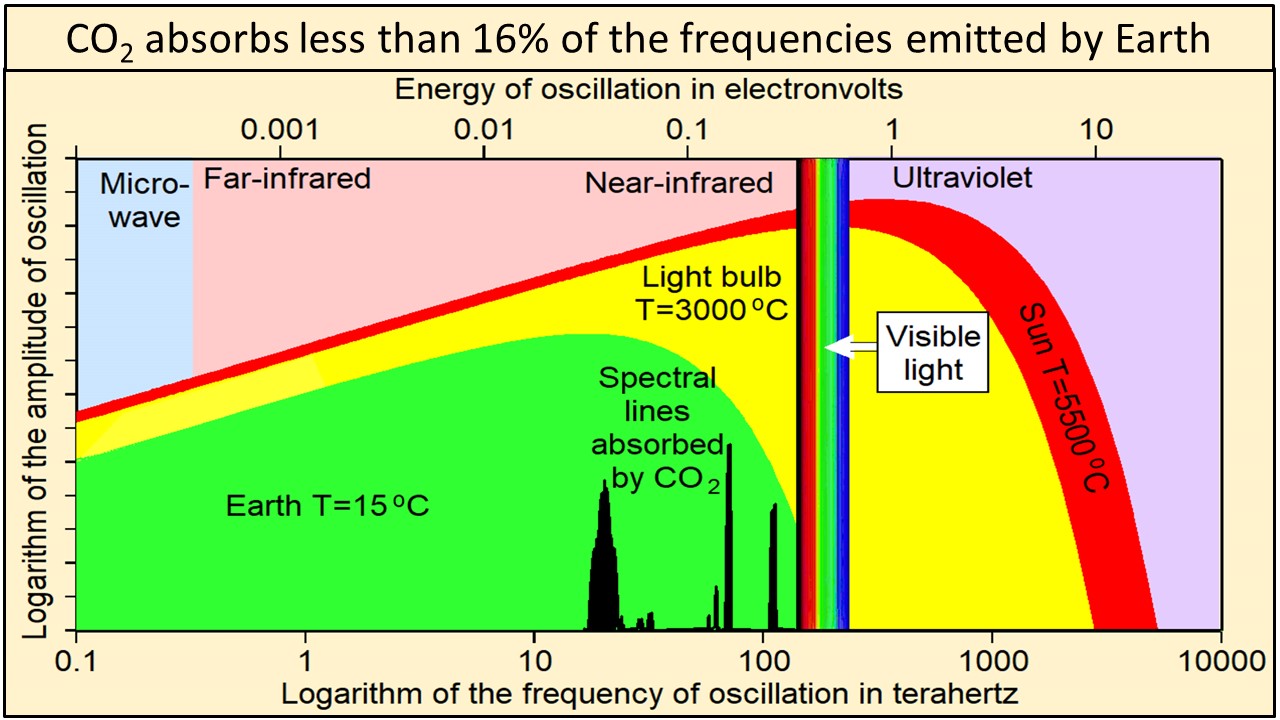
Black co2 abssorption lines are not to scale.

This model can be applied on Earth surface considering it as a coloured opaque body: On one side, with respect to its thermal emission, it behaves like a black body fulfilling the Stefan/Boltzmann-law. On the other side, it adsorbs only a part βs of the incident solar light, converting it into heat, whereas the complementary part is reflected. However, the intensity of the incident solar light on Earth surface, Φsurface, is not identically equal with its extra-terrestrial intensity beyond the atmosphere, but depends on the sea level since the atmosphere absorbs a part of the sunlight. Remarkably, the atmosphere behaves like a black body, too, but solely with respect to the emission: On one side, it radiates inwards to the Earth surface, and on the other side, it radiates outwards in the direction of the rest of the atmosphere.

However, this method implies three considerable snags:
•  Firstly, TEarth means the constant limiting temperature of the Earth surface which is attained when the sun had constantly shone onto the same parcel and with the same intensity. But this is never the case, except at thin plates which are thermally insulated at the bottom and at the sides, since the position of the sun changes permanently.

•  Secondly, this formula does not allow making a statement about the rate of the warming up-process, which depends on the heat capacity of the involved plate, too. This is solely possible using the author’s approach (see Chapter 3). Nevertheless, it is often attempted (e.g. in [35]), not least within radiative transfer approaches.

•  Thirdly, it is principally impossible to determine the absolute values of the solar reflection coefficient αs with an Albedometer or a similar apparatus, because the intensity of the incident solar light is independent of the distance to the surface, whereas the intensity of the reflected light depends on it. Thus, the herewith obtained values depend on the distance from Earth surface where the apparatus is positioned. So they are not unambiguous but only relative.

In the modern approach of Hansen et al. [5] the Earth is apprehended as a coherent black body, disregarding its segmentation in a solid and a gaseous part, and thus disregarding the contact area between Earth surface and the atmosphere where the reflexion of the sunlight takes place. As a consequence, in Equation (4b) the expression with Tair disappears, whereas a total Earth temperature
appears which is not definable and not determinable. This approach has been widely adopted in the textbooks, even though it is wrong (see also [15]).

Altogether, the matter of fact was neglected that the proportionality of the radiation intensity to the absolute temperature to the fourth is solely valid if a constant equilibrium is attained. In contrast, the subsequently described method enables the direct detection of the colour dependent solar absorption coefficient βs = 1 –αs using well-defined plates. Furthermore, the time/temperature-courses are mathematically modelled up to the limiting temperatures. Finally, relative field measurements are possible based on these results.

3. The Measurement of Solar Absorption-Coefficients with Coloured Plates

Within the here described and in [20] published lab-like method, not the reflected but the absorbed sun radiation was determined, namely by measuring the temperature courses of coloured quadratic plates (10 × 10 × 2 cm3) when sunlight of known intensity came vertically onto these plates. The temperatures of the plates were determined by mercury thermometers, while the intensity of the sunlight was measured by an electronic “Solarmeter” (KIMO SL 100). The plates were embedded in Styrofoam and covered with a thin transparent foil acting as an outer window in order to minimize erratic cooling by atmospheric turbulence (Figure 5). Their heat capacities were taken from literature values. The colours as well as the plate material were varied. Aluminium was used as a reference material, being favourable due to its high heat capacity which entails a low heating rate and a homogeneous heat distribution. For comparison, additional measurements were made by wooden plates, bricks and natural stones. For enabling a permanent optimal orientation towards the sun, six plate-modules were positioned on an adjustable panel (Figure 6).
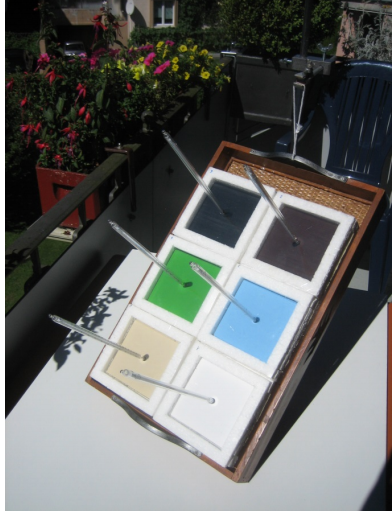
The evaluation of the curves of Figure 7 yielded the colour specific solar absorption-coefficients βs rendered in Figure 9. They were independent of the plate material. Remarkably, the value for green was relatively high.
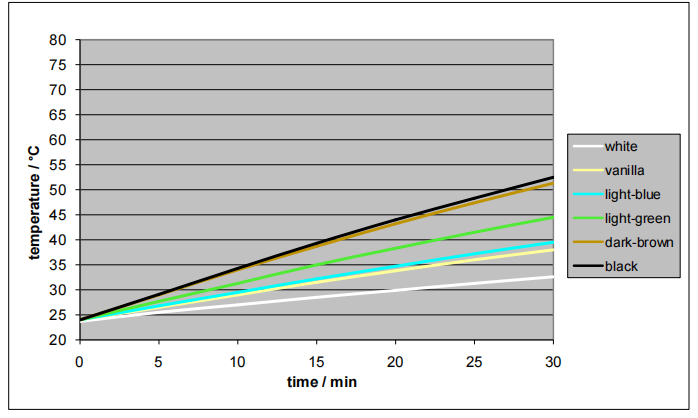
Figure 7. Warming-up of aluminium plates at 1040 W/m2 [20].

If the sunlight irradiation and thus the warming-up process would be continued, finally constant limiting temperatures are attained. However, when 20 mm thick aluminium plates are used, the hereto needed time would be too long, exceeding the constantly available sunshine period during a day. Instead, separate cooling-down experiments were made, allowing a mathematical modelling of the whole process including the determination of the limiting temperatures.
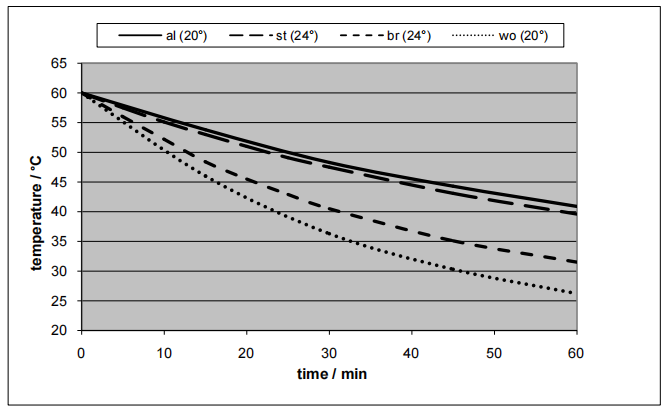
Figure 10. Cooling-down of different materials (in brackets: ambient temperature) [20]. al = aluminium 20 mm; st = stone 20.5 mm; br = brick 14.5 mm; wo = wood 17.5 mm.

These limiting temperature values are in good accordance with the empirical values reported in [24] and with the Stefan/Boltzmann-values. As obvious from the respective diagrams in Figure 11 and Figure 12, the limiting temperatures are independent of the plate-materials, whereas the heating rates strongly depend on them.  In principal, it is also possible to model combined heating-up and cooling-down processes [20]. However, this presumes constant environmental conditions which normally do not exist.

4. Thermal Gas Absorption Measurements

If the warming-up behaviour of gases has to be determined by temperature measurements, interference by the walls of the gas vessel should be regarded since they exhibit a significantly higher heat capacity than the gas does, which implicates a slower warming-up rate. Since solid materials absorb thermal radiation stronger than gases do, the risk exists that the walls of the vessel are directly warmed up by the radiation, and that they subsequently transfer the heat to the gas. And finally, even the thin glass-walls of the thermometers may disturb the measurements by absorbing thermal radiation.

By these reasons, quadratic tubes with a relatively large profile (20 cm) were used which consisted of 3 cm thick plates from Styrofoam, and which were covered at the ends by thin plastic foils. In order to measure the temperature course along the tube, mercury-thermometers were mounted at three positions (beneath, in the middle, and atop) whose tips were covered with aluminium foils. The test gases were supplied from steel cylinders being equipped with reducing valves. They were introduced by a connecter during approx. one hour, because the tube was not gastight and not enough consistent for an evacuation. The filling process was monitored by means of a hygrometer since the air, which had to be replaced, was slightly humid. Afterwards, the tube was optimized by attaching adhesive foils and thin aluminium foils (see Figure 13). The equipment and the results are reported in [21].

Figure 13. Solar-tube, adjustable to the sun [21].

The initial measurements were made outdoor with twin-tubes in the presence of solar light. One tube was filled with air, and the other one with carbon-dioxide. Thereby, the temperature increased within a few minutes by approx. ten degrees till constant limiting temperatures were attained, namely simultaneously at all positions. Surprisingly, this was the case in both tubes, thus also in the tube which was filled with ambient air. Already this result delivered the proof that the greenhouse theory cannot be true. Moreover, it gave rise to investigate the phenomenon more thoroughly by means of artificial, better defined light.

Figure 14. Heat-radiation tube with IR-spot [21].

Accordingly, the subsequent experiments were made using IR-spots with wattages of 50 W, 100 W and 150W which are normally employed for terraria (Figure 14). Particularly the IR-spot with 150 W lead to a considerably higher temperature increase of the included gas than it was the case when sunlight was applied, since its ratio of thermal radiation was higher. Thereby, variable impacts such as the nature of the gas could be evaluated.

Due to the results with IR-spots at different gases (air, carbon-dioxide, the noble gases argon, neon and helium), essential knowledge could be gained. In each case, the irradiated gas warmed up until a stable limiting temperature was attained. Analogously to the case of irradiated coloured solid plates, the temperature increased until the equilibrium state was attained where the heat absorption rate was identically equal with the heat emission rate.

Figure 15. Time/temperature-curves for different gases [21] (150 W-spot, medium thermometer-position).

As evident from the diagram in Figure 15, the initial observation made with sunlight was approved that pure carbon-dioxide was warmed up almost to the same degree as air does (whereby ambient air only scarcely differed from a 4:1 mixture between nitrogen and oxygen). Moreover, noble gases absorb thermal radiation, too. As subsequently outlined, a theoretical explanation could be found thereto.

Interpretation of the Results

Comparison of the results obtained by the IR-spots, on the one hand, and those obtained with solar radiation, on the other hand, corroborated the conclusion that comparatively short-wave IR-radiation was involved (namely between 0.9 and 1.9 μm). However, subsequent measurements with a hotplate (<90˚C), placed at the bottom of the heat-radiation tube ([15], Figure 16), yielded that long-wave thermal radiation (which is expected at bodies with lower temperatures such as Earth surface) induces also temperature increase of air and of carbon-dioxide, cf. Figure 17.

Thus, the herewith discovered absorption effect at gases proceeds over a relatively wide wave-length range, in contrast to the IR-spectroscopic measurements where only narrow absorption bands appear. This effect is not exceptional, i.e. it occurs at all gases, also at noble gases, and leads to a significant temperature increase, even though it is spectroscopically not detectable. This temperature increase overlays an eventual temperature increase due to the specific IR-absorption since the intensity ratio of the latter one is very small.

This may be explained as follows: In any case, an oscillation of particles, induced by thermal radiation, acts a part. But whereas in the case of the specific IR-absorption the nuclei inside the molecules are oscillating along the chemical bond (which must be polar), in the relevant case here the electronic shell inside
the atoms, or rather the electron orbit, is oscillating implicating oscillation energy. Obviously, this oscillation energy can be converted into kinetic translation energy of the entire atoms which correlates to the gas temperature, and vice versa.

5. The Altitude-Paradox of the Atmospheric Temperature

The statement that it’s colder in the mountains than in the lowlands is trivial. Not trivial is the attempt to explain this phenomenon since the reason is not readily evident. The usual explanation is given by the fact that rising air cools down since it expands due to the decreasing air-pressure. However, this cannot be true in the case of plateaus, far away from hillsides which engender ascending air streams. It appears virtually paradoxical in view of the fact that the intensity of the sun irradiation is much greater in the mountains than in the lowlands, in particular with respect to its UV-amount. Thereby, the intensity decrease is due to the scattering and the absorption of sunlight within the atmosphere, not only within the IR-range but also in the whole remaining spectral area. If such an absorption, named Raleigh-scattering, didn’t occur, the sky would not be blue butblack.

However, the direct absorption of sunlight is not the only factor which determines the temperature of the atmosphere. Its warming-up via Earth surface,which is warmed up due to absorbed sun-irradiation, is even more important. Thereby, the heat transfer occurs partly by heat conduction and air convection, and partly by thermal radiation. But there is an additional factor which has to be regarded: namely the thermal radiation of the atmosphere. It runs on the one hand towards Earth (as counter-radiation), and on the other hand towards Space. Thus the situation becomes quite complicated, all the more the formal treatment based on the Stefan/Boltzmann-relation would require limiting equilibrated temperature conditions. But in particular, that relation does not reveal an influence of the atmospheric pressure which obviously acts a considerable part.

In order to study the dependency on the atmospheric pressure, it would be desirable solely varying the pressure, whereas the other terms remain constant by varying the altitude of the measuring station above sea level which implicates a variation of the intensity of the sunlight and of the ambient atmosphere temperature, too. The here reported measurements were made at two locations in Switzerland, namely at Glattbrugg (close to Zürich), 430 m above sea level, and at the top of the Furka pass, 2430 m above sea level. Using the barometric height formula, the respective atmospheric pressures were approx. 0.948 and 0.748 bar.  At any position, two measurements were made in the same space of time.
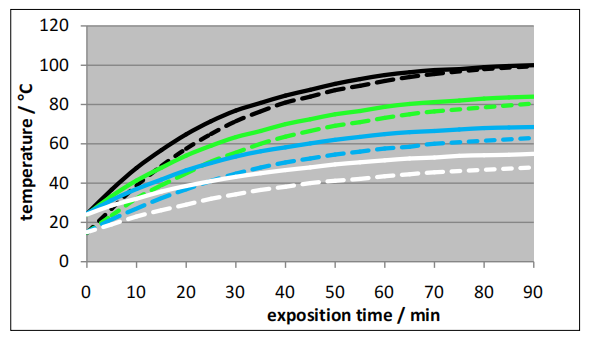
Figure 18. Comparison of the temperature courses during two measurements [24] (continuous lines: Glattbrugg; dotted lines: Furka).

Figure 18 renders the data of one measurement pair. Obviously, the limiting temperatures were not ideally attained within 90 minutes. Moreover, the evaluation of the data didn’t provide strictly invariant values for A. But this is reasonable in view of the fact that the sunlight intensity was not entirely constant during that period, and that its spectrum depends on the altitude over sea level. Nevertheless, for the atmospheric emission constant A an approximate value of 22W·m−2• bar−1• K−0.5 could be found.

These findings indeed confirm that in a way a greenhouse-effect occurs, since the atmosphere thermally radiates back to Earth surface. But this radiation has  nothing to do with trace gases such as CO2. It rather depends on the atmospheric pressure which diminishes at higher altitudes.

If the oxygen content of the air would be considerably reduced, a general reduction of the atmospheric pressure and, as a consequence, of the temperature would proceed. This may be an explanation for the appearance of glacial periods. However, other explanations are possible, in particular the temporary decrease of the sun activity.

Over all it can be stated that climate change cannot be explained by ominous greenhouse gases such as CO2, but mainly by artificial alterations of Earth surface, particularly in urban areas by darkening and by enlargement of the surface (so-called roughness). These urban alterations are not least due to the enormous global population growth, but also to the character of modern buildings tending to get higher and higher, and employing alternative materials such as concrete and glass. As a consequence, respective measures have to be focussed, firstly mentioning the previous work, and then applying the here presented method.

7. Conclusions

The herewith summarized work of the author concerns atmospheric physics with respect to climate change, comprising three specific and interrelated points based on several previous publications: The first one consists in a critical discussion and refutation of the customary greenhouse theory; the second one outlines the method for measuring the thermal-radiative behaviour of gases; and the third one describes a lab-like method for the characterization of the solar-reflective behaviour of solid opaque bodies, in particular for the determination of the colour-specific solar absorption coefficients.

As to the first point, three main flaws were revealed:

•  Firstly, the insufficiency of photometric methods in order to determine the heating-up of gases in the presence of thermal radiation;
•  Secondly, the lack of  causal relationship between the CO2-concentration in the atmosphere and the average global temperature, based on the reasoning that the empiric simultaneous increase of its concentration and of the global temperature would prove a causal relationship instead of an analogous one; and
•  Thirdly, the inadmissible application of the Stefan/Boltzmann-law to the entire Earth (including the atmosphere) versus Space, instead of the application onto the boundary between the Earth surface and the
atmosphere.

As to the second point, the discovery has to be taken into account according to which every gas is warmed up when it is thermally irradiated, even noble gases, attaining a limiting temperature where the absorption of radiation is in equilibrium with the emitted radiation. In particular, pure CO2 behaves similarly to pure air. Applying kinetic gas theory, a dependency of the emission intensity on the pressure, on the root of the absolute temperature, and on the particle size could be found and theoretically explained by oscillation of the electron shell.

As to the third point not only a lab-like measuring method for the colour dependent solar absorption coefficient βs was developed, but also a mathematical modelling of the time/temperature-course where coloured opaque plates are irradiated by sunlight. Thereby, the (colour-dependent) warming-up and the (colour-independent) cooling-down are detected separately. Likewise, a limiting temperature occurs where the intensity of the absorbed solar light is identical equal with the intensity of the emitted thermal radiation. In the absence of wind-convection, the so-called heat transfer coefficient B is invariant. Its value was empirically evaluated, amounting to approx. 9 W·m−2•K−1.

Finally, the theoretically suggested dependency of the atmospheric thermal radiation intensity on the atmospheric pressure could be empirically verified by measurements at different altitudes, namely in Glattbrugg (430 m above sea level and on the top of the Furka-pass (2430 m above sea level), both in Switzerland, delivering a so-called atmospheric emission constant A ≈ 22 W·m−2•bar−1•K−0.5. It explained the altitude-paradox of the atmospheric temperature and delivered the definitive evidence that the atmospheric behavior, and thus the climate, does not depend on trace gases such as CO2. However, the atmosphere thermally reradiates indeed, leading to something similar to a Greenhouse effect. But this effect is solely due to the atmospheric pressure.

Therefore, and also considering the results of Seim and Olsen [23], the customary greenhouse doctrine assuming CO2 as the culprit in climate change has to be abandoned and instead replaced by the here recommended concept of improving the albedo by brightening parts of the Earth surface, particularly in cities, unless fatal consequences will be hazarded.
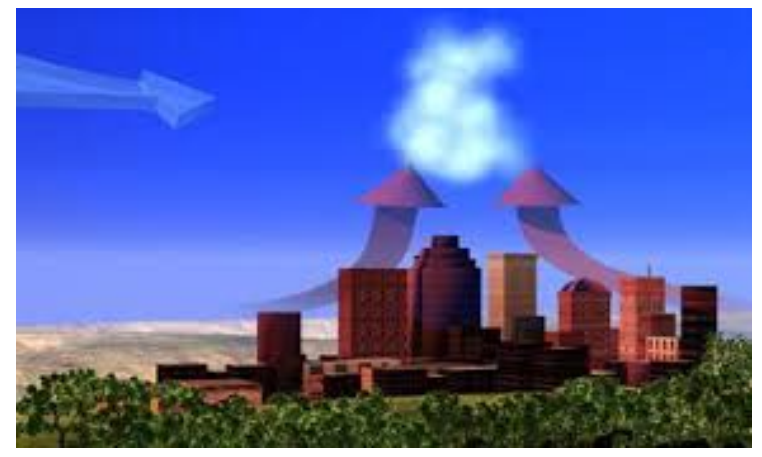
Figure 24. Up-winds induced by an urban heat island.


via Science Matters

https://ift.tt/GfuwDm8

August 4, 2024 at 01:33PM

Role of Humans in the Global Water Cycle and Impacts on Climate Change

by Bruce Peachey and Nobuo Maeda

Contemporary climate models only include the impact of water vapor as positive feedback on warming; the impact of direct anthropogenic emissions of water vapor has not been seriously considered.

Background

Recent climate change and increasingly scarce fresh water resources are two major environmental issues facing humanity. Water vapor is the most abundant greenhouse gas. Contemporary climate models only include the impact of water vapor as positive feedback on warming; the impact of direct anthropogenic emissions of water vapor has not been seriously considered.

Our recent publication used the NCEP/NCAR reanalysis data set to examine whether the Clausius−Clapeyron equation can form a basis for such positive feedback commonly assumed in the contemporary climate models [1]. We found that:  (1) qualitatively, the log-linear nature of the Clausius−Clapeyron equation [(ln Pv) vs (1/T)] demonstrates a significant level of consistency when averaged over expansive regions like specific latitude zones around the globe; (2) this consistency does not extend to individual locations where a plot of (ln Pv) vs (1/T) becomes nonlinear, indicating substantial undersaturation that varies with time; (3) quantitatively, the discrepancies between the locally observed and the expected values of the slopes of (ln Pv) vs (1/T)  are wide-ranging; and (4) the absolute amount of water vapor has increased substantially above the population centers and the agricultural areas in the Northern Hemisphere between 1960 and 2020, but not in the Southern Hemisphere where the surface area of the oceans is much greater. These findings suggest that direct anthropogenic emissions of water vapor are an important driver that influences the local water vapor content.

Our paper concluded that the use of the Clausius–Clapeyron equation as a basis for calculating the positive water vapor feedback appears to be on shaky ground [1]. Since the discrepancies between the observed and the expected values of the slopes of (ln Pv) vs (1/T) were wide-ranging [1], it remains unclear if the amount of atmospheric water vapor will truly increase by as much as 6 to 7% in response to every 1 °C of warming, as commonly assumed.

In the present contribution, we highlight: (1) the role of humans in the global water cycle and impacts on climate change, (2) the regional nature of many aspects of “global” warming, (3) propose that future research effort should be directed toward obtaining the relevant data as a matter of urgency.

Water cycle

Human activities indeed have been impacting climate but most of the key factors are related to water, as opposed to CO2 [2-6]. Atmospheric water vapor increase in the Northern Hemisphere has been by several percent per decade. In contrast, there has been little change in the Southern Hemisphere. Unlike water, CO2 is in a single phase and largely uniformly distributed in the atmosphere. Thus, if CO2 were the cause of the current climate change, and if the ocean is the source of the water vapor that is supposed to increase by about 6 to 7% in response to every 1 °C of warming caused by the non-aqueous greenhouse gases, then the Southern Hemisphere should have observed more of the consequences than the Northern Hemisphere due to its much larger surface area of the oceans. To the contrary, a 2% average increase in precipitation, that amounts to an average of about 2 Tt/year over the last century, has been observed in the Northern Hemisphere land precipitation, while no such increase was observed in the Southern Hemisphere land precipitation [7]. This increase in the Northern Hemisphere land precipitation has been accompanied by an estimated 2 to 4% increase in the frequency of heavy precipitation events in the last 50 years, again in the Northern Hemisphere but not in the Southern Hemisphere.

Water is being consumed by humans at an increasing rate, predominantly in the Northern Hemisphere, at least by 3 to 4 Tt/year (excluding some sources such as reservoir evaporation). This increasing water consumption has been accompanied by reductions in the return flows of the fresh water to the oceans from the rivers in regions with intensive irrigation & industry, again predominantly in the Northern Hemisphere. Other major contributors identified by the IPCC are water emissions and land use. Calls for the comprehensive integration of substantial changes in the hydrological cycle into global climate models are not new [8, 9], but have received limited support, and consequently these causes have generally been ignored and not incorporated into the contemporary climate models to date.

Natural land water flux is based on water vapour coming on to land areas from the ocean, water falling as precipitation with some being re-evaporated from the landscape with the remaining flow, of about 40 Tt/yr, flowing back into the ocean to balance the flow of water vapour from the ocean. Ocean water vapor flux is 6 times larger than the land water vapor flux, even though the global water surface area is only about 3 times larger than the land area [2]. This is because: (1) the ocean surface is darker and hence absorbs more solar energy and (2) the ocean surface is always wet, which enhances mass transfer compared to the land surface, which sometimes is wet and sometimes is dry. At any one time, the atmosphere contains about 13 Tt of water, which contributes most of the greenhouse effect, and a given water molecule on average only spends about 10 days in the atmosphere each time it goes through the cycle [10].

Global water budgets are found in many publications on water availability and show some variations in numbers used, but are within a reasonable range, and generally agree with each other. For this analysis, we show schematically a global water budget in Figure 1, which uses the numbers from “Global Warming – The Complete Briefing” by Houghton [11]. Here we assume that the total amount of water in the atmosphere does not change materially in a short time span of a year (after all seasons in a year), notwithstanding the fact that warming leads to increased water vapor content.

More recent literature (https://www2.whoi.edu/site/globalwatercycle/) provides slightly different numbers of (after converting the unit of m3/s to Tt/yr) 41 instead of 40 for the horizontal land to the ocean water flux, 69 instead of 71 for the upward land to land atmospheric water flux in Figure 1, 110 instead of 111 for the downward land atmosphere to land water flux, 426 instead of 425 for the upward ocean to oceanic atmosphere water flux and the same 385 for the downward oceanic atmosphere to ocean water flux, which provides the readers with an idea of the amount of variations involved. Our conclusions will remain unaltered regardless of which version of numbers we use.

Screen Shot 2024-08-04 at 10.28.24 AM

Figure 1 Global conservation of water masses adapted from [2]. The numbers show the movement of water masses in tera tons per year. This is the base case before the recent warming became an issue.

The numbers in Figure 1 show the movements of water in tera tons (1 Tt = 1012 t = 1015 kg) per year before the recent warming. The inflows and the outflows of water must be balanced at each reservoir of “land”, “ocean”, “sky above land” and “sky above ocean”, to satisfy the conservation of mass. These four entities can, but do not need to, be geometrically continuous.

Water withdrawal and water use data is available from a number of sources and studies. Most estimates put human water withdrawals in the range of 4 to 5 Tt/yr worldwide, with over 60% of that going to irrigation, 20 to 30% to industrial cooling and the remainder for domestic use. For example, the IPCC’s estimate of anthropogenic water withdrawals that are reducing ocean discharge flows in rivers such as the Nile, Colorado, Yellow, Rio Grande, and other rivers that are heavily used for irrigation places the reduction in the return flows to the ocean (the 40 Tt from “land” to “ocean”) is around 10%, or 4 Tt/yr [7, 12]. Houghton reports “in the United States, for the Missouri river basin it is 30%, for the Rio Grande it is 64%, and for the lower Colorado 96%. Almost none of the water in the Colorado river reaches the sea” [11]. In short, the water consumption on such river systems as a percentage of the total discharge can be substantial. More recently, the latest 2021 IPCC Climate Change report reported the magnitude of the impacts humans have had on water cycle on land in that: “Direct redistribution of water by human activities for domestic, agricultural and industrial use of about 24,000 km3/year is equivalent to half the global river discharge or double the global groundwater recharge each year” [13]. Therefore this 24 Tt/yr is ~60% of the total estimated return flow of 40 Tt/yr to the oceans.

Unfortunately, these reports do not provide an explanation as to where the water goes after it has been withdrawn or redistributed. Consequently, what is less clear is the actual amount of evaporation of water to the atmosphere. For irrigation withdrawals, most of the water is evaporated during irrigation or from the field after irrigation, whereas for most domestic water withdrawals the water may be returned to the source or another water body as sewage. The main industrial water use is for cooling thermal plants, however, the relationship between withdrawals and evaporation loss of water varies greatly, depending on the cooling process used (i.e. evaporative cooling on-site or return of hot water to a large body of water). Some data sources breakdown water volumes by use, by water basin, or by country with accuracy varying depending on what is being reported, consistency in the reporting, measuring methodologies, and the rigour applied to the data collection process [11, 14-21]. Often these estimates do not include other water losses, where the water transfer is unintentional or unmeasured, such as losses to groundwater reservoirs, or evaporation from hydroelectric or irrigation reservoirs, they may also not contain withdrawals of groundwater from aquifers which have greatly increased in recent years [22].

A major challenge for a contemporary climate model is: How to generate a 5% increase in land precipitation in Northern hemispheric land areas, which has been reported to occur in the IPCC reports [7, 12], but not in Southern hemispheric land areas?

Since the Northern Hemisphere contains 67.3% of the Earth’s land, if we neglect the Southern hemispheric land precipitation increases for simplicity, the increased Northern hemispheric land precipitation by 5% would result in about 3.4% increase in global land precipitation. Such 3.4% increase of the 111 Tt downward water flux over the entire landmass equates to about 4 Tt extra downward water flux. Under the contemporary non-aqueous greenhouse gas-driven global warming paradigm, this extra 4 Tt would have to come from the oceans through a 10% (of the 40 Tt) increase in the water vapor content of air crossing onto land masses from the oceans. Now, one cannot realistically assume that 100 % of this extra water vapor generated from the ocean surface will exclusively flow to the land: the majority should precipitate back onto the ocean.

For simplicity, here we assume that the same proportion of the water vapor generated as that shown in Figure 1 would partition into the land and to the ocean downward fluxes. Then, to generate the 4 Tt increase in the water vapor content on the landmass, both the upward and the downward water fluxes over the entire ocean surface must also increase by 10% over historic levels. Then, the resulting global water balance (without considering the Northern vs Southern hemispheric water partitions) would look something like what we schematically draw in Figure 2.

Screen Shot 2024-08-04 at 10.29.46 AM

Figure 2 Global conservation of water masses that corresponds to the settings assumed by the contemporary climate models. The numbers show the movement of water masses in tera tons per year. Non-aqueous greenhouse gases initiate a positive feedback in which the initial warming leads to increased evaporation from the oceans of 42 tera tons per year. 38 of the incremental 42 tera tons would directly precipitate back onto the ocean and 4 out of the 42 tera tons would transport to over a land area before precipitating. The 4 tera tons of the excess water that has precipitated on the land would need to flow back to the ocean to close the water cycle, which is contrary to the observations.

The purported change of water from the oceans to the land areas to account for increased land precipitation would generate a significant (+10%) increase in total water outflow off continental land masses (the return flow of about 4 tera tons to compensate for the excess water evaporated from the ocean as a part of the purported positive feedback mechanism in the contemporary climate models), as shown in Figure 2, which is incidentally contrary to the observations that show dwindling outflows of major rivers around the globe [7, 12]. Nor does it explain how the only area showing incremental precipitation is the latitude band from 30 to 60 degrees North, with no significant change in the Southern Hemisphere.

The water mass balance (budget) above also has significant energy balance implications. To achieve the required 42 Tt/yr of incremental water evaporation off oceans would require a large amount of incremental solar energy being absorbed. We estimate that this would require on the order of 10 Zeta Joules/year being absorbed by the oceans (42 Tt/yr × 2260 kJ/kg) or a 10% increase in solar energy absorbed. Given that the average estimated incremental radiative forcing is ~ 2 W/m2 of the earth’s surface, it is much more realistic to assume that the incremental radiative forcing would proportionately partition so that the ocean to the oceanic atmosphere water flux would increase by ~ 2 [W/m2] / 300 [W/m2] × 425 [Tt/yr] = 2.8 Tt/yr, assuming the 300 W/m2 is the net average radiation absorbed by the earth and 425 Tt/yr being the upward water flux over the oceans (note our conclusion remains unaltered even if the correct number were 200 W/m2 or 400 W/m2 as the net average radiation absorbed by the earth). Then, about 10% (the same proportion as in Figure 2) of the 2.8 Tt/yr incremental water vapor, or 0.28 Tt/yr, would transfer to land areas while the rest would precipitate back to the ocean, which would be considerably less than the 4 Tt/yr incremental precipitation observed over land areas. In short, the scenario envisioned in Figure 2 is highly unrealistic.

Figure 2 is for the global water mass balance and hence does not account for any regional-scale details. From a regional water mass and energy conservation perspective, an intensified non-aqueous greenhouse gas effect resulting in global warming should have a much greater impact on climate in the Southern Hemisphere because its fraction of the ocean is far greater. Yet the IPCC climate data shows a definite bias towards precipitation from climate change being a predominantly Northern Hemisphere phenomenon, and the total precipitation over the Southern Hemispheric land masses has not increased [7, 12]. The contemporary climate model simulations show that most of the extra evaporation to originate in the Southern Hemisphere, so it leaves the question open as to how the water vapour purportedly generated in the Southern Hemispheric oceans preferentially crosses into the Northern Hemispheric land masses.

To the contrary, the areas of increased precipitation tend to be in cool wet Northern areas, fed by air masses from hot, dry or highly populated areas, with high anthropogenic water emissions, which are unassociated with “global” warming. The main region in the Southern Hemisphere, which shows a similar response to the Northern Hemisphere, is Patagonia in South America, which has an irrigation and energy intensive economy. Patagonia, through ocean and atmospheric circulation patterns, feeds water and energy to the Antarctic Peninsula, which is the only part of Antarctica to show any impact of “global” warming [23]. Since the latent heat of vaporization of water is large, one tonne of water vapour contains enough energy to melt 6.7 tonnes of ice or snow. An analysis should be undertaken as to the relationship between the water use in Patagonia and deterioration of ice masses on the Antarctic Peninsula.

Other regions in the Southern Hemisphere, such as New Zealand, the western coasts of Australia and Southern Africa, show little change in precipitation that they should have experienced with increased water evaporation from the oceans that is purported to occur under the non-aqueous greenhouse gas-driven, water vapor positive feedback amplified, paradigm. To the contrary, the South Island of New Zealand, with its high mountains and the Tasman Sea to the west and should have experienced substantially more precipitation, has not. In Australia, the coasts of Western Australia remain dry, and increased precipitation and extreme heavy rainfalls instead occur in Eastern Australia which is downwind of the water withdrawn from the Murray–Darling Basin for irrigation.

Since there is sufficient evidence / observations that support the idea that anthropogenic emissions are an important driver of recent warming [1], we now consider how the conservation of water masses might look like if anthropogenic emissions of water vapor were indeed the primary driver of the recent trend of climate warming. As noted above, wetter land surfaces and new vegetative cover after irrigation are darker than the dry surfaces before irrigation, and consequently absorb more sunlight. The concomitant incremental radiation energy absorbed through increasing the area of absorption by spreading water from lakes, rivers and underground aquifers over fields and rice paddies is still an incremental energy input, and must be released by the water during condensation (cloud formation) and precipitation in the Northern areas. Anthropogenic emissions of water vapor, which is predominantly emitted in the low to mid latitudes of the Northern Hemisphere (between 0 and 60°N), would move water and energy poleward to the Arctic through atmospheric circulation patterns.

The condensation of water vapor would release latent heat, cause melting of Northern and inland ice sheets, increase Northern cloud cover, and increase precipitation and severe weather events, wherever the water comes out. Such movements of water masses also explain the reported freshening trend in water flowing to the Arctic, Atlantic and Pacific, and the increasing salinity and temperature increases in tropical water masses, which are no longer receiving those cool fresh water returns from rivers. Figure 3 shows how the water balance might look like in this scenario. As was the case in Figures 1 and 2, Figure 3 is for the global scale description that does not include any granularity or geographical spread of each of land and ocean components.

Screen Shot 2024-08-04 at 10.30.23 AM

Figure 3 Global conservation of water masses when the Anthropogenic Emissions of Water Vapor is assumed to drive the recent trend of climate warming and climate change. The numbers show the movement of water masses in tera tons per year. Here, extra 4 tera tons per year of water vapor would be generated from the land and virtually all of them precipitate back on the (colder parts of) the land.

As we did during the calculation of the water mass balance in Figure 2, since the Northern Hemisphere contains 67.3% of the Earth’s land, if we neglect the Southern Hemispheric land precipitation increases for simplicity, the increased Northern Hemispheric land precipitation by 5% would result in about 3.4% increase in global land precipitation. Such 3.4% increase in the 111 Tt downward water flux over the entire landmass equates to about 4 Tt extra downward water flux, which has been observed to be concentrated in the cold Northern Hemispheric landmass. Unlike in Figure 2, however, the extra 4 Tt does not come from the sky above ocean, but instead comes from the warm, dry and/or populated regions of the landmass.

On a regional basis, anthropogenic emissions of water vapor also better match the observations of reduced flows in highly utilized rivers and lakes in dry, heavily populated regions such as China, India, Pakistan and the southwestern United States, and the corresponding increases in rainfall in Northern temperate regions. Examples of regional–scale “unusual patterns” include: (1) weekly patterns of rainfall on the east coast of the United States showed that rainfall was 22% higher on Saturdays than any other day of the week, with Sunday to Tuesday being the lowest days [24]; (2) workweek diurnal temperature variations, where some water emitting areas showed night time cooling on weekends, while other non-water emitting regions showed cooler nights on weekdays [25]. Neither natural planetary orbital cycles nor global warming should be able to generate weekly or workweek patterns, but water emissions from power generation, and irrigation, tend to drop on weekends.

Another notable regional-scale issue is that the mass balance and the energy balance around the Gulf of Mexico should show the impacts of reduced water inflow into the Gulf from the Rio Grande, Missouri, and Mississippi rivers. The reduced flows of fresh, cool water into the Gulf should result in a warming of surface waters which in turn could potentially (1) impact the strengths and paths of hurricanes, (2) generate warmer climate downstream of the Gulf stream (e.g., Western Europe due to a warmer yet lower rate of flow). These are regional, as opposed to the global, “unusual patterns”, but the point is that anthropogenic emissions of water vapor have major, observable impacts in regional scales.

Conclusions and Recommendations

Anthropogenic water emissions are large enough to result in a ~5 to 7% incremental increase (4 to 5 Tt/yr) in land-to-atmosphere water flux and a similar increase in water vapor in the atmosphere over land areas impacted by human water uses such as irrigation, evaporative cooling and evaporation from water reservoirs. These water emissions are about 1000× the net increase in carbon mass emitted to the atmosphere and contribute significant amounts of latent energy to the atmosphere in cold northern areas, which GHG emissions do not. We recommend that such direct anthropogenic emissions of water vapor should be coherently incorporated into the contemporary climate models before forcing extreme actions related to the carbon balance alone.

About the authors:   Nobua Maeda is an Associate Professor of Civil and Environmental Engineering at the University of Alberta, Canada.  Bruce Peachey is President of New Paradigm Engineering in Alberta, Canada.

References

1.         X. Li, B. Peachey, and N. Maeda, Global Warming and Anthropogenic Emissions of Water Vapor. Langmuir (2024) 40, 7701-7709.

2.         B. Peachey, Mitigating human enhanced water emission impacts on climate change. IEEE EIC Climate Change Conference (2006) 470-477.

3.         B. Peachey, Environmental stewardship – What does it mean? Process Safety and Environmental Protection (2008) 86, 227-236.

4.         D. Koutsoyiannis, Rethinking Climate, Climate Change, and Their Relationship with Water. Water (2021) 13, 849.

5.         D. Koutsoyiannis and Z.W. Kundzewicz, Atmospheric temperature and CO2: Hen-Or-Egg Causality? Sci (2020) 2, 83.

6.         D. Koutsoyiannis and C. Vournas, Revisiting the greenhouse effect – a hydrological perspective. Hydrological Sciences Journal (2024) 69, 151-164.

7.         IPCC, Fifth Assessment Report (AR5), The Physical Science Basis. (2014).

8.         K.K. Goldewijk, A. Beusen, G. van Drecht, and M. de Vos, The HYDE 3.1 spatially explicit database of human-induced global land-use change over the past 12,000 years. Global Ecology and Biogeography (2011) 20, 73-86.

9.         R.P. Allan, The Role of Water Vapour in Earth’s Energy Flows. Surveys in Geophysics (2012) 33, 557-564.

10.       F. Franks, ed. Water – A Comprehensive Treatise. (1972-1982), Plenum: New York

11.       J. Houghton, Global Warming – the Complete Briefing. (1994): Lion Publishing.

12.       IPCC, Fourth Assessment Report (AR4), The Physical Science Basis. (2007).

13.       T.H. Abbott, Interactions between Atmospheric Deep Convectionand the Surrounding Environment. (2021).

14.       P. Doll, F. Kaspar, and B. Lehner, A global hydrological model for deriving water availability indicators: model tuning and validation. Journal of Hydrology (2003) 270, 105-134.

15.       F. Jaramillo and G. Destouni, Local flow regulation and irrigation raise global human water consumption and footprint. Science (2015) 350, 1248-1251.

16.       T. Gleeson, Y. Wada, M.F.P. Bierkens, and L.P.H. van Beek, Water balance of global aquifers revealed by groundwater footprint. Nature (2012) 488, 197-200.

17.       C. Prudhomme, I. Giuntoli, E.L. Robinson, D.B. Clark, N.W. Arnell, R. Dankers, B.M. Fekete, W. Franssen, D. Gerten, S.N. Gosling, S. Hagemann, D.M. Hannah, H. Kim, Y. Masaki, Y. Satoh, T. Stacke, Y. Wada, and D. Wisser, Hydrological droughts in the 21st century, hotspots and uncertainties from a global multimodel ensemble experiment. Proceedings of the National Academy of Sciences of the United States of America (2014) 111, 3262-3267.

18.       R.G. Taylor, B. Scanlon, P. Doell, M. Rodell, R. van Beek, Y. Wada, L. Longuevergne, M. Leblanc, J.S. Famiglietti, M. Edmunds, L. Konikow, T.R. Green, J. Chen, M. Taniguchi, M.F.P. Bierkens, A. MacDonald, Y. Fan, R.M. Maxwell, Y. Yechieli, J.J. Gurdak, D.M. Allen, M. Shamsudduha, K. Hiscock, P.J.F. Yeh, I. Holman, and H. Treidel, Ground water and climate change. Nature Climate Change (2013) 3, 322-329.

19.       Y. Wada, Modeling Groundwater Depletion at Regional and Global Scales: Present State and Future Prospects. Surveys in Geophysics (2016) 37, 419-451.

20.       Y. Wada and M.F.P. Bierkens, Sustainability of global water use: past reconstruction and future projections. Environmental Research Letters (2014) 9.

21.       Y. Wada, L.P.H. van Beek, and M.F.P. Bierkens, Nonsustainable groundwater sustaining irrigation: A global assessment. Water Resources Research (2012) 48.

22.       Y. Wada, M.F.P. Bierkens, A. de Roo, P.A. Dirmeyer, J.S. Famiglietti, N. Hanasaki, M. Konar, J. Liu, H.M. Schmied, T. Oki, Y. Pokhrel, M. Sivapalan, T.J. Troy, A.I.J.M. van Dijk, T. van Emmerik, M.H.J. van Huijgevoort, H.A.J. Van Lanen, C.J. Vorosmarty, N. Wanders, and H. Wheater, Human-water interface in hydrological modelling: current status and future directions. Hydrology and Earth System Sciences (2017) 21, 4169-4193.

23.       R.A. Bindschadler and C.R. Bentley, On thin ice? Western Antarctica’s ice sheet. Scientific American (2002) 287, 98-105.

24.       R.S. Cerveny and R.C. Balling, Weekly cycles of air pollutants, precipitation and tropical cyclones in the coastal NW Atlantic region. Nature (1998) 394, 561-563.

25.       P.M.D. Forster and S. Solomon, Observations of a “weekend effect” in diurnal temperature range. Proceedings of the National Academy of Sciences of the United States of America (2003) 100, 11225-11230.

via Climate Etc.

https://ift.tt/LklOmg0

August 4, 2024 at 12:34PM