
Thanks to their chaotic intermittency, any increase in wind and solar capacity brings with it their capacity to bring down whole power grids.
In Australia, the only thing preventing a total system black are its remaining coal-fired power plants. The very plants that the massive subsidies, punitive mandates and ludicrous wind and solar targets are deliberately designed to put out of business, for good.
Every time one of these plants is knocked out of the game, wholesale power prices increase substantially, to the advantage of the remaining players.
In the piece below the team from Jo Nova takes a look at the situation in New South Wales, where one plant, Eraring is being kept alive, thanks to under the table taxpayer subsidies, so that the Labor government can suppress power prices long enough to be re-elected. Cynical doesn’t cover it.
STT hears from insiders that Eraring is being held together with little more than Band-Aids – the boiler tubes, steam pipes and other infrastructure are paper-thin and close to total failure.
Given that the plant was slated for closure in August 2025, the operators have refrained from spending anything on routine repairs and maintenance. And who can blame them. Unable to dispatch power to the grid 24 x 7, their profitability was wrecked by the preferential treatment of subsidised wind and solar.
With Eraring the only thing keeping the lights on in NSW when wind and solar output collapse – ie every calm night – the government is doing all it can to keep the plant ticking along.
Smart but deceptive: NSW govt keeps big coal plant on until just after the next election to avoid $3b electricity bill shock
Jo Nova Blog
Jo Nova
14 August 2024
Hiding the costs of renewables until after the next election.
The largest coal plant in Australia was supposed to close in August next year, but the NSW government decided to buy a two year extension until a few months after the next state election. Now the modeling comes out showing that they decided to keep the Eraring coal plant running to prevent the shocking price spikes from disturbing the voters. Keeping the coal plant will reduce wholesale electricity bills by a few billion dollars. (Why don’t we keep it open for ten years?)
Presumably his reelection chances would be worse if “saved the planet”, and shut the coal plant a few months before the election instead.
They know the voters don’t want the transition. They know it will cost more. And yet they do it anyway…
Bizarrely, this news comes from the renewable industry site Reneweconomy, where Giles Parkinson doesn’t seem to notice this shows coal power is cheap and renewables are hideous. Apparently he doesn’t mind inflicting costs on hapless homeowners, he is just bummed that they couldn’t force more unreliable energy and battery packs on the grid even sooner:
NSW confirms Eraring closure delay driven by fear of pre-election price shocks
The NSW state Labor government has confirmed that its controversial decision to delay the closure of the country’s biggest coal fired power generator at Eraring was primarily driven by concerns over a possible jump in wholesale electricity prices.
The 2.88 gigawatt (GW) Eraring facility on the central coast was due to close on August, 2025, but under an underwriting deal with the state government which could be worth up to $450 million, Origin Energy will now keep at least two units open until August, 2027, a few months after the next state election.
Delaying the closure of Eraring even longer until 2028 could save $4.4 billion:
Modelling that the Minns government relied upon – produced by Endgame Economics and ICA Partners – has now been released (or at least bits of it) – and confirms that the greatest benefit of the delayed closure would come from lower prices.
A summary of the Endgame analysis tabled in parliament on Tuesday suggests that the savings on wholesale market prices would total $4.4 billion, with a relatively small benefit of $300 million allocated to increased energy security and $200 million for avoided system strength measures.
The report says this would outweigh the $1.1 billion negative benefits from higher emissions resulting from the burning of more coal, and other costs of $600 million, including $400 million in payments to Origin. Overall, it puts the net benefits at $3.2 billion to $3.5 billion.
More bizarrely, Giles Parkinson argues that the futures market is predicting even higher prices than the modelers are:
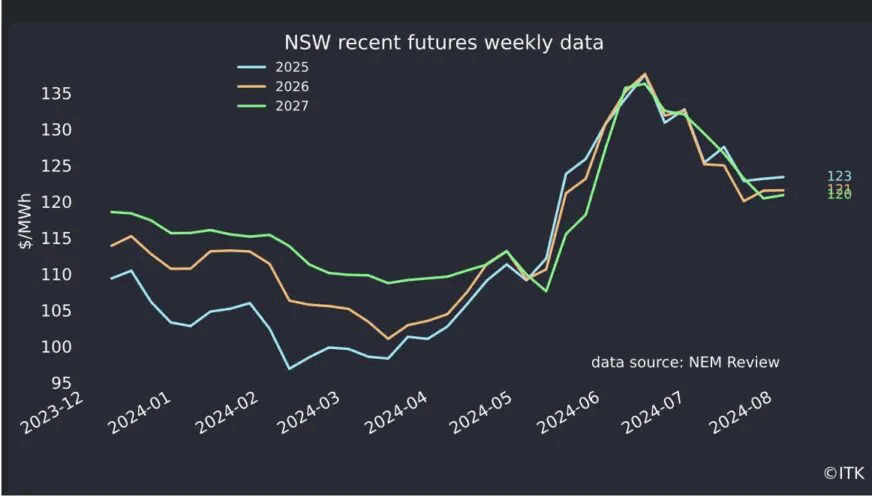
He views this train-wreck as a bad situation caused by Big Market Players exploiting the market, and they absolutely are. But he doesn’t admit that if we weren’t trying to ram a fake transition down everyone’s circuits with unreliable generators, the Predators wouldn’t have nice juicy price spikes to prey on (and subsidized cushions to land on).
With the true genius of all communists-at-heart Giles Parkinson tells us this has nothing to do with prices:
Again, this had nothing to do with the actual cost of generation or the prospect of a supply shortfall, it was simply lack of competition.
But Giles has no idea what competition even is. If more coal power was competing we’d still have cheap electricity. The market he wants is not a free market, it’s just a different kind of Soviet.
So warn the voters of New South Wales. The Chris Minns Labor government is trying to hide the cost of the unreliables until after the election.
Jo Nova Blog


 Iowa Climate Science Education