The Week That Was: 2024 08-17 (August 17, 2024)
Brought to You by SEPP (www.SEPP.org)
The Science and Environmental Policy Project
Quote of the Week: “But it turns out that falsehood and evil can be taught as easily as good. Education is a great power, but it can work either way.” — Richard Feynman, The Meaning of It All: Thoughts of a Citizen-Scientist.
Number of the Week: $28.92/MW-day to $269.92/MW-day in one year
THIS WEEK:
By Ken Haapala, President, Science and Environmental Policy Project (SEPP)
Scope: This TWTW will begin by discussing a letter Richard Lindzen and William Happer sent to the Kentucky state legislature. It will then discuss Geoscientist Tom Gallagher’s views of the drivers of climate change during the Holocene. Christopher Monckton wrote a good defense of John Clauser, exposing a frivolous attack. Bryan Leyland explains how close New Zealand grid is getting to major blackouts
*********************
Encouraging Post: The Kentucky Legislative Research Commission posted a letter it received by Richard Lindzen and William Happer: “Physics Proves Carbon Dioxide is Now a Weak Greenhouse Gas So That All Net Zero Policies Will Have A Trivial Effect on Temperature, But Disastrous Effects on People Worldwide.” The letter begins:
“The United States and countries worldwide are vigorously pursuing regulations and subsidies to reduce carbon dioxide emissions to Net Zero by 2050 on the assumption, best stated by the Intergovernmental Panel on Climax Change (IPCC), that the “evidence is clear that carbon dioxide (CO2) is the main driver of climate change,” and is “responsible for more than 50% of the change”
We are career physicist with a special expertise in radiation physics, which describes how CO2 affects heat flow in Earth’s atmosphere. The physics of carbon dioxide is that CO2’s ability to warm the planet is determined by its ability to absorb heat, which decreases rapidly as CO2’s concentration in the atmosphere increases. This scientific fact about CO2 changes everything about CO2 and climate change.
Carbon Dioxide is Now a Weak Greenhouse Gas.
At today’s CO2 concentration in the atmosphere of approximately 420 parts per million, CO2 has little ability to absorb [additional] heat and therefore is now a weak greenhouse gas. Its ability to warm the planet and at higher levels of CO2 is very small. This also means that the common assumption that carbon dioxide is “the main drive of climate change” is no longer true and is scientifically false.
More carbon dioxide cannot cause catastrophic global warming or more extreme weather. Neither can methane or nitrous oxide, the levels of which are so small that they are irrelevant to climate.
In reality, CO2’s role has fundamentally flipped. Now more CO2 does two beneficial things for humanity: (1) it provides a slight increase in warming, and (2) it creates more food for people worldwide, covered further below.”
The letter notes five implications of government actions to regulate CO2 each with its rationale. The implications are:
“First. Net Zero Efforts Will have a Trivial Effect on Temperature.
Second. Disastrous Net Zero Effects for People Worldwide.
Third. More Carbon Dioxide Means More Food.
Fourth. Fossil Fuels Must Not Be Eliminated.
Fifth. All Net Zero Actions Worldwide Should Be Stopped Immediately.”
It is amazing that nations run by intelligent, rational people are willing to destroy their industrial economic foundations based on the fallacious exaggerations of the IPCC and its twisted science. See link under Challenging the Orthodoxy.
*******************
Climate Change over the Holocene: The July 15, 2023, TWTW discussed a presentation by Geoscientist Tom Gallager based on data revealed in the September 11, 2024, journal Science, published by the American Association for the Advancement of Science (AAAS) in an article written by Thomas Westerhold and over 20 European scientists titled, “An astronomically dated record of Earth’s climate and its predictability over the last 66 million years.” The summary stated:
“Deep-sea benthic foraminifera preserve an essential record of Earth’s past climate in their oxygen- and carbon-isotope compositions. However, this record lacks sufficient temporal resolution and/or age control in some places to determine which climate forcing and feedback mechanisms were most important. Westerhold et al. present a highly resolved and well-dated record of benthic carbon and oxygen isotopes for the past 66 million years. Their reconstruction and analysis show that Earth’s climate can be grouped into discrete states separated by transitions related to changing greenhouse gas levels and the growth of polar ice sheets. Each climate state is paced by orbital cycles but responds to variations in radiative forcing in a state dependent manner.”
Deep-sea benthic foraminifera are small marine creatures living on the bottom of the oceans at all depths including The Abyss, the deep ocean. Most are smaller than 1 to 2 millimeters, but some can grow to over 5 centimeters (2 inches). The larger ones were observed in the limestone that once covered the Egyptian pyramids. They were from the Eocene Epoch (about 33.9 to 56 million years ago. Britannica states:
“Foraminiferans inhabit virtually all marine waters and are found at almost all depths, wherever there is protection and suitable food (microscopic organisms).
“An important constituent of the present-day planktonic (floating) and benthic (bottom dwelling) microfaunas, foraminiferans have an extensive fossil record that makes them useful as index fossils in geological dating and in petroleum exploration. The word foraminiferan does not refer to the external pores found in some species but to the foramina (openings or apertures) between adjacent chambers after a new chamber envelops a previous one. When the foraminiferans die, their empty calcareous tests sink and form the so-called foraminiferal ooze that covers about 30 percent of the ocean floor. Limestone and chalk are products of the foraminiferan bottom deposits.” [Boldface added]
The abstract of the Westerhold paper states:
“Much of our understanding of Earth’s past climate comes from the measurement of oxygen and carbon isotope variations in deep-sea benthic foraminifera. Yet, long intervals in existing records lack the temporal resolution and age control needed to thoroughly categorize climate states of the Cenozoic era and to study their dynamics. Here, we present a new, highly resolved, astronomically dated, continuous composite of benthic foraminifer isotope records developed in our laboratories. Four climate states—Hothouse, Warmhouse, Coolhouse, Icehouse—are identified on the basis of their distinctive response to astronomical forcing depending on greenhouse gas concentrations and polar ice sheet volume. Statistical analysis of the nonlinear behavior encoded in our record reveals the key role that polar ice volume plays in the predictability of Cenozoic climate dynamics. [Boldface added]
The implication that greenhouse gases were involved with these four climate states was questionable because the data was presented in clumps. Willis Eschenbach unraveled these clumps and showed that the four climate states were roughly stable in terms of temperature but had wide variations in CO2 concentrations. For example, during Coolhouse Earth 1, roughly 34 million years ago to about 13.9 million years ago, CO2 varied from about 280 parts per million volume (ppmv) to over 800 ppmv (almost twice that of today) yet temperatures varied little and remained roughly constant, around 6°C (11°F) above today’s temperatures.
It is important to note that in terms of time, the deep sediments accumulate slowly and are not precise. Year-to-year, or even century-to-century comparisons cannot be made. millennium-to-millennium or even longer periods need to be used.
Using the data unraveled by Eschenbach, Tom Gallagher showed that the 67 million years with temperature variation of up to 18°C (32°F) could be explained by the movement of continents (continental drift) and how it influences ocean currents. As Gallager points out this new data source includes:
- “Proxy data from several sources and techniques.
- [Supporting] Continental Drift
- New, extensive data set became available in September 2020.
- High sample density and accuracy.
- Very Long Time Series analysis of 18O and 13C in microscopic plankton”
For Earth’s climate:
- “The Sun: is the primary energy source for climate.
- Oceans: the primary energy “storage” mechanism.
- Ocean Currents: the primary energy “transport” and “collection”
- vehicle.
- The atmosphere: has a negligible capacity to store long term climate.
- Energy.”
What we see is that over the past 3 million years Milankovitch Cycles have become especially important. This is due to the closing of the Caribbean Seaway which allowed East-West equatorial current to go from the Atlantic to the Pacific. Now the dominant surface currents such as the North Atlantic Gyre transport heat from the tropics to the higher latitudes, where the heat is lost to space, cooling Earth.
There are three sets of cycles of 24,000, 41,000 and 100,000 years. During the Holocene, the last 11,700 years, Earth warmed quickly to a peak about 9,000 years ago then slowly cooled. This is due to Earth’s Obliquity, the angle between the axis of rotation and Earth’s orbital plane (the axial tilt). This is the 41,000-year cycle. [The chart shows a rapid warming in the last 100 years or so, but this is not explained. It may be due to the use of surface land temperatures thermometer data which are heavily influenced by urbanization and changes in land use. (The period is too short to use deep-sea benthic foraminifera proxy data.)]
The current warm period was preceded by others, the latest being the Minoan, the Roman, and Medieval, all of which occurred during recorded history. The fastest warming rates occurred during the Early Holocene Optimum. To Gallager the Modern Period of the past few hundred years:
“Climate and Weather are driven by:
• Solar Cycles
• Oceanic Currents
• Oceanic Oscillations (Creating lag and a periodic frequency)
• Regional Oceanic Energy conditions that drive long term regional pulsating climate variations”
Among the interesting points Gallager discusses is that he focuses on the phases of water (solid, liquid, and gas (water vapor)) and their importance in determining weather and climate. Water is the greatest absorber of solar energy, especially in the visible spectrum where most of the solar energy lies. Sunlight penetrates many meters deep into water, causing very slow heating of huge volumes of water throughout the oceans, so the oceans serve as a very large heat reservoir. Gallager also emphasizes the importance of clouds.
In discussing water vapor, Gallager mentions that its light weight makes water vapor boyant in the atmosphere and it carries CO2, making it carbonic acid, a weak acid. [A weak acid does not produce many hydrogen ions in a water-based solution.] The cooling rate of air is many times that of water. [In terms of long-term heat storage, the oceans are many times more important than the atmosphere.]
“Water (in either liquid or vapor form) is the dominant energy storage and transport mechanism.”
The energy storage capability between air and water is so large that it cannot be easily shown graphically. The Gulf Stream distribution system is why Europe is so warm, even though it is at the same latitude as northern Canada or Russia. In North America, low winter temperatures occur in the central part of the land mass demonstrating the rapid loss of heat by the land masses and the atmosphere. The parts of the land mass that are at or near the oceans are shielded from the loss of heat by them. Climate models do not take these features into account.
In short, in considering climate change internal to Earth’s systems, the IPCC and its collaborators do not use the most important mechanism for Earth and focus on a bit role in a complex, evolving play.
The remainder of this video and the next video on recent history will be covered in upcoming TWTWs. It is important to remember that we live during a brief warm period in Icehouse Earth where the conditions are: “Wet, Warm, Non-glacial Times when Vegetation and Civilization thrive.” But the default conditions are: “Dry, Dusty, Cold, and Glacial.”
See link under Challenging the Orthodoxy for Part 2 of the video presentation; http://www.sepp.org/science_papers/ICSF%20Paleo%20Talk.pdf for slides summarizing all three presentations sent to TWTW by Jim O’Brien of the Irish Climate Science Forum from Gallager’s presentation to ICSF and CLINTEL; and https://www.sepp.org/twtwfiles/2023/TWTW%207-15-23.pdf for the July 15, 2023, discussion of Gallager’s first video.
*******************
Frivolous Criticism: Nobel Laureate John Clauser has come under criticism for his position that there is no climate crisis, and the UN IPCC greatly underestimates the cooling influence of clouds. Christopher Monckton of Brenchley produced a 13-point rebuttal published by Climate Gate .NL. It begins (translated from Dutch):
“As part of the usual campaign of Rufmord (Goebbels’ word for reputation assassination of opponents you can’t meet in a debate) orchestrated by the climate establishment against anyone who dares to question the official story on climate change, a YouTube Influenzerin who fancies herself an all-knowing physicist but admits she knows little about climate change, recently launched a sharply worded and viciously delivered YouTube tirade against Dr. John Clauser, a recent Nobel laureate, for his speeches to Doctors for Disaster Preparedness in the US and to the European Institute for Climate and Energy (EIKE) in Vienna.
Members of Clintel have shown interest in knowing whether and to what extent the criticism of Dr. Clauser – to the extent that it was recognizably scientific criticism – had any value. This note lists the criticism (stripped of the childish climate communist nonsense of the Influenzerin) and answers it. Criticisms are in bold, answers in Roman letters.
1. Clauser says that IPCC defines global warming by referring to the Earth’s net energy imbalance (the 0.6 W m–2 excess of incoming over outgoing radiative flux density), while IPCC says, “Global warming refers to the change in global surface temperature from a baseline…”.
This is childish hair-splitting. Clauser’s claim, made clear in his lecture …, is that it is the radiative imbalance that determines the change in global temperature.” [Boldface added]
See link under Challenging the Orthodoxy.
*******************
Race to the Bottom: Francis Menton calls it hitting the wall, but it also can be called hitting the bottom – in the race to Net Zero, which country can destroy the most sources of prosperity the fastest. New Zealand is well on its way to be a leader in this perverse race. Writing for Net Zero Watch, New Zealander Bryan Leyland demonstrates how close New Zealand is to reaching a government enforced blackout by over-relying on weather dependent electricity generation, including hydro power (which is weather dependent over several years, reservoirs must be refilled.)
Leyland is professionally qualified to comment. He has a Master of Science degree and is a power systems engineer with 60 years’ experience in all aspects of power generation and supply all over the world. Leyland begins:
“New Zealand has major problems with its power supply. There are three underlying reasons: the weather, a flawed electricity market and a drive for ‘net zero.’
Sixty-five percent of New Zealand’s electricity is provided by hydropower, and the remainder by geothermal, gas, coal, wind and some solar. In a dry year, hydro’s ability to deliver falls away, and we lose about 10% of our generation. In the past, we always tried to have the reservoirs full by the end of summer to guard against this possibility. But, when we switched to an electricity market, this was forgotten.
This year, we failed to refill the reservoirs, and levels are now unusually low, and declining fast. They could bottom out if it does not rain heavily in the next month or so.
The ability of our fossil fuel power stations to step into the gap has been severely restricted. We used to get 20% of our electricity from gas-fired power stations, but six years ago, as part of their decarbonisation policy, the previous government banned further exploration, and we are now desperately short of fuel. The new government is encouraging new exploration efforts, but it will be too little too late.
And the situation has been made worse by poor market design. New Zealand was one of the pioneers of electricity markets, and chose a risky model, which has proved to be seriously flawed – it has failed to deliver sufficient generating capacity to get us through a dry year.
As a result, the problems this year have led to wholesale market prices rising to ridiculous levels – as much as £1/kWh. This has already caused some factories to shut down; others are under threat. The politicians are beginning to realize that the energy crisis could have serious effects on consumers, and there is speculation that they will be forced to intervene. This could mean forcing our gas and coal-fired power stations to run flat out day and night – assuming they have enough fuel, which is not at all certain. Failing this, the only solution in the short term may be rolling blackouts. That will cause major disruption all over the country.
Here Leyland brings up a serious issue of confusing important objectives. When reliable and affordable power is required a market system based on marginal cost pricing may not deliver reliability. It takes deliberate intervention to balance reliability with pricing. Long term, five years or more, average cost pricing may be needed. Leyland identifies the long-term problem:
If it does rain heavily and soon – within a month or six weeks – we could be out of trouble. But then the long-term problem rears its head: empty storage lakes that need to be refilled, not a lot of snowpack to melt in the springtime, declining supplies of gas, and the imminent shutdown of a 380 MW combined cycle station, which needs a gas supply for the next 20 years or so. None can be solved in the time available.
All we are doing is building more wind and solar, which means that, more and more, the price will skyrocket when they are in short supply and crash when they are abundant. This means that they will not be making enough money to pay for their construction and operation. As New Zealand does not directly subsidize wind and solar power, we can’t even be sure that the generators will be stupid enough to continue building them. To be economic, wind and solar must be supported by low-cost long-term storage. But there is no technology that can deliver this right now. Batteries are too expensive by a factor of 50 or so.
The expectation is that the demand is going to increase, as domestic and industrial heat and road transport are electrified (although the extent to which this will happen in the face of rising power prices is debatable). However, we will certainly get more and more data centers, which are a 24-hour per day load and need a reliable supply.
So, the load will go up but, compared to now, our ability to keep the lights on when wind and solar are not delivering will reduce. Australia is 2000 km away, so there is no chance of importing from there, even if they did have power to spare.
We could build more geothermal stations, but that takes time, especially as the oil rigs they need to drill production wells have all departed overseas. There is probably 1000 MW so of known geothermal potential, and there is the possibility that more could be found with exploration. But this is not a quick solution.
The only quick solution is to buy more turbines running on diesel. Not a nice prospect. [Very expensive]
In the long-term we could consider more hydro generation, but that is blocked by the environmentalists, even though there is probably 2000 MW of potential left in the South Island. For those who do not believe in dangerous man-made climate change, more coal and gas generation are an obvious solution.
For those who believe that man-made global warming is real and dangerous, we could be urgently considering nuclear power, which is the only practical and economic way of reducing CO2 emissions from thermal power generation. I suspect that in spite of a long-held opposition to nuclear armed and propelled ships, the New Zealand public are more sympathetic to nuclear power than they are believed to be.
Whatever happens, New Zealand faces a very uncertain future with its power supply. I strongly suspect it will be just the first of many countries to run into this kind of trouble.” [Boldface added] See link under Challenging the Orthodoxy.
*******************
Additions and Corrections: TWTW does not discuss Earth’s Internal Heat when it discusses heat from Earth radiating to space because the value is so small. For example, according to the University of California, Berkeley, Museum of Paleontology:
“While Earth’s internal heat is the energy sources for processes like plate tectonics and parts of the rock cycle, it provides only a fraction of a percent to the Earth’s average atmospheric temperature. Overall, Earth’s interior contributes heat to the atmosphere at a rate of about 0.05 watts per square meter while incoming solar radiation adds about 341.3 watts per square meter.” After calculating for albedo, the solar power hitting the Earth’s surface is almost 5000 times greater. See link under Changing Earth.
*******************
Number of the Week: $28.92/MW-day to $269.92/MW-day in one year. In the US race to hit bottom from Net Zero, PJM capacity auction for 2024/25 delivery was $28.92/MW. For 2025/26 delivery it is $269.92, an increase over 9-fold. The auction that closed on July 30, 2024, covers the period of June 1, 2025, through May 31, 2026. “The auction cleared a diverse mix of resources, including 48% of gas, 21% of nuclear, 18% of coal, 1% of solar, 1% of wind, 4% of hydro, 5% of demand response and 2% from other resources.”
The PJM service region goes from eastern North Carolina to Virginia then through Ohio plus part of Illinois including Chicago. It includes Pennsylvania, New Jersey and Washington, DC. The consumers in these areas will pay for government policies closing reliable coal-fired power plants and denying new combined cycle gas plants. See links under Energy Issues – US and https://www.pjm.com/-/media/about-pjm/newsroom/2024-releases/20240730-pjm-capacity-auction-procures-sufficient-resources-to-meet-rto-reliability-requirement.ashx.
NEWS YOU CAN USE:
Challenging the Orthodoxy — NIPCC
Climate Change Reconsidered II: Physical Science
Idso, Carter, and Singer, Lead Authors/Editors, Nongovernmental International Panel on Climate Change (NIPCC), 2013
Summary: https://www.heartland.org/_template-assets/documents/CCR/CCR-II/Summary-for-Policymakers.pdf
Climate Change Reconsidered II: Biological Impacts
Idso, Idso, Carter, and Singer, Lead Authors/Editors, Nongovernmental International Panel on Climate Change (NIPCC), 2014
http://climatechangereconsidered.org/climate-change-reconsidered-ii-biological-impacts/
Climate Change Reconsidered II: Fossil Fuels
By Multiple Authors, Bezdek, Idso, Legates, and Singer eds., Nongovernmental International Panel on Climate Change, April 2019
http://climatechangereconsidered.org/climate-change-reconsidered-ii-fossil-fuels/
Why Scientists Disagree About Global Warming
The NIPCC Report on the Scientific Consensus
By Craig D. Idso, Robert M. Carter, and S. Fred Singer, Nongovernmental International Panel on Climate Change (NIPCC), Nov 23, 2015
http://climatechangereconsidered.org/why-scientists-disagree-about-global-warming/
Nature, Not Human Activity, Rules the Climate
S. Fred Singer, Editor, NIPCC, 2008
http://www.sepp.org/publications/nipcc_final.pdf
Challenging the Orthodoxy – Radiation Transfer
The Role of Greenhouse Gases in Energy Transfer in the Earth’s Atmosphere
By W.A. van Wijngaarden and W. Happer, Preprint, Mar 3, 2023
Dependence of Earth’s Thermal Radiation on Five Most Abundant Greenhouse Gases
By W.A. van Wijngaarden and W. Happer, Preprint, December 22, 202o
Challenging the Orthodoxy
Physics Proves Carbon Dioxide is Now a Weak Greenhouse Gas So That All Net Zero Policies Will Have A Trivial Effect on Temperature, But Disastrous Effects on People Worldwide
By Richard Lindzen and William Happer, Posted by the Kentucky Legislative Research Commission, July 18, 2024
Lessons from Paleoclimatology: Conveniently Ignored By the IPCC
By Tom Gallagher, Irish Climate Science Forum and CLINTEL, April 20, 2022 [H/t Jim O’Brien]
Slides: http://www.sepp.org/science_papers/ICSF%20Paleo%20Talk.pdf
Videos
Paleoclimatology Part 1 https://youtu.be/K6tWEjkEiZU
Paleoclimatology Part 2 https://youtu.be/iZSYSWPYEbU
Paleoclimatology Part 3 https://youtu.be/YMHKt9ylPpQ
Link to paper: An astronomically dated record of Earth’s climate and its predictability over the last 66 million years
By Thomas Westerhold, et al. (over 20 co-authors), AAAS Science, Sep 11, 2020 https://www.science.org/doi/10.1126/science.aba6853
Is the criticism of John Clauser’s presentation at the EIKE climate conference correct?
By Christopher Monckton of Brenchley, Climate Gate, NL, Accessed Aug 16, 2024
Use English translation button on upper right of new window, includes video of Clauser’s address to ICSF/EIKE
The Bill Walton Show | CO2 The Miracle Molecules with Dr Will Happer and Greg Wrightstone
Video plus text by Charles Rotter, WUWT, Aug 10, 2024
All-blackout
By Bryan Leyland, Net Zero Watch, Aug 9, 2024
The Earth After Net Zero 50
By John Whitmore Jenkins, CO2 Coalition, Aug 11, 2024
Link to: The Earth After NET ZERO 50: What Happens When the Lights Go Out?
By John Whitmore Jenkins, CO2 Coalition, 2024
Math Confirms Foolishness of Climate Alarmism
By Gregory Wrightstone, CO2 Coalition, Aug 15, 2024
Corrected version
Phoma destructiva’s 2nd Comment on Pubpeer
By Andy May and Marcel Crok, WUWT, Aug 14, 2024
[SEPP Comment: Addressing controversial criticisms of natural causes of climate change considered to be human caused.]
Defending the Orthodoxy – Bandwagon Science
Almost half a billion children live in areas experiencing at least twice as many extremely hot days as their grandparents – UNICEF
Eight countries, including Mali, Niger, Senegal, South Sudan and Sudan, are home to children who spend more than half the year in temperatures above 35 degrees Celsius / 95 degrees Fahrenheit
Press Release, UNICEF, Aug 14, 2024 [H/t Carbon Brief]
UNICEF adopted the following definitions to define heat metrics:
- Heatwaves – any period of 3-days or more when the maximum temperature each day is in the top 10 per cent of the local 15-day average.
- Heatwave frequency refers to the number of heatwaves per year.
- Heatwave duration refers to the total number of days an event lasts.
- Heatwave severity refers to the temperature above the local 15-day average during the heat wave, expressed in degrees Celsius.
- Extremely high temperatures (extremely hot days) – when a day exceeds 35 °C. [95°F]
[SEPP Comment: How many solid 60-year temperature records are there in the countries named? These tropical African countries are now experiencing temperatures that were common in summer in the temperate US in the 1930s?? UNICEF uses:
ERA5-Land: a state-of-the-art global reanalysis dataset for land applications
By Joaquín Muñoz-Sabater, et al., Earth System Science Data, Sep 7, 2021
Questioning the Orthodoxy
Anthropogenic Global Warming is Political, Not Physical, Science
By Arvid Pasto, WUWT, Aug 13, 2024
July 2024 the Hottest Ever? Not So Fast!
By Ron Clutz, Science Matters, Aug 13, 2024
Shows the areas for which we have no data, yet record heat was claimed.
Zero Emissions Grid Demonstration Project Follies: No Fraudulent Demonstration Projects Allowed!
By Francis Menton, Manhattan Contrarian, Aug 13, 2024
The moral is that we should accept no claim of achievement of zero emissions electricity from anyone who maintains a continuing connection to a grid with hydrocarbon generation on it. Otherwise, there is way too much potential for cheating.
[SEPP Comment: After discussing the failure in El Hierro Island (pop. about 12,000) where in 2023 wind power plus storage produced 35% of its electricity. [Menton does not discuss another failed example: King Island, Tasmania (pop. under 2,000, where hydro and wind and solar produce 65% of electricity of its electricity while diesel is need for the rest.] Menton questions the claims of Switch, Inc., one of the nation’s largest developers of data centers. Menton demonstrates its claims of 100% renewables fail.]
Anemia Would Rise in Climate Obsessed’s Meatless Dystopia
By Vijay Jayaraj, CO2 Coalition, July 22, 2024
Climate Deniers of the World, Unite!
By Tilak Doshi, The Daily Sceptic, Aug 13, 2024
After Paris!
IPCC meeting in Sofia fails to agree timeline for seventh assessment report
By Multiple Authors, Carbon brief, Aug 6, 2024
However, many countries raised concerns. First, there was disagreement about whether or not to include hydrogen and PM2.5 – particulate matter with a diameter of under 2.5 micrometres – in the report.
A series of huddles were held to iron out these disagreements. On 2 August, the delegates agreed to change the name of the report to “2027 IPCC methodology report on inventories for short-lived climate forcers”.
However, in the absence of consensus on the case for including PM2.5 and hydrogen, the panel decided to come back to this discussion in the future.
The document suggests setting the agenda for the expert meeting on gender, diversity and inclusivity – which is planned in late 2024 or early 2025 – and providing training on inclusive practices for lead authors and contributing lead authors during the first lead author meeting.
[SEPP Comment: The one thing agreed upon is the need for lots of meetings by “experts.”]
Social Benefits of Carbon Dioxide
Another New Study Finds Rising CO2 Enhances Planetary Greening And Reduces Drought Risk
By Kenneth Richard, No Tricks Zone, Aug 12, 2024
Link to paper: Elevated CO2 concentrations contribute to a closer relationship between vegetation growth and water availability in the Northern Hemisphere midlatitudes
By Yang Song et al 2024 Environmental Research Letters, July 12, 2024
Seeking a Common Ground
Put Climate Insanity Behind Us
By Ron Clutz, Science Matters, Aug 10, 2024
Link to paywalled article: Conrad Black: Time for the climate insanity to stop
We have been racing to destroy our standard of living to avert a crisis that never materialized
By Conrad Black, National Post (Can), Aug 10, 2024
The Top Five Climate Science Scandals
When self-correction in science goes wrong
By Roger Pielke Jr., The Honest Broker, Aug 12, 2024
Science, Policy, and Evidence
Biden administration releases national heat strategy
By Rachel Frazin, The Hill, Aug 14, 2024
In addition, the National Oceanic and Atmospheric Administration said it would put $200,000 toward helping up to 10 communities run simulated heat drills.
Last month, on July 22, the Earth saw its hottest day ever recorded. July 21 and 23 also exceeded a prior record set last year. 2023 was the hottest year ever recorded, though this year could break that record.
[SEPP Comment: Doubt the claims of the hottest day ever recorded.]
Models v. Observations
“We should have better answers by now”: Broken Climate Models Can’t even Explain the Recent Warm Bump
By Eric Worrall, WUWT, Aug 15, 2024
Measurement Issues — Atmosphere
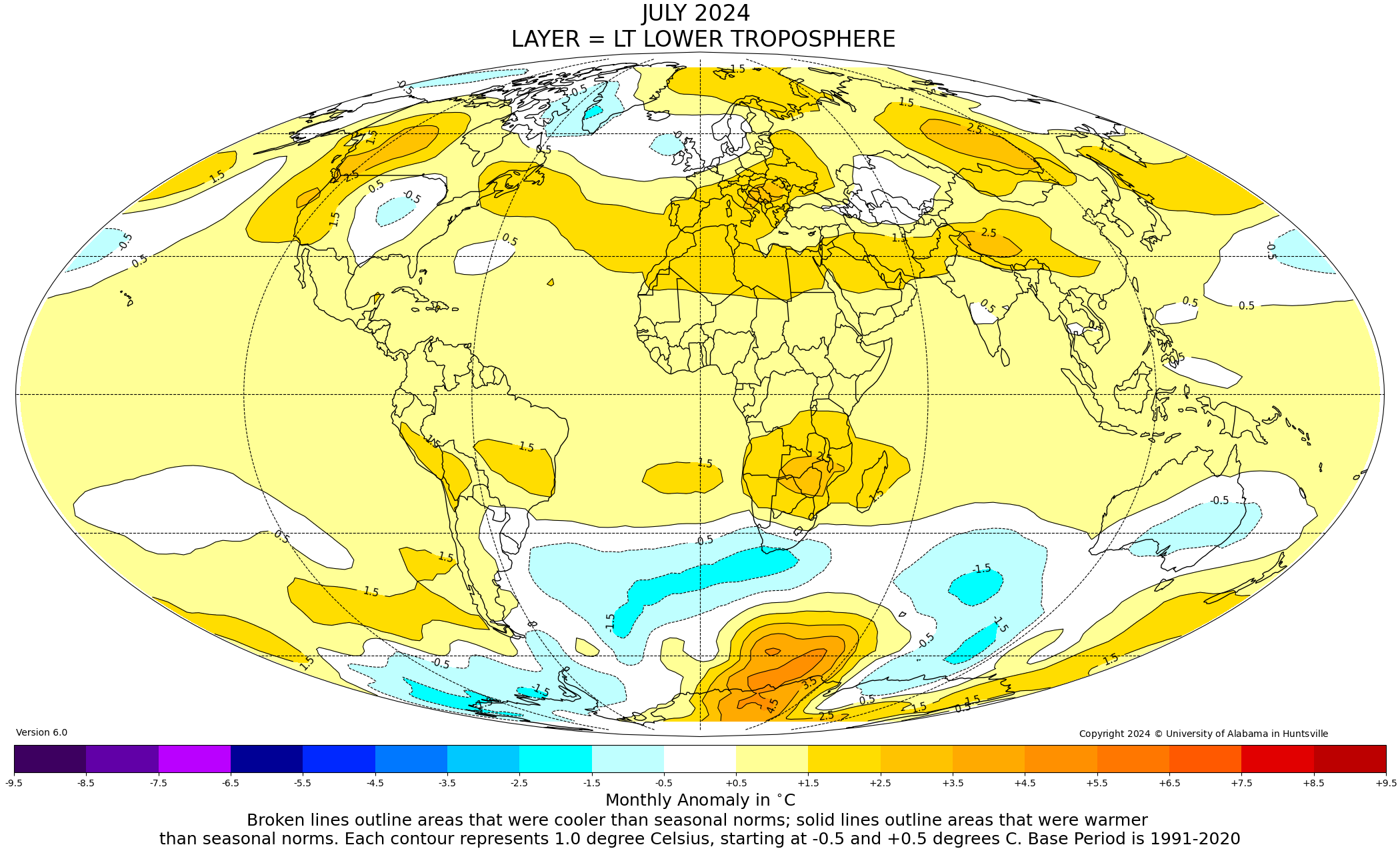
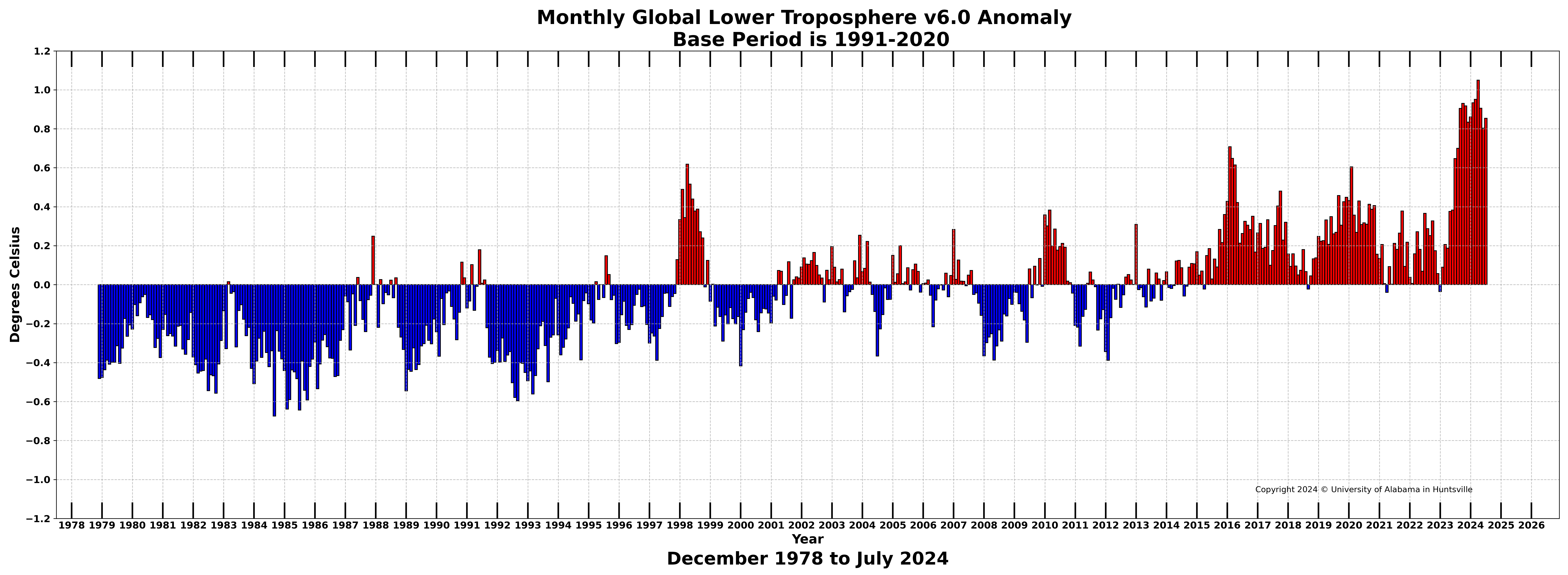
Global Temperature Report
By John Christy and Roy Spencer et al., Earth System Science Center, July 2024
Map: https://www.nsstc.uah.edu/climate/2024/July/202407_Map.png
Graph: https://www.nsstc.uah.edu/climate/2024/July/202407_Bar.png
Text: https://www.nsstc.uah.edu/climate/2024/July/GTR_202407JUL_v1.pdf
Note that the calculated trend for the entire record is +0.1548 °C/decade, so we will anticipate the trend to be +0.16 °C/decade [0.29°F/decade] next month as we round up to the nearest hundredth of a degree. The sharp El Niño spike in the last 13 months has led to the trend magnitude increasing as it has.
Changing Weather
NOAA Criteria Suggest Full-Fledged La Niña Unlikely in 2024 – Even A Single La Niña Threshold Unlikely During the Indian Southwest Monsoon
By Ashok Patel, Gujaratweathe, Aug 9, 2024
http://www.gujaratweather.com/wordpress/?p=32494
How Does the National Weather Service Predictions Compare to the Best Commercial Forecasts?
By Cliff Mass, Weather Blog, Aug 15, 2024
Why is the Chicago NWS office so good? It is not because the weather is boring there! Clearly, excellent staff and local leadership.
This week marks the 55th anniversary of Hurricane Camille…a category 5 storm at landfall and one of the most devastating in US history
By Meteorologist Paul Dorian, Via WUWT, Aug 14, 2024
Changing Climate
New Study: Warmest Carpathian Temperatures Of The Last 2000 Years Were 2°C Warmer Than Today
By Kenneth Richard, No Tricks Zone, Aug 15, 2024
Link to paper: Two chironomid-inferred mean July air temperature reconstructions in the South Carpathian Mountains over the last 2000 years
By Zoltan Szabo, et al., The Holocene, March 2024
Changing Seas
Oceans Warming Uptick July 2024
By Ron Clutz, Science Matters, August 15, 2024
AMOC Uncertainties
By Frank Bosse, Via AMOC Collapse Depends Entirely On Models…Will Occur Sometime Between Now And Infinity, No Tricks Zonee, Aug 10, 2024
A “collapse” of the AMOC (Atlantic overturning circulation) cannot be “calculated” at all.
Coral Sr/Ca-SST reconstruction from Fiji extending to ~1370 CE reveals insights into the Interdecadal Pacific Oscillation
By Juan P. D’Olivo et al., AAAS Science, Aug 14, 2024 [H/t Bernie Kepshire]
From abstract: The southwestern tropical Pacific is a key center for the Interdecadal Pacific Oscillation (IPO), which regulates global climate. This study introduces a groundbreaking 627-year coral Sr/Ca sea surface temperature reconstruction from Fiji, representing the IPO’s southwestern pole. Merging this record with other Fiji and central tropical Pacific records, we reconstruct the SST gradient between the southwestern and central Pacific (SWCP), providing a reliable proxy for IPO variability from 1370 to 1997.
Notably, the 20th century conditions, marked by simultaneous basin-scale warming and weak tropical Pacific zonal-meridional gradients, deviate from trends observed during the past six centuries.
Variation of 50-Year Relative Sea Level Trends — Northeast United States
By Kip Hansen, WUWT, Aug 11, 2024
Changing Cryosphere – Land / Sea Ice
Record Antarctic Sea Ice Growth
By Tony Heller, His Blog, Aug 11, 2024
Permafrost melt raises threat of ‘giant mercury bomb’ in Arctic: Study
By Sharon Udasin, The Hill, Aug 15, 2024
Link to paper: Mercury stocks in discontinuous permafrost and their mobilization by river migration in the Yukon River Basin
By M Isabel Smith, et al. Environmental Research Letters, Aug 15, 2024
[SEPP Commet: Mercury is found throughout the world, mostly in deposits of cinnabar. Why is the release of Arctic mercury a “bomb”?]
Arctic Melt Update
By Tony Heller, His Blog, Aug 10, 2024
Fatal polar bear attack in Davis Strait last week: important details being withheld
By Susan Crockford, Polar Bear Science, Aug 13, 2024
Western Hudson Bay sea ice breakup for polar bears like the 1980s for 3 of the last 5 yrs
By Susan Crockford, Polar Bear Science, Aug 13, 2024
Changing Earth
Earth’s internal heat
By Charles Marchall, et al., University of California, Berkeley, Museum of Paleontology, Accessed Agu 17, 2024 [H/t Michael Kelly, University of Cambridge]
Researchers uncover historical patterns in Earth’s rotational deceleration
By Simon Mansfield, Sydney, Australia (SPX) Aug 15, 2024
Link to paper: Geological evidence reveals a staircase pattern in Earth’s rotational deceleration evolution
By He Huang, et al., PNAS, Aug 6, 2024
From the abstract: Specifically, there are two intervals with high Earth rotation deceleration, 650 to 500 Mya and 350 to 280 Mya, separated by an interval of stalled deceleration from 500 to 350 Mya. The interval with stalled deceleration is attributed mainly to reduced tidal dissipation due to the continent-ocean configuration at the time, not to changes in Earth’s dynamical ellipticity from continental assembly or glaciation.
Agriculture Issues & Fear of Famine
Who is directing the war on agriculture and nutrition?
By Paul Driessen, WUWT, Aug 11, 2024
Lowering Standards
Junk Temperature Measuring Network Means the Met Office Cannot Prove There’s Been a “Dramatic Increase” in Temperature
By Chris Morrison, The Daily Sceptic, Aug 13, 2024
Communicating Better to the Public – Use Yellow (Green) Journalism?
MSM Absent In Reporting “Dozens Of Night Time Low Temp Records” Across US
By Tyler Durden, Zero Hedge, Aug 10, 2024 [H/t Bernie Kepshire]
Greece tops ‘heat death list’ as temperatures soar across Europe
By Paul Homewood, Not a Lot of People Know That, Aug 14, 2024
[SEPP Comment: Despite the headline near the end, the story contained the following: “The researchers said that the vulnerability to heat of European societies has progressively decreased over the present century due to societal adaptation processes, without which heat-related mortality over the past year would have been 80 per cent higher.]
No, NYT, ‘Climate Tipping Points’ are Not in Our Near Future
By Anthony Watts, Climate Realism, Aug 15, 2024
[SEPP Comment: Is the NYT worried about sailing too far from the sight of land?]
Wrong, New York Times, the Great Barrier Reef is Not in Danger
By Anthony Watts, WUWT, Aug 13, 2024
NY Times Claims Vanilla Is ‘Disappearing’ Due to Climate Change – As Production Doubles
By James Taylor, Climate Realism, Aug 5, 2024
Communicating Better to the Public – Make things up.
The Climate Of Lies Keeps Getting Hotter
By I & I Editorial Board, Aug 16, 2024
The Times wants us to worry about the mass death of coral reefs, the abrupt thawing of permafrost, the collapse of Greenland ice, the breakup of West Antarctic ice, a sudden shift in the West African monsoon, loss of the Amazon rainforest and the shutdown of Atlantic currents.
And when might disaster be visited on all these hot spots? Well, says the Times, it depends on a number of variables and in some cases the timeline is just “hard to predict.”
“Meteorologist John Burchfield breaks down the science”
By Tony Heller, His Blog, Aug 10, 2024
Research widely cited to support pausing LNG exports riddled with errors, analysis says
This isn’t the first time that Cornell Professor Robert Howarth has been criticized for his research. His history of being an outspoken advocate for the rapid elimination of fossil fuels has led to industry accusations that his research is biased.
By Kevin Killough, Just the News, Aug 11, 2024
Communicating Better to the Public – Use Propaganda
Bumper crop of BBC bias
Press Release, Net Zero Watch, Aug 14, 2024
Link to: Tall Climate Tales from the BBC, 2023
By Paul Homewood, Net Zero Watch, 2024
From Executive Summary of the report: Where climate change is concerned, the BBC is now little more than a lobby group. Given the enormous cost of achieving Net Zero, not to mention the wholesale changes it will mean to people’s lifestyles, the public are entitled to fully impartial reporting from the BBC
Communicating Better to the Public – Protest
Washington State Voters Confront Their Climate Commitment Act
By Paul Fundingsland, WUWT, Aug 12, 2024
Questioning European Green
German Green Raw Deal: First Half 2024 Insolvencies Skyrocket 30%, Near 10-Year High
By P Gosselin, No Tricks Zone, Aug 11, 2024
Germany’s Creditreform registered 11,000 corporate insolvencies in the first half of 2024. This is an increase of almost 30 percent compared to the same period last year (8,470 cases) and marks the highest level for almost ten years.
The number of consumer insolvencies has also risen again.
Heat pumps could bring the German economy to its knees
By Paul Homewood, Not a Lot of People Know That, Aug 15, 2024
Green Jobs
Biden marks Inflation Reduction Act anniversary amid GOP attacks
By Brett Samuels, The Hill, Aug 16, 2024
Biden, in a statement, touted the law as the “largest climate investment in history that is lowering energy costs and creating good-paying union jobs, …
[SEPP Comment: Lowering energy costs? Where are the high-paying green jobs?]
Litigation Issues
Climate disaster survivors urge Merrick Garland, DOJ to prosecute Big Oil
By Saul Elbein, The Hill, Aug 15, 2024
GAO Sues Wisconsin for Records re: “UN Foundation” Funding of Government Activism
By Staff, Government Accountability & Oversight (GAO), Aug 16, 2024
Subsidies and Mandates Forever
“Green” Hydrogen Subsidies Are 1,900x Larger Than What’s Given To Nuclear
Hydrogen producers can get up to $25B per EJ in federal tax credits! That’s 9x solar, 47x wind, & 1,800x hydrocarbons; I’ll be talking H2 & alt-energy in Eldorado, TX on Thursday
By Robert Bryce, His Blog, Aug 13, 2024
The late Charlie Munger was among the most successful investors of the modern era. Munger, who died late last year, was the vice chairman at Berkshire Hathaway, the conglomerate headed by his friend and colleague, Warren Buffett. Munger, a native of Omaha, had many pithy sayings, but among his most memorable was: “Show me the incentives, and I’ll show you the outcome.”
Energy Issues – Non-US
What shall we do with the drunken sailor?
By Andrew Montford, Net Zero Watch, Aug 16, 2024
Link to: ESO unveils proposal to connect 4.5GW of clean power in the Celtic Sea and boost growth in South Wales and South-West
By Staff, Strategic Energy Planning, Electricity System Operator [National Grid], Aug 13, 2024
So Mr Miliband’s plan will add at least a net £15 billion to the annual cost that consumers have to cover. That’s a minimum of £555 per household. As Ronald Reagan famously said:
“We could say the government spend like drunken sailors, but that would be unfair to drunken sailors, because the sailors are spending their own money.”
Net Zero Watch warns of years of rising electricity bills
Press release, Net Zero Watch, Aug 16, 2024
The Incestuous Green Blob
By David Turver, The Daily Sceptic, Aug 11, 2024
What Did the Lords LDES Report Say?
The Executive Summary of the report talks about “cheap” renewables and insists the prize for investing in storage is that the electricity system will be cheaper.
However, as wind and solar power are intermittent in nature, they require some sort of backup or storage to ensure that the grid can always meet demand. Adding storage adds extra capital costs to the system but does not increase the amount of electricity generated. This extra expenditure must therefore increase the full system costs of electricity. So, the opening premise of their report is wrong, calling into question the rest of their analysis.
Energy Issues – Australia
Smart but deceptive: NSW govt keeps big coal plant on until just after the next election to avoid $3b electricity bill shock
By Jo Nova, Her Blog, Aug 14, 2024
[SEPP Comment: Tell no one how we plan to keep the lights on during cold, still winter nights.]
Energy Issues — US
PJM capacity prices hit record highs, sending build signal to generators
Consumers across the PJM Interconnection footprint will pay $14.7 billion for capacity in the 2025/26 delivery year, up from $2.2 billion in the last auction.
By Ethan Howland, Utility Dive, July 31, 2024
For the majority of the PJM region, capacity prices for the 2025/26 delivery year soared to $269.92/MW-day, up from $28.92/MW-day in the last auction, the grid operator said in an auction report. Prices hit zonal caps of $466.35/MW-day for the Baltimore Gas and Electric zone in Maryland, and $444.26/MW-day for the Dominion zone in Virginia and North Carolina. The auction’s total cost to consumers jumped to $14.7 billion from $2.2 billion in the last auction.
PJM Capacity Auction Prices Surge Over Nine-Fold, Signal Urgent Need for New Power Generation
By Sonal Patel, Power Mag, July 31, 2024
PJM Auction a Strong Indicator America Needs More Electricity
By Raymond Gifford, Real Clear Energy, August 12, 2024
Open Letter to National Renewable Energy Laboratory RE: Los Angeles 100% Renewable Energy Study
By Gregory Wrightstone, CO2 Coalition, Aug 12, 2024
Based on the data: Placing more reliance on alternative energy systems, such as wind and solar energy systems, increases the price of electricity, while reducing grid reliability.
[SEPP Comment: Has the goal of government regulations shifted from reliable and affordable electricity to neither reliable nor affordable?]
$2.2B for 13 GW of New Transmission Capacity: DOE Unveils Latest Boost for U.S. Grid Modernization
By Sonal Patel, Power Mag, Aug 6, 2024
Infrastructure to Enable 4.8 GW of Offshore Wind. The second round allocates $389 million to the Power Up New England project, which features “new and upgraded transmission points of interconnection in Southeast Massachusetts and Southeast Connecticut to unlock up to 4,800 MW of additional offshore wind and innovative battery energy storage systems in Southwest Connecticut and Northern Maine to enhance grid resilience and optimize delivery of renewable energy.
Ørsted, Mission Clean Energy to build 1 GW of grid storage in MISO territory
Each of the four projects being installed in the Midcontinent Independent System Operator’s Central and Northern regions will have 800 MWh to 1,200 MWh of capacity.
By Brian Martucci, Utility Dive, Aug 13, 2024
Link to rebuttal to claim by PJM on need for reliable electricity Illinois Deactivations: Maintaining Reliability with Energy Storage
By Kevin Carden and Chase Winkler, National Resources Defense Council and Astrape Consulting, August 2024
From the rebuttal: “This report shows that 3 GW of battery storage and expected replacement resources, all sited within Illinois, can resolve a resource adequacy shortfall driven by retiring generation without the need for transmission upgrades. [Actually: 2,972 megawatts (MW) of 4-hour battery storage.]
[SEPP Comment: Air-head electricity. No discussion of costs involved.]
Washington’s Control of Energy
Biden Admin Cements Gas Stove Rule After Insisting It Isn’t Going After Gas Stoves
By Nick Pope, Daily Caller, Aug 13, 2024
Link to Federal Register: Energy Conservation Program: Energy Conservation Standards for Consumer Conventional Cooking Products
A Rule by the Energy Department on 08/12/2024
Soaring Summertime Temperatures Will Put the Heat on America’s Energy Supply
By Patrice Douglas, Real Clear Energy, August 15, 2024
To ensure Americans have access to reliable, affordable energy this summer, policymakers should be focused on boosting domestic energy production and accelerating energy infrastructure projects by cutting through bureaucratic red tape.
The True Cost of Biden’s Bet on BEVs
By Duggan Flanakin, Real Clear Energy, August 09, 2024
Nuclear Energy and Fears
China Starts Construction of More Reactors as Part of Rapid Nuclear Buildout
By Darrell Proctor, Power Mag, July 29, 2024
Another Fourth-Generation Nuclear Reactor Begins Construction in the U.S.
By Sonal Patel, Power Mag, July 30, 2024
Construction of Hermes, Kairos Power’s 35-MWth iterative non-power demonstration molten salt nuclear reactor, has officially kicked off in Oak Ridge, Tennessee. The effort marks another major step for the burgeoning advanced nuclear industry, which celebrated the groundbreaking of TerraPower’s Kemmerer 1, a pioneering sodium-cooled fast reactor demonstration, in June.
When completed as anticipated in 2027, Hermes will become Kairos Power’s first nuclear build. The demonstration molten salt reactor is part of the Alameda, California–based engineering company’s notable “rapid iterative development approach” to developing and marketing nuclear power plant designs based on its fluoride salt-cooled, high-temperature reactor (KP-FHR) technology.
[SEPP Comment: No estimate on cost.]
Nuclear Power Startup Plans 6-GW Fleet of U.S. Plants
By Darrell Proctor, Power Mag, July 25, 2024
The Nuclear Company, headquartered in Lexington, said its business model would lean on “proven, licensed technology and a design-once, build-many approach.” The company in a July 18 news release said it would develop “standardized processes and scheduling in order to sequence work and minimize delays, including moving construction expertise from one site to the next immediately to improve efficiency.”
Governor Youngkin [VA] Has Set the Precedent for Nuclear Energy in America
By Glenn Davis, Power Mag, July 29, 2024
Why the Nuclear Industry Always Has Its Hand Out
By Craig Shirley, Real Clear Energy, August 13, 2024
It appears all too easy for nuclear plant owners to strong-arm their ratepayers and governments into assuming great expense, especially when other forms of clean energy are available. Earlier this month Constellation Energy made a hard lobbying push to have nuclear subsidies added to the Commonwealth of Pennsylvania’s budget and they came up with bupkes. Unbelievably, they asked for $500 million with a straight face.
[SEPP Comment: What are the other forms of reliable generation available if fossil fuels are banned? Unreliable wind and solar which often cannot produce when needed and increase the costs of reliable forms.]
Alternative, Green (“Clean”) Solar and Wind
Go-ahead for £4.3 billion subsea connection project
By Paul Homewood, Not a Lot of People Know That, Aug 13, 2024
According to the article: EGL2 is part of SSEN Transmission’s Pathway to 2030 programme, a £20bn investment to upgrade the electricity network in the north of Scotland to unlock the country’s renewable energy resources in support of national net zero and energy security targets. It is also part of National Grid’s The Great Grid Upgrade, 17 major infrastructure projects that will update the grid network boosting energy security, affordability and helping England and Wales become more self-sufficient.
[SEPP Comment: Access to “cheap” unreliable wind power is not cheap.]
‘Seriously, this sucks.’ How a small Minnesota town was left with a giant pile of wind turbine blades
Grand Meadow wants someone to get rid of the mess, after a failed effort to recycle the massive, worn-out parts.
By Walker Orenstein, Star Tribune, August 9, 2024 [H/t Bernie Kepshire]
[SEPP Comment: One can see them on Google Earth.].
Feds must rethink authorizing harassment of whales by offshore wind
By David Wojick, CFACT, Aug 14, 2024
From Endangered Species Act of 1973 (ESA): “The ESA is administered by two federal agencies, the United States Fish and Wildlife Service (FWS) and the National Marine Fisheries Service (NMFS). NMFS handles marine species, and the FWS has responsibility over freshwater fish and all other species.”
[SEPP Comment: Both federal agencies are derelict in their duties.]
Solar Panel Complaints Are the Latest Attack on Private Property Rights for Farmers
By Greg Brophy, Real Clear Energy, August 12, 2024
Alternative, Green (“Clean”) Energy — Storage
The Zero Emissions Grid Demonstration Project Follies
By Francis Menton, Manhattan Contrarian, Aug 10, 2024
Texas grid’s first geothermal deal will put clean-energy battery on coal facility land
By Saul Elbein, The Hill, Aug 13, 2024
California Dreaming
Floating Offshore Wind – A Financial Catastrophe
Be Edward Ring, What’s Current? Accessed Aug 16, 2024
Newsom blames oil companies for gas prices, but his own energy czar disagrees
By Kenneth Schrupp, The Center Square, Aug 12, 2024
Oh Mann!
“averting climate catastrophe”
By Tony Heller, His Blog, Aug 15, 2024
Environmental Industry
Environmentalism or Individualism? (Part 6: The “Ideal” of Primitivism)
By Robert Bidinotto, Master Resource, Aug 16, 2024
Last of a six-part series;
“Environmentalism reflects an antipathy for a complex, technological, and free society where survival is bought at the cost of ambition, learning, thinking, taking risks, and working hard, within a free, competitive marketplace.”
BELOW THE BOTTOM LINE
Frequent-flying climate sticker sticks to the runway in Frankfurt
By AR Göhring, EIKE, Aug 11, 2024
Use English translation
There is at least one ray of hope: Because of his frequent sticking, Yannick S. has now been sentenced to a fine of over 100,000 euros, which he cannot pay. If NGOs or fundraising campaigns do not help, the sticking criminal could end up in prison instead. How many years would that amount to?
Carbon naughty list: Russia, Australia, USA, export more “climate damage” than any other nations
By Jo Nova, Her Blog, Aug 15, 2024
[SEPP Comment: More selective nonsense: By far, the biggest producer of CO2, China, is not on the list.]
Now your emails and memes are destroying the planet
By Jo Nova, Her Blog, Aut 10, 2024
If only we had cheap reliable, renewable energy sources that worked 24 hours a day, we wouldn’t have to worry, would we? But data centers that only work when the wind blows are not much use to anyone
Study: “Insidious” Repetition of Climate Skeptic Claims Creates Doubt
By Eric Worrall, WUWT, Aug 10, 2024
WEF: Climate Change Causes Pakistani Men to Beat up Their Wive
By Eric Worrall, WUWT, Aug 10, 2024
Link to article: How climate change affects youth mental health in Pakistan
By Henna Hundal and Sikander Bizenjo, World Economic Forum (WEF), Aug 8, 2024
ARTICLES
1. The Real Green Energy Transition: Auto Maker Layoffs
Stellantis will lay off 2,450 production workers in Michigan as it replaces classic Ram trucks with EVs.
By The Editorial Board, WSJ, Aug 11, 2024
TWTW Summary: The editorial begins with:
Stellantis is showing what the real green-energy transition looks like: On Friday the auto maker announced plans to lay off 2,450 workers in Michigan as it ramps up electric-vehicle production. As consolation, the laid-off workers will receive a generous parting gift.
Car makers are struggling to sell higher-priced cars as consumers pull back after three years of inflation. At the same time, the rich labor agreement that Stellantis, Ford and GM struck last autumn with the United Auto Workers is raising costs. The companies need healthy profits from gas-powered trucks to subsidize their money-losing EV production.
Hence Stellantis’s scramble to slash costs. The company last month announced buyouts for salaried workers in the U.S. On Friday it said it will lay off as many as 2,450 production workers in Warren, Mich., where it produces its classic Ram 1500 pickup, as it rolls out a new electric model. Workers can send a thank you card to UAW president Shawn Fain.
Car companies scrap old models all the time as they come out with new ones. But making EVs requires fewer workers than gas-powered cars, and Stellantis is seeking to take advantage of those manufacturing efficiencies. The problem, and the tragedy for the workers, is that such decisions are being driven by government mandates rather than market choices.
The Environmental Protection Agency’s new emissions rules will effectively require companies to produce one to two electric trucks for every gas-powered truck as soon as 2027 and nearly four to one by 2032. California’s mandates are even more aggressive and will ban the sale of new gas-powered cars by 2035.
Some 15 states have adopted California’s EV quotas, including Minnesota, where Gov. Tim Walz imposed them over strong opposition from his state’s auto dealers. Kamala Harris also supported banning new gas-powered cars nationwide by 2035 when she ran for President in 2019. Does she still? Will anyone ask?
The article goes into politics and the generous lay-off benefits offered by Stellantis, then concludes:
As government destroys more jobs, taxpayers will inevitably be asked to compensate for the damage.
*****************
2. Whistling Past a $1.9 Trillion Federal Deficit
If Trump won’t press Harris on too much spending, nobody will.
By The Editorial Board, WSJ, Aug. 12, 2024
TWTW Summary: The editorial begins with:
“Ten months into the fiscal year, and the U.S. government is running a deficit of $1.52 trillion, with a few hundred billion dollars of additional red ink still expected to be spilled before Sept. 30. That’s according to the Treasury Department’s latest monthly statement of receipts and outlays, the July edition, posted Monday. Read it and weep, because America’s leaders aren’t.
The cumulative receipts for the year so far total $4.09 trillion, including $2.04 trillion of individual income taxes, $1.44 trillion coming from social insurance and retirement programs, and $413 billion in corporate income taxes. Alas, the government’s outlays total $5.6 trillion, including $1.21 trillion for Social Security, $763 billion in net interest, and $721 billion for Medicare. Spending on national defense, to compare, is $715 billion.
The Treasury report says its estimate of the deficit for the full fiscal year is $1.87 trillion. This ought to be an astounding figure during peacetime and without a recession or any kind of a national emergency. Yet many politicians in Washington seem inured to the numbers, as if boring accountants can’t tell American voters what’s possible or how to feel about the country’s future. Simply imagine what can be, unburdened by what has been, as Vice President Kamala Harris sometimes says.
The deficit and debt should be a big topic of debate during the 2024 election, and one that probably wouldn’t redound to Ms. Harris’s benefit. For one thing, she could be forced to defend the spending binge that has taken place on President Biden’s watch, as well as the 9.1% year-over-year inflation that his policies helped to ignite.”
The article continues that both presumptive candidates have not offered a position on the increasing national debt.
via Watts Up With That?
August 19, 2024 at 04:11AM

 Iowa Climate Science Education