Month: August 2024

All Hail Nuclear: Because Solar Panels Can’t Survive Hailstorms or Hurricanes

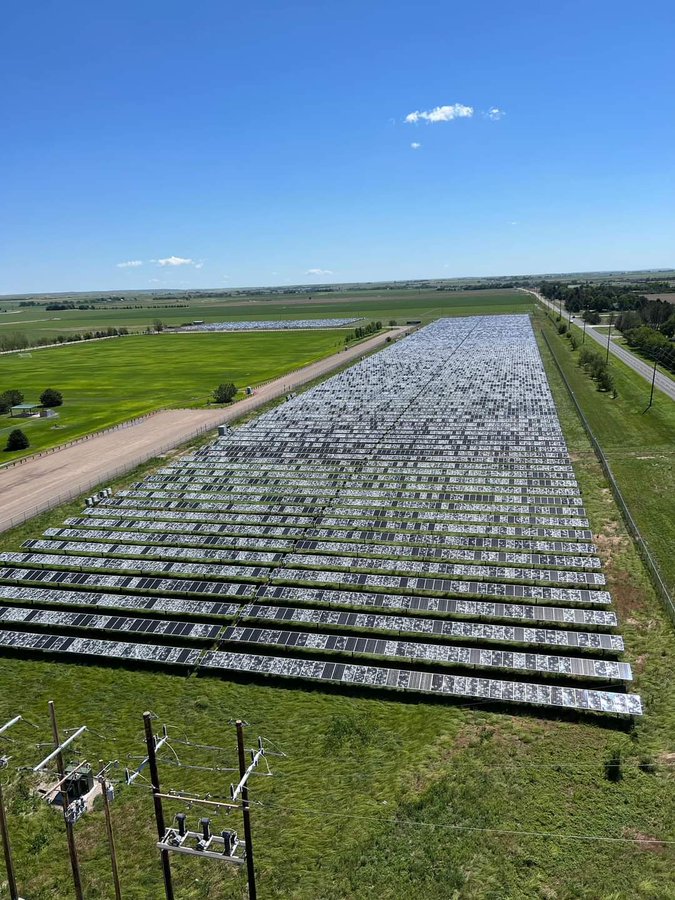
Solar panels deliver power for around 6 hours a day, struggle during wet/cloudy weather and a decent hailstorm or hurricane wipes them out completely.

Anyone recommending solar power as a solution to our growing need for electrical energy needs their head read.

Certain parts of the world suffer regular, violent hailstorms, where hailstones outsize golf balls and sometimes match the, even larger, cricket ball.

That a little ice from the heavens can destroy millions of dollars’ worth of solar panels in a matter of minutes ought to be a matter of serious concern for those in charge of a power grid, where solar increasingly dominates for a few hours either side of midday.

There is, of course, a solution: new-age nuclear. As this Sky News interview with Dr Adi Paterson makes plain.

The ‘next big hailstorm’ will destroy solar panels and the ‘lights will go out’
Sky News Australia
Adi Paterson
23 June 2024

Former ANSTO Chief Executive Dr Adi Paterson says the next “big hailstorm” will result in Australia losing “500 megawatts” of power.

Opposition Leader Peter Dutton announced the Coalition’s nuclear policy last week, including the seven proposed sites for the nuclear reactors.

“My fear for the Sydney basin is what I call the big hailstorm,” Dr Paterson said.

“When the big hailstorm comes, and a big hailstorm will come in the next 20 years, we will lose 500 megawatts of power in the Sydney Basin which is keeping the lights on.

“That is AEMO’s plan.

“This hail will smash the panels on our roofs, and the lights will go out.”

Transcript

Rowan Dean: A former CEO of ANSTO, Dr. Adi Paterson, great to have you here, Adi. You did a cracker of an interview on the ABC during the week. You ran Lucas Heights for a while. You’re a world renowned nuclear expert. The ABC was a fantastic interview because you completely blew them out of the water. They didn’t know where to look or what to do, and we’re desperate to get you off and it’s quite difficult to now find that particular interview on the ABC site. What a surprise. Now let’s get stuck into it. Why should Australia, in your opinion, be a nuclear power?

Dr Adi Paterson: I think we can’t afford not to be a nuclear power. I think the big challenge we are now facing, which is depressing to me, is that we are in a massive thought bubble about how we can get electrons from solar panels and wind turbines, both of which I worked on in the 1990s and the early 2000s, and came to the conclusion that they would not work. Everybody thinks that solar panels are new.

The first solar panel revolution happened 20 years ago and it failed. But my fear for the Sydney Basin is what I call the big hailstorm. What we don’t know, that is already we’re facing solar panel risk. If we get a mega hailstorm across the Sydney Basin, we will lose a power, literally a power plant. We used to build big plants out in the bush. Our power plant now given to us by AEMO is the rooftops of Sydney.

When the big hailstorm comes and a big hailstorm will come in the next 20 years, we will lose 500 megawatts of power in the Sydney Basin, which is keeping the lights on, and that is AEMO’s plan because these hail will smash the panels on our roofs and the lights will go out. That’s the plan. Build bigger solar panels out in the bush where they also have hailstorms. I don’t think anybody’s done the risk management or the control or the thought about what this will mean for us.

The same for wind turbines. Wind turbines might last for about 20 years. The big wind turbines are now seven megawatts. That is a massive machine. In the Sydney Basin, they work 37% of the time, summarising two days out of every five. Everybody says to me, “Adi, but the wind’s always blowing somewhere.” No, it’s not. It’s highly correlated across Eastern Australia.

Now, if somebody said to you, “I’m going to give you a car, it’s really wonderful. It’s completely green, but you can only use it two days out of five.” What would you say? “Probably not.” I’m going to give you a really wonderful solar car, but you work in an emergency room at a hospital or you run the sewage plants or you have to get to the airport to bring the aircraft after dark. I’m afraid you can’t use this car if it’s not charged up after dark.

We are building a world where solar panels, wind turbines, which are flaky resources, Germany has already failed and is deindustrializing. I think it’s possible that BMW will move out of Germany in the next five years because Munich now is a little bubble of failed plans, which is the AEMO plan.

My own view is that AEMO should be completely restructured. It should be brought back into the real world, not Animal Farm. Animal Farm where frankly, I think Animal Farm is a little bit kind to the AEMO paradigm at the moment. Really what I’m saying with humour is that I’m deeply worried. I think the Australia that we love is on the edge of a cliff. I think that we have got a thought bubble in an Animal Farm in Canberra and AEMO, and I think we are in big trouble.

Rita Panahi: And we’re not looking at the overseas experience. We’re not looking at Germany, for example, and we keep hearing this mantra from the renewables, not just the renewable sector, but also most of our politicians, that nuclear is the most expensive form of energy, and then we had that CSIRO GenCost report come out saying the same thing. Nuclear is going to be far more expensive than renewables. What’s your response to that?

Dr Adi Paterson: The GenCost report looks at one reactor, which is being built in Finland. It’s a gigawatt scale. That’s a thousand megawatts. I’m not proposing that we build, and I haven’t proposed that we build gigawatt scale reactors in Australia for the last two years, but people are not listening. I think we should be building reactors at the scale of a large wind turbine.

There are reactors being built in the world today that are five megawatt reactors. I’ve just told you that a big wind turbine is seven megawatts. Now what are you going to choose? A five megawatt reactor or a seven megawatt wind turbine. One that’s going to be on all the time that connected into the grid that you’ve already got. It’s very close to an existing power source. It’s got a safety case, which is the container on the pad.

You don’t need a 10 kilometre safety zone. These are already licenced. In Idaho, they’re building one of these things. Bill Gates is building a molten salt reactor in Wyoming. These are actual real projects that are being built now.

The great thing about them is that we already have a supply chain in Australia because these reactors are smaller than the OPAL reactor, which has a 20 megawatt core. We’ve already approved that in Australia, so I think we’ve got to move away from the gigawatts and fear and move to the megawatts and-

Rowan Dean: And you’ve called the GenCost report a con. GenCon.

Dr Adi Paterson: I call it GenCon report. It’s worse than that. It is actually a form of fascism. It is put together by an economist with a master’s degree and a person who is a proponent of wave power. It’s not the CSIRO report. It’s 10 spreadsheets which are sold to the Australian public as if it’s mandated by somebody who can spell nuclear. It has not a single ounce of credibility. I believe that we could have a new report.

In fact, I was talking to one of my colleagues that we’re going to start a little start up to do this, to take out the GenCon narrative and to create reports for a municipality level, for each municipality, of what nuclear could do for you with these smaller plants that I’m talking about. Some of these plants could literally be in our backyard within five to seven years. That’s the build time. It’s about the same duration as a wind turbine project, a big wind turbine project takes. We just have to change the paradigm. We lift the ban, we take the power away from the central government and we give it back to state governments.

Rowan Dean: James?

James Morrow: Adi, just quickly, the UAE, they’ve got lots of sun as we do, but they’ve introduced nuclear. What’s happened to the price of electricity since they’ve gone nuclear?

Dr Adi Paterson: Well, first of all, it’s become much better quality so you can keep your industry going. And the other great thing about it is that they’ve really solved the problem of all the gas and other plants they were using. Now, they built big ones because they had a big problem, but the people in other communities are building small ones, so the UAE actually built big plants, first one, seven years, second one, five years. It’s just wrong to suggest that it takes too long and costs too much. What costs too much is not being strategic. Nuclear is complicated, but hey, we can deal with complexity. We are Australia.

Rowan Dean: And you reckon the cost will come down with nuclear energy in this country?

Dr Adi Paterson: I’m absolutely certain because I’m an expert on the grid, not just nuclear. The cost of defence, you pay more for the cost of defence of the plant, but the cost in the home goes down to one third. We know this from Finland, their big expensive nuclear plant, when they switched it on, the price of electricity to Finnish consumers went to 30%.

Rowan Dean: Fantastic. It’s been done. Brilliant. Adi Patterson, thanks so much for talking to us, a fount of knowledge there on nuclear energy and there’s so much more we could talk about there. Thanks so much for coming on Outsiders…
Sky News

via STOP THESE THINGS

https://ift.tt/P4WTUOc

August 18, 2024 at 02:30AM

ONE THIRD OF UK TEENAGERS THINK CLIMATE CHANGE IS DELIBERATELY EXAGGERATED

This is a headline from January 2024, but I have only just seen it and I found it surprising, and also heartening at the same time. In some ways we should not be surprised as many teenagers are rebels and like to oppose the status quo. Climate change has become so on-message that it is now almost a state religion. 

Out in the real world, unlike in our institutions, such as government, there is actually a lot of scepticism which teenagers will pick up on. What this tells us is just how transient public support for the coming policies to decarbonise our lives really is. 

Rather like immigration, people have not really accepted the arguments (for mass immigration).They have merely tolerated it. But as soon as they have an excuse to let their true feelings be known there are a lot of people willing to do so. Read the report on this survey here:

 New deniers eh? One third of UK teenagers think climate change is deliberately exaggerated « JoNova (joannenova.com.au)

via climate science

https://ift.tt/dX02k8n

August 18, 2024 at 01:34AM

Net Zero Watch warns of years of rising electricity bills

From NOT A LOT OF PEOPLE KNOW THAT

By Paul Homewood

London: 16 August 2024

Net Zero Watch warns of years of rising electricity bills

Net Zero Watch has warned that Labour’s plans for the electricity system mean that consumers face years of rising bills. Analysis by the campaigning organisation indicates that consumers could be paying over £500 per year extra.

The staggering increase is due to the Government’s plans to vastly increase renewables capacity, the cost of which far outweighs any possible savings from reductions in fuel usage in gas-fired power stations.

And Net Zero Watch is warning that government plans for a major deployment of floating offshore wind will make the situation even worse.

Net Zero Watch director Andrew Montford said:

Floating offshore wind is probably the most expensive form of electricity ever deployed on a commercial basis in the UK, and all the signs are that it will remain so.

Mr Montford said:

“Mr Miliband’s plans are not sustainable and will never be realised in practice. The only question is how much damage the Secretary of State will do to the country before Mr Starmer is forced to replace him.”

Notes to editors

  • The analysis is set out in a recent posting at the Net Zero Watch website.
  • Floating offshore wind has levelised costs of well over £200/MWh. Developers of new capacity are being offered £240 in the current renewables auction.
  • The impact on consumers would be felt partly through electricity bill increases, and partly through cost of living increases.

via Watts Up With That?

https://ift.tt/RzsSHI1

August 18, 2024 at 12:07AM

Environmentalism or Individualism? (Part 1: America’s Enlightenment Heritage)

By Robert Bidinotto

Ed. Note: The ideology of environmentalism has proven itself to be, by far, the most persuasive enemy of the Master Resource, energy. Pollution … Health Hazards … Species Extinction … Ecosystem Destruction … Resource Exhaustion … Global Cooling … Global Warming … Melting Glaciers … Rising Seas … Climate Change. Why do the enemies of energy industries seem always to fall back, in the end, on environmentalist themes for their strongest and most effective stands? Is there something deeply embedded in our Western culture that makes the philosophy of environmentalism the most influential instrument for opposition to the energy industry?

Today, Master Resource begins a six-part series analyzing the philosophic basis of environmentalism, its enmity to the technologies of instrumental reason (especially energy technology), as well as its incompatibility with the foundational individualist philosophy of the United States. Written some years ago by the award-winning essayist Robert Bidinotto, this manifesto seemed worth preserving here at MR now that Bidinotto has moved on professionally to writing a political-thriller series.

Subsequent posts: “Conservation vs. Preservation” (Part 2) is here; “Inhuman Rights” (Part 3) is here; “Philosophic Conflict” (Part 4) is here; “The Value of Nature” (Part 5) is here; and “The ‘Ideal’ of Primitivism” (Part 6) is here.

The new Environmentalism was the complete antithesis of the American Founders’ Enlightenment outlook of reason, science, individualism, self-responsibility, personal freedom, private property, and capitalism.

Every culture and its institutions are the living embodiments of certain dominant ideas. At its birth, America’s basic premises were part and parcel of the glorious historical period that was rightly called “the Enlightenment.”

In his book The Empire of Reason, historian Henry Steele Commager wonderfully captured the spirit of the American Enlightenment. Men such as Franklin and Jefferson, he wrote, had “a prodigality about them; they recognized no bounds to their curiosity, no barriers to their thought, no limits to their activities.” Commager cited “their confidence in Reason, their curiosity about the secular world and—with most of them—their indifference to any other, their addiction to Science—if useful—their habit of experimentation, and their confidence in improvement…” Heroic achievers, these men “exalted Reason and worshipped at the altar of Liberty.”1

That linkage between reason and liberty wasn’t coincidental: men of reason require freedom to explore, to communicate their ideas, to realize their visions. And what is the goal of these activities? In Jefferson’s immortal words, “the pursuit of happiness”: that is, personal fulfillment and self-interest.

Such were the ideas and values of America’s Founders. Their individualist ethic, embodied in the social system of capitalism, has produced—in what amounts historically to the blink of an eye—the greatest material abundance the world has ever known. Once people were encouraged to employ their minds in the pursuit of personal values—and once they were politically free to do so—a torrent of human ingenuity and energy was unleashed, curing hunger, disease, poverty, and ignorance on an unprecedented scale.

Not just America, but every country and culture that adopted these ideas progressed dramatically to the extent it did so. On the other hand, every society that turned its back on these ideas continued to suffer, as primitive societies had suffered throughout history. Witness in our time the intellectual, economic, and political collapse of all forms of socialism, including fascism and communism.

It would seem that this practical demonstration of the extraordinary benefits of reason, individualism, liberty, and capitalism should have been enough to convince all the world—and certainly the world’s intellectuals and leaders—of their unarguable merits. Yet ironically, these Enlightenment ideas, which have given the world so much, are still considered controversial and suspect. And not just the ideas, but also the rational faculty that generates them.

——————

In fact, Man himself is no longer praised as a conqueror of nature’s obstacles, nor even accepted as just another part of the natural world. To many, he is an interloper, an alien presence on the planet—even nature’s enemy—and his creative works are increasingly regarded as a growing menace to all that exists.

“[W]e are threatening to push the earth out of balance,” warned former Vice President Al Gore in his book, Earth in the Balance. “Modern industrial civilization, as presently organized, is colliding violently with our planet’s ecological system. The ferocity of its assault on the earth is breathtaking, and the horrific consequences are occurring so quickly as to defy our capacity to recognize them, comprehend their global implications, and organize an appropriate and timely response.”2

Philip Shabecoff, formerly the chief environmental reporter for the New York Times, summed up this outlook in his history of the American environmental movement: “…[A]n unspoiled land of great beauty and wonder began to change when Europeans came here five hundred years ago,” he wrote. “Its resources were squandered…large areas were sullied, disfigured, and degraded, and…our negligent use of the Promethean forces of science and technology has brought us to the verge of disaster.”3

The Promethean allusion is strikingly appropriate, for Prometheus was the Titan of Greek mythology who loved Man, and brought to him the fire of the Gods—a tool by which he could transform nature for his own benefit. It is perhaps the archetypal myth of Western civilization.

But many—certainly, many who rally under the green banner of environmentalism—now hold that worldview in contempt.

Environmentalism vs. The Enlightenment

The essence of the environmentalist outlook is suggested in the title of Mr. Gore’s book, and made clear in its pages. It’s the view that everything in nature exists in a perfectly harmonious balance—a balance ever threatened by the activities of Man.

The roots of this outlook lie deep in antiquity. “We encounter the ‘paradise myth’ all over the world in more or less complex forms,” writes classical scholar Mircea Eliade. “Actually, all these myths show primitive man enjoying blessedness, spontaneity, and liberty, which he has most annoyingly lost as the consequence of the ‘fall’…”4

For example, in seminally influential writings, the Greek writer Hesiod (circa 750650 BC) presented the so-called “myth of the ages,” or of a lost, blissful “Golden Age.” The Roman poet Ovid (43 BC–AD 17), “one of the most influential of the Latin writers of antiquity,”5 fleshed out the myth of the ages and transformed it into a consistent, compelling story of man’s decay that is remarkably resonant with the themes and narratives of contemporary environmentalism.

In these transcultural myths, the cause of Man’s decadence or “fall” from a previous blissful state of paradise is almost always rooted in the sin of hubris, of pride, and of self-assertion—especially intellectual self-assertion—against authority.

Consider the Greek myth of Prometheus. By giving men the knowledge of the gods, Prometheus enrages Zeus, who chains him to a rock to suffer a thousand years of torture. And to punish Man he sends him the first mortal woman, Pandora, bearing a box that he forbids her to open. But moved by curiosity, she opens it anyway, unleashing on Man all the evils of the world.

Similarly, when given wings of wax, Icarus is warned by his father not to try to fly too high, but the lad ignores him. Soaring upward, the aspiring youth flies too close to the sun, where his wings melt and he falls to his doom.

The Greeks believed that hubris had to be suppressed by recognizing something greater than oneself, by cultivating a sense of humility before the gods or some higher good. Man’s proper path lay in self-restraint, in practicing virtues centered on the idea of moderation, such as prudence, wisdom, and temperance. The importance of humility and steering a moderate course is illustrated in the cautionary Greek myth of Phaëton, who insists on driving his father’s chariot to bear the sun across the sky. But heedless of warnings, he fails to stay on the middle course through the heavens and, flying out of control, sets the world on fire and perishes.

This fear of unrestrained human aspirations, especially Man’s boundless thirst for knowledge, is equally evident in the Judeo-Christian tradition. To the ideals of humility and moderation, the Old Testament incorporates its own version of the paradise myth in the form of a pastoral ideal, symbolized by the Garden of Eden.

In Genesis 2:4–3:24 (King James Version), God plants a Garden, separate from the rest of nature, “and there he put the man whom he had formed” (2:8). This Garden is like a desert oasis, irrigated by a river from Eden—an earthly paradise that contains “every tree that is pleasant to the sight, and good for food” (2:9–10). God also creates for Adam (“man”) a female companion, whom the man later names Eve.

Adam and Eve live together in the “pleasant” Garden as naked, ignorant primitives, eating the fruit of the trees that God has planted for them (there is no mention of killing and eating animals). Provided a virtually effortless sustenance, Adam’s only assigned tasks in the Garden are “to dress it and keep it” (2:15) and to name all the animals.

But Adam and Eve defy the authority of God and eat fruit from a forbidden Tree of Knowledge of Good and Evil. As a result of this Original Sin, God tells them that, as punishment, they will be expelled from the paradisiacal Garden into the harsh state of nature. Thereafter, merely to survive, Adam must “till the ground from whence he was taken”—soil that God has “cursed” and filled with thorns and thistles—and he must labor “in sorrow” to produce bread by “the sweat of [his] face” until he dies. Eve is cursed, too: she henceforth will conceive and give birth “in sorrow” and be subjugated to the will of her husband (3:16-24).

The Judeo-Christian story of Man’s fall from a pastoral “paradise” mirrors the core themes of the transcultural “myth of the ages” and similar ones. Other tales from the Bible reinforce these themes. For example, later in Genesis, when men try to build a tower that can reach heaven, God laments that “now nothing will be restrained from them, which they have imagined to do.”6 So to punish men once again for their unrestrained imagination and ambition, He scatters them across the earth and confuses their languages.

Consider the basic premises about Man and his world that these ancient morality tales have transmitted across the centuries—premises communicated in songs, sermons, images, icons, fiction, films, and scholarly works—premises that have shaped the thinking and the lives of billions. Here, in summary, is their message:

Everything in nature exists in harmonious balance and perfect order (the myth of the Golden Age and the Eden myth). Man’s duty is to accept his humble niche within this benign, bountiful, and balanced paradise, where he can exist simply and non-intrusively (the virtue of humility). However, Man’s ambition—especially his quest to improve himself by gaining and applying knowledge—represents a grave peril to this pastoral ideal (the sin of pride). Man’s ambitious exercise of his creative intelligence disturbs the tranquility and destroys the harmony of the pristine natural order (the danger of reason and the sin of selfish ambition).

To prevent chaos, therefore, Man’s evil, selfish appetites must be curbed, and his intelligence suppressed. That is the task of morality, whose virtues consist of constraints: humility, obedience, self-suppression, sacrifice of self to a “greater” good. By limiting Man’s disruptive ambitions and creative aspirations, then, morality will preserve the natural balance and order.

Since antiquity, this worldview has been drummed dogmatically into billions of brains—so successfully that it’s now the reigning interpretive template. It’s the basis for most people’s understanding of the world around them. It’s the code of values governing their choices and actions. It’s the metaphysical and moral heritage upon which writers such as Al Gore and Philip Shabecoff draw—and which they intuitively trust their readers to share.

It’s the spiritual soil in which the seeds of the environmentalist philosophy and movement have taken root and flourished.

It’s also the complete antithesis of the philosophical outlook of America’s Founders:  a rejection of the Enlightenment outlook that, like Prometheus, championed Man and his requirements for living on earth: reason, science, individualism, self-responsibility, personal freedom, private property, and capitalism.

Rational individualism was the emerging worldview for people newly liberated from superstition, savagery, stagnation, and slavery—people striving to explore, develop, use, and enjoy the earth’s resources. Rational individualism was the philosophy of modernity.

But even in America, this modern, progressive ideal never fully overcame the pre-modern “ideal” of The Eden Premise. That atavistic ideal continued to hold a viselike grip upon millions who feared the prospect of self-responsibility, and hated the socio-economic system that demanded it.

_____________________________

  1. Henry Steele Commager, The Empire of Reason: How Europe Imagined and America Realized the Enlightenment (Garden City, NJ: Anchor Press/Doubleday, 1977), pp. 3, 15, 241. ↩︎
  2. Al Gore, Earth in the Balance: Ecology and the Human Spirit (New York: Plume edition/Penguin Books, 1993), pp. 2, 269. ↩︎
  3. Philip Shabecoff, A Fierce Green Fire: The American Environmental Movement (New York: Hill and Wang, 1993), p. xiii. ↩︎
  4. Mircea Eliade, “The Yearning for Paradise in Primitive Tradition,” Diogenes, University of Chicago Press, Summer 1953; reprinted in Henry A. Murray, ed., Myth and Mythmaking (Boston, MA: Beacon Press, 1968), p. 62. ↩︎
  5. Larry Kreitzer, Prometheus and Adam: Enduring Symbols of the Human Situation (Lanham, MD: University Press of America, 1994), p. 27. ↩︎
  6. Tower of Babel story: Genesis 11:1–9 (King James Version). ↩︎

About the Author

Robert Bidinotto is an award-winning journalist, editor, lecturer, and novelist who reports on cultural and political issues from the perspective of principled individualism. Over three decades he has established a reputation as a leading critic of environmentalism.

As a former Staff Writer for Reader’s Digest, Bidinotto authored high-profile investigative reports on environmental issues, crime, and other public controversies—including articles on global warming and the 1989 Alar scare. His Alar article was singled out for editorial praise by Barron’s and by Priorities, the journal of the American Council on Science and Health. He authored a monograph, The Green Machine,and for several years ran a website (“ecoNOT”), both critically examining the environmentalist philosophy and movement.

Bidinotto’s many articles, columns, and reviews also appeared in SuccessWriter’s Digest, The Boston HeraldThe American SpectatorCity JournalThe Freeman, and Reason. He served as the award-winning editor of The New Individualist, a political and cultural magazine, and as editor of publications for the Capital Research Center, a nonprofit watchdog group.

In 2011, Bidinotto began writing political thrillers. HUNTER—the debut novel in his Dylan Hunter series—soared to the top of the Amazon and Wall St. Journal bestseller lists. BAD DEEDS, the first sequel, dramatizes the evils and dangers of environmentalism. A number-one best-selling Audible political thriller, BAD DEEDS was named “Book of the Year” by the Conservative-Libertarian Fiction Alliance. Bidinotto’s thrillers are available on Amazon.

Learn more about Robert Bidinotto at his fiction website, “The Vigilante Author” and at his nonfiction blog.  

via Watts Up With That?

https://ift.tt/sixRbvm

August 17, 2024 at 08:02PM