Month: August 2024

Sinking Solar: Sun Sets On Great Subsidised Solar Panel Scam

A decade back, householders with solar panels were the smuggest cats around. These days, not so much.

In the beginning, they crowed about the (ludicrously generous) returns from the Government underwritten Feed In Tariffs (FIT) they received for power sent back to the grid (which in many Australian states often topped $0.50 per KWh, the equivalent of $500 per MWh – at a time when coal-fired plants were delivering power all day, every day for less than $30 per MWh).

And they revelled in the upfront subsidies which covered a very substantial proportion of the cost of their panels

Now, it’s all moaning and gnashing of teeth.

Governments were knocked down in the rush, as the well-heeled signed up for millions of cut-priced panels which literally gave them a license to print money. All of which was born by taxpayers, across the board.

With their initial budgets well and truly blown, governments started to reel in the subsidies and/or cut the FITs. In Australia, the figures vary, but most now get about 10% of what was initially on offer. And they don’t like it.

With their ageing panels degrading – or fatally faulting – the smugness of the ‘we’ve got solar’ set is being wiped out by a new reality: economics.

Cory Bernardi (a former Federal Senator for South Australia) outlines below the new sinking feeling being experienced by those who signed up to the great subsidised solar scam.

The Sun is Setting on Solar
Confidential Daily
Cory Bernardi
24 July 2024

The great solar con is crumbling as the world wakes up to the inefficiency and overselling of this toxic future landfill content.

While many householders who have been on the receiving end of generous subsidies to put these panels on their home may see things differently, the data tells a clear tale.

The global capacity for solar panel manufacturing is around 1,600 GW while the demand is less than one third of that capacity (500 GW). That means prices are falling in a desperate drive to pump demand but consumers are wary.

They’ve been sold the dream of free power so many times, that they see their power bills rising and dismiss the rhetoric.

First off, the affordability of solar is entirely dependent on taxpayer subsidies. That means those who can afford the many thousands to install solar do so at the expense of others.

Many years ago, I spent roughly 20K to save around 6K per annum on our power bill. Yes, it was a large power bill (for a large home) but around half of the cost of installation was subsidised by taxpayers.

Part of the attractiveness was a feed in tariff that was super competitive for any power we exported into the grid.

But those days are gone with most feed in tariffs around 10% of the price you pay for the electricity they sell to you.

But even that’s not enough with some providers now limiting the amount you can supply to the grid. I was told recently that one family is now being charged for anything they feed-in in excess of that limit!

My latest bill (for a much smaller home with solar) arrived this week and any savings from my panels was more than offset by the assorted supply charges and fees introduced.

Incredibly, as power prices rise, the wisdom of solar installation becomes less appealing.

With so much ‘free power’ available we always seem to be paying more. If that doesn’t bell the cat on the con then I don’t know what will.

But the problems with solar go much further than that.

The disgraceful use of prime agricultural land for ‘solar farms’ is a direct threat to our food future. Not to mention what the disposal of the array of toxic components in each panel will do to the environment when their 25 year lifespan is up.

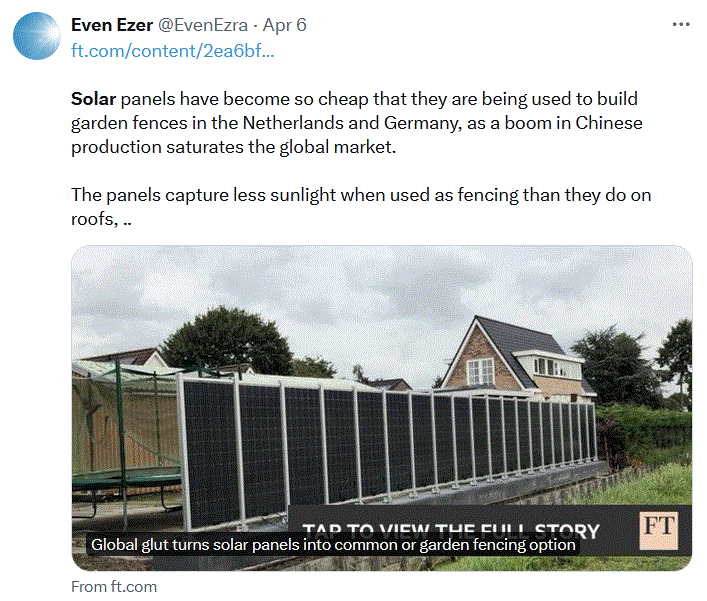
For a decade or so, around four fifths of the solar supply has come out of China leading the Financial Times to report:

“There is overcapacity in every segment, starting with polysilicon and finishing with the module,” said Yana Hryshko, head of global solar supply chain research at the consultancy Wood Mackenzie.

According to BloombergNEF, panel prices have plunged more than 60 percent since July 2022.

Blogger Jo Nova was even more pointed in her observations.

But there’s an argument to be made that the grid itself has reached the limit. The Duck Curve has been quacking on grids in California and Australia for years. Ponder that in towns like Alice Springs the microgrid is in danger of falling over when a cloud rolls in, and only 1 in 4 homes there have solar panels. Indeed, in the sunny centre of Australia, the limit for solar power appears to be just 13% — meaning it’s hard to stabilise the grid when more than 13% of the annual supply is made from solar power.

So just as a global solar industry is imploding the Australian government has decided to spend a billion of your dollars so Australia can become a solar manufacturing superpower.

It’s another extraordinary case of government ideology trumping reality.

Thought for the Day
“It’s better to admit you walked through the wrong door than spend your life in the wrong room.”
Unknown
Confidential Daily
via STOP THESE THINGS

https://ift.tt/kTSCGlA

August 16, 2024 at 02:30AM

FALSE CLIMATE INFORMATION FROM THE BBC

Most people now believe that the climate coverage from the BBC has become a litany of one-sided propaganda. This can now be verified by the following report: 

Tall Climate Tales from the BBC, 2023 (squarespace.com)

How sad that our state broadcaster, once renowned for its impartiality, should now be ridiculed for its attempt to brainwash its viewers and listeners. Not only sad, but also completely wrong, as on such an important issue costing us all so much, we desperately need a good source of balanced, reliable information. By going down this route they will lose the trust of all but the most naive of their audience.

via climate science

https://ift.tt/kVhAxRu

August 16, 2024 at 01:46AM

Environmentalism or Individualism? (Part 6: The “Ideal” of Primitivism)

Ed. Note. This concludes our six-part series on the incompatibility of environmentalist ideology with the foundational individualist philosophy of the United States. Part 1 is here. Part 2 is here. Part 3 is here. Part 4 is here. Part 5 is here.

“Environmentalism reflects an antipathy for a complex, technological, and free society where survival is bought at the cost of ambition, learning, thinking, taking risks, and working hard, within a free, competitive marketplace.”

Despite all the benefits of modernity, the primitive tribal “ideal” of self-denial still persists, most explicitly within the environmentalist movement.

Because of its enduring popularity, many view its environmentalist advocates as sincere idealists, but simply too extreme. Nothing could be further from the truth. In fact, their supposed “ideal” isn’t ideal at all. No, I’m not criticizing them for being too committed to a principle. I’m accusing them of being committed to the wrong principle.

Ask yourself the following question: Where is there a place for humans and their works in a world where pristine nature is deemed ideal, and the productive use of nature for human gain is deemed immoral?

In essence, environmentalists are attacking our very right to live, period. That position permits no compromise. To concede an inch of ground to it is to surrender, in principle, the entire battle for our lives, well-being, and happiness.

For too long, defenders of modernity have tacitly conceded the realm of philosophy—and the mantle of moral idealism—to its critics. Too few have demanded that the environmentalists answer such philosophical questions as:

  • Why does untouched nature have “value” in itself?
  • What, exactly, does that mean?
  • By what standards do you maintain that the human use of a natural resource constitutes an illegitimate claim, or an aesthetic desecration?
  • And by what standard is a life of scarcity and self-denial virtuous?

So long as the “ideal” of a pristine nature unspoiled by self-interested human use remains unchallenged, that ideal will remain the compass that sets the direction of national debate and policy. And its logic will demand that we slowly, inexorably surrender more and more of our property and profits, more and more of our rights and freedoms.

That’s certainly the vision of environmentalist leaders. “We must make the rescue of the environment the central organizing principle of civilization,” declares Al Gore. The changes demanded by this organizing principle, he says, will be “wrenching” and “will affect almost every aspect of our lives together on this planet.”1

Yet that prospect doesn’t appear to faze him or his environmentalist colleagues in the least. Paul Ehrlich, for example, makes it clear that the environmentalist goal isn’t to make poor people better off. Since he believes that rich people, by using more resources, cause many times more “ecological destruction” than poor people, Ehrlich concludes: “Actually, the problem in the world is that there are too many rich people.”2

Environmentalism reflects an antipathy for a complex, technological, and free society where survival is bought at the cost of ambition, learning, thinking, taking risks, and working hard, within a free, competitive marketplace. One sees the true environmentalist motive clearly captured in the book title Returning to Eden—a woozy yearning for an egalitarian garden, where fruit drops from the tree into one’s lap, where the struggle to survive ceases, where all animals lie down in peace and harmony. The Eden of environmentalism is a risk-free place where idle wishes will be the coin of the realm.

Defending the Human Quest

But we don’t live in a mythical Eden. We live on a planet where the struggle to survive is an implacable fact of nature. And those of us who do wish to survive—and thrive—can no longer afford to remain on the moral defensive. We can no longer afford to remain agnostic and mute about the philosophical issues at the root of the attacks on our lives and livelihoods. We can’t expect to rally public support against the environmentalists if we fail to challenge, openly and unapologetically, the moral assumptions underlying their efforts.

No, a moral assault must be met head-on—with a moral response. To clarify the public debate, we must do two things. First, we must begin to understand and uphold the moral rightness of the human use of nature. Second, we must begin to understand and uphold our own moral right to do our work, and to profit from it.

So far, the critics of modernity have been winning the public relations battle. But there’s nothing inevitable about that. I don’t believe that the public is fundamentally predisposed against a rational view of Man and nature. They’re merely confused by arguments that pit the alleged moral claims of nature against the moral claims of human nature.

But defenders of Man have one huge advantage over their adversaries. The anti-human premises of environmentalism clash with every person’s life, well-being, happiness, and—perhaps above all—his self-esteem.

As a case in point, science writer Jeremy Burgess, himself an environmentalist, wondered aloud: “Is it just me, or does everyone else feel guilty for being alive too? …Eventually, and probably soon, we shall all be reduced to creeping about in disgrace, nervous of our simplest pleasures.”3

This, then, is the emotional reward of environmentalism: a metaphysical inferiority complex.

And how could it be otherwise? If untouched nature is the ideal, then, in logic, our lives, interests, well-being, and pleasures must be sacrificed to the “greater” interests of our surroundings. And if they aren’t—if our selfish, life-serving acts impinge on the “ideal” in any way, as they must—then we will come to feel guilty about being alive.

But no one is born spitting into his own face. A metaphysical inferiority complex has to be acquired. It clashes with everything in the human spirit: the desires to learn, to grow, to do, to succeed, to be happy.

It’s time that we reject the environmentalists’ degrading view of human nature, and go on the moral offensive.

It’s time that we, as human beings, assert our right to exist as our nature demands.

It’s time that we stop apologizing for our every footprint, for our every fence, for our every meal.

It’s time that we stop regarding our homes as morally inferior to the trees they came from, or our children’s needs as less morally important than Bambi’s.

It’s time that we recapture the Enlightenment legacy, and build upon the philosophical work begun so nobly by America’s Founders—those heroic achievers who “exalted Reason and worshipped at the altar of Liberty.” It’s time that we define and defend a new vision: an inspiring individualist vision of human potential, in which each human being is honored as an end in himself, with reason as his guide to action, and his own life, well-being, and happiness as his ultimate reward.

_____________________________

  1. Al Gore, Earth in the Balance: Ecology and the Human Spirit (New York: Plume edition/Penguin Books, 1993), p. 269. ↩
  2. Quoted in “Population Expert Says Americans Most Destructive,” Associated Press, April 6, 1990. ↩
  3. Jeremy Burgess, “Excuse Me for Being Alive,” Forum, New Scientist 130, no. 1770 (June 8, 1991), p. 52. ↩

About the Author

Robert Bidinotto is an award-winning journalist, editor, lecturer, and novelist who reports on cultural and political issues from the perspective of principled individualism. Over three decades he has established a reputation as a leading critic of environmentalism.

As a former Staff Writer for Reader’s Digest, Bidinotto authored high-profile investigative reports on environmental issues, crime, and other public controversies—including articles on global warming and the 1989 Alar scare. His Alar article was singled out for editorial praise by Barron’s and by Priorities, the journal of the American Council on Science and Health. He authored a monograph, The Green Machine,and for several years ran a website (“ecoNOT”), both critically examining the environmentalist philosophy and movement.

Bidinotto’s many articles, columns, and reviews also appeared in Success, Writer’s Digest, The Boston Herald, The American Spectator, City Journal, The Freeman, and Reason. He served as the award-winning editor of The New Individualist, a political and cultural magazine, and as editor of publications for the Capital Research Center, a nonprofit watchdog group.

In 2011, Bidinotto began writing political thrillers. HUNTER—the debut novel in his Dylan Hunter series—soared to the top of the Amazon and Wall St. Journal bestseller lists. BAD DEEDS, the first sequel, dramatizes the evils and dangers of environmentalism. A number-one best-selling Audible political thriller, BAD DEEDS was named “Book of the Year” by the Conservative-Libertarian Fiction Alliance. Bidinotto’s thrillers are available on Amazon.

Learn more about Robert Bidinotto at his fiction website, “The Vigilante Author” and at his nonfiction blog.  

The post Environmentalism or Individualism? (Part 6: The “Ideal” of Primitivism) appeared first on Master Resource.

via Master Resource

https://ift.tt/wxdVEPD

August 16, 2024 at 01:04AM

PJM Auction a Strong Indicator America Needs More Electricity

By Raymond Gifford

Among any teen reprobate’s fabled pranks is to take a brown paper bag full of dog poo, light it on fire on the porch of your victim, ring the doorbell, run, and wait for the stinky hilarity to ensue.

And then there are the recent results from the PJM Capacity Auction.

Though not as stinky or juvenilely funny, the capacity auction results promise to trigger a political, regulatory, and consumer conflagration that no ring-and-run joke can match. What’s more, if exogenous forces outside of the PJM regulatory construct—such as permitting delays, policy hostility to dispatchable resources, and financing challenges—intervene, the capacity price increases will leave consumers paying for nothing while still not solving the capacity shortfall.

First, the results: The RTO Zone clearing price rose nearly tenfold from $28.92 to $262.92 per MW-day. Meanwhile, the Baltimore zone cleared at $466.35 per MW-day, up from $73.00 in the prior auction, and the Dominion zone cleared at $444.26 per MW-day. While corks may be popping for some of the generators active in PJM, customers are in for higher electric bills as PJM tries to induce more capacity into its market for 2026 delivery.

While PJM’s top-down engineered price formation bears only a passing resemblance to true bottom-up price emergence from willing sellers to willing buyers, the massive jump in capacity prices sends a blaring signal: PJM is glaringly short of capacity. This shortage means electricity prices will be much higher in the region as consumers are ultimately on the hook for these new capacity payments. Nonetheless, when capacity prices reveal this much volatility, it raises two questions for customers and regulators:

1.   Will these new capacity auction prices succeed in inducing new generation into the market?

2.   Will policymakers and customers tolerate the jarring capacity price volatility shock, or will they push for regulatory and political changes?

The question of whether the capacity auction results will succeed in inducing new generation into the market (or convincing older, inevitably thermal assets to stay in the market) is tough. The mismatch between capacity markets looking forward three years and new asset investments lasting 20, 30, or 40 years has always been a challenge for capacity market designers.

As an investor, do I sink hundreds of millions or billions of dollars into an asset whose capacity payment is only assured for three years? Particularly for dispatchable thermal resources, would high-capacity payments in three years trigger a commitment of capital to be earned back over decades when policies and political forces aim to strand that asset sooner rather than later? For new nuclear investments, the market viability for existing nuclear units in RTOs has been so precarious that many states opted to subsidize their nuclear generation. Even for hybrid renewable/storage generation projects, with the lowered accredited capacity values and historic capacity market price volatility over the years, does the project pencil financially?

To be sure, there are different risk appetites among investors. Perhaps the rich capacity payments awaiting generators from this auction will induce new generation onto the system. But even those with the risk appetite will be tempered by the practical impediments to getting projects completed in the PJM footprint.

The political economy of the auction outcome promises to be just as volatile. Though the entire PJM footprint will face higher prices, Maryland and Virginia, in particular, are in for vertiginous rises in the cost of capacity. These two states have embraced state policies to ‘correct’ what have been viewed as PJM shortcomings, and Virginia periodically alludes to exiting PJM altogether. The political economy of soaring electric rates is predictably bad for incumbent politicians. Ask former governors Bob Ehrlich (MD) and Gray Davis (CA) how electric rate shock worked out for them.

A final question on the political economy of the auction results lands at FERC’s doorstep. Chairman Phillips and Commissioner Christie are former regulators within PJM’s footprint. Does FERC accept the auction’s price results as “just and reasonable” because the market, such as it is, has spoken? Or do they open the hood on the auction to see if the money being drawn from consumers’ pockets will induce the new capacity and hence result in just and reasonable outcomes?

There are no easy answers to PJM’s capacity crisis. The auction results are so jarring that a good Marxist would celebrate the result as “heightening the contradictions” so that a revolution can come along. For the non-Marxist analysts among us, we can hope that some serious scrutiny and deliberation can help extinguish the flaming bag of poo left on the porch of the PJM footprint.

Raymond Gifford previously served as Chairman of the Colorado Public Utilities Commission and is the managing partner in the Denver office of the law firm Wilkinson Barker Knauer. 

This article was originally published by RealClearEnergy and made available via RealClearWire.

via Watts Up With That?

https://ift.tt/AdtQZIS

August 16, 2024 at 12:04AM