Month: August 2024

Oceans Warming Uptick July 2024

The best context for understanding decadal temperature changes comes from the world’s sea surface temperatures (SST), for several reasons:

  • The ocean covers 71% of the globe and drives average temperatures;
  • SSTs have a constant water content, (unlike air temperatures), so give a better reading of heat content variations;
  • Major El Ninos have been the dominant climate feature in recent years.

HadSST is generally regarded as the best of the global SST data sets, and so the temperature story here comes from that source. Previously I used HadSST3 for these reports, but Hadley Centre has made HadSST4 the priority, and v.3 will no longer be updated.  HadSST4 is the same as v.3, except that the older data from ship water intake was re-estimated to be generally lower temperatures than shown in v.3.  The effect is that v.4 has lower average anomalies for the baseline period 1961-1990, thereby showing higher current anomalies than v.3. This analysis concerns more recent time periods and depends on very similar differentials as those from v.3 despite higher absolute anomaly values in v.4.  More on what distinguishes HadSST3 and 4 from other SST products at the end. The user guide for HadSST4 is here.

The Current Context

The chart below shows SST monthly anomalies as reported in HadSST4 starting in 2015 through July 2024.  A global cooling pattern is seen clearly in the Tropics since its peak in 2016, joined by NH and SH cycling downward since 2016, followed by rising temperatures in 2023 and 2024.

Note that in 2015-2016 the Tropics and SH peaked in between two summer NH spikes.  That pattern repeated in 2019-2020 with a lesser Tropics peak and SH bump, but with higher NH spikes. By end of 2020, cooler SSTs in all regions took the Global anomaly well below the mean for this period.  

Then in 2022, another strong NH summer spike peaked in August, but this time both the Tropic and SH were countervailing, resulting in only slight Global warming, later receding to the mean.   Oct./Nov. temps dropped  in NH and the Tropics took the Global anomaly below the average for this period. After an uptick in December, temps in January 2023 dropped everywhere, strongest in NH, with the Global anomaly further below the mean since 2015.

Then came El Nino as shown by the upward spike in the Tropics since January 2023, the anomaly nearly tripling from 0.38C to 1.09C.  In September 2023, all regions rose, especially NH up from 0.70C to 1.41C, pulling up the global anomaly to a new high for this period. By December, NH cooled to 1.1C and the Global anomaly down to 0.94C from its peak of 1.10C, despite slight warming in SH and Tropics.

In January 2024 both Tropics and SH rose, resulting in Global Anomaly going higher. Since then Tropics have cooled from a  peak of 1.29C down to 0.84C.  SH also dropped down from 0.89C to 0.65C. NH lost ~0.4C as of March 2024, but has risen 0.2C over April to June. Despite that upward NH bump, the Global SST anomaly cooled further.  Now in July there was a warming uptick in all regions, bringing the global anomaly up to match January 2024. The NH anomaly is now matching July 2023. The next months will reveal the strength of 2024 NH warming spike, which could rise to the 2023 level or recede.

Comment:

The climatists have seized on this unusual warming as proof their Zero Carbon agenda is needed, without addressing how impossible it would be for CO2 warming the air to raise ocean temperatures.  It is the ocean that warms the air, not the other way around.  Recently Steven Koonin had this to say about the phonomenon confirmed in the graph above:

El Nino is a phenomenon in the climate system that happens once every four or five years.  Heat builds up in the equatorial Pacific to the west of Indonesia and so on.  Then when enough of it builds up it surges across the Pacific and changes the currents and the winds.  As it surges toward South America it was discovered and named in the 19th century  It is well understood at this point that the phenomenon has nothing to do with CO2.

Now people talk about changes in that phenomena as a result of CO2 but it’s there in the climate system already and when it happens it influences weather all over the world.   We feel it when it gets rainier in Southern California for example.  So for the last 3 years we have been in the opposite of an El Nino, a La Nina, part of the reason people think the West Coast has been in drought.

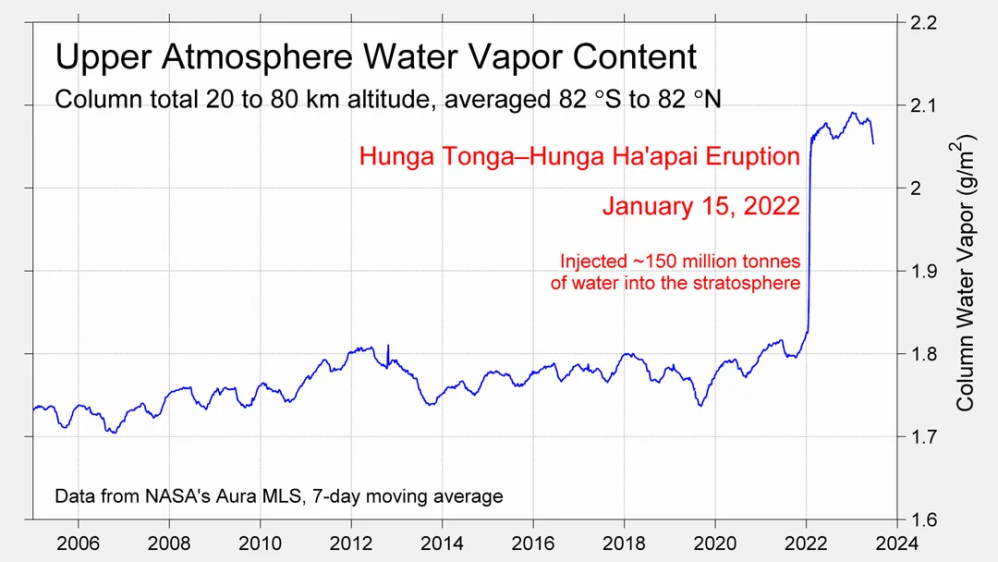
It has now shifted in the last months to an El Nino condition that warms the globe and is thought to contribute to this Spike we have seen. But there are other contributions as well.  One of the most surprising ones is that back in January of 2022 an enormous underwater volcano went off in Tonga and it put up a lot of water vapor into the upper atmosphere. It increased the upper atmosphere of water vapor by about 10 percent, and that’s a warming effect, and it may be that is contributing to why the spike is so high.
A longer view of SSTs
To enlarge, open image in new tab.

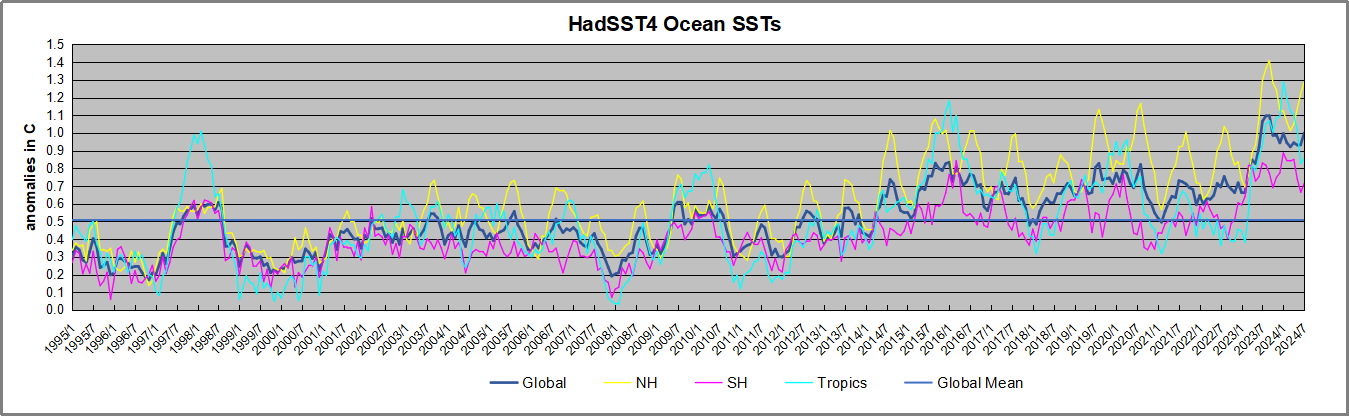
The graph above is noisy, but the density is needed to see the seasonal patterns in the oceanic fluctuations.  Previous posts focused on the rise and fall of the last El Nino starting in 2015.  This post adds a longer view, encompassing the significant 1998 El Nino and since.  The color schemes are retained for Global, Tropics, NH and SH anomalies.  Despite the longer time frame, I have kept the monthly data (rather than yearly averages) because of interesting shifts between January and July. 1995 is a reasonable (ENSO neutral) starting point prior to the first El Nino. 

The sharp Tropical rise peaking in 1998 is dominant in the record, starting Jan. ’97 to pull up SSTs uniformly before returning to the same level Jan. ’99. There were strong cool periods before and after the 1998 El Nino event. Then SSTs in all regions returned to the mean in 2001-2. 

SSTS fluctuate around the mean until 2007, when another, smaller ENSO event occurs. There is cooling 2007-8,  a lower peak warming in 2009-10, following by cooling in 2011-12.  Again SSTs are average 2013-14.

Now a different pattern appears.  The Tropics cooled sharply to Jan 11, then rise steadily for 4 years to Jan 15, at which point the most recent major El Nino takes off.  But this time in contrast to ’97-’99, the Northern Hemisphere produces peaks every summer pulling up the Global average.  In fact, these NH peaks appear every July starting in 2003, growing stronger to produce 3 massive highs in 2014, 15 and 16.  NH July 2017 was only slightly lower, and a fifth NH peak still lower in Sept. 2018.

The highest summer NH peaks came in 2019 and 2020, only this time the Tropics and SH were offsetting rather adding to the warming. (Note: these are high anomalies on top of the highest absolute temps in the NH.)  Since 2014 SH has played a moderating role, offsetting the NH warming pulses. After September 2020 temps dropped off down until February 2021.  In 2021-22 there were again summer NH spikes, but in 2022 moderated first by cooling Tropics and SH SSTs, then in October to January 2023 by deeper cooling in NH and Tropics.  

Then in 2023 the Tropics flipped from below to well above average, while NH produced a summer peak extending into September higher than any previous year.  Despite El Nino driving the Tropics January 2024 anomaly higher than 1998 and 2016 peaks, following months cooled in all regions, and the Tropics continued cooling in April, May and June along with SH dropping, suggesting that the peak might be reached, though now in July NH warming has again pulled the global anomaly higher.

What to make of all this? The patterns suggest that in addition to El Ninos in the Pacific driving the Tropic SSTs, something else is going on in the NH.  The obvious culprit is the North Atlantic, since I have seen this sort of pulsing before.  After reading some papers by David Dilley, I confirmed his observation of Atlantic pulses into the Arctic every 8 to 10 years.

Contemporary AMO Observations

Through January 2023 I depended on the Kaplan AMO Index (not smoothed, not detrended) for N. Atlantic observations. But it is no longer being updated, and NOAA says they don’t know its future.  So I find that ERSSTv5 AMO dataset has current data.  It differs from Kaplan, which reported average absolute temps measured in N. Atlantic.  “ERSST5 AMO  follows Trenberth and Shea (2006) proposal to use the NA region EQ-60°N, 0°-80°W and subtract the global rise of SST 60°S-60°N to obtain a measure of the internal variability, arguing that the effect of external forcing on the North Atlantic should be similar to the effect on the other oceans.”  So the values represent sst anomaly differences between the N. Atlantic and the Global ocean.

The chart above confirms what Kaplan also showed.  As August is the hottest month for the N. Atlantic, its variability, high and low, drives the annual results for this basin.  Note also the peaks in 2010, lows after 2014, and a rise in 2021. Now in 2023 the peak was holding at 1.4C before declining.  An annual chart below is informative:
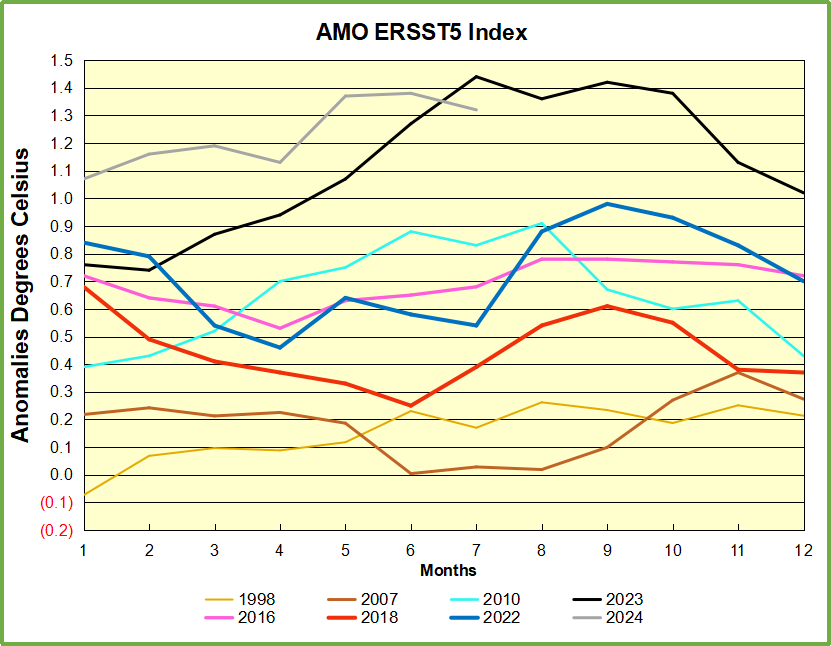
Note the difference between blue/green years, beige/brown, and purple/red years.  2010, 2021, 2022 all peaked strongly in August or September.  1998 and 2007 were mildly warm.  2016 and 2018 were matching or cooler than the global average.  2023 started out slightly warm, then rose steadily to an  extraordinary peak in July.  August to October were only slightly lower, but by December cooled by ~0.4C.

Now in 2024 the AMO anomaly started higher than any previous year, then leveled off for two months declining slightly into April.  Remarkably, May shows an upward leap putting this on a higher track than 2023, and rising slightly higher in June.  In 2024 the anomaly declined and is now lower than the peak reached in 2023.

The pattern suggests the ocean may be demonstrating a stairstep pattern like that we have also seen in HadCRUT4. 
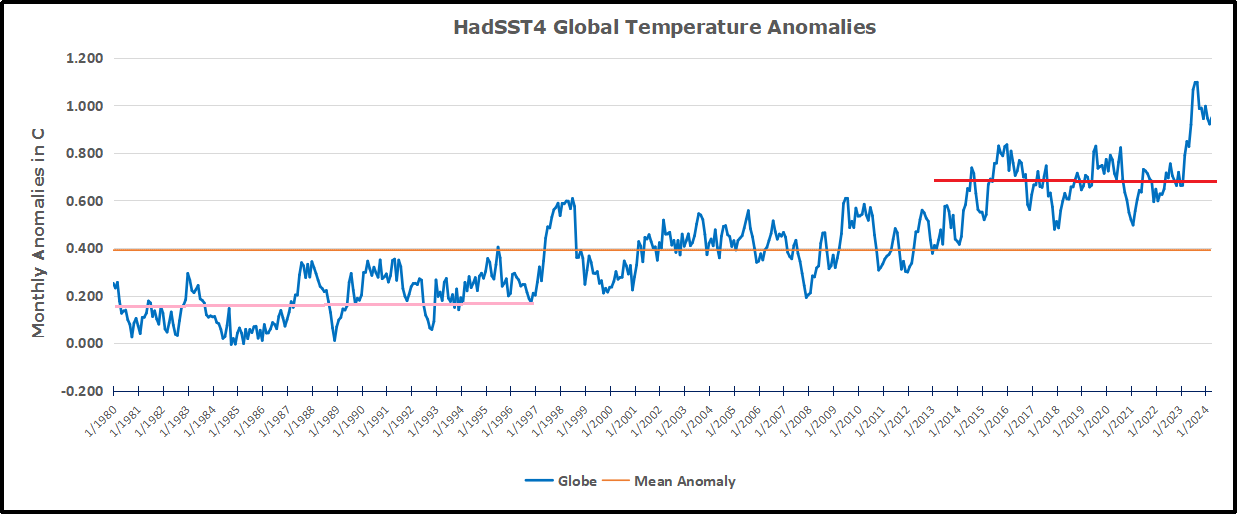
The purple line is the average anomaly 1980-1996 inclusive, value 0.18.  The orange line the average 1980-202404, value 0.39, also for the period 1997-2012. The red line is 2013-202404, value 0.66. As noted above, these rising stages are driven by the combined warming in the Tropics and NH, including both Pacific and Atlantic basins.

See Also:

2024 El Nino Collapsing

Curiosity:  Solar Coincidence?

The news about our current solar cycle 25 is that the solar activity is hitting peak numbers now and higher  than expected 1-2 years in the future.  As livescience put it:  Solar maximum could hit us harder and sooner than we thought. How dangerous will the sun’s chaotic peak be?  Some charts from spaceweatherlive look familar to these sea surface temperature charts.

Summary

The oceans are driving the warming this century.  SSTs took a step up with the 1998 El Nino and have stayed there with help from the North Atlantic, and more recently the Pacific northern “Blob.”  The ocean surfaces are releasing a lot of energy, warming the air, but eventually will have a cooling effect.  The decline after 1937 was rapid by comparison, so one wonders: How long can the oceans keep this up? And is the sun adding forcing to this process?

Space weather impacts the ionosphere in this animation. Credits: NASA/GSFC/CIL/Krystofer Kim

Footnote: Why Rely on HadSST4

HadSST is distinguished from other SST products because HadCRU (Hadley Climatic Research Unit) does not engage in SST interpolation, i.e. infilling estimated anomalies into grid cells lacking sufficient sampling in a given month. From reading the documentation and from queries to Met Office, this is their procedure.

HadSST4 imports data from gridcells containing ocean, excluding land cells. From past records, they have calculated daily and monthly average readings for each grid cell for the period 1961 to 1990. Those temperatures form the baseline from which anomalies are calculated.

In a given month, each gridcell with sufficient sampling is averaged for the month and then the baseline value for that cell and that month is subtracted, resulting in the monthly anomaly for that cell. All cells with monthly anomalies are averaged to produce global, hemispheric and tropical anomalies for the month, based on the cells in those locations. For example, Tropics averages include ocean grid cells lying between latitudes 20N and 20S.

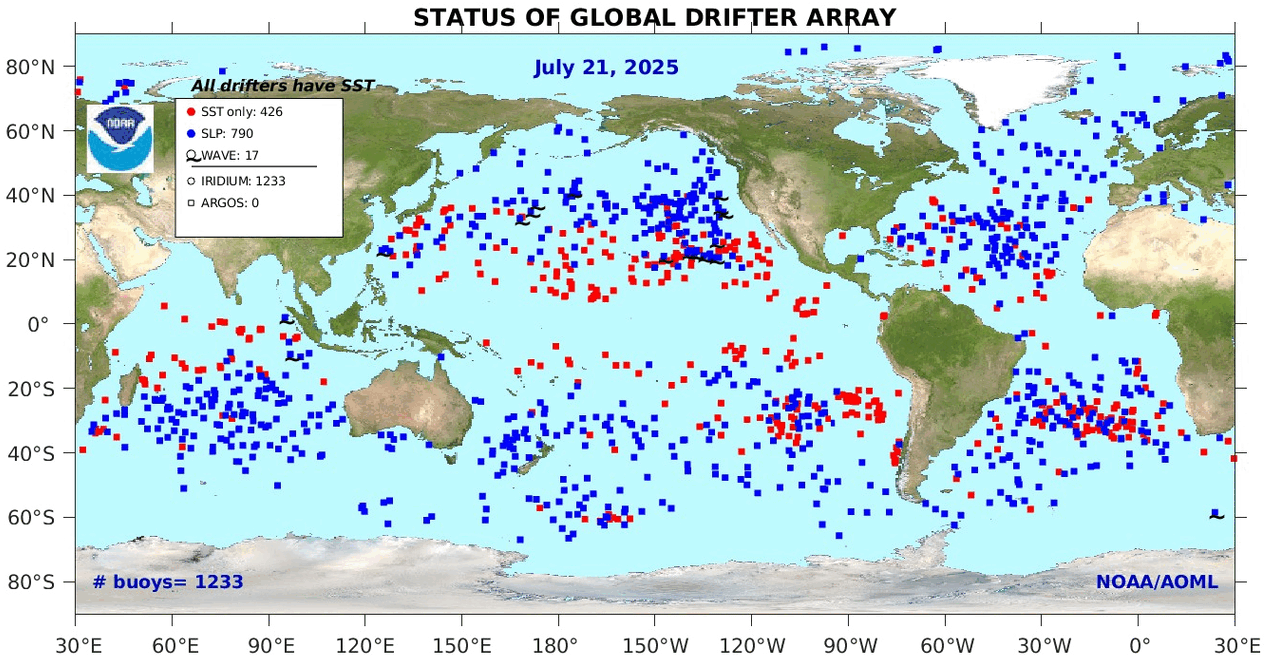
Gridcells lacking sufficient sampling that month are left out of the averaging, and the uncertainty from such missing data is estimated. IMO that is more reasonable than inventing data to infill. And it seems that the Global Drifter Array displayed in the top image is providing more uniform coverage of the oceans than in the past.

uss-pearl-harbor-deploys-global-drifter-buoys-in-pacific-ocean

USS Pearl Harbor deploys Global Drifter Buoys in Pacific Ocean


via Science Matters

https://ift.tt/D9vNGMC

August 15, 2024 at 03:58PM

Dear Elon, 1,000ppm of carbon dioxide is safe, we breath it every day

Every person here is breathing out 40,000 ppm CO2

By Jo Nova

Elon is scratching for a reason to keep worrying about CO2

In the interview with Donald Trump, Elon Musk tried to argue that we ought be limiting carbon dioxide because we are too close to 1,000ppm where people get headaches. Not to put too fine a point on it, but we breath out air at 40,000 ppm fifteen times a minute for our entire lives. If 1,000 ppm gave us a headache or made us nauseous, we’d have to hold our breath every time we kissed someone.

@ElonMusk:  The point I was making is that, even if CO2 did not cause global warming, it is uncomfortable to breathe air with >1000 ppm of CO2. Given that the outdoor ppm away from cities is now ~420 (lol), it is already getting close to 1000 ppm indoors in cities at times. You can buy a cheap CO2 monitor and measure this for yourself.

As the global base level of CO2 keeps increasing, it will cause air quality in cities to feel stuffy and unpleasant, resulting in drowsiness, poor concentration and eventually headaches and nausea. That would not be a good future.

And then he quotes CO2meter.com which, ahem, sells CO2 meters, and has an incentive to wildly overstate the problems with CO2, which they do.

CO2 is not the problem, the stale air and other pollutants cause headaches and sleepiness

The point of CO2 meters is not so much to warn us about excessive CO2 levels, but to indicate how well the room is ventilated.  CO2 levels are just an indicator for air quality. Air with higher CO2 levels usually also has higher levels of organic compounds, humidity, body odour, mold, chemicals from furniture and paint (like formaldehyde) and potentially viruses too. When people report headaches and nausea, the high CO2 levels are not the issue, it’s the bioeffluence that causes problems. When researchers do cognitive tests with pure CO2 added to clean air, performances don’t suffer.  The stale air is the problem, not the CO2. (See Zhang, and Misra where they compared the cognitive effects from badly ventilated air and clean air with high CO2 levels up to 3,000ppm. Problems disappear when they use fresh air plus higher CO2.) Well ventilated rooms may also be cooler rooms, which might explain why results so often contradict each other.

Classrooms are at 1,000ppm “typically”

While outdoor air is 420ppm, indoor levels of CO2 are commonly 1,000ppm in classrooms every day, and can rise as high as 3,000ppm if all the windows are shut. The recognized occupational health and safety levels for long term working exposure are 5,000 ppm for 8 hours straight, five days a week. It’s no big deal.

The National Collaborative Centre for Environmental Health (Canada) measured school and buildings and advises that “Typically, in an occupied classroom situation, the recommended level of ventilation would correspond to a CO2 level of approximately 1000-1100 ppm“. Furthermore, they said the “lowest level at which a human health effect (i.e. acidosis) has been observed in humans is 7,000 ppm, and that only after several weeks of continuous exposure in a submarine environment”.

The occupational limits for CO2recommended by the American Conference of Governmental Industrial Hygienists (ACGIH) are 5000 ppm (TLV-TWA) and 30,000 ppm (TLV-STEL), based on the direct effects on acidification of the blood.  — via Marc Morano and Climate Depot

NASA Office of the Chief Health and Medical Officer

 Station views of Russian Modules during VKD-51 spacewalk

At NASA The Office of the Chief Health and Medicial Officer reports that a typical spacecraft works at around 3,000-7,000 ppm (or o.3-0.7% CO2). The recommended exposure is 5,000, and the permissible exposure limit is 10,000 ppm. Although the flight surgeons found levels of nearly 7,000 were safe and “didn’t affect performance”. On Apollo 13, CO2 levels rose to 20,000ppm. Sweating and shortness of breath became a problem above 30,000 ppm.

Submariners typically live with CO2 levels of 2,000- 5,000 ppm, and when a small sample of sailors was tested at 600, 2500 or 15,000 ppm, the researchers couldn’t find any difference in results from an 80 minute test on decision making. (Rodeheffer at al) Likewise another study at the Johnson Space Centre, people did cognition tests at 600, 1,200, 2,500 and 5,000ppm and there was no dose response effect. Results look rather random.

Lowther et al looked at 51 studies in 2021, and found nothing conclusive in terms of harms from CO2 below 5,000ppm. Most studies were confounded, results were conflicting. Teams of researchers are hunting to find another problem “due to CO2”. If there was a strong negative effect of CO2 it would have shown up by now. Instead CO2 is only associated with occasional headaches and nausea — probably because it is high in crowded rooms with little ventilation.

One large review in 2019 was described as showing CO2 affected people at levels as low as 1,000ppm, but the paper itself  points at the confounding data and uses the words “possible” and “potential effects” and concludes “we need more studies.”

REFERENCES

Lowther, Scott D., Sani Dimitroulopoulou, Kerry Foxall, Clive Shrubsole, Emily Cheek, Britta Gadeberg, and Ovnair Sepai. 2021. “Low Level Carbon Dioxide Indoors—A Pollution Indicator or a Pollutant? A Health-Based Perspective” Environments 8, no. 11: 125. https://ift.tt/F29kxh4

Mishra AK, Schiavon S, Wargocki P, Tham KW. Respiratory performance of humans exposed to moderate levels of carbon dioxide. Indoor Air. 2021 Sep;31(5):1540-1552. doi: 10.1111/ina.12823. Epub 2021 May 15. PMID: 33991134.

Rodeheffer CD, Chabal S, Clarke JM, Fothergill DM. Acute Exposure to Low-to-Moderate Carbon Dioxide Levels and Submariner Decision Making. Aerosp

Zhang X, Wargocki P, Lian Z, Thyregod C. Effects of exposure to carbon dioxide and bioeffluents on perceived air quality, self-assessed acute health symptoms, and cognitive performance. Indoor Air. 2017 Jan;27(1):47-64. doi: 10.1111/ina.12284. Epub 2016 Mar 7. PMID: 26825447.

h/t to Willie Soon, Marc Morano and Climate Depot.

Photo: NASA/Mark T. Vande Hei (taking some images of the Russian modules) Jan 2022

10 out of 10 based on 1 rating

via JoNova

https://ift.tt/L8913W4

August 15, 2024 at 03:54PM

Heat pumps could bring the German economy to its knees

By Paul Homewood

h/t Philip Bratby


image

  • Emissions would come down. It would create a high skill, high wage economy. And it would reboot industry, accelerate productivity, and deliver a boost to growth. For years we have been told that moving to Net Zero would create hundreds of thousands of jobs, and billions of euros, dollars and pounds have been thrown at the companies promising to make that happen.

  • But hold on. Now it turns out that the green jobs are disappearing at an accelerating pace – and the investment in creating them will have been squandered.

    There should be plenty of money to be made from heat pumps, especially in a country such as Germany where the Greens are part of the coalition government, and where a relatively new, well-insulated housing stock makes them more than a match for older gas or oil boilers. And yet, it has turned out to be far from easy. According to the German business paper Handelsblatt Stiebel Eltron, one of the country’s largest pump manufacturers has this week been forced to announce job losses. The reason? Sales have been weaker than it expected. Despite generous subsidies for homeowners, and €18.6 million from the state to support production, the pumps are falling flat, with only 90,000 sold in the first half of this year against an official target for 2024 of 500,000.

    The trouble is, that is far from an isolated example. Shares in the German battery manufacturer Varta are down by over 80 per cent so far this year, and there are warnings that the company may not survive after making heavy losses on energy storage unit for hybrid sports cars.The Belgium chemical group Umicore announced a €1.6 billion hit last month as slowing sales of EVs hit its battery material business, and it decided to postpone plans for a battery recycling plant. Siemens Energy has announced big losses on its unit that makes the giant wind turbines that were to be built across the countryside and along every coastline. And of course, all the major European auto manufacturers have had to scale back their plans for electric vehicles as sales disappoint, and high-quality, cheap Chinese models take whatever few orders there are.

    The list goes on and on. The companies that poured billions into building the industrial infrastructure for the transition to Net Zero are running into trouble one by one.

    It is not hard to work out what has gone so badly wrong. Governments have tried to pick winners, backing new technologies before they have proven themselves in the marketplace, and then doubling down on that up with quotas and subsidies even in the face of consumer indifference. Even worse, they have thrown their support behind the wrong businesses, rewarding companies that tick all the right climate change boxes, rather than waiting to see which ones can make the best product at the lowest possible cost. Industrial strategy, as so often in the past, has been a recipe for disaster.

    Right, now we are seeing the entirely predictable consequences of that. Money is being wasted on an epic scale, right across the continent. No one should be in the least surprised if many of the green projects the British government has backed turn out to be hopelessly uneconomic as well, yet our energy secretary Ed Miliband, and the climate change fanatics who put constant pressure on the Government to reach Net Zero harder and faster, are intent on pouring even more money into what will inevitably be an even larger series of white elephants. In reality, the “well paid green jobs” are disappearing fast, replaced with poorly paid “green redundancies”. Governments will be left with a huge bill for a costly series of mistakes – and the unfortunate workers who thought they were being offered a lucrative career will have to find something else to do very quickly.

  • https://www.telegraph.co.uk/news/2024/08/15/heat-pumps-could-bring-the-german-economy-to-its-knees/

  • via NOT A LOT OF PEOPLE KNOW THAT

    https://ift.tt/mY0MU9y

    August 15, 2024 at 12:37PM

    Western Hudson Bay sea ice breakup for polar bears like the 1980s for 3 of the last 5 yrs

    From Polar Bear Science

    Susan Crockford

    The 1980s and early 1990s are said to have been the “good old days” for sea ice conditions and polar bears in Western Hudson Bay, with all tagged bears usually ashore by mid-to-late August. Then an abrupt step-change in sea ice breakup dates brought polar bears to shore an average of two weeks earlier in the late 1990s. From then until 2019, the only significant outlier to all tagged bears being ashore by about late July was 2009, which was such an unusually cold year that the last bears came ashore about August 20.

    That pattern changed in 2020, when the last bears came off the ice as late as they had in 2009, on August 21. Something similar happened in 2022, when the last bears came off a small remnant of ice even later, about August 26. And this year, the bears may be moving ashore even later: there is even more ice remaining off WH and much of it is thick compacted ice that hasn’t melted much over the last few weeks, which means bears have been as late onshore as the 1980s for three out of the last five years.

    About 40% of all tagged bears were still offshore at August 8. Below, chart showing position of tagged polar bears at August 8 (11/27 or 41% are still on the ice):

    Two years ago, at August 7, 2022 (below), there appeared to be barely any ice off WH but we know that satellites notoriously under-report ice by up to 20% during the melt season because they misclassify melt-ponds over ice as open water. Still, the last tagged bears stayed offshore another two weeks in 2022 on whatever bits of ice remained, like they did in the 1980s when there was more ice available:

    This year the situation is even more unusual. Against all predictions of deteriorating summer sea ice conditions, there is a large patch of thick to very thick sea ice off W. Hudson Bay. Below, see the daily sea ice stage of development chart (i.e. thickness) for August 10: W. Hudson Bay has much more ice this year than 2022, and there could be even more misclassified as open water:

    Polar bear specialist Andrew Derocher dutifully reported the unexpected tagged polar bear/sea ice situation in WH last week but failed to mention that this is the third time in five years that bears have been offshore the first week in August as they were in the 1980s even as he acknowledges that this phenomenon should be good news for bear survival.

    In my opinion, 40% of all tagged bears being offshore is what I would call more than “some.” So many bears offshore and the current ice conditions suggest it’s possible that more than one or two bears might remain on that large block of thick ice until very late August or even early September, which might be the first time that’s happened since the 1980s (if it even happened then).

    For comparison, in 2022, at August 5, 33% of tagged bears (8/24) were still out on small patches of ice that satellites were obviously under-reported because (given that some bears appear to be on no ice whatsoever):

    Even with some bears onshore, there has not yet been a problem bear report issued by the town of Churchill for 2024. In 2020, the first problem bear report (for the last week of August) was not released until September 1, so we may have to wait a few weeks more to find out the situation there.

    via Watts Up With That?

    https://ift.tt/ZD1ECOF

    August 15, 2024 at 12:02PM