Month: September 2024

Physicists: Non-Greenhouse Gases (O2 and N2) Are Mainly Responsible For The 33°C Greenhouse Effect

“The heat retention in the greenhouse Earth is caused by all gas components…mainly by nitrogen and oxygen. It is not permissible to exclusively assign the GH effect of 33° to water vapour, CO2, and the other trace gases.” – Ullman and Bülow, 2024

Chemical physicists Helmut Ullman and Martin Bülow have published a new paper detailing the lack of meaningful or noticeable “specialness” that trace greenhouse gases like carbon dioxide (CO2, 0.042% of the atmosphere) and methane (CH4, 0.00018%) possess in determining Earth’s greenhouse effect heating.
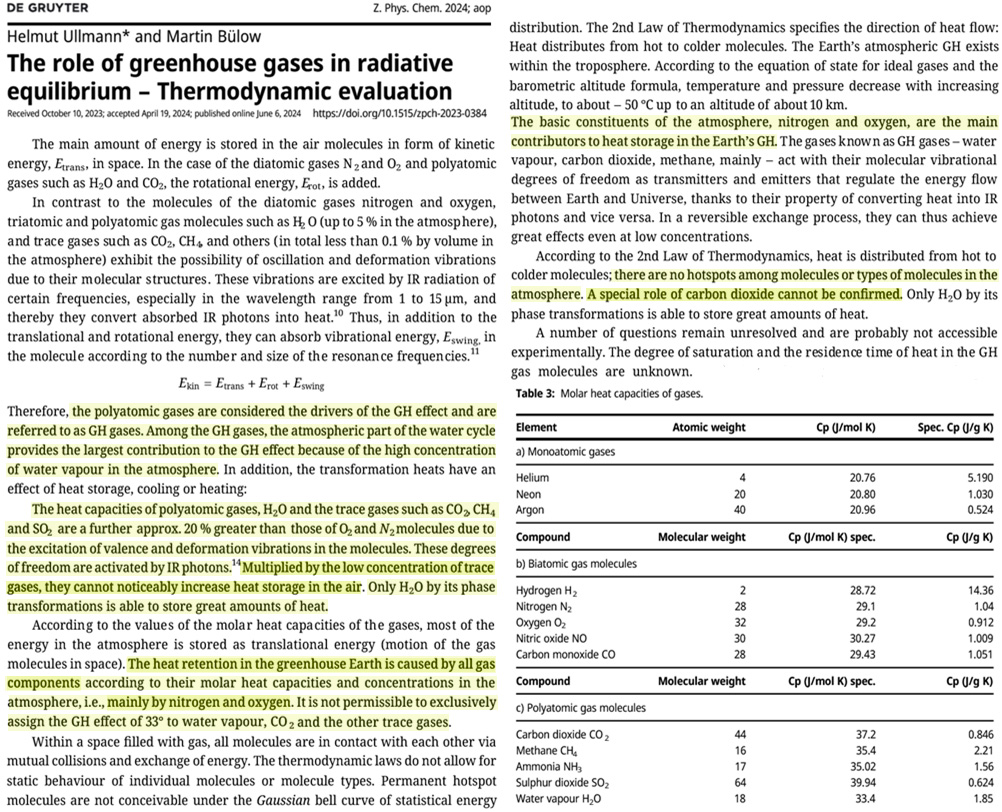
Image Source: Ullman and Bülow, 2024

The imagined 33°C greenhouse effect thought experiment

The popularized greenhouse effect thought experiment requires imagining what temperature the Earth would be if there were no atmospheric greenhouse gases (water vapor, CO2, CH4). It is believed these trace (less than 0.1% of the atmospheric composition combined) heat-absorbing gaseous agents, combined with water vapor (up to 4% of the atmosphere in tropical areas), are the only gases capable of restricting heat loss to space. Thus, greenhouse gases are thought to ultimately keep the Earth’s land and ocean surface temperature 33°C warmer (288 K vs. 255 K) than it would otherwise be in their imagined absence.

It is simultaneously imagined that even though oxygen (O2, 21%), nitrogen (N2, 78%), and argon (Ar, 0.9%) together account for 999,000 ppm (99.9%) of the atmosphere’s gaseous composition, none of these gases absorb and re-emit heat, and thus they cannot slow cooling or count as contributors to the imagined 33°C warmer Earth atmosphere. Only the trace gases and water vapor – the so-called greenhouse gases – can slow cooling, or retain heat.

That’s what the thought experiment says, anyway. Physics say otherwise.

The O2 and N2 greenhouse effect

Ullmann and Bülow point out that the greenhouse effect is not only not exclusively determined by trace greenhouse gases like CO2 or CH4, but these trace gases play such an unimportant role that they’re not even noticeable. Only water vapor has the capacity to absorb heat to a degree that is detectable. The primary gaseous determinants of Earth’s greenhouse effect are not trace gases like CO2 and CH4, but, consistent with their atmospheric abundance, N2 and O2.

“The basic constituents of the atmosphere, nitrogen and oxygen, are the main contributors to heat storage in the Earth’s GH [greenhouse effect].”

“The heat retention in the greenhouse Earth is caused by all gas components…mainly by nitrogen and oxygen. It is not permissible to exclusively assign the GH effect of 33° to water vapour, CO2, and the other trace gases.”

Non-greenhouse gases absorb heat too

There is good reason to conclude O2 and N2 are the primary greenhouse effect determinants. Contrary to popular belief, real-world experiments show that N2, O2, and Ar actually do absorb heat, albeit about 20% less effectively than the so-called greenhouse gases do. A mere 20% dropoff is not significant when the abundance (99.9%) of these gases is considered relative to the abundance (less than 0.1%) of greenhouse gases.

“The heat capacities of polyatomic gases, H2O and the trace gases such as CO2, CH4, and SO2 are a further approx. 20% greater than those of O2 and N2 molecules. … Multiplied by the low concentration of trace gases, they cannot noticeably increase heat storage in the air. Only H2O…is able to store great amounts of heat.”

As mentioned, this phenomenon has been observed experimentally. For example, when air (99% O2 and N2), pure (100%) CO2, and pure (100%) Ar are warmed in experimental conditions, they all absorb heat to nearly the same degree.
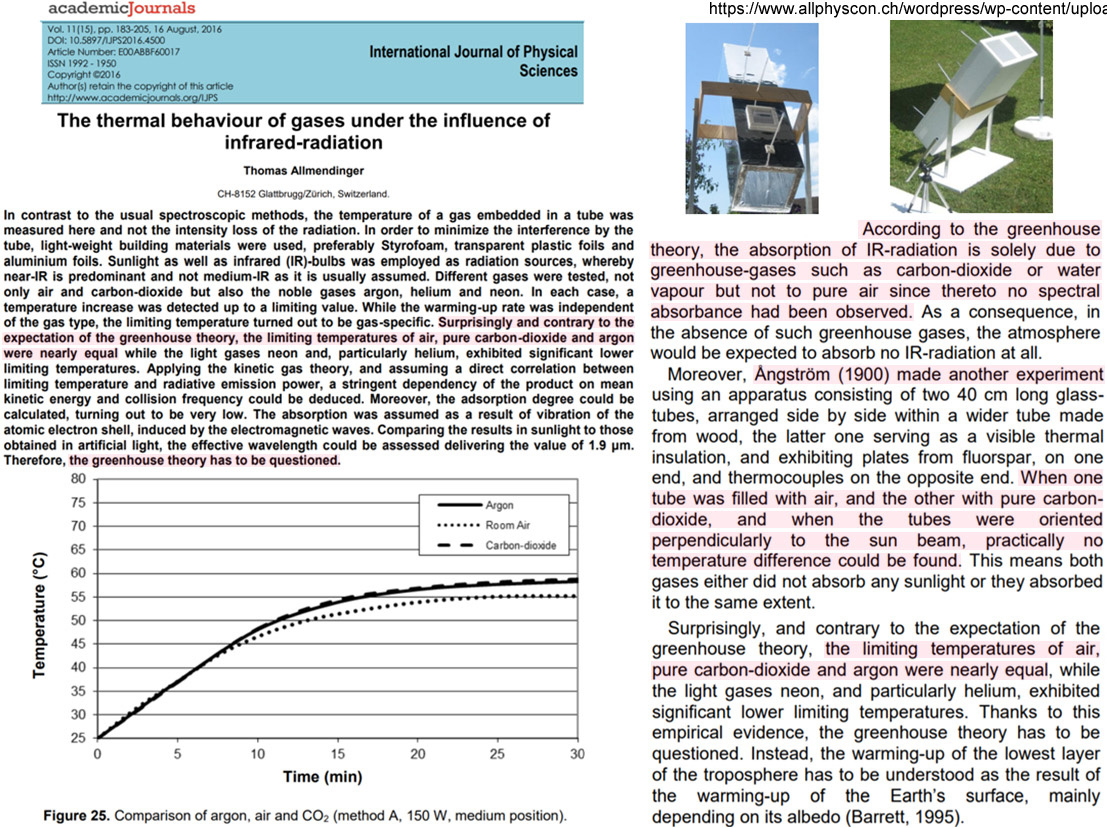
Image Source: Allmendinger, 2016

Scientists agree: O2 and N2 are greenhouse gases

An earlier work published in Geophysical Research Letters (Hopfner et al., 2012) also clarifies that O2 and N2 should be considered “natural greenhouse gases in Earth’s atmosphere.” Although O2 and N2 absorb heat (infrared radiation) more weakly than CO2 and CH4, they do indeed absorb heat, and they do not have a negligible role in Earth’s greenhouse effect because of their relative abundance when compared to CO2 and CH4.

“This work challenges a common perception on the negligible role of O2 and N2 as natural greenhouse gases in Earth’s atmosphere…”

“It is in fact the large abundance of oxygen and nitrogen which compensates for their only weak interaction with infrared radiation…”

“Due to the atmospheric concentration of atmospheric N2 (O2) that is about 2000 (550) times higher than that of Co2 and about 4.4 x 10⁵ (1.2 x 10⁵) times more abundant than CH4, even the weak infrared absorption of N2 (O2) can become radiatively important.”

“Thus, we object to the view that the radiative forcing of N2 increase operates only indirectly by broadening the absorption lines of other gases.”
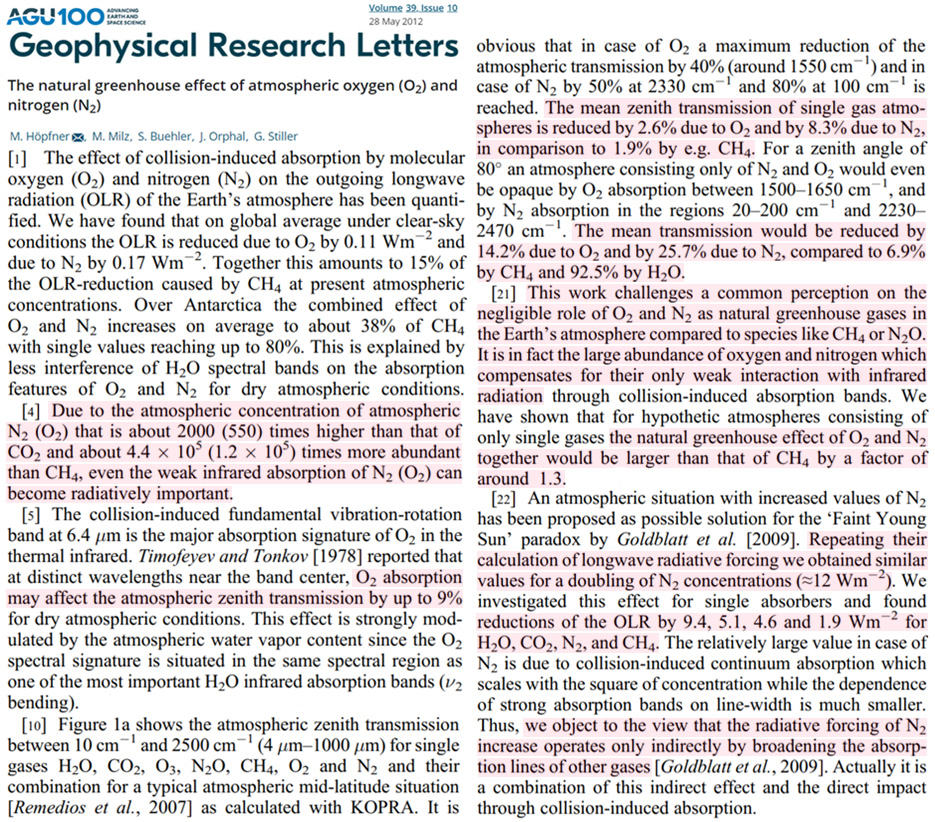
Image Source: Hopfner et al., 2012

CO2 is nothing special

Finally, Drs. Ullmann and Bülow emphasize just how non-special CO2 is as a greenhouse gas in Earth’s atmosphere. As noted above, they point out that CO2’s contribution to the greenhouse effect is not even noticeable. They also assert that the laws of physics require there is no so-called “hotspot” in Earth’s atmosphere due to the conglomeration of CO2 molecules. There is nothing CO2 does that is thermally “special” relative to other gases.

“According to the 2nd Law of Thermodynamics, heat is distributed from hot to cold molecules; there are no hotspots among molecules or types of molecules in the atmosphere. A special role of carbon dioxide cannot be confirmed.”

via NoTricksZone

https://ift.tt/E4PNifp

September 30, 2024 at 08:27PM

The Green New Folly: How Virtue-Signaling Killed a Ferry and Wasted Millions

Original reporting by eugyppius

Ladies and gentlemen, grab your popcorn because the green energy saga out of Schleswig-Holstein has everything: incompetence, mindless virtue-signaling, and an eco-friendly ferry that apparently doubles as a wind sail. Spoiler alert: It doesn’t end well.

Here’s the tragicomedy: Once upon a time in the quiet German countryside, there was a diesel-powered ferry, the Missunde II. For two decades, this workhorse reliably transported over 120,000 automobiles and 50,000 bicycles annually across the Schlei inlet—a body of water barely 100 meters wide. Not exactly the English Channel. But alas, the Missunde II had a fatal flaw in the eyes of the virtue-signaling bureaucrats: it was powered by diesel. And we all know that diesel is the villain in our modern-day environmental morality play.

There was nothing wrong with the Missunde II, except that she ran on diesel, which as we know is an evil fuel destined to destroy the world; and that her diesel engines made noise, as diesel engines do. Thus the bureaucrats of the State Office for Coastal Protection decided some years ago to replace the old and reliable Missunde II with a newer, silent and much more environmentally friendly solar-powered ferry, to be named Missunde III. Their decision was entirely typical. The Office for Coastal Protection is subordinate to the Environmental Ministry of Schleswig-Holstein, and the Environmental Ministry is in the hands of an extremely bald man named Tobias Goldschmidt, who likes to talk about how he will make Schleswig-Holstein carbon-neutral – one ferry at a time.

The carbon-neutral Missunde III cost 3.3 million Euro, and she was finally delivered after various delays in January 2024. Unlike her filthy, noisy predecessor, the Missunde III has a glorious roof, to carry her precious solar panels aloft:
https://www.eugyppius.com/p/how-schleswig-holstein-sold-their

Enter the Green Bureaucrats

The geniuses at Schleswig-Holstein’s Office for Coastal Protection—subordinate to the grand Environmental Ministry—decided to replace the “dirty” diesel ferry with a solar-powered marvel of modern eco-engineering, the Missunde III. After all, who could resist a shiny new boat with solar panels on its roof, especially when it promises to save the planet, one ferry ride at a time? The cost? A mere 3.3 million euros. No big deal when you’re spending other people’s money.

The Missunde III, according to the planners, was going to usher in a new era of clean transportation across the inlet. No more diesel fumes or engine noise polluting the idyllic coastal landscape. Just the gentle hum of solar-powered motors quietly ferrying cars and bikes from one side to the other.

Or so they thought.

Reality Strikes: Solar Panels Don’t Like Wind

Reality has a funny way of upending even the best-laid plans, especially when those plans are designed more for PR than practicality. Turns out, the solar panels on the Missunde III were about as useful as a screen door on a submarine. The ferry’s fancy solar roof acted like a giant sail in the face of Schleswig-Holstein’s famously stiff coastal winds. Instead of gliding effortlessly across the Schlei, the Missunde III struggled. Its motors couldn’t handle the drag from the wind, and it took twice as long to make the crossing compared to its diesel-powered predecessor. Not only that, but the increased weight of the solar ferry put too much strain on its guidance cables, and it couldn’t even dock properly. It turns out when you let ideology steer your projects, you often end up in a ditch—or in this case, adrift in a river.

Thus the sun-powered Missunde III languished in harbour while people argued about how much environmental harm they should be allowed to inflict on the inlet to make her steerable. All the while, the automobiles that normally would’ve ridden the ferry across the Schlei had to take lengthy detours to the nearest bridge 30 kilometres away. Sometimes you have to break a few eggs to make an omelette, and sometimes you have to increase carbon emissions while you wait for somebody to make your emissions-free ferry work.

https://www.eugyppius.com/p/how-schleswig-holstein-sold-their

Environmentalists Stuck in an Environmental Jam

Now, here’s the part where the absurdity really ramps up. In order to fix the Missunde III’s docking problems, authorities decided they needed to drive extra dolphins (marine piling structures, not the mammals) into the bed of the Schlei. But the Schlei is a protected nature preserve, which meant that installing the dolphins required soil assessments and permits, and all that bureaucratic rigamarole takes time. So instead of reducing carbon emissions, the environmentalist brain trust behind the Missunde III managed to increase them, as cars were forced to take a 30-kilometer detour while the ferry languished in the harbor, out of service.

The Return of the Outlaw Diesel

After months of costly detours, exasperated local officials demanded that the old, faithful Missunde II be brought back into service. But there was a hitch: The ferry had already been sold for the grand sum of 17,000 euros—a pittance for a vessel that had reliably served the community for decades. And wouldn’t you know it, making the Missunde II seaworthy again would require extensive renovations costing 1.8 million euros.

Authorities quietly sold the outmoded and embarrassing Missunde II for 17,000 Euro to some dim person who failed to grasp that diesel ferries are not the way of the future. The buyer perhaps regretted his purchase, because he left the poor boat moored in Maasholm, near the head of the Schlei, where she began to decay in the elements. Such is the necessary if cruel fate of technologically unadvanced and environmentally unfriendly watercraft.

But wait, it gets better. After realizing their solar-powered dream boat was a lemon, the same environmental bureaucrats who sold the Missunde II in the first place came crawling back to the buyer and bought it back for 100,000 euros—almost six times what they sold it for. Let that sink in. In the name of environmentalism, they wasted millions on a solar-powered ferry that doesn’t work, then had to spend a fortune to get the reliable old diesel ferry back into service.

Lessons Not Learned

As of September 2024, the Missunde III still isn’t operational. Engineers are trying to outfit it with additional bow thrusters to help it cope with the winds, but it’s anyone’s guess if or when it will ever see regular service. Meanwhile, the old Missunde II is back on the water, ferrying cars and bikes across the Schlei just like it did before this farcical green energy experiment began.

The Missunde II has been given a new permit to sail until 2028, because nobody believes that the hyper-advanced super-silent Missunde III will be up to the simple task of ferrying automobiles across 100 metres of water anytime soon.

And what has Schleswig-Holstein gained for its 3.3 million euros (plus another hundred thousand, plus a almost 2 million for repair, to buy back the diesel ferry)? A nice rooftop of solar panels that would be better suited to a garden shed, a wind-sail masquerading as a ferry, and a reminder that virtue-signaling environmentalism often leads to nothing but wasted money and time.

The Moral of the Story

This fiasco is a perfect example of what happens when ideology trumps common sense. The green energy fanatics in government are so blinded by their obsession with cutting carbon emissions that they can’t see the forest for the trees—or in this case, the ferry for the sail. It’s not about actually solving problems or making things work better; it’s about feeling good about themselves and showing off their “green” credentials to the world, no matter how many millions of euros they flush down the toilet in the process.

Now it is September, and Missunde III is no closer to ferrying automobiles across the Schlei than she was in March. Among other things, engineers have decided she’ll have to be outfitted with additional bow thrusters to deal with the stiff currents. Thus the Office for Coastal Protection finally went limping back to the not-so-dim buyer who purchased the Missunde II for 17,000 Euros, and struck a deal to buy it back from him for 100,000 Euros. The Missunde II has been given a new permit to sail until 2028, because nobody believes that the hyper-advanced super-silent Missunde III will be up to the simple task of ferrying automobiles across 100 metres of water anytime soon.

The Missunde III debacle should serve as a cautionary tale to anyone who thinks the Green New Deal or Net Zero policies will usher in some kind of environmental utopia. More often than not, these projects are little more than expensive virtue-signaling exercises that do more harm than good. If this is the future of green energy, then God help us all.

HT/Fabius Maximus

via Watts Up With That?

https://ift.tt/ias60cC

September 30, 2024 at 08:07PM

Note to Australian Broadcasting Corporation News, Pacific Island Sea Level Projections Are Wrong

A September 26th article on the Australian Broadcasting Corporation (ABC) website, titled “Sea level rise inevitable for Pacific Islands despite future greenhouse gas emissions reduction, NASA finds,” suggests that small island nations are doomed to disappear beneath the waves regardless of any actions to prevent climate change. The claim is both erroneous and irrelevant. Erroneous because actual data show sea level rise (SLR) on Kiribati and other island nations to be far lower than the projections from NASA. Irrelevant because it has been documented that many Pacific Islands have actually been growing in size and adding land mass over time.

“Pacific Island nations such as Tuvalu, Kiribati, and Fiji will experience at least 20 centimeters of sea level rise in the next 30 years regardless of whether greenhouse gas emissions change in the short term, according to new research from NASA,” says ABC.

A quick inspection of Kiribati’s tide gauge data from the National Oceanic and Atmospheric Administration (NOAA) shows this to be false.

Simple math shows what the value will be in 30 years: 2.34mm/year X 30 years = 70.2mm or 7.02 centimeters, about a third of the NASA projection of 20 centimeters in 30 years. Based on tide gauge data for Tuvalu and for Fiji, estimated SLR for 30 years is also far lower than what NASA predicts, a prediction uncritically parroted by ABC.

The reason for the disparity is that the scientific tool NASA used to make its projection is the Pacific Flood Analysis Tool, using model projections instead of actual data. The website says this:

The latest generation of global climate models are used to account for the global-mean thermosteric and ocean dynamic regional sea level rise and similar methods are used for assessing vertical land motion contributions as in past reports. The IPCC AR6 incorporates multiple methods of projecting future ice-sheet changes, which are the major sources of future sea level rise and pose the biggest source of uncertainty in projecting the timing and magnitude of future possible rise amounts. (emphasis mine)

Clearly, NASA used the climate models from the IPCC Sixth Assessment Report (AR6). However, it is telling that when you first visit the Pacific Flood Analysis Tool website, there’s a pop-up message with this disclaimer:

Disclaimer: The NASA Pacific Flooding Analysis Tool provides a scientific assessment of potential flooding frequency and extent due to sea-level rise based on peer-reviewed techniques. The results are provided without warranty of any kind.

Of course, the fact that NASA must put such a broad caveat of “no warranty” on the highly uncertain SLR projections was lost on ABC, who wrote about it as if it were fact.

Climate Realism has written multiple times about the fact that the sixth generation of climate models (CMIP6) used in AR6 are erroneous because they run too hot, creating future projections that have no reasonable basis when compared to actual data.

These climate models produce “implausibly hot forecasts of future warming,” resulting in SLR projections that are wildly erroneous.

But all of that is irrelevant, because Climate Realism has regularly exposed false claims about Pacific islands sinking due to SLR. As far back as October 2020, articles such as New Climate Summary: Islands Not Losing Land or People to Sea Level Rise clearly show such claims to be wrong.

For example, climate activists often claim the island nation of Tuvalu is shrinking due to rising seas. However, a recent peer-reviewed study found eight out of Tuvalu’s nine coral atolls have grown in size during recent decades, and 3/4ths of Tuvalu’s 101 reef islands have similarly grown in size.

Additional peer-reviewed studies (see herehere, and here) confirm the same processes are allowing – and will continue to allow – other Pacific islands to keep up with rising seas. A full summary of this island growth in the face of rising seas is posted at climateataglance.com in: Islands and Sea Level Rise.

ABC failed miserably when it comes to doing basic journalistic research for this story. The fact that no fact check was even attempted is so egregious, one must wonder if it is purposeful, rather than just an indication of incompetence. A paragraph at the very bottom their story suggests it may be purposeful.

“While scientists say rising sea levels will bring significant impacts to Pacific Island nations, some research has shown hundreds of islands in the Pacific are growing in land size due to sediment, corals and other debris being washed ashore,” ABC grudgingly acknowledges.

There it is. ABC evidently trusts computer model outputs over real world data. It seems that ABC, just like many other media outlets, downplays any good news about climate and focuses almost exclusively on the bad news to further the climate crisis narrative.

Anthony Watts

Anthony Watts is a senior fellow for environment and climate at The Heartland Institute. Watts has been in the weather business both in front of, and behind the camera as an on-air television meteorologist since 1978, and currently does daily radio forecasts. He has created weather graphics presentation systems for television, specialized weather instrumentation, as well as co-authored peer-reviewed papers on climate issues. He operates the most viewed website in the world on climate, the award-winning website wattsupwiththat.com.

This post originally appeared at ClimateREALISM

via Watts Up With That?

https://ift.tt/Sq6NI75

September 30, 2024 at 04:05PM

Mark Jacobson’s Big Lemon Gumdrops

It’s been quite awhile since I’ve posted about one of my favorite climate/energy subjects — Stanford professor Mark Z. Jacobson. Back when he dropped his lawsuit against Chris Clack and a bunch of other authors on a paper critiquing his work, I wrote a blog post profiling his legalistic mindset and concluding that he would be soldiering on. Well, he’s certainly been soldiering on and even putting his legalistic mindset to use. He testified in the Held v Montana climate lawsuit case which ruled that a bunch of Montana school children have a right to a safe and stable climate. You can read dueling expert witness PDFs between him and Judith Curry.

While Jacobson’s Clack lawsuit has set him back a bit, he still has lots of acolytes who quote his work, kind of like Michael Mann, but not to the same ridiculous extent. BTW Jacobson and Mann appear to be kindred spirits who quote and retweet each other. Back in 2021 Jacobson did a paper with Robert Howarth (Manhattan Contrarian profile) about blue hydrogen that got a lot of attention from people such as the Just Have a Think guy. Lately, if you manage to view his Twitter/X feed, you’ll see a lot of graphs that look like this:

The big yellow areas that look like gumdrops are California’s electricity demand that is supplied by solar. The left graph is percentages contained under a square red demand box. On the left side of both gumdrops are what look like little black dirt specs of a battery portion which is what they look like on most such graphs if they show up at all. But California is a rich state with determined green policies, so on the right side of the gumdrops they have grown into what might be called dust bunnies. The colored bands that blanket the gumdrops are hydro, wind and other renewable energy sources. All the fossil, nuclear and imported electricity is somehow mixed into the spacious upper white corners. I suppose with enough time, money and hieght added to the gumdrops, those dust bunnies can grow to cover that white space with, I dunno, a big moldy compost pile. All kidding aside, there is a lot of progress being made adding batteries to the grid which is probably a good thing as long as you’re not living next to a bank of them that catches fire. Apparently, one of them recently had a fire that lasted nearly two weeks.

These gumdrop graphs have been showing up at places such as the nearly dormant Rabett Run in this post by Brian Schmidt. Brian is a very civic minded Californian and some time ago he and I were contemplating making a bet over what proportion of California’s electricity would be generated by gas at some predetermined point in the future. Twitter/X advanced search doesn’t seem to go back that far and I don’t recall the exact details. I’m not a rich Californian so I chickened out. I offered to bet a case of his favorite craft beer, but he insisted on a more substantial sum. The bar graph on the bottom shows a significant drop in California’s gas share from 222.1 GWH/D in 2023 to 161.3 GWH/D in 2924 (March 7 to September 28) and I very likely would have lost. It’s not clear how much impact batteries will have on the grid. There will certainly be advances. Right now China is making EVs with sodium ion batteries that don’t offer very good energy per weight but may offer a significant cost advantage for the grid. Batteries, of course, still have to be charged and I would think that nuclear energy would be a more reliable and constant source than wind or solar.

In other Jacobson news, he recently wrote a letter to the editors of the Wall Street Journal claiming that states with high proportions of renewable electricity have lower rates. Francis Menton of the Manhattan Contrarian noticed it and wrote a post on it. He came up with quite different numbers than Jacobson. As the main example, Jacobson found South Dakota getting 95% of its electricity from renewables and having the 9th lowest rates. Menton found it getting 77% and having the 22cnd lowest rate. He found the “publicly-available data for South Dakota are quite inconsistent and contradictory, but however you look at it they don’t come close to backing up Jacobson’s claim.” In a comment, I suggested that Jacobson might be counting only residential and not industrial users.

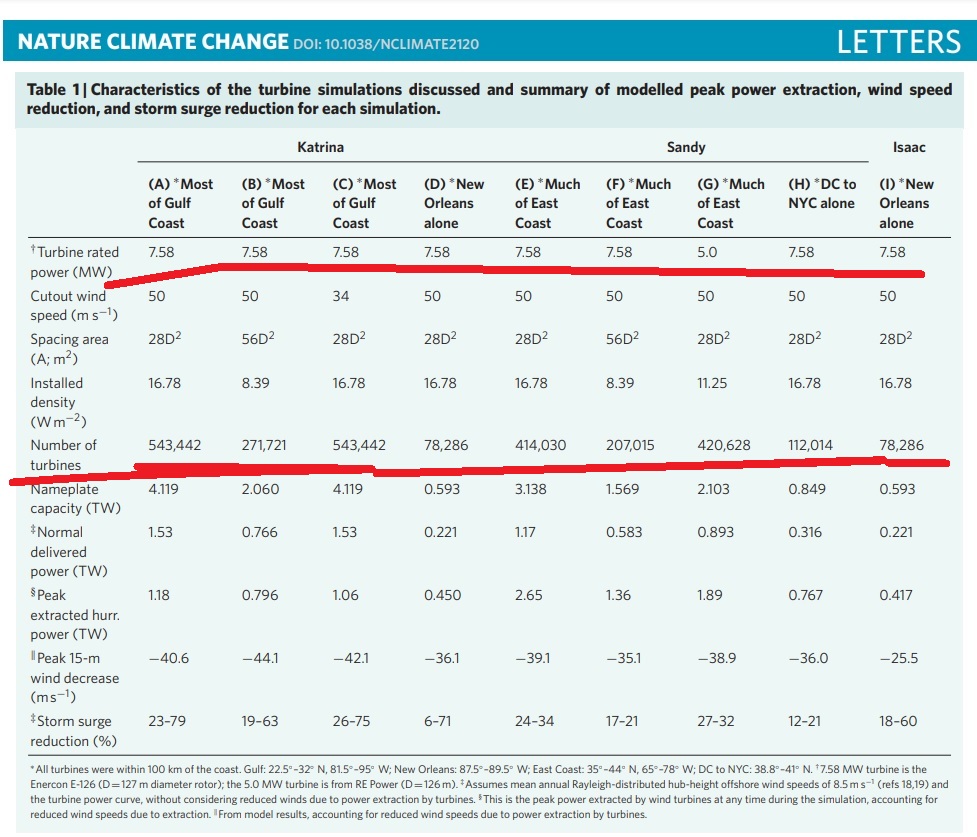
There’s one more thing I have to get in. Jacobson made a tweet where he said Florida should think twice about banning offshore wind. He quotes one of his studies about “taming hurricanes with arrays of offshore wind turbines”. It’s from 2014 and I’ve taken a brief look at it before and been suspicious of it. I just looked it over again and found the money shot! He has a table where he has various scenarios for several hurricanes where he blankets the Gulf of Mexico with about half a million 7 and a half MW offshore wind turbines:

via Climate Scepticism

https://ift.tt/6doCJOy

September 30, 2024 at 03:56PM