
 A reminder that first there was Social Cost of Carbon (SCC) which purported to estimate future costs of damages from CO2 emissions. Now there is Social Costs of Green House Gases (SC-GHG) which ups the ante by adding purported damages from methane (CH4) and Nitrogen oxides (N2O). At the end of this post are references describing this sordid history.
Remember also the regulators game. Regulations by far outnumber laws passed by congress, and they impose costs upon businesses and consumers of the targeted industries. Instigating agencies justify their rules by claiming greater savings from preventing future damages. So the higher the damages estimates the more intensive and expensive can be the regulations.
Mark Krebs provides a recent example of this in his Master Resource article Heat Pump Subsidies: Never Enough. It reports on various machinations by the Biden/Harris regime to spend all the money they can on decarbonizing projects before their term ends. As Biden himself said after terminating his re-election campaign: We should have named the Inflation Reduction Act what it really was, the Green New Deal.
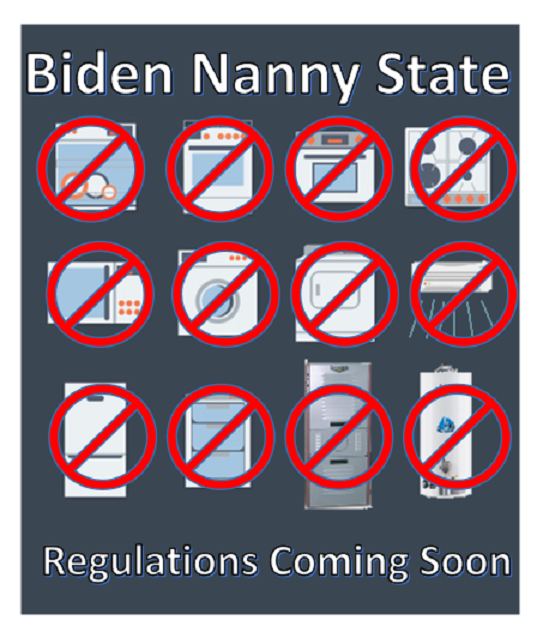
The article includes this quote from Competitive Enterprise Institute’s (CEI) regarding SCC (with my bolds):
Junk Science Behind Federal Appliance Regs About to Get Junkier
The Biden-Harris administration has embarked on a wave of anti-consumer home appliance regulations over the last several years. Each was justified in part by overblown claims of climate change benefits. And now, the Department of Energy (DOE) has proposed using a new methodology that would further inflate these hypothetical benefits to justify even worse regulations in the years ahead.
DOE is in the process of creating new energy use limits for stoves, dishwashers, furnaces, washing machines, water heaters, ceiling fans, refrigerators, and more. The agency always asserts that consumers experience net gains from these regulations, but CEI has filed comments highly critical of these rosy assumptions. In reality, such rules often raise the up-front costs of appliances more than is likely to be earned back in the form of energy savings. Some rules also compromise appliance choice, performance, and reliability.
But DOE’s fictitious consumer benefits are only part of the problem. CEI has also taken issue with the agency’s assertions that these regulations deliver quantifiable climate change benefits. For example, DOE’s costly 2023 final rule for residential furnaces was estimated by the agency to provide $16.2 billion worth of such benefits.
The agency arrives at this figure by calculating the reduced energy use attributable to the efficiency standards and then estimating the amount of greenhouse gas emissions avoided as a result – mostly carbon dioxide emitted to produce electricity at coal or natural gas-fired power plants. Then it multiplies the tons of emissions avoided by the calculated per unit dollar cost to society of such emissions.
Until now, DOE has relied upon the 2021 Interagency Working Group on the Social Cost of Greenhouse Gases (IWG 2021). IWG 2021 provides the agency with the per ton Social Cost of Greenhouse Gases (SC-GHG) values.
Relying on IWG 2021 was bad enough, but in its most recent proposed rule for commercial refrigeration equipment DOE is switching to an updated 2023 version of SC-GHG provided by the Environmental Protection Agency.
The new methodology takes several already-dubious assumptions in IWG 2021 and stretches them further. For one category of commercial refrigeration equipment covered in the proposed rule, DOE calculates the climate benefits of $48-$320 million dollars under IWG 2021 but a whopping $564-$1,713 million under the new way. That’s around 5-10 times higher.
How Did They Weaponize SC-GHG?
Briefly recapping, the Obama WH activist bean counters pushed numbers around and came up with $51 per ton of CO2 emitted. Then Trump WH said more realistic interest rates give an SCC of $1 per ton CO2. Then Biden/Harris came into power with a deluge of Excutive Orders (EO), including one that reset SCC at 51$ Maybe you recall scenes like this from early 2021:
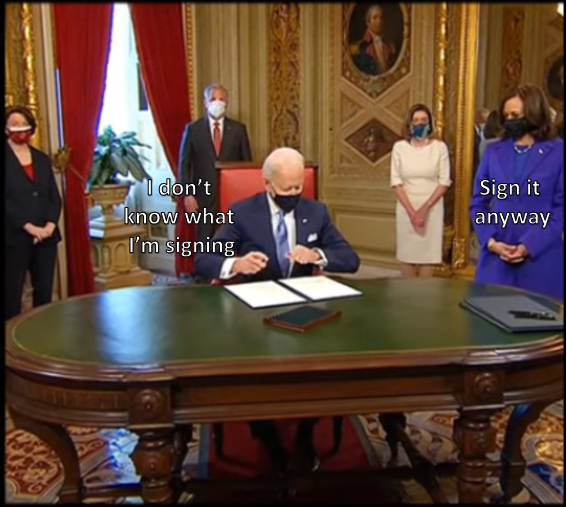
That prompted ten states to file for an injunction against Biden’s EO 13990 which was granted by the federal District Court of Louisiana February 2022. Manhattan Contrarian commented at the time (my bolds):
On taking office, the Trump administration took steps to neutralize the SCC, so that not much has been heard from it for a while. But Biden’s EO 13990 caused the Obama-era version to get re-instated. The Biden people claim that they are working on further tweaks to the regulations, but meanwhile a large group of Republican-led states went ahead and commenced litigation.
With a regulatory initiative obviously intended to force a gigantic transformation of the economy without statutory basis, the Biden people defended against the Complaint using every shuck and jive and technicality known to man. The SCC rules were not “final” because the administration was still working on a few more tweaks (and then a few more, and then a few more); the state plaintiffs lacked “standing” because the harm was to citizens rather than the state itself; and so forth. The court was having none of it.
The heart of the court’s decision is its determination that the SCC falls under the Supreme Court’s “major questions doctrine,” under which the bureaucracy cannot on its own authority impose “new obligations of vast economic and political significance” unless Congress “speaks clearly.” The states had identified some 83 pending projects involving something in the range of $447 and $561 billion dollars as affected by the SCC rule. That impressed the court as easily within the concept of “major questions.”
However in March 2022 the Fifth Circuit Court of Appeals stopped the injunction, and in May 2022 the Supreme Court refused a request by plaintiff states to block EO 13990.
From Technical Support Document: Social Cost of Carbon, Methane, and Nitrous Oxide 2021
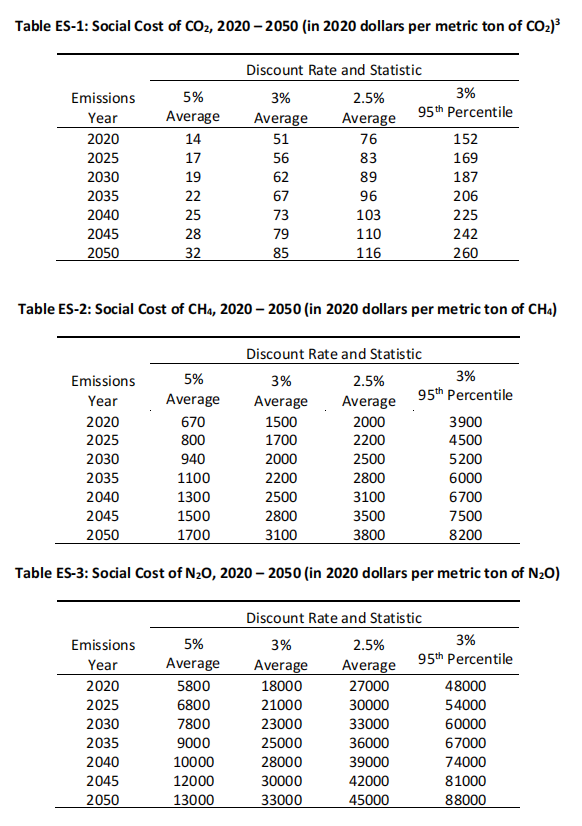
This table was the same one produced by Obama WH. Note that at 5% discount rate, CO2 goes from $14 to $32 in 2050. Obama era regulations presumed the 3% rate which results in $51 up to $85. Note the astronomical numbers for CH4 $1500 per ton up to $3100. And N2O starts at $18,000 to $33,000. Hide your cows and fertilizers!. But that was not expensive enough for Team Biden/Harris .
From the EPA Report on the Social Cost of Greenhouse Gases: Estimates Incorporating Recent Scientific Advances 2023
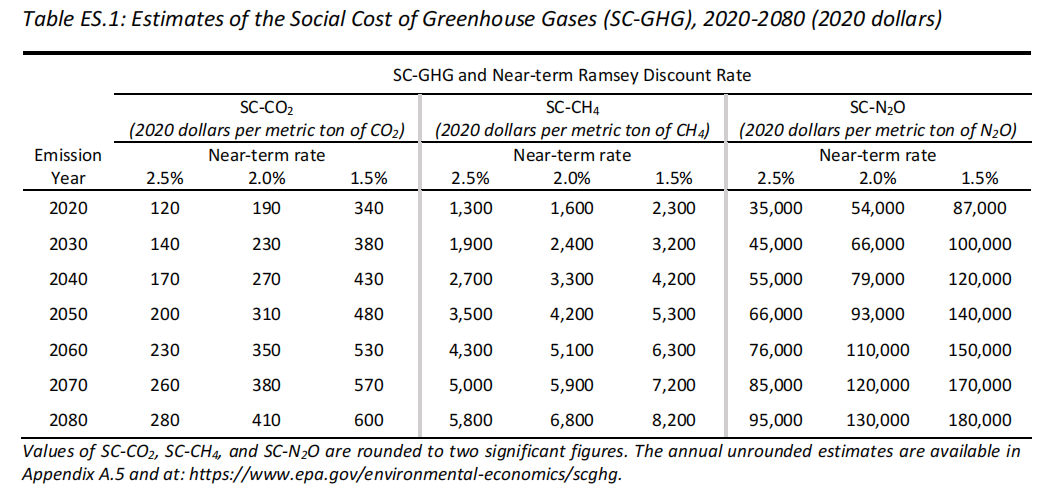
So no more 5% rate, and the middle scale is 2% rather than 2.5%. That starts at $190 per ton of CO2 up to $310 by 2050 and $410 in 2080. CH4 on the same basis is $1600 to $4200 in 2050 up to $6800 by 2080. Of course a ton of N2O is unaffordable at $54,000 up to $130,000.
In other words, this regime can regulate the hell out of appliance manufacturers and agricultural operations, among others, justified by such numbers. It started with gas stoves, but won’t end there.

Will anyone put a stop to them?

via Science Matters
September 19, 2024 at 01:14PM
 Iowa Climate Science Education