
Photo by Horacio_Fernandez https://ift.tt/SFnPkuc
By Jo Nova
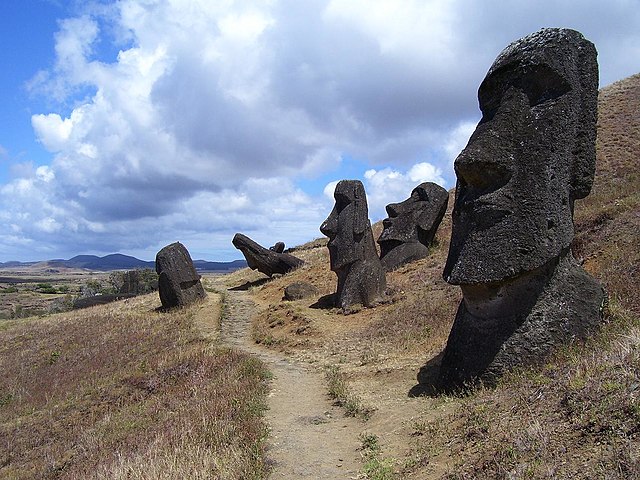
It was always the Posterchild Catastrophe of Doomsters, but two new studies suggest Easter Island might be a story of remarkable human achievement instead.
In environmentalist legends, Easter Island was The Ecocide: they built nearly 1,000 giant stone statues but stupidly chopped down all its trees, and died in horrible wars. It was the sorry tale of ecological collapse and deforestation that we could tell small children at bedtime. After the last trees were sliced and diced, a catastrophe of horrors surely followed as the population of 15,000 people ran out of food and no one could make a boat to escape. Obsidian flakes across the island were interpreted as weapons of war and one anthropologist claimed there was a huge civil war that ended in the battle of 1680. Environmental hell on Earth was here…
But new research on the genomes of some islanders suggests that the population was probably small all along. When the Europeans arrived there were only about 3,000 people, but a genetic analysis suggests there are no signs of a recent collapse in the population. Another study of the fields suggests they made some very sophisticated gardens, but only ever had fields big enough to sustain about 4,000 people. And the obsidian fragments were probably domestic tools.
Adding to the tale of remarkable survival, apparently the inhabitants somehow managed to get to South America and collected some native Indian genes which they brought back. These survived on for another 15 to 20 generations.
So it may be that an isolated island of only 3,000 people was capable of feeding itself sustainably, somehow making huge statues, and also sailing 3,700 kilometres to South America and then finding their way back again. (Or maybe, wonders Jo, whether some South Americans just managed a one way trip? How would we know? — On that score, the authors of the Nature paper say they can’t tell genetically, but there is archaeological evidence and oral history of trans-Pacific contact from Polynesia right across to South America).
Famed Polynesian island did not succumb to ‘ecological suicide,’ new evidence reveals
Most recently Carl Lipo, an archaeologist at Binghamton University, and his team used satellite imagery and machine learning to map the island’s rock gardens, a method of spreading rocks to improve soil productivity. In a paper in Science Advances in July, they concluded Rapa Nui’s agriculture was far less extensive, and its population smaller, than the “ecocide” theory had proposed. Although the ancient Rapanui did cut down most of the island’s trees, the deforestation did not trigger a cultural or population crisis, they say. “Their ability to adapt was successful,” Atallah Leiva says.
The farmers of Rapa Nui (Easter Island) used rocks to improve the soil:
While it is true that the small island — which is just 63 square miles (164 square kilometers), or slightly smaller than Washington, D.C. — has poor soil quality and limited freshwater resources, researchers have discovered that the story of the Rapanui is one of survival in challenging ecological conditions.
One method the Rapanui used to enhance the island’s volcanic soil was “lithic mulching,” or rock gardening, in which pieces of rock were added to cultivation areas to boost productivity. The rock gardens generated better airflow in the soil, helping mediate temperature swings and maintaining nutrients — including nitrogen, phosphorus and potassium — in the soil.
Yet another paper suggests that the banal truth of the deforestation was not because humans chopped them all down, but because the first settlers bought some rats:
What really happened to the trees
More recently, a picture has emerged of a prehistoric population that was both successful and lived sustainably on the island up until European contact. It is generally agreed that Rapa Nui, once covered in large palm trees, was rapidly deforested soon after its initial colonization around A.D. 1200. Although microbotanical evidence, such as pollen analysis, suggests the palm forest disappeared quickly, the human population may only have been partially to blame.
The earliest Polynesian colonizers brought with them another culprit, namely the Polynesian rat. It seems likely that rats ate both palm nuts and sapling trees, preventing the forests from growing back. But despite this deforestation, my own research on the diet of the prehistoric Rapanui found they consumed more seafood and were more sophisticated and adaptable farmers than previously thought.
The bottom line is that the genetic analysis only has about 15 samples from remains of Islanders of the 1800s and while the rock garden analysis used field trips they also relied on some satellites and AI, so no one really knows for sure. The catastrophist environmentalist story almost certainly ran away with itself, but there is an element of indigenous sainthood working the other way too:
“Working with Indigenous groups, we face so many tropes and outdated narratives that people keep perpetuating—even scientists,” says Kathrin Nägele of the Max Planck Institute for Evolutionary Anthropology, who wrote an accompanying commentary for Nature. “I hope this … ancient DNA [study] puts the last nail in the coffin of this [collapse] narrative.”
Most likely the Rapanui were remarkable survivors who were just as capable of screwing things up as any of us. Hopefully scientists will figure out what really happened, instead of beating us over the head with their favorite ideology.
Lord give us a dispassionate scientist…
REFERENCES
Davis et a (2024) Island-wide characterization of agricultural production challenges the demographic collapse hypothesis for Rapa Nui (Easter Island), Science Advances, 21 Jun 2024 Vol 10, Issue 25 DOI: 10.1126/sciadv.ado1459
Moreno-Mayar, J.V., Sousa da Mota, B., Higham, T. et al. Ancient Rapanui genomes reveal resilience and pre-European contact with the Americas. Nature 633, 389–397 (2024). https://ift.tt/sB1l9KJ
0 out of 10 based on 0 rating
via JoNova
September 19, 2024 at 05:30PM
 Iowa Climate Science Education