Month: September 2024

New Study Finds CO2 Is Merely A Climate ‘Spectator’, A Non-Factor In Explaining Paleoclimate Changes

“…sea surface temperature has been the primary determinant of baseline atmospheric P(CO2) across the entire Cenozoic” – Frank, 2024

A new study analyzes paleo atmospheric CO2 levels using the modern-day observation that oceans release more CO2 as they warm and less CO2 as they cool – a reference to Henry’s Law.

“…ambient CO2 is released or dissolved only after a positive or negative change in global mean ocean temperature.”

Application of Henry’s Law allows for the calculated interpretation that the reconstructed 100s of ppm (±200-800 ppm) CO2 variations over the last 66 million years (the Cenozoic), as well as throughout the last 420,000 years of ice core records, are driven or “primarily determined” by sea surface temperature (SST).

“Temperature-driven re-equilibration of carbon dioxide across the sea surface can explain the rise and fall of atmospheric P(CO2) throughout the 420 kYr glacial record of the VOSTOK ice core. The correspondence implies a glacial-interglacial global mean SST range of 11°C (280-291 K)…”

The study introduces undersea tectonics variability as a explanatory mechanism for warm and cool periods. High magma activity periods warmed the oceans, and the additional warmth led to elevated (>1000 ppm) atmospheric CO2 levels (net outgassing) as a consequence. During less active magmatic activity periods, the oceans cooled, and this cooling drove the drawdown in atmospheric CO2.

A Henry’s Law SST-induced CO2 concentration record implies glacial-interglacial global mean sea surface temperature amplitudes reached 11°C (280 to 291 K) over the last 420,000 years. 291 K is a few degrees warmer than the modern temperature calculation (288 K).

“…the general decline in SST across the Cenozoic may reflect a relative quiescence of submarine magmatism and thus of magmatic heating, rather than being caused by a secular decline in the radiative forcing of atmospheric CO2.”

“…the most parsimonious interpretation of the Cenozoic record is that ocean temperature rose with large-scale magmatic activity and fell in its absence. P(CO2) followed. In this light, atmospheric CO2 has been a molecular spectator of the changing climate.”

The presence of a geothermal mechanism explaining warm vs. cold SST periods precludes the need for orbital factors, such as the Milankovitch cycles, to drive glaciations and deglaciations.

“Milankovitch orbital forcing must have been present during the late Cretaceous and throughout the Cenozoic, but did not produce glaciations.”

CO2 radiative forcing is also not considered an explanatory factor in global climate changes over the last 66 million years.

“The notion of exogenous CO2 forcing adds no additional explanatory value.”

“A generalizing conclusion is that the dogma of atmospheric CO2 as the predominant driver of global surface temperature should be set aside.”

So, to summarize, temperature variations are the “primary determinant” of CO2 variations, with CO2 variation a consequence rather than a causal factor in climate. Atmospheric CO2 is thus a (1) “molecular spectator,” (2) has “no explanatory value” in ocean temperature variability, and (3) “should be set aside” as a considered causal factor in glaciations and deglaciations.
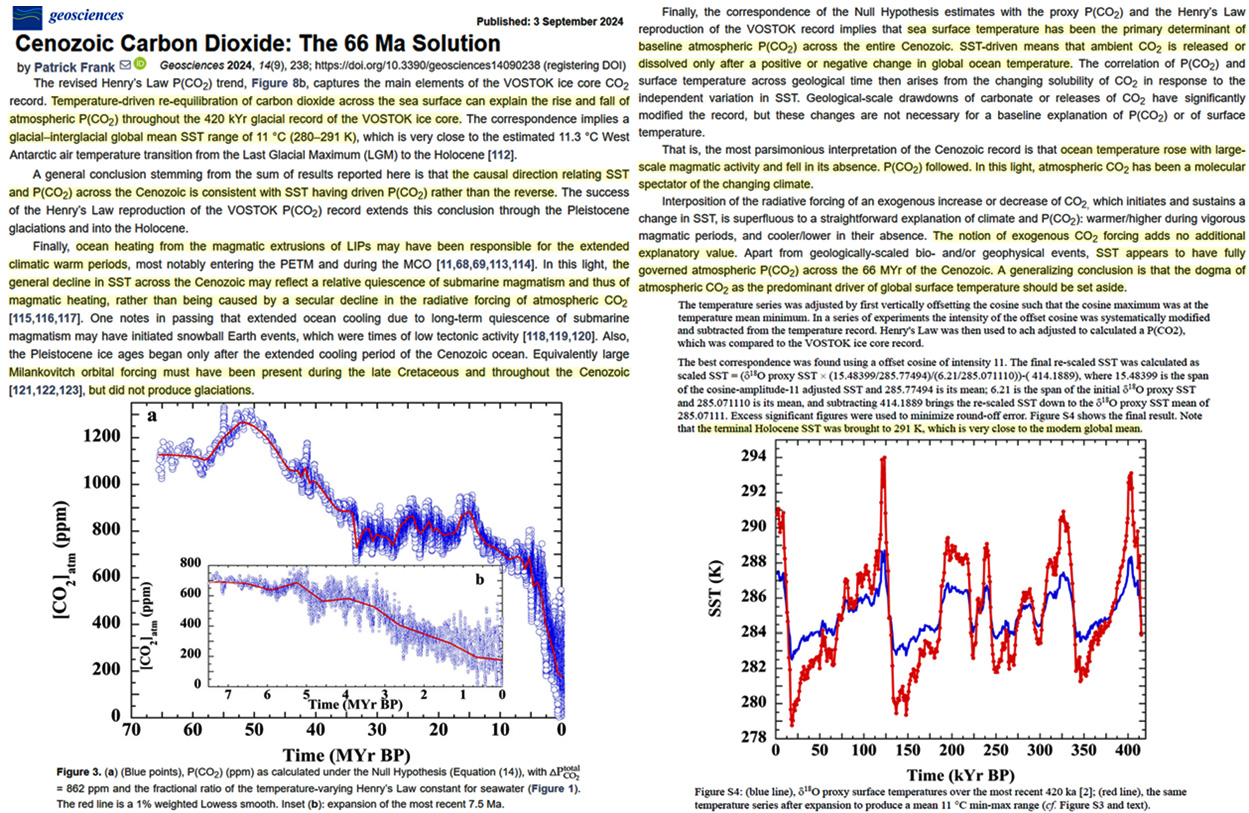
Image Source: Frank, 2024

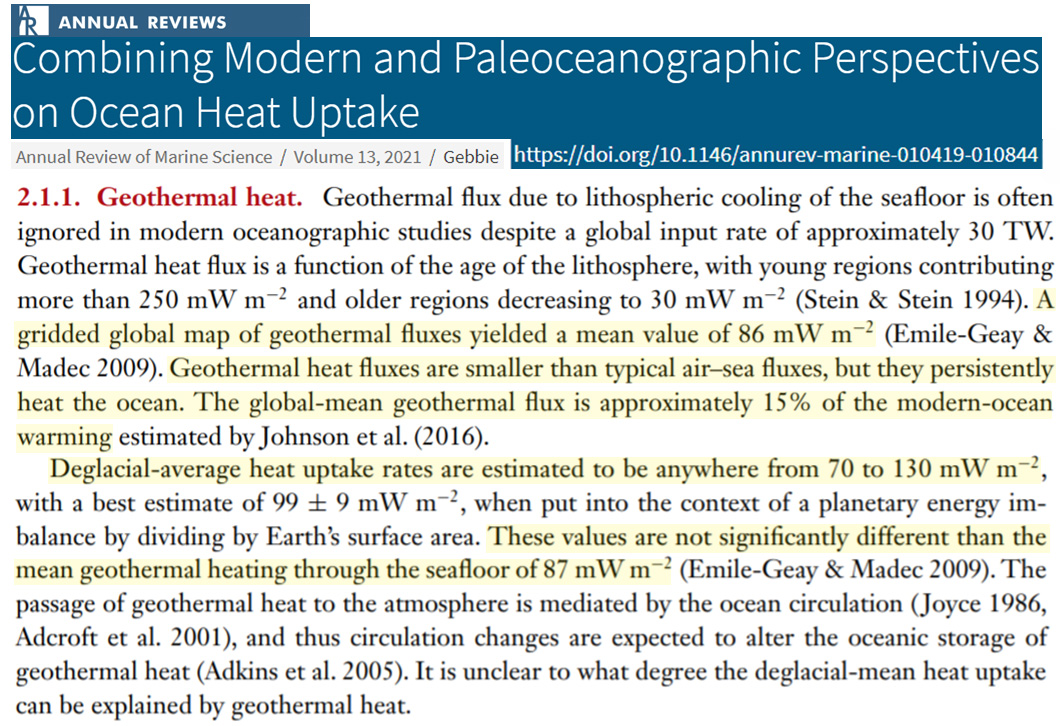
It may be important to note that approximately 15-20% of current global warming (0.095 W/m² of the 0.48 W/m² heating rate) can be attributed to geothermal heat fluxes through the sea floor that “persistently heat the ocean” (Gebbie, et al., 2021). The value attained for geothermal heating of the ocean, 87 mW/m², is similar to that which is required to end a glacial period (melt ice sheets) and transition into an interglacial. In other words, a bottom-up ocean-warming mechanism is ongoing.
Images Source: Gebbie, 2021
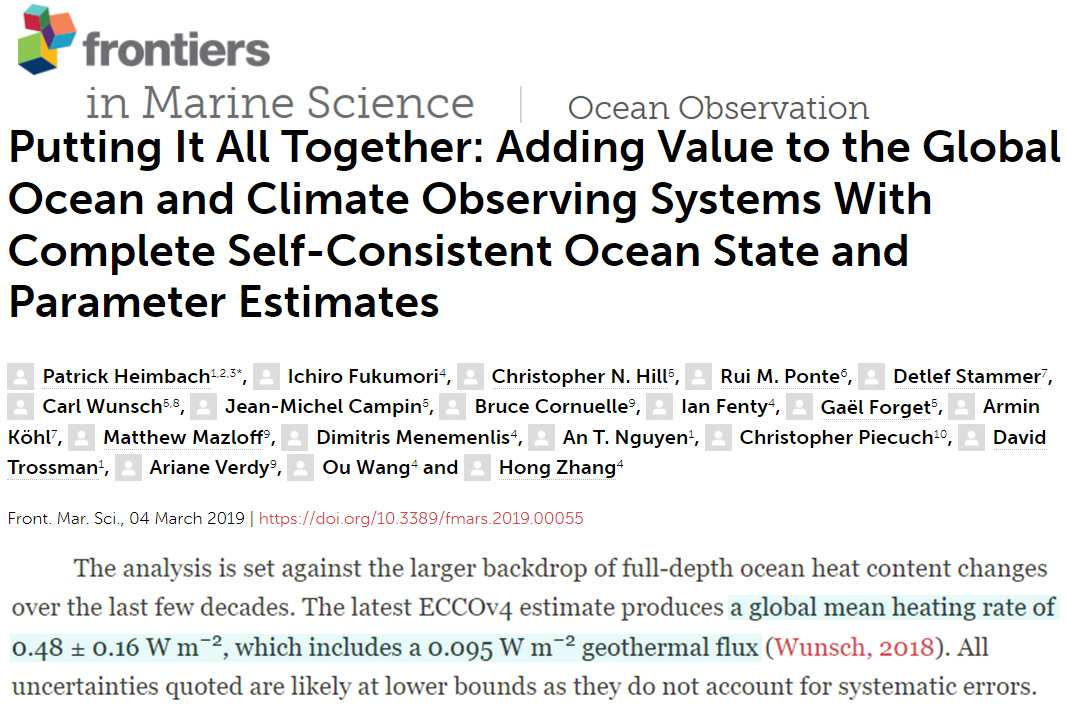
Image Source: Heimbach et al., 2019

A magmatic ocean-warming mechanism driving glacial-interglacial transitions is supported by the conclusion that the ocean bottom waters warmed 2°C from 19,000 to 17,000 years ago. This is about 1000 years before the surface warmed and CO2 began rising (Stott et al., 2007), So, consistent with the conclusions of the new Dr. Frank study, geothermal heat fluxes can thus potentially explain a large portion of glacial-interglacial transitions – as well as millennial-scale global ocean temperature changes.
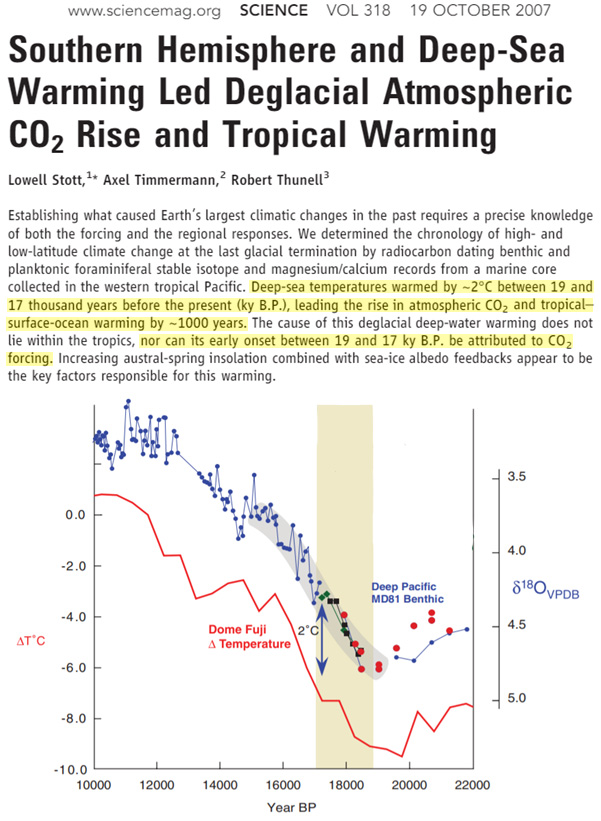
Image Source: Stott et al., 2007

via NoTricksZone

https://ift.tt/J7HVX6f

September 5, 2024 at 05:05PM

Hide those climate plans until after the election

Political lies. Hidden messages.

By Jo Nova

Life on Earth is about to collapse but the government may have to keep their 2035 emissions target a secret until after our next election. Shucks…

The government was supposed to release the “2035 update” by February next year. It was part of the sacred Paris Agreement that they pump up the NetZero promises every five years, which means by February 2025. But when The Australian newspaper asked if the government would keep that deadline, the spokeswoman pointedly did not say “Yes”.

When asked by The Australian if the government would stick to its February deadline, the spokeswoman said: “The Albanese government is working to bring down energy prices and emissions after a decade of delay, dysfunction and denial – but our progress is precarious.

— by Rosie Lewis, The Australian

Australia will, of course, be caught in the wake of the US Election with our election coming by May next year. It will be so much harder here to run on climate piety if Trump wins (beyond the margin of cheating). And the rise of skeptical parties in Europe is spooking campaign managers.

Suddenly climate activists don’t want climate on the agenda

In tandem, ‘o-so-conveniently, the chief climate propaganda unit simultaneously announced they might have to delay giving their “frank and fearless advice” until after the election too, proving they are not frank at all, and very afraid the voters will drive a pike through their climate balloon.

They all know the public won’t vote for the Labor Party if they reveal their extortionate plans. The only way for the blob to get what they want is to hide it. They are just copying “the Team-Kamala Plan”. (Don’t mention the Climate.) In the US, Kamala is saying nothing about the climate, and the Greens fully endorse her silence. The only way to solve that paradox is to assume deceit and trickery is part of the plan.

For the same reason, The Climate Change Authority (CCA) (the Australian propaganda unit) also realize that if they lay out the path to Net Zero by 2050 before the election, the Prime Minister will be put on the spot, and forced to deny or admit the points on the list, and they don’t want that. He might have to agree to let Australians buy the car they want, eat whatever they like, and even install gas stoves.  That won’t stop him doing those things after the election, but it will make it more embarrassing. It’s harder to win the subsequent election if the opposition can play an annoying reel of him saying  “there will be no carbon tax under the government I lead” and that sort of thing. It’s so much better to lay low, then spring those horrible plans later, after a storm or a flood.

Look at the vapid excuses the Climate Change Authority make for  delaying the “advice”:

CCA chair Matt Kean, who was hand-picked by Mr Bowen [The Minister], said the release of the advice wouldn’t be “dictated by domestic political timetables”, leaving open the possibility of it coming after the federal election.

In other words, it is absolutely being dictated by domestic political timetables.

“The Climate Change Authority’s role is to provide independent, frank and fearless advice to the parliament and to the government of the day, irrespective of political colour,” Mr Kean, a former NSW Liberal treasurer, said.

“That advice needs to be informed by all of the facts and that’s why we will take our time to do the appropriate work to ensure the recommendations we make are as robust as possible.”

— by Rosie Lewis, The Australian

Never in history did they wait for “all the facts” before telling everyone what to do. Aren’t we in a desperate race to stave off extinction? Nevermind

The only voters who want NetZero targets are the billionaires who invest in unreliable power

There are no school-girls screaming for climate action any more, just investors:

As the Climate Change Authority prepares to release a review into what actions key sectors could take to reach net zero by 2050, Investor Group on Climate Change policy managing director Erwin Jackson said businesses needed stability.

“Investors are looking for all governments to announce strong 2035 climate targets well before the COP in Brazil at the end of next year,” he said.

“Failing to act on climate change will make the job of Australian farmers, businesses, communities and investors even harder as they face more extreme weather events and an increasingly volatile future.”

When they say “businesses need stability” they really mean “businesses need subsidies”.

0 out of 10 based on 0 rating

via JoNova

https://ift.tt/DZv4dps

September 5, 2024 at 04:27PM

Degrowth: The Final Solution

From MasterResource

By Robert Bradley Jr.

“Degrowth is about government authoritarianism overriding the natural human impulse to improve. Marcus Feldthus of the Copenhagen Business School needs to reeducate himself about ends and means to at least be able to inform his students about the happy side of life and living.”

No-growth (stagnation) is bad enough. In business, every promotion must be balanced by a demotion or retirement. For one person to buy more, another person must buy less. Charity not, the zero sum game is a recipe for low morale and infighting, just of the opposite of charity through abundance.

Take another step backward to a negative sum game. More losers than winners. The survival of the fittest. Glum is the word as rising expectations is replaced by despair.

Less is not more but less. Less convenience, less leisure, less security, and less philanthropy toward others. And with incentives stymied, the desperadoes look to government to intervene at the expense of others. French economist and classical liberal Frédéric Bastiat (1801-1850) wrote in 1848:

… it is a well-established fact that the state cannot procure satisfaction for some without adding to the labor of others…. The state is the great fictitious entity by which everyone seeks to live at the expense of everyone else.

What needs “degrowth” is government, not the market, a subject for another time.

“Planetary Boundaries”

What is the latest thinking and pitch from the degrowth movement? This social media post from Marcus Feldthus, whose self-described mission is to “build a post growth business in the pursuit of sustainability,” provides an update. His website advertises an online course, “Aligning Business with Planetary Boundaries,” based on four precepts (verbatim):

  1. Why green growth fails to deliver results fast enough and sufficiently.
  2. How the inequality and ecological crises are connected.
  3. Cases of companies that get sustainability right and wrong.
  4. How to start implementing post growth thinking in a business.

He urges his students to “start a conversation about the assumptions in your company.”

No-growth, de-growth …. Ouch! Calling Julian Simon!

Feldthus continues on the environmental front (reproduced verbatim):

  1. Assuming you can decouple carbon emissions from economic growth sufficiently to live up to the Paris Agreement (no evidence of that happening)
  2.  Assuming some new technology will magically appear and solve point 1 (techno-optimism ignores that hope is not a strategy)
  3.  Assuming climate change is the only problem (when there are 8 other planetary boundaries)
  4.  Assuming stable prices on energy and materials (when energy expenditures are increasing)
  5.  Assuming that increases in energy efficiencies lead to absolute energy and material reductions in a growth-based system (the money you save, you use to grow the output, to make more money, which cancels out the initial savings – also known as The Rebound Effect)
  6.  Assuming that you can recycle your way out of the ecological crisis (the 2nd law of thermodynamics explains why that is not possible)
  7.  Assuming that services have no, or an insignificant, ecological footprint (services cannot entirely replace the material sector)

Marcus Feldthus sees hope and momentum:

Degrowth is breaking into the mainstream. Covered by: UN, Harvard Business Review, NY Times, Ernst & Young, BBC, and Bloomberg Festival. As something to be explored, not ridiculed. Here is a quote from each 👇

Bloomberg Festival: Ted Talk by Gaya Herrington

“Our choice is not whether to keep growing or not. But whether the end of growth is coming by design or disaster. Either we choose limits or have them forced upon us.”

Harvard Business Review: In Defense of Degrowth

“The core of the degrowth argument is the historical fact that economic growth and emissions are inexorably connected (…) To be realistic about the fundamental challenges of growth, we must adjust our cultural assumptions and reconfigure unsustainable business models.”

UN Rapporteur, Olivier De Schutter: Eradicating poverty beyond growth

“The transition to a post-growth development trajectory, focused on the realization of human rights rather than on an increase in the aggregate levels of production and consumption, should be explicitly mentioned in A Pact for the Future”.

New York Times: Shrink the Economy, Save the World?

“Less than two decades ago, an economist like Herman Daly, who argued for a “steady-state economy,” was such an outlier that his fellow economist Benjamin Friedman could declare that “practically nobody opposes economic growth per se.” Yet today there is a burgeoning “post-growth” and “degrowth” movement doing exactly that — in journals, on podcasts, at conferences.”

Ernst & Young: A new economy

“Seemingly organized under many different frameworks (e.g., Doughnut Economics, Beyond GDP, ecological economics, degrowth and regenerative economics), these concepts share the common vision of an economy founded on human and planetary flourishing. We suggest they also point to five guiding principles foundational to accelerating the transition toward this goal.”

BBC: Less is more: Can Degrowth Save The World? by Alvaro Alvarez Ricciardelli

“A group of academics and activists are questioning the possibility of endless economic growth on a finite planet. They instead advocate for a bold solution: degrowth.”

And, if you want to understand what this shift means for businesses, I just launched a beginner’s guide on it. It’s called Post Growth Business 101. 📌 Get it here: https://lnkd.in/ePFW-j5a

Final Comment

Degrowth is the final solution against modernity. It is an anti-human philosophy of stagnation and decline based on the belief that there are too many people. Remember Paul Ehrlich?

Degrowth is a fringe movement within Deep Ecology. It sanctions deindustrialization and thus welcomes high energy prices and energy rationing, even blackouts.

Degrowth is about government authoritarianism overriding the natural human impulse to improve. It lurks in high places and must be exposed for what it is. Marcus Feldthus of the Copenhagen Business School needs to reeducate himself about ends and means to at least be able to inform his students about the happy side of life and living.

via Watts Up With That?

https://ift.tt/x3s8wHQ

September 5, 2024 at 04:03PM

12 years of Polar Bear Science winding down as I transition to writing Biology Bites on Substack

While I’m not done with polar bears completely, it seems I’ve been so successful at informing the public and defanging the rabid activists that fewer examples of nonsense seem to pop up. And it turns out I have other things I’d like to write about.

I’ve spent my entire career as an unconventional scientist and I’m betting that many of the stories I’ve amassed along the way will be of interest to a wider audience. So, after 12 years of blogging here at PolarBearScience, I’m branching out with a new writing forum called “Biology Bites,” hosted on Substack.

Biology Bites is an amalgam of stories about my unique career in evolutionary biology, some of the fascinating things I’ve learned or discovered along the way, and some of the on-going issues that still grab my attention.

I’m hoping that at least some of my readers will choose to become paid subscribers at a cost of US$5 per month, which is probably the price of a cappuccino most places and is the lowest price Substack allows.

Only subscribers get to comment and I look forward to being able to interact with readers in a way I haven’t been able to do here. Subscribers also have exclusive access to audio podcasts, so if you prefer to listen to long essays rather than read them, you may find it worth the price of a subscription.

There’s also an option to make a single or recurring donation of an amount you can afford, if the price of a monthly subscription is too daunting. I have the option of “gifting” a subscription to those who donate.

Head over and check it out. I’ve got a few posts up already and you don’t have to subscribe to access most of the content. If you sign up, even as a free subscriber, each new post will arrive as an email.

And just for fun, below is a summary of activity at PolarBearScience from late July 2012 to early September 2024.

Note that December 2017 (the very dark blue square) was when National Geographic released their video of an emaciated polar bear it claimed was “what climate change looks like” but also just days after the Harvey et al. BioScience paper attacking my scientific integrity was released in late November. Both topics got a lot of media attention and brought tons of traffic to this blog. In part, these events prompted the writing of my hugely popular 2019 book, The Polar Bear Catastrophe That Never Happened.

April 2019 (the medium-dark blue square) was when media promoted the David Attenborough/Netflix documentary episode that blamed climate change for hundreds of walrus falling off a cliff to their deaths, which I called “tragedy porn” and “contrived nonsense.” Again, the media storm brought a lot of traffic here. I was able to show readers that this Netflix claim was a deliberate lie and wrote a book with all the receipts. Fallen Icon: Sir David Attenborough and the Walrus Deception also discussed in detail the 2017 National Geographic starving polar bear incident mentioned above, since both used emotionally-shocking imagery in an effort to gain public support, only to have it backfire bigtime.

I’ve done some good work here and will keep this blog going as an important internet archive. I will likely add to it from time to time as issues arise.

But I think the time has come to do the same elsewhere for other topics that interest me.

Wish me luck. I hope to see some of you over at Biology Bites.

via polarbearscience

https://ift.tt/l3Ayh8j

September 5, 2024 at 03:57PM