Month: September 2024

Iver Water Works DCNN 4590 – An emerging pattern of selected and unsatisfactory locations.

51.51247 -0.496131 Met Office Assessed CIMO Class 4(S) & UNSATISFACTORY Installed 28/6/2016

In researching this station I discovered a seriously concerning pattern of new Met Office sites – New Site locations are NOT conforming to an even geographic spread. They are clustering in specific areas likely to misrepresent area and national climate recording.

This is a long post so firstly,

Iver Water Works weather station was installed only 8 years ago. From the start it was a poor site in the very unnatural surroundings of a water treatment works. Close to the perimeter fencing it was assessed CIMO Class 4(S) with the “S” indicating suffering from “shading” effects. This shading is almost certainly caused by the electricity pylons carrying SSE’s Iver- Longford 132kV distribution line or the separate National Grid Iver – Laleham 275kV Transmission line. Map courtesy of Open Infrastructure.

{The potential effects of such high voltage transmission lines in close proximity to modern meteorological observation technology will be the subject of a future post. Should anyone have specific information on this subject please pop details in the comments below.}

The CIMO guide specifically states “Ground covered with natural and low vegetation (< 25 cm) representative of the region” In what way does the image below indicate “natural and low vegetation”?

The Met Office now concede this site is officially “Unsatisfactory” for climate reporting purposes despite having only recently seen fit to install it and continuing to include its ongoing temperature readings in the historic record. From FOI request as at September 2024:-

Clearly the Iver Water Works site is below acceptable standards and its current readings should not be used for the historic temperature record.

It was seeing the above image that I suddenly realised the selective pattern of new site locations in the London area. The vehicles in the image are stored from Heathrow Airport. The Heathrow site weather station itself is very close by. Having previously considered each Met Office site in isolation and small area mapping, I opted to manually mark them on a larger area map.

The Met office states ” Stations are usually around 40 km apart, enabling us to record the weather associated with the typical low pressure and frontal systems that cross the UK.”

I took an area map of Greater London and drew a circle of 40km radius from the identified central point of the King Charles 1 statue at the top of The Mall close to Charing Cross. I then simply drew north/south, and east/west markers and went on to mark out a 12 hour clock face for reference points. Within this 40km radius are 14 currently operating Met Office weather stations supplying readings to the temperature record. Their geographic distribution is anything but even.

From midnight to 4 O’clock there is just High Beach (Class 5 and Unsatisfactory Installed 1978)

From 4 O’clock to 8 O’clock there is also just the one at Kenley Airfield (Class 4 and Satifactory installed 1988).

However, from 8 O’clock to just 10 O’clock there are……Eleven

  • St James’s Park – Class 5 and Unsatisfactory installed 1903.
  • Battersea Heliport – Class 5 and Unsatisfactory installed 2018
  • Teddington: Bushy Park – Class 4(S) and Satisfactory installed 2017
  • Wisley Class 4 and Excellent (installed 1904)
  • Chertsey Abbey Meads – Class 3 and Good installed 2017 (surrounded by solar panels)
  • Kew Gardens – Class 2 and Excellent installed 1910 at current site.
  • Heathrow – Class 3 and Good installed 1947
  • Cippenham Sewage Treatment Plant – Class 4(S) and Satisfactory installed 2017
  • Iver Water Treatment Works – Class 5 and Unsatisfactory installed 2016
  • RAF Northolt – Class 5 and Satisfactory installed 1947
  • Amersham Field Centre – Class 4 and satisfactory installed 2015 (adjacent a National grid substation.)

From 10 O’clock to Midnight there is again just Rothamsted (Class1 and Excellent, installed 1853)

I cannot see any meteorological reasoning behind such an ongoing and increasing concentration of sites in such a small sector from west-south-west to west-north- west London whilst almost completely ignoring nearly 80% of the capital. This trend is also seen in the “Missing Met stations” with sites at Hampton Water Works (closed 2019) Northwood (closed 2015) and Hampstead (closed 2016) still reporting “climate averages” for this sector.

Even more worrying is the poor quality of the sites with 10 from 14 being in Class 4/5 and 4 from 14 considered Unsatisfactory. In fact only Rothamsted on the northern periphery near Harpenden is Class 1.

So what has happened to any north, east and south London sites? Whilst sites such as Heathrow are absurdly rated as Class 3 (subject of later analysis) and seemingly must be retained however unrepresentative their readings may be, the likes of Greenwich Observatory are immediately expunged.

It seems imperative to the Met Office that the site below at Heathrow Airport is retained and others demonstrably even more compromised are added to it…..

But simultaneously the Met Office could seemingly not find a site anywhere below (Greenwich Park Observatory) to take readings so closed down the only acceptable long term site they had for a large area around.

I am not going to conjecture why such an unrepresentative selection of weather stations has come to exist nor why it is now becoming a worsening situation just yet, though I do have my own views. I would rather ask any readers to offer their views please.

via Tallbloke’s Talkshop

https://ift.tt/I3Xp1EK

September 26, 2024 at 03:11AM

Tally of U.S. wind & solar rejections hits 735

You won’t read much about this in major media outlets, but nearly every week, local communities across the US are rejecting or restricting solar and wind projects. The latest rejection occurred a few days ago in Center, Nebraska, when the Knox County Board of Supervisors voted 6 to 1 to deny a conditional-use permit for […]

via CFACT

https://ift.tt/Q9rvfnp

September 26, 2024 at 02:36AM

Germany’s Nuclear Power Rejection Delivers Wind & Solar Driven Energy Calamity

Germany’s wind and solar obsessed energy policy has delivered a perfect power pricing and supply calamity. Not only did their green tinged lunatics squander billions on chaotically intermittent wind and solar, they deliberately destroyed one of Europe’s best run nuclear power generation fleets, in the bargain.

Whenever calm, cloudy weather hits – aka ‘dunkelflaute’ – the Germans scramble to draw coal-fired power from Poland and nuclear power from France, in the absence of which the German grid would totally collapse on a routine basis. Apparently the German hard left that run the show have no qualms about using power from their neighbours’ ‘dirty’ coal-fired plants and ‘evil’ nuclear plants. Provided those generators don’t sit on German soil, then all is well in green lunatic land.

As the team from Jo Nova report below, had the Germans maintained their nuclear generation capacity they would have been a whole lot better off than they are now.

Renewable Fiasco: If Germany just kept nuclear power, it could have saved $600b and cut emissions by 73%
Jo Nova Blog
Jo Nova
4 September 2024

If the Germans just did nothing at all, it would have been Greener.

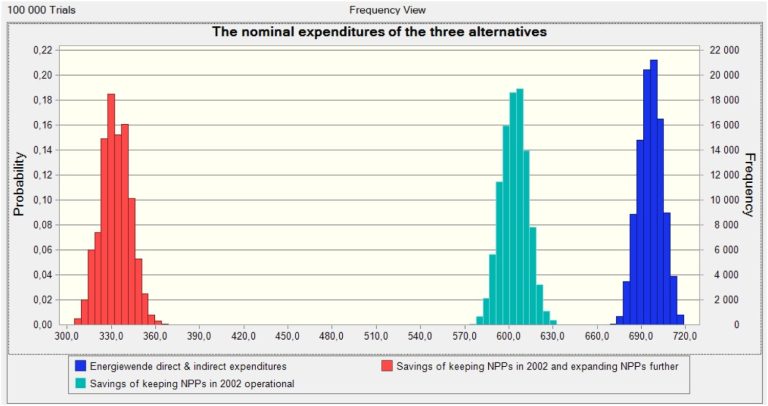
Germany already had nuclear power in 2002, if they just kept it and didn’t build all the wind and solar plants, they wouldn’t have had to spend 697 Billion Euro on subsidies, and would have cut their emissions by 73% more.

If ever there is a statistic that says there is something rotten in the State of Climate Panic, this is surely it. I mean, does CO2 matter or doesn’t it? Do the Greens care at all, or even a bit? If there was a climate emergency and The Greens were worried about CO2, they might have protested that the EnergieWende was a reckless experiment. But if the Greens were tools for communists, foreign states or banker-investors, then they might keep choosing options that benefit other countries, help Bankers or just make Big Government bigger.

Either the German Greens have utterly failed at the very task they set out to do, or they were really aiming at something else.

Ross Pomery writes at RealClearScience and  WattsUpWithThat

Study Quantifies Germany’s Disastrous Switch Away From Nuclear Power
At the dawn of the millennium, Germany launched an ambitious plan to transition to renewable energy. “Die Energiewende” initiated a massive expansion of solar and wind power, resulting in a commendable 25 percent reduction in carbon emissions by 2022…

In 2002, nuclear power supplied about a fifth of Germany’s electricity. Twenty-one years later, it supplied none. A layperson might think that cheap wind and solar could simply fill the gap, but it isn’t so simple.

Jan Emblemsvåg, a Professor of Civil Engineering at Norway’s NTNU just published a study comparing the ambitious German Energiewende renewable program with nuclear power:

“what if Germany had spent their money on nuclear power and not followed their policy from 2002 through 2022 (20 years); would Germany have achieved more emission reductions and lower expenses?”

Even German bureaucrats admit Energiewende “poses a threat to the German economy”:

German Federal Accounting Office (Bundesrechnungshof) writes about the German policy dubbed ‘Die Energiewende’ in German, and it concludes: ‘The Bundesrechnungshof warns that the energy transition in its current form poses a threat to the German economy and overburdens the financial capacity of electricity-consuming companies and households’ (Bundesrechnungshof Citation2021a).

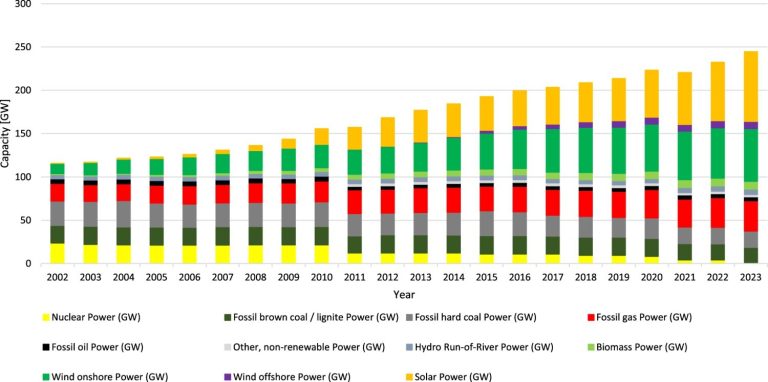
A whole lot of wind (green) and solar (orange) power were added to the German grid and it was worse than useless:

Given these results, there can be no doubt whatsoever that if Germany had invested in NPPs [Nuclear Power Plants] instead of VREs [Variable Renewable Energy], Germany would have decarbonised more with far less nominal expenditures. The short conclusion is that Germany would have reached its climate goals with a substantial margin at half the expenditures of Energiewende.

The Germans have done this experiment so we don’t have to
Just burn that money in a pyre to the Weather Gods:

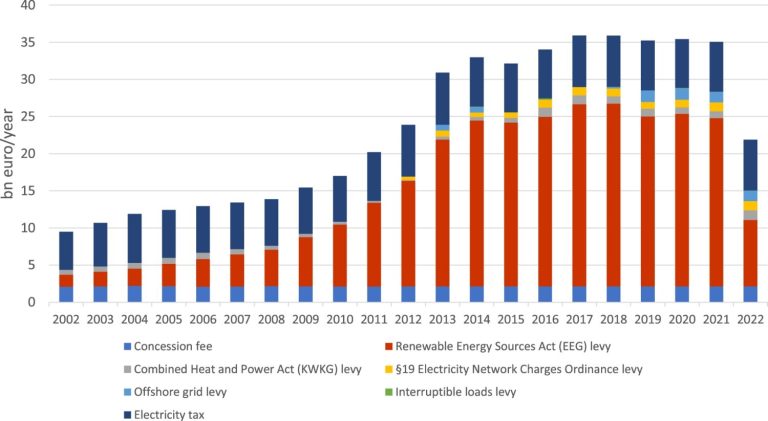
German expenses for renewable energy
https://www.tandfonline.com/doi/full/10.1080/14786451.2024.2355642#d1e128

These costs do not include the added burden of expensive electricity on businesses and homes, the opportunity costs of money that could have been spent elsewhere, or the loss of talent, brains and industry to other countries.

Building new nuclear plants was still cheaper than wind and solar
The paper goes through another scenario where more nuclear plants were built with careful estimations of the costs and long times to construct plants and still concludes that the Germans would have saved $330 billion euro.

What if Germany had built nuclear plants instead of wind and solar ones?
https://www.tandfonline.com/doi/full/10.1080/14786451.2024.2355642#d1e128

Not coincidentally, in 2024 Germany has some of the most expensive electricity in Europe, business confidence is low, and  VW have just announced that after 87 years in production, they might have to close their German factories.

Volkswagen, which was founded in 1937, said on Monday that it could no longer rule out unprecedented plant closures in Germany as it seeks ways to save several billion euros.

Chief executive Oliver Blume said: “The economic environment has become even tougher and new players are pushing into Europe. Germany as a business location is falling further behind in terms of competitiveness.”

Volkswagen employs around 650,000 workers globally, almost 300,000 of whom are in Germany, and the threat of factory closures sparked an immediate fierce backlash …

REFERENCE
Emblemsvåg, J. (2024). What if Germany had invested in nuclear power? A comparison between the German energy policy the last 20 years and an alternative policy of investing in nuclear power. International Journal of Sustainable Energy, 43(1). https://doi.org/10.1080/14786451.2024.2355642
Jo Nova Blog

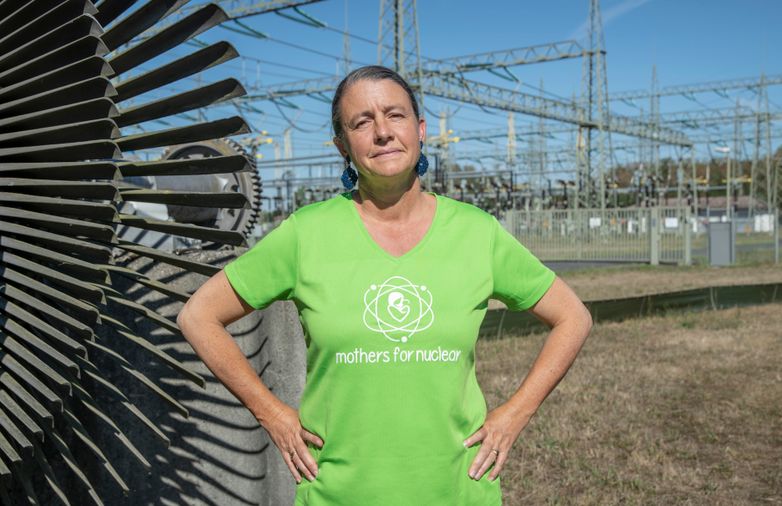
German mothers get it.

via STOP THESE THINGS

https://ift.tt/4PiOlBC

September 26, 2024 at 02:34AM

THE DANGER OF IMPORTED BATTERIES BEING USED AS WEAPONS

The danger of rechargeable batteries has been highlighted by the Israeli military using pagers as small bombs to kill or injure members of Hezbollah. It could be a serious concern as the following linked article explains: 

 What if a foreign hacker could turn home batteries into “pager-bombs” but 7,500 times bigger? « JoNova (joannenova.com.au)

via climate science

https://ift.tt/SxQUtPj

September 26, 2024 at 01:34AM