Month: September 2024

Wrong, Time, Climate Change Did Not Cause Flooding in Europe

From ClimateREALISM

By Linnea Lueken

1024px-2024_Most_przy_ul._Matejki_w_Klodzku_powodz_1.
Jacek Halicki, CC BY-SA 4.0 , via Wikimedia Commons

Time magazine recently posted an article, titled “Is Climate Change Causing the Deadly Floods in Europe?” that, while providing some balance, still asserts that the recent flooding in Poland and other parts of Europe reflects a broader worsening pattern caused by climate change. This is false. There is no indication in the data showing a “pattern” of increasing flood severity or incidence.

Time admits that it’s “difficult to draw a conclusive link between this event and climate change,” but then says “experts say the most severe floods to hit the region in at least two decades fit into a broader pattern of extreme weather events.”

Later, Time quotes a professor from the University of Bristol who recommends attribution studies to determine whether or not the flooding is caused by climate change:

“It’s really difficult to relate a single event to climate change impact,” says Paul Bates, a professor of hydrology at the University of Bristol who specializes in the science of flooding. Bates says that in order to definitively prove whether or not climate change contributed to the flooding in Europe, researchers will need to conduct an attribution study, which takes at least several weeks. “Every time we do an attribution study, we tend to find that the events we see have been exacerbated by climate change, and I’m pretty sure that will be the case here, but we don’t yet conclusively know,” says Bates.

Several weeks for a peer reviewed study, that would be amazingly rapid.

As Climate Realism has pointed out before many times, attribution studies are over-trusted by the media and scientists, and are often used more like propaganda than science. Attribution studies compare unverified, counterfactual models of the Earth’s climate and emissions, assuming ahead of time that any difference between the models is due to human-caused carbon dioxide emissions. Neither model represents the world as it really is, and the modelers assume the conclusion before it is reached, using the models only to confirm their preexisting belief. As a result, the models never discover anything other than a human influence on weather events, and almost invariably suggest that human activities likely contributed to each event studied.

While it is true that warmer air holds more water, that does not translate directly to an increase in intense rainfall. Also, warming does not occur consistently even within a nation’s own borders, with some places (like cities) seeing more warming than the countryside, which in some places can even see cooling trends. Global average warming does not cause regional storms.

The Intergovernmental Panel on Climate Change’s 6th Assessment Report indicates that there is no sign yet of any increase in heavy precipitation and pluvial (flash or rain-caused) flooding. And only under the most extreme, unrealistic scenario does the IPCC speculate with medium confidence that climate change might impact flooding after 2050. (See figure below)

Figure 1 – Table 12.12 | on Page 90 – Chapter 12 of the UN IPCC Sixth Assessment Report. Emergence of Climate Impact Drivers (CIDs)

The European flood discussed in the article was not unprecedented. The Danube River, which carried much of the flooding in Europe this year, had an even worse flood in 1997. Similar floods devastated Budapest in 1838, Vienna has always fought with the Danube, and there are many other longstanding historical records of major floods throughout history in the region.

Cities that invested in flood management fared better in the recent event than those that didn’t –this would be the case whether or not climate change was a factor in flooding trends. Overall, Time’s post isn’t that terrible, it is careful to not make any statements that are too certain when it comes to the climate connection. However, it is a mistake to suggest that there is an existing pattern of worsening severe weather like flooding caused by climate change when available data shows no changing trends.

via Watts Up With That?

https://ift.tt/mpKEbLz

September 24, 2024 at 08:06AM

The boiler tax is just the start of Labour’s energy catastrophe

By Paul Homewood


 image

We already know that there will be a steep rise in capital gains tax in the horror Budget that is planned for next month.

We may well see fresh levies on landlords, increases in inheritance taxes, a raid on pension funds and perhaps an increase in the employer’s rate of National Insurance. And yet, on top of all that, the Government has another charge in store for us that it conveniently forgot to mention during the election campaign.

The boiler tax is back.

Not only is it idiotic to revive a policy that was scrapped because it didn’t work, it is just a foretaste of what is to come over the next five years. The Government is planning an ideologically driven energy policy that will plunge the economy into crisis.

It will be the unlikeliest return since the Spice Girls said they were getting back together. Most of us probably assumed that the boiler tax was dead and buried when, in a rare moment of common sense, the Sunak government decided to scrap it.

The scheme set a strict quota for a percentage of all new heating systems that had to be powered by heat pumps instead of conventional boilers, with fines for any installers who didn’t meet the target.

Given that no one was buying expensive and unreliable pumps – surprise, surprise – installers were left with no choice but to pay the fine and pass on the cost in the form of a surcharge on any customer who needed a new piece of kit.

It was, in effect, a boiler tax. And now Ed Miliband, the Energy Secretary, has decided to reimpose it from next year. If your heating packs up over the winter, prepare to pay extra to get it fixed. And pensioners already worried about losing the winter fuel allowance will have even more reason to fear freezing over January and February.

The trouble is, there are two big problems with bringing the boiler tax back.

First, it was scrapped for a very simple reason. It was completely bonkers. No one was buying heat pumps because they are poorly suited for the UK’s elderly housing stock, and it is not fair to punish the installers for not selling enough of a product that people don’t want.

Even if you did want to impose a levy on traditional heating systems, then it hardly made any sense to impose it only on people who purchase a new one, not least because it encourages people to keep running old, inefficient systems for as long as possible (we will have a similar issue with quotas for electric cars, in the unlikely event anyone in government cares about rational arguments).

It would be better to simply impose an extra charge on all heating systems. The decision to reimpose it tells us something about the green commissars now in charge of the UK’s energy policy. They don’t care about practicalities, or what works. They only care about the target.

Next, and more importantly, it is a terrifying glimpse into how energy policy will develop over the next five years.

The Government is pressing ahead with forcing everyone to install a smart meter despite complaints from the consumer champion Martin Lewis last week that 19pc of them don’t work. A failure rate that would be unacceptable in a toaster or a washing machine, and lethal in a car, is somehow completely fine because it is a “green” product.

Billions are about to be spent on GB Energy, even though no one seems to have the faintest idea what it will actually do apart from hiring the inevitable diversity officers. The oil and gas industry in the North Sea is being killed off, by windfall taxes, by refusing to fight legal actions by green activists, and by refusing any more development licences.

The countryside is about to be carpeted with windmills even if there is not enough storage capacity to make them effective, and there is precious little sign of either the large or small nuclear reactors that might actually make a difference getting built.

To cap it all, we will soon have waiting lists for the sale of new cars and vans, because there are quotas and fines for manufacturers to force us all to buy electric vehicles. The list goes on and on. We are only three months into the Starmer administration, and already energy policy has abandoned any contact with reality.

And yet the blunt truth is this: no economy can prosper without reliable, cheap power. According to a report from Sam Bowman and Ben Southwood only last week, British industrial energy costs are 74pc higher than in the United States, and 32pc higher than in France.

Much the same is true in the heavily regulated consumer market. We are placing a crippling burden on companies that makes it impossible for them to compete in global markets even compared to our European neighbours. And we are placing huge extra costs on households at precisely the same time as they are getting hammered by rising taxes and wages are stagnating once again.

Everyone agrees – well, almost everyone – that transitioning to a low-carbon economy is an important policy goal, and one that should be achievable as technology advances so long as we don’t try and set a global example.

But the boiler tax was a bad policy, poorly designed, and has already been shown not to work. It was quite rightly scrapped. By reviving it, Miliband and the team around him have demonstrated that they will be driven by a series of bizarre, ideologically inspired targets that don’t make any sense to anyone.

The boiler tax is just the start – it will get far, far worse over the next five years.

via NOT A LOT OF PEOPLE KNOW THAT

https://ift.tt/cW4Uw0O

September 24, 2024 at 06:32AM

St. James’s Park London WMO 03770 – Officially Unsatisfactory and Unrealistic conclusions.

51.50494 -0.13096 Met Office Assessed CIMO Class 5 and UNSATISFACTORY Installed 1/1/1903

London ranks as one of the world’s largest and most intense Urban Heat Islands (UHI).

“London’s urban centre has the joint-fourth most extreme urban heat island (UHI) “hot spot” of six major cities around the world, with temperatures 4.5°C hotter than rural surroundings, according to new research by global sustainable development consultancy, Arup.”

https://www.arup.com/news/londons-most-extreme-urban-heat-island-hot-spot-compared-to-five-other-global-cities-in-new-survey/

Urban heat is not some rarely understood scientific principle, it is common knowledge – a phenomenon that is experienced by almost everyone at some time. This additional urban heat is even a regular feature of popular music lyrics such as “hot now, summer in the city….” by the “Lovin’ Spoonful” .

500 years ago the population of the Greater London metropolitan area was estimated to be under 50,000 whilst now it stands at almost 15 million – a growth worth noting for later context.

The “centre” of London from where distances to/from London are calculated is generally regarded as the King Charles 1 statue at the head of The Mall just a short walk from Charing Cross Station. The St James’s Park weather station is an even shorter walk away from this “centre” of London

The Met Office asses the site as the lowest possible standard of CIMO Class 5 with a noted inaccuracy by siting of up to 5°C……but then again, given Arup’s above assessment of London UHI effects and most people’s common knowledge, it could not reasonably be assessed otherwise. The Met Office have also published data (following Freedom of Information request) showing the assessment of the site by their own unique standards as being their lowest possible category of UNSATISFACTORY as of September 2024.

Just in case the headline image does not tell you everything you really need to know about this site, here is an aerial image.

A wider angle view locates the site at the extreme edge of the park alongside the dense urban area.

There is no real site security and I personally have seen a traffic cone with a half drunk pint of lager balanced above on top of the Screen. In hot sunny weather, sun bathers, office workers and the general public flock to the park and cover most of the grass. As can be seen above, service/supply vehicles are frequently parked around the area. To suggest this is a reliable site for supplying accurate readings of the natural countrywide environment for the historic climate record is somewhat difficult to accept. However this site is regularly highlighted as the regional or national high on the Met Office’s daily extremes listings nonetheless.

In the July 2022 hot weather event the Met Office claimed this site recorded the National 2nd highest temperature ever of 40.2°C only pipped by 0.1°C by RAF Coningsby with the latter’s own extraneous influences – the subject of a future review. Unquestionably the instrumentation at St James’s Park will have accurately recorded the unique site conditions at that time but clearly the Met Office overlooked Arup’s above report (and their own physical senses) about the likelihood of the UHI effect artificially enhancing temperatures by up to 4.5°C. They subsequently conjectured these high temperatures were a flavour of things to come –

Met Office Chief Scientist Professor Stephen Belcher said: “In a climate unaffected by human influence, climate modelling shows that it is virtually impossible for temperatures in the UK to reach 40°C.”

Obviously the UHI climate in St James’s Park central London is definitely a result of “human influence” (about 15 million human influences ) so Professor Stephen Belcher is not making any inappropriate comment regarding specific weather station locations. I suspect, though, that he was suggesting causes other than the blatantly obvious real ones for the elevated temperatures in specific sites.

World Weather Attribution a so called “think tank” organisation based at Imperial College London (another short walk away from St James Park) analysed 3 specific Met Office sites in relation to this same 2022 weather event. They concluded

“At three individual stations the 1-day maximum temperatures are as rare as 1 in 500 years in St James Park in London, about 1 in 1000 years in Durham and only expected on average once in 1500 years in today’s climate in Cranwell, Lincolnshire. “ *

Again WWA seemed conveniently to not recognise Arup’s detailed assessment of the London UHI which as I referred to above has been caused by the increase in population of just 50,000 to 15,000,000 over WWA’s highlighted 500 year period. The issue of the site recording device’s location also being rated Unsatisfactory and failing to meet any defined WMO acceptable standards also seemed to escape their consideration despite the site being so close by.

All the above further indicates that the Met Office is supplying unrepresentative data from many demonstrably poorly sited and thus inadequately accurate locations. This spurious data is then analysed beyond any reasonably realistic representation of its data quality leading to questionable conclusions. Professor Belcher’s and WWA’s computer “models” could be said to be experiencing “GIGO – Garbage in, Garbage out” This is not good scientific practise.

However, there is actually a much worse site used by the Met Office only a short distance away from St James Park to be shown in my next review of…….Battersea Heliport.

*Cranwell and Durham will be reviewed in the near future.

via Tallbloke’s Talkshop

https://ift.tt/mofaFTS

September 24, 2024 at 06:30AM

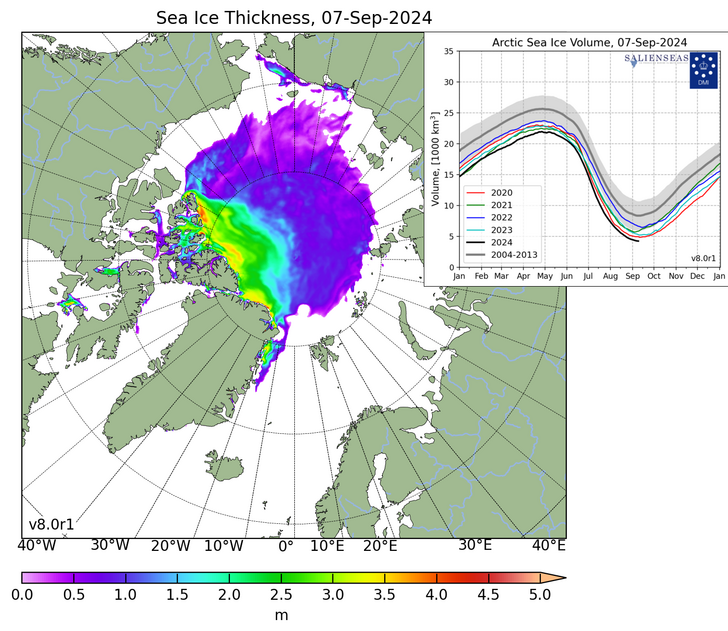
Arctic Ice Still There!

By Paul Homewood

Another summer ends, and yet again the Arctic sea ice refuses to melt away!

https://ocean.dmi.dk/arctic/icethickness/thk.uk.php

The ice extent hit the minimum on 7th September, with NSIDC showing 4.213 million sq km:

image

https://noaadata.apps.nsidc.org/NOAA/G02135/seaice_analysis/

Following the steady loss of ice between the 1990s and early 2000s, which culminated with a lot of ice loss through the Fram Strait in 2007, the ice extent has remained remarkably stable since.

I wonder when we’ll get apologies from all of those who predicted it would all be gone years ago?

image

image

image

image

image

image

https://notalotofpeopleknowthat.wordpress.com/2022/09/26/what-happened-to-the-ice-free-arctic/

via NOT A LOT OF PEOPLE KNOW THAT

https://ift.tt/vtqK3y2

September 24, 2024 at 06:22AM