Photovoltaic projects crumble in harsh alpine environments…Swiss solar panels on dam project fails after just 2 years.
Who cares if it works or not?
It’s often how the green racket works: Conjure up some green energy producing pie-in-the-sky project, no matter how unfeasible it may be, propose it to technically illiterate bureaucrats – who permit and fund it with little hesitation – build it, and, after realizing it won’t ever work, abandon it and let the next generation deal with the mess. In the meantime, you will have earned a tidy sum of money.
The latest likely example of such a project is “Axpo in Glarus Süd”, described at Blackout News here: “Solar panels at Muttsee dam fail after two years – solar plant not suitable for mountain use.”
It was heralded as a pioneering project and designed to last 20 years while providing green power (at least in the summertime) to nearly 3000 people. But, as Blackout News reports: “After just two years, considerable problems are already apparent. Of the 5,000 or so solar panels installed, around 270 are damaged, reports the newspaper Südostschweiz.”
A solar system in the harsh environment of the Swiss Alps? What could possibly go wrong?
Surely the builders and those approving the project had to have been familiar with extremely harsh winter conditions and massive snowfalls of the Swiss Alps, and that the system would never have a chance. Obviously no one cares much about reality anymore. The important thing, it seems, is to grab all that green cash and make a stash.
Panels damaged after just 2 years
Already, just 2 years in operation, 270 panels (5%) of the Muttsee project need to be replaced, and that at an exorbitant cost. Just check out the Axpo promotion video and take a look at the equipment needed to build the project. The helicopters, cranes, rigging and this caliber of personnel aren’t cheap.
Axpo promotion video: “Construction start of Switzerland’s largest solar facility.”
So far I haven’t found data on the project’s return on investment time.
Another embarrassing fact: “The full extent of the damage only became clear when the snow at 2500 meters above sea level had completely melted,” reports Blackout News.
No one became aware of the damage until spring had arrived?
Kite & Key explains in above video Why the Odds Are Stacked Against Net Zero. For those preferring to read I provide a text from the captions, though the video is entertaining along with great images, some of which are included with the text in italics with my bolds.
Overview
Are we at the beginning of the end of fossil fuels? That’s the theory advanced by an international coalition of politicians who aim to get us to net zero carbon emissions by the year 2050. Just one problem: Research from the experts in their own governments suggests it’s a nearly impossible task. Enthusiasts for net zero often say we’re on the cusp of an “energy revolution.”
And that theory has a big problem: Energy revolutions don’t happen — at least not in the way that politicians often describe. While it’s true that technological and economic factors sometimes change the energy mix — countries that get wealthier become less dependent on wood, for example — the broader trend in the history of the world’s energy consumption can be defined by three words: more, more, more.
In a power-hungry world, we keep adding new energy sources. But there’s rarely any subtraction. And, with global energy demand expected to increase by about 35% by 2050, it’s nearly impossible that we can get all the power we need from carbon-free sources. For instance, meeting the net zero goals would require the construction of over 9,000 nuclear plants by 2050. The number currently being built around the world? 59.
So, what will the future of energy really look like? Our video explores.
Transcription
It doesn’t happen that often. But every once in a while, a single generation witnesses a technological breakthrough that will change the world forever. The printing press. The beginning of human flight. And, for our generation, an inevitable full scale revolution in clean energy… …that’s running a little behind schedule… …Ok, way behind schedule.
“The beginning of the end of the fossil fuel era.” That’s how the United Nations referred to the outcome of a 2023 climate change summit held in…the United Arab Emirates. Which is sort of like having the Prohibition Conference in Vegas. Nevertheless, delegates from throughout the world left the gathering having pledged that the world would transition away from fossil fuels and get the world to net zero carbon emissions by the year 2050.
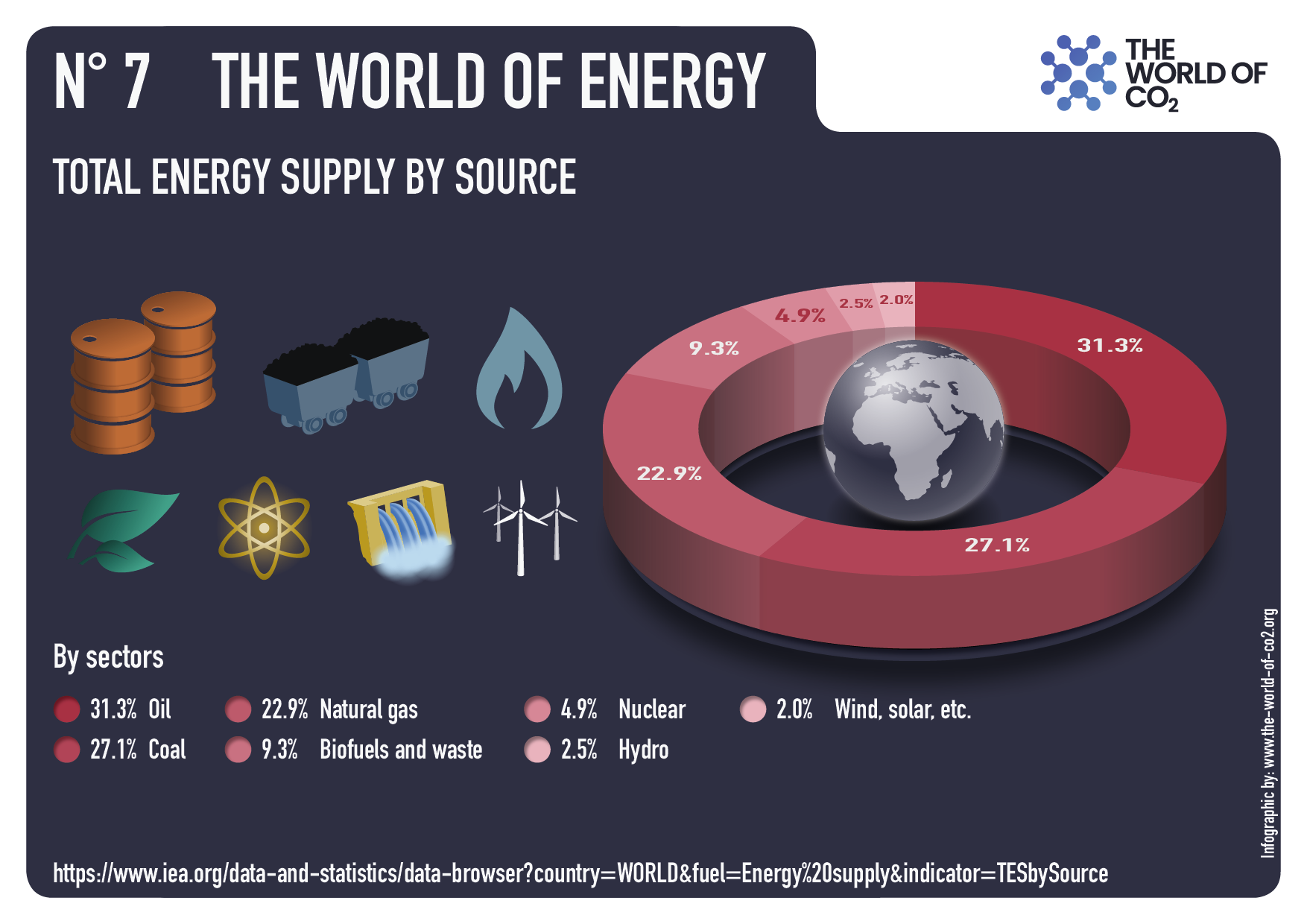
Now, the rationale for this is clear enough. Leaders from around the globe are worried that without a shift over to carbon-free energy sources like wind, solar, hydro, and nuclear the world will face significant problems as a result of climate change.
But, regardless of why they’re doing this, the more important question is whether they can do it. Because here’s the thing about energy revolutions: they don’t happen. At least not in the way that the UN is imagining. To understand why, it’s worth looking at the history of the world’s energy consumption – which looks like this.
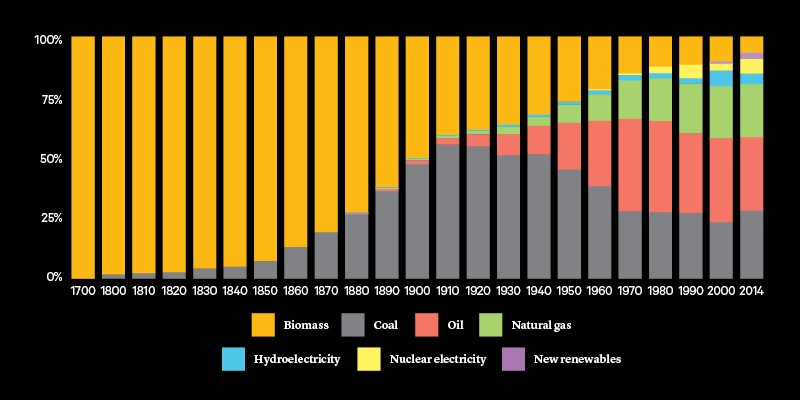
Go back a couple of centuries and the world basically ran on “traditional biomass”– -which is a fancy way of saying … wood. We burned a lot of wood and also … dung. Then in the mid 19th century, coal came into the picture in a big way. By the 20th century, we’re using tons of oil.And natural gas is a big factor too, especially as we cross into the 21st century, and fracking makes it both abundant and more affordable. As the years went by, we added low-carbon sources of energy as well, like nuclear, hydro, wind, and solar–though overall, they’re still a pretty small part of the picture.
Now, there are two important things to note about this chart. First, the history of the world’s energy consumption can be defined in three words: more, more, more. Which kind of makes sense. After all, pretty much everything that defines modern life involves a lot of energy. Between 1950 and 2022, for example, the population of the U.S. a little more than doubled. But in that same time period, our electricity use got 14 times larger.
And second, because of that “more and more, more” trend, the only things we’ve ever had that look like energy “revolutions” have been about adding new sources into the mix, not getting rid of existing ones as net zero goals propose.
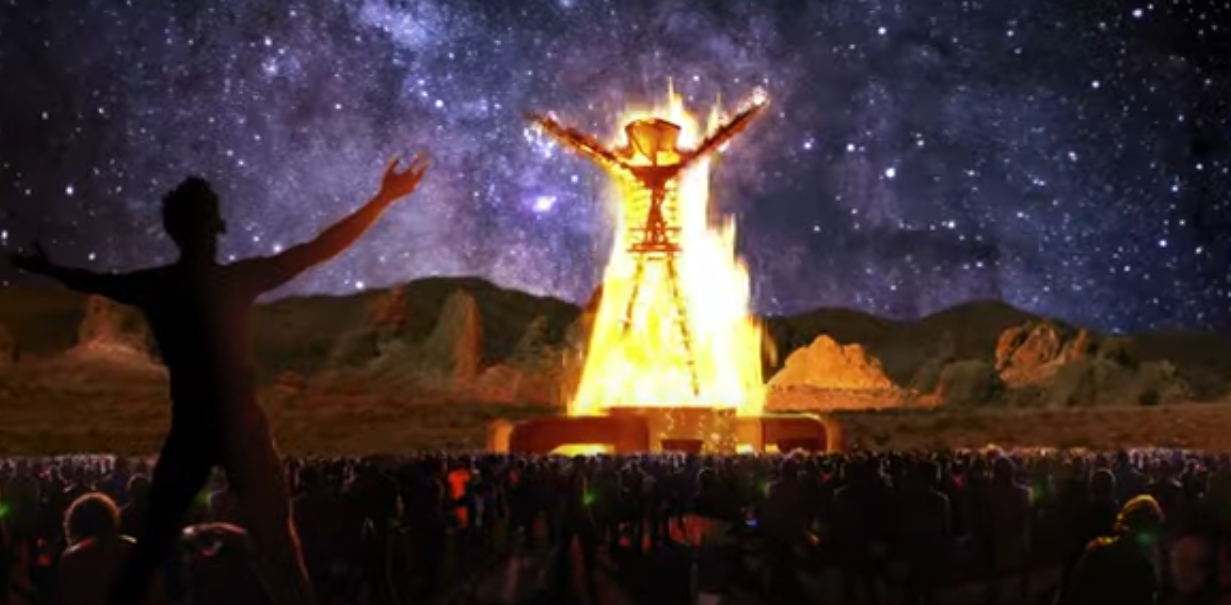
Now, to be clear, that doesn’t mean that nothing ever changes. In wealthier nations, the rise of cheaper natural gas has led to less coal usage, especially in the U.S. And poorer countries usually abandoned traditional biomass as they get wealthier, because no advanced nation powers itself by burning wood. We use it for much more sophisticated purposes…like doing psychedelics in the Nevada desert.
But using a little less coal or wood or relatively modest changes–and importantly are driven by cold, hard economic facts. By contrast, what the net zero goals entail is replacing all of this … with this … in just about 25 years. Based on little more than the fact that politicians just want it to happen.
To understand just how tall a task this is, it’s worth looking at what it would require to make it a reality. It’s estimated that meeting net zero goals would require deploying 2000 new wind turbines… …every day … for the next 25 years. To give you some context for that, the U.S. builds about 3000 new wind turbines… …a year.
Alternately, you could open one new nuclear plant every day for the next 25 years. For the record, that’s over 9,000 of them. And, also for the record, as of 2023, the number that were actually being built across the entire world was … 59. And here in the U.S. anyway, it generally takes over a decade to build them.
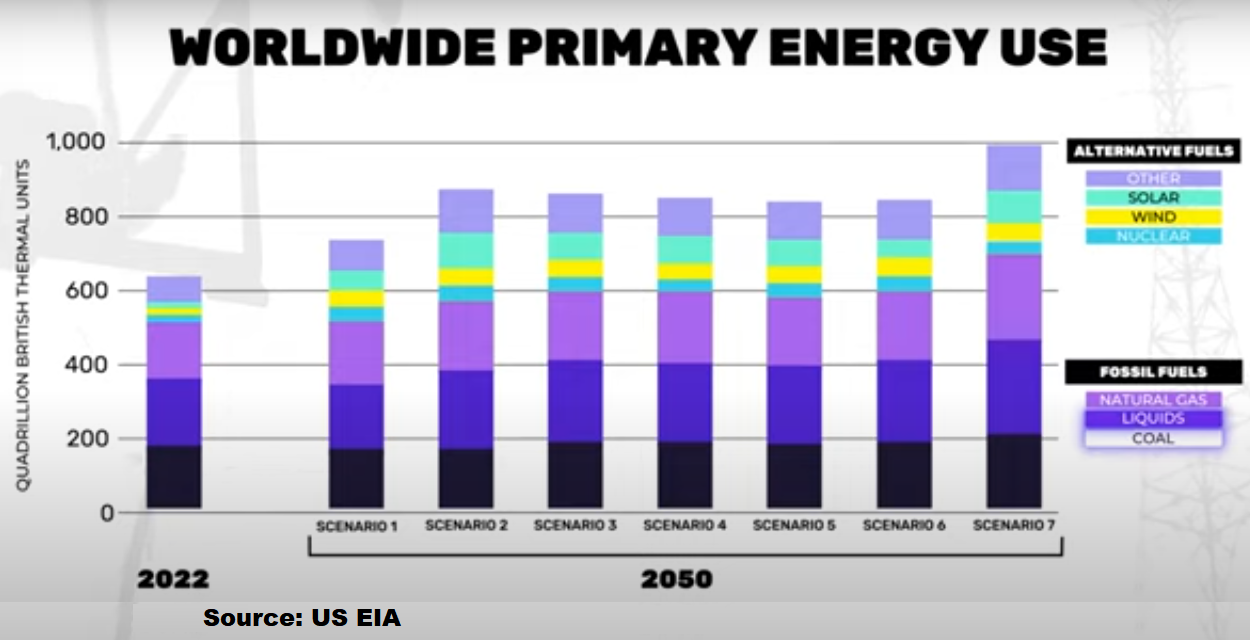
And those are some of the reasons why what politicians promise about net zero and what the experts in their own governments say…don’t exactly match up. The government’s U.S. Energy Information Administration, or EIA, projects that by the year 2050, far from seeing a revolution in energy, America will be a little less reliant on coal, a little more so on renewables…and the rest of the picture looks pretty much the same as today.
And in fact, this is true for the entire world. The EIA ran seven different scenarios for what the world’s energy consumption could look like in 2050, and while all of them showed a significant increase in renewables … they also all showed a world that continued to get most of its energy from things like coal, oil, and natural gas. Not exactly “the beginning of the end of the fossil fuel era.”
The reason for all of this: We simply can’t take enormous quantities of energy offline in a world where it’s predicted that we’re going to need almost 35% more of it by the year 2050. For one thing, there are a lot of poor countries around the world who are going to need dramatically more energy to bring themselves up to even a fraction of our standards of living.
And for another, the technologies of the future require vast amounts of power. By the year 2030, it’s estimated the computer usage around the world will take up as much as five times more of the world’s electricity production as it did even in 2020. The digital cloud we all use to store data already uses twice as much electricity as the entire nation of Japan. And with new energy-hungry technologies like AI on the way, things are only gonna move further in that direction.
Which means the real future of energy is probably: everything. Nuclear, natural gas, wind, and solar, oil, hydropower, coal. We’re going to need all of it. Probably not much wood though. Except for these guys.
A minor rate of ocean warming as reported here could easily be normal natural variation. The use of ‘historic data from research vessels’ in addition to more recently collected data conflicts starkly with the estimated range of warming for ‘parts of the deep ocean’ given to four decimal places. Other parts – maybe not so much, or even strong cooling (in much of the western North Atlantic), but the study says ‘the warming trend dominates the global integral for the deep layer’. Any tiny increase in temperature somewhere gets tagged as a ‘hot spot’.
– – –
New research published today shows that using data collected by deep ocean robots, called Deep Argo floats, combined with historic data from research vessels has increased confidence that parts of the global deep ocean are warming at a rate of 0.0036 to 0.0072 degrees Fahrenheit (0.002 to 0.004 degrees Celsius) each year, says NOAA.
“Ocean warming is the dominant element of global warming and a major driver of climate change,” said Greg Johnson, an oceanographer at NOAA’s Pacific Marine Environmental Lab and lead author of the study, which was published in the journal Geophysical Research Letters.
“This study confirms the previously reported deep ocean warming, and reduces the uncertainties about the global ocean heat uptake in waters below 1.2 miles (2000 meters), a key area of the ocean for predicting sea level rise and extreme weather.”
The new research also provides more detailed information about the geographic patterns of the deep ocean warming, which can help scientists better understand changes in the global ocean conveyor belt called the global meridional overturning circulation, also key to predicting weather and climate changes.
The research shows that the deepest ocean waters off Antarctica are a hot spot for warming. These bottom waters carry the warming north, traveling along the ocean conveyor belt.
Another hot spot of warming is in the deep ocean waters off Greenland, which no longer receive large amounts of sinking cold waters from the ocean surface due to increased atmospheric warming and freshening of those surface waters from ice melt.
More detailed information about deep ocean warming can help improve climate models used to prepare society for future changes in ocean and air temperatures that drive sea level increases, precipitation, tropical cyclone frequency and intensity, and their impacts on humans and the environment.




 Iowa Climate Science Education