If brand-new offshore wind turbines are liberating their 100m blades and distributing their toxic entrails along the Atlantic coastline during perfectly calm weather, imagine what a blistering Hurricane might do to the tens of thousands of blades that now flap above the ocean waves.
In the video above, a vicious little twister makes short work of a fleet of these things in Iowa earlier this year.
As Paul Driessen explains below, however, the Atlantic Hurricane is magnitudes more powerful and destructive than a localised tornado.
With tonnes of toxic blade gunk already washing up on the coastline (during benign weather), Paul ponders a scenario where thousands of these things get battered by the kind of storms for which the Atlantic coast of the USA is renowned.
In the second piece – as if on cue – a typhoon that hit Hainan, China obliterated dozens of these things, proving Paul’s point in the way that only Mother Nature can.
Looming ‘clean’ energy disasters off our coasts
Watts Up With That?
Paul Driessen
25 August 2024
Photos of oil-covered seals and birds from California’s 1969 Santa Barbara blowout helped launch the environmental and stop-oil movements. Some 90,000 barrels polluted ocean waters and yet, when I was scuba diving beneath it two decades later, the same production platform support structure once again hosted a magnificent ecosystem with millions of anemones, mussels, starfish, crabs and fish.
The 2010 Deepwater Horizon drillship disaster killed eleven workers and blasted 3-4 million barrels of oil and enormous amounts of natural gas into the Gulf of Mexico. Yet within a surprisingly short time after the runaway well was capped, wave action, oil-dispersant chemicals, dust-covered oil droplets slowly sinking to the seafloor, and other natural forces had cleansed the waters of oil.
Those other forces were hydrocarbon-degrading microbes that are always present in ocean waters worldwide – but rapidly reproduce when they sense oil in their environs. After depleting the hydrocarbon food sources, the microbes die off to normal numbers, and new organisms degrade the byproducts the initial foragers created, until those nutrients are also gone. Then their populations also plummet, in a newly clean ocean.
The disasters spurred industry to implement better blowout prevention technologies and procedures.
Irrelevant, anti-oil activists say, they also emphasize why we must banish oil and gas – and replace fossil fuels with clean, green wind, solar and battery power. Otherwise, wildlife, beaches and tourism will be threatened repeatedly by oil spills.
It’s becoming increasingly obvious that these supposed alternatives won’t work – especially as AI, EVs, data centers, government-mandated electric heating and cooking, and charging grid-backup batteries, double or triple electricity generation demands. Intermittent electricity cannot power modern nations. Wind and solar cannot produce thousands of essential products that require petrochemical feed stocks. These energy sources are not clean, green, renewable or sustainable. They endanger wildlife.
A recent mishap off the Nantucket, Massachusetts coast underscores yet another reason why hundreds or thousands of monstrous wind turbines cannot be permitted in America’s coastal waters.
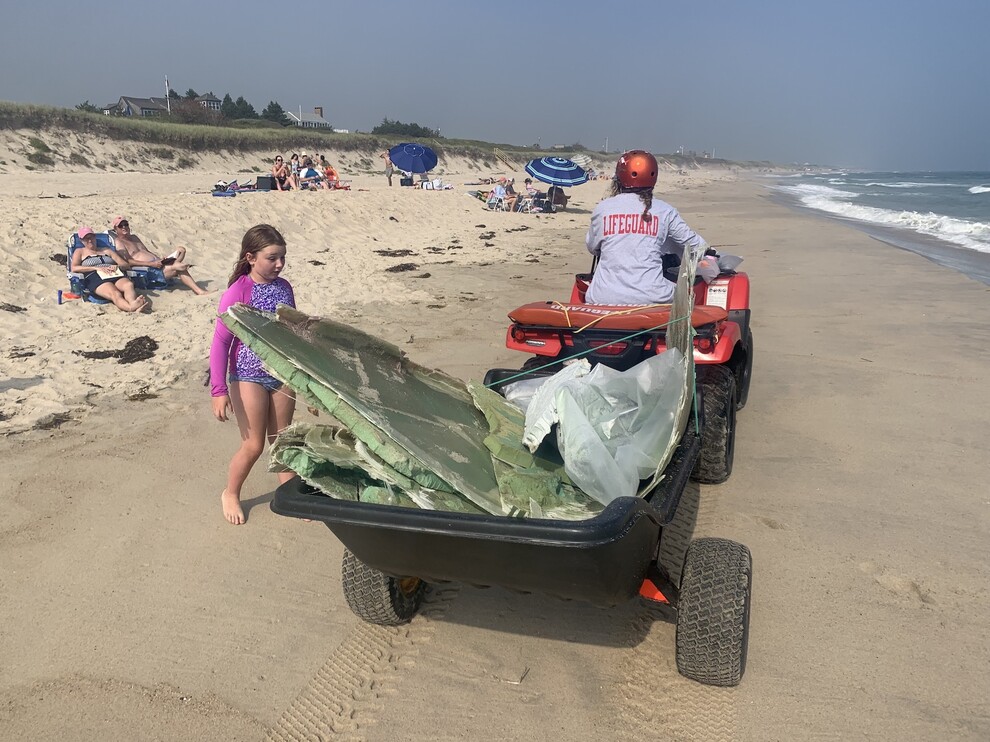
Shards, chunks and finally the rest of a turbine blade fell into the ocean. One blade … from a 62-turbine project that’s only three-fourths completed … broken by its own weight, not by a storm.
And yet beaches had to be closed amid peak tourist season, while crews picked up pieces of fiberglass-resin-plastic-foam blades, and boats dodged big pieces floating in the water. Worse, Vineyard Wind didn’t tell Nantucket officials about the problems until two days after the blade began disintegrating.
Each blade is 350 feet long and 140,000 pounds. That’s more than a fully occupied Boeing 737 jetliner. Vineyard Wind involves 186 blades: 65,000 feet (12 miles) in total combined length, weighing in at a combined 26,000,000 pounds!
The Biden-Harris offshore wind plan calls for 30,000 megawatts of generating capacity by 2030. That’s 2,500 gigantic 12-MW offshore turbines. That won’t even meet New York State’s current peak summer electricity needs, before all these extra demands kick in. Offshore wind’s contribution toward meeting future demands for all Atlantic Coast states could easily require 5,000 such turbines: 15,000 blades, weighing a combined 2 billion pounds and spanning a combined 5,250,000 feet (995 miles)!
Even more disturbing, the entire Atlantic coastline is hurricane country. Every year, almost without fail. The only questions are how many hurricanes, how powerful, and where each one will hit.
NOAA records for landfalling hurricanes – those that actually hit US beaches and cities – reveal that 105 Category 1-5 hurricanes struck the Atlantic seaboard, from Florida to Maine, from 1851 through 2023. Add in those that remained at sea, where the turbines will be, and that number could double.
Of that total, 23 were Category 3-5 (111-157 or higher mph winds). Most struck Florida, Georgia and South Carolina. But 39 made landfall between North Carolina and Delaware – and 19 hit Northeastern States, including nine Category 2-3 monsters (96-129 mph winds).
Mind you – these turbines will be weakened by constant corrosive salt spray and frequently by sub-hurricane storms. When the inevitable big hurricane roars up the coast, devastation will follow.
Kamala Harris is bullish about offshore wind. For the last 3-1/2 years she’s helped run an administration that’s determined to convert the USA to wind, solar and battery power, expedite permits for onshore and offshore “clean energy” projects, and even waive requirements that offshore wind developers post bonds and pay for removing damaged, broken and obsolete offshore wind towers.
She supports banning plastic straws but has never asked how many plastic straws it would take to equal 15,000 offshore wind turbine blades. (Using nautical terms, an unfathomable number.) Moreover, plastic straws don’t contain dangerously sharp fiberglass shards, and can’t sink fishing boats that collide with enormous but hard-to-see slabs of turbine blades.
Ms. Harris, Tim Walz and other wind zealots ignore worries about hurricanes wiping out forests of offshore wind turbines as anti-wind fearmongering. History says otherwise.
The 1935 Labor Day Hurricane clobbered Florida with 200+ mph devastation, Georgia with Category 1 winds. The Great New England Hurricane of 1938 smashed into New York, Connecticut, Rhode Island and Massachusetts with 115-120 mph force. 1944’s Great Atlantic Hurricane – punished the coast from North Carolina to New Jersey and Massachusetts with Category 2 winds.
Edna hit the Northeast with Category 2 winds in 1954, Donna did it again in 1960, and Gloria clobbered the region with 96-115 mph blasts in 1985, even reaching New Hampshire and Maine! Isabel hit North Carolina and Virginia in 2003. The “minor” Category 1 hurricane of 2012, better known as Superstorm Sandy, was also devastating.
This summary includes just some that hit North and Mid-Atlantic States, and a few that slammed Florida, Georgia and South Carolina – all prime territory for forests of offshore turbines, fixed to the seafloor or insanely sitting atop enormous floating platforms off Maine and other states. They’d all flounder.
Replacing hundreds or thousands pf torn, damaged and smashed turbines and blades would take years, perhaps decades. Meanwhile, there would be no electricity in a Harris-Biden-Walz-Democrat government-mandated all-electric Eastern Seaboard. The absence of heating, air conditioning and power for homes, hospitals and everything else would displace millions and kill thousands.
Hopefully, politicians and bureaucrats could expedite new gas turbine and modular nuclear power plants. That would mean only a few years of deprivation and blackouts, instead of many years, perhaps decades.
Otherwise, floating slabs of broken turbine blades would endanger boats for months or years, until they are retrieved, hauled ashore and landfilled. Cleaning up billions of sharp shards of fiberglass – each an inch to a couple feet in length, and nearly invisible – would likely take decades, during which time they would impale and imperil beach walkers, swimmers, fish, whales, dolphins and other marine life.
I’m not a microbiologist, but I’m not aware of any microbes that devour fiberglass, resin or plastic foam.
With no bonds or requirements that Big Wind cover cleanup and turbine removal costs, electricity-bereft taxpayers and ratepayers would be left holding the bag.
Before we rush any further into this “renewable energy transformation,” can we first have some realistic, commonsense analysis? Can we at least think before casting our ballots this fall?
Watts Up With That?

Victims of Super Typhoon Yagi include Hainan wind farm
Dialogue Earth
Niu Yuhan
11 September 2024
The most powerful autumn storm to have hit China since 1949 made landfall on 6 September.
Super Typhoon Yagi caused four deaths and 95 injuries. More than 720,000 had to relocate in Guangdong province, and half a million people were affected in Hainan province.
Five or six huge turbines were also severely damaged at a wind farm in coastal Hainan, according to its operator.
Landing just a few kilometres from the wind farm, Yagi reached over 83 metres per second (300 km per hour), far exceeding requirements for the typhoon resistance of wind turbines, an industry insider told media.
Qin Haiyan, secretary general of China Renewable Energy Society’s Wind Energy Committee, explained that the turbines were not yet operational “so their anti-typhoon features could not be activated.”
Energy Observer reported that the damaged turbines were part of a capacity-expansion project. The plan, intended for completion in October, involved dismantling the original 32 smaller turbines and replacing them with 16 turbines, each with a capacity of 6.25 megawatts and worth nearly 10 million yuan (1.37 million USD).
“To boost capacity, many companies have been extending wind turbine blades and increasing tower heights without upgrading other components, which has compromised safety. Additionally, many existing technical standards were originally developed for smaller turbines, raising concerns about whether they are applicable to larger turbines,” reported Energy Observer.
Caixin highlighted that China’s wind power industry has been grappling with intense price competition in recent years and the race to lower costs often comes at the expense of quality.
Dialogue Earth


 Iowa Climate Science Education