Month: September 2024

Human CO2 Emissions Are Supercharging Corn Yields

By Vijay Jayaraj

How can carbon dioxide, which has been portrayed as a dangerous pollutant threatening the very existence of humankind, be considered even remotely beneficial?  Sadly, such a question can be expected from people – children and adults – who have been fed irrational fears in place of well-established science that shows CO2 to be an irreplaceable food for plants and necessary for all life.

Even some who recognize CO2 as sustenance consider increasing atmospheric concentrations of the gas to be potentially catastrophic, a view devoid of scientific basis and inimical to the fortunes of malnourished millions. 

Corn, or maize, is foundational—along with rice, wheat, soyabean—to global food security, serving as a critical source of nourishment for both humans and livestock. Over the past few decades, increases in atmospheric CO2 from industrial emissions have tracked with notable boosts in corn yields. 

Between 1900 and 2024, the national corn yield in the U.S. rose to 183 bushels per acre (bu/A) from just 28 bushels. During the same period, atmospheric COincreased from 295 parts per million (ppm) to 419 ppm. Worldwide, corn yield rose from a mere 29 bu/A in 1961 to 86 bu/A in 2021

This phenomenon is not merely coincidental; it is deeply rooted in the physiological characteristics of corn as a C4 category plant. C4 plants like corn – so named for the number of carbon atoms in their photosynthetic product — possess unique biochemical pathways that make their photosynthesis particularly efficient under high concentrations of CO2 and elevated temperatures. Such plants employ a mechanism that concentrates CO2 in specialized structures called bundle sheath cells.

Higher COlevels also improve water-use efficiency in corn, which is particularly beneficial where water supplies are limited or during droughts. This efficiency translates into enhanced growth rates and potentially greater yields. In fact, researchers say that “less water will be required for corn under a high-CO2 environment in the future than at present.”

Augmented corn yields driven by increased atmospheric CO2 have had profound effects worldwide, contributing to an agricultural boom that bolstered farm incomes and enhanced food security across diverse regions. Countries like the U.S. with significant corn production have experienced elevated export revenues, strengthening national economies and their positions in the global market.

But this remarkable impact of elevated CO2 is not just limited to C4 crops like corn. C3 plants, such as wheat, rice, potatoes, and soybeans, all rely on an enzyme called rubisco for carbon fixation. Rubisco’s efficiency improves significantly with higher CO2 concentrations because it reduces the enzyme’s tendency to bind with oxygen—a process known as photorespiration that limits productivity. 

Consequently, elevated atmospheric COoften results in enhanced photosynthesis and biomass accumulation in C3 species, although to a lesser extent than with C4 plants. This is why rice and wheat yields can increase by up to 20-30% under elevated CO2 conditions. We have witnessed this in yield increases across most C3 food crops. 

Notably, greenhouse farming—agronomy practiced inside a translucent tent to retain the sun’s warmth—often uses CO2 concentrations artificially increased to more than twice ambient levels to enhance growth.

The relationship between rising atmospheric CO2 and crop yields is clearly a positive one. So, ignore fearmongering media headlines about toxic human COemissions. You, your family and the industries that support our society have greened the planet with daily emissions of carbon dioxide, making food more plentiful and affordable for those grappling with poverty and everybody else.

This commentary was first published at California Globe on September 18, 2024.

Vijay Jayaraj is a Research and Science Associate at the CO2 Coalition, Arlington, Virginia. He holds a master’s degree in environmental sciences from the University of East Anglia, U.K., and a postgraduate degree in energy management from Robert Gordon University, U.K.

via Watts Up With That?

https://ift.tt/X0tCluW

September 19, 2024 at 08:04PM

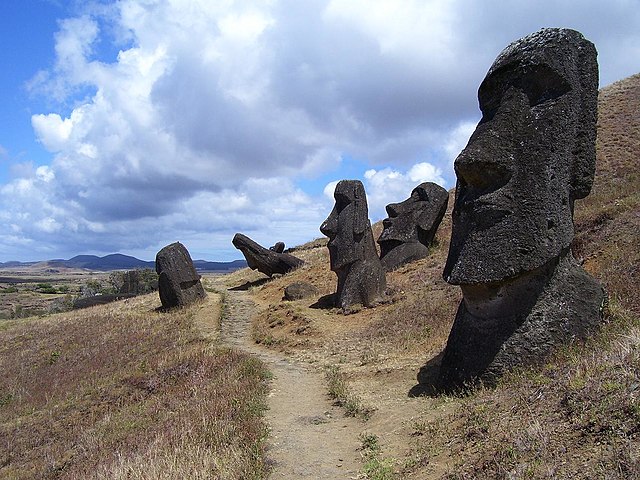
What if Easter Island was a sustainable success story instead of an ecocidal disaster?

Easter Island

Photo by Horacio_Fernandez https://ift.tt/SFnPkuc

By Jo Nova

It was always the Posterchild Catastrophe of Doomsters, but two new studies suggest Easter Island might be a story of  remarkable human achievement instead.

In environmentalist legends, Easter Island was The Ecocide: they built nearly 1,000 giant stone statues but stupidly chopped down all its trees, and died in horrible wars. It was the sorry tale of ecological collapse and deforestation that we could tell small children at bedtime. After the last trees were sliced and diced, a catastrophe of horrors surely followed as the population of 15,000 people ran out of food and no one could make a boat to escape. Obsidian flakes across the island were interpreted as weapons of war and one anthropologist claimed there was a huge civil war that ended in the battle of 1680. Environmental hell on Earth was here…

But new research on the genomes of some islanders suggests that the population was probably small all along. When the Europeans arrived there were only about 3,000 people, but a genetic analysis suggests there are no signs of a recent collapse in the population. Another study of the fields suggests they made some very sophisticated gardens, but only ever had fields big enough to sustain about 4,000 people. And the obsidian fragments were probably domestic tools.

Adding to the tale of remarkable survival,  apparently the inhabitants somehow managed to get to South America and collected some native Indian genes which they brought back. These survived on for another 15 to 20 generations.

So it may be that an isolated island of only 3,000 people was capable of feeding itself sustainably, somehow making huge statues, and also sailing 3,700 kilometres to South America and then finding their way back again. (Or maybe, wonders Jo, whether some South Americans just managed a one way trip? How would we know? — On that score, the authors of the Nature paper say they can’t tell genetically, but there is archaeological evidence and oral history of trans-Pacific contact from Polynesia right across to South America).

Famed Polynesian island did not succumb to ‘ecological suicide,’ new evidence reveals

Science

Most recently Carl Lipo, an archaeologist at Binghamton University, and his team used satellite imagery and machine learning to map the island’s rock gardens, a method of spreading rocks to improve soil productivity. In a paper in Science Advances in July, they concluded Rapa Nui’s agriculture was far less extensive, and its population smaller, than the “ecocide” theory had proposed. Although the ancient Rapanui did cut down most of the island’s trees, the deforestation did not trigger a cultural or population crisis, they say. “Their ability to adapt was successful,” Atallah Leiva says.

The farmers of Rapa Nui (Easter Island) used rocks to improve the soil:

While it is true that the small island — which is just 63 square miles (164 square kilometers), or slightly smaller than Washington, D.C. — has poor soil quality and limited freshwater resources, researchers have discovered that the story of the Rapanui is one of survival in challenging ecological conditions.

One method the Rapanui used to enhance the island’s volcanic soil was “lithic mulching,” or rock gardening, in which pieces of rock were added to cultivation areas to boost productivity. The rock gardens generated better airflow in the soil, helping mediate temperature swings and maintaining nutrients — including nitrogen, phosphorus and potassium — in the soil.

Yet another paper suggests that the banal truth of the deforestation was not because humans chopped them all down, but because the first settlers bought some rats:

What really happened to the trees

More recently, a picture has emerged of a prehistoric population that was both successful and lived sustainably on the island up until European contact. It is generally agreed that Rapa Nui, once covered in large palm trees, was rapidly deforested soon after its initial colonization around A.D. 1200. Although microbotanical evidence, such as pollen analysis, suggests the palm forest disappeared quickly, the human population may only have been partially to blame.

The earliest Polynesian colonizers brought with them another culprit, namely the Polynesian rat. It seems likely that rats ate both palm nuts and sapling trees, preventing the forests from growing back. But despite this deforestation, my own research on the diet of the prehistoric Rapanui found they consumed more seafood and were more sophisticated and adaptable farmers than previously thought.

The bottom line is that the genetic analysis only has about 15 samples from remains of Islanders of the 1800s and while the rock garden analysis used field trips they also relied on some satellites and AI, so no one really knows for sure. The catastrophist environmentalist story almost certainly ran away with itself, but there is an element of indigenous sainthood working the other way too:

“Working with Indigenous groups, we face so many tropes and outdated narratives that people keep perpetuating—even scientists,” says Kathrin Nägele of the Max Planck Institute for Evolutionary Anthropology, who wrote an accompanying commentary for Nature. “I hope this … ancient DNA [study] puts the last nail in the coffin of this [collapse] narrative.”

Most likely the Rapanui were remarkable survivors who were just as capable of screwing things up as any of us. Hopefully scientists will figure out what really happened, instead of beating us over the head with their favorite ideology.

Lord give us a dispassionate scientist…

REFERENCES

Davis et a (2024)  Island-wide characterization of agricultural production challenges the demographic collapse hypothesis for Rapa Nui (Easter Island),  Science Advances, 21 Jun 2024 Vol 10, Issue 25 DOI: 10.1126/sciadv.ado1459

Moreno-Mayar, J.V., Sousa da Mota, B., Higham, T. et al. Ancient Rapanui genomes reveal resilience and pre-European contact with the Americas. Nature 633, 389–397 (2024). https://ift.tt/sB1l9KJ

0 out of 10 based on 0 rating

via JoNova

https://ift.tt/ZX5zcO3

September 19, 2024 at 05:30PM

Artemis I Demonstrated Adequate Radiation Shielding for Manned Lunar Missions

Guest “We already knew this from the Apollo Program” by David Middleton

NASA’s “crash test dummies” Helga and Zohar, along with an array of radiation instrumentation demonstrated that the Artemis spacecraft provides adequate shielding for short duration lunar missions. The results of these measurements were recently published in Nature.

a, Radiation instrumentation and phantoms inside Orion. These consist of the NASA HERA system, the ESA EAD system, as well as the NASA CAD and DLR M-42 instruments. The HERA system and the EADs were hard-mounted at various distinctly shielded locations in Orion. CAD and M-42 were placed on the front and back surfaces (skin) and inside (organs) (M-42) of the MARE phantoms (Extended Data Figs. 14). b, Placement of the instrumentation and hardware inside the Orion spacecraft. c, The Orion flight profile with respect to radiation for the NASA Artemis I mission. After launch at 06:47 UTC on 16 November 2022, Orion passed the inner (proton-dominated) and outer (electron-dominated) Earth radiation belts. Orion then ventured into interplanetary space dominated by GCRs. It passed the Moon twice on 21 November (first lunar fly-by at a distance of 130 km) and on 5 December (second lunar fly-by at a distance of 128 km). During these fly-bys, the Moon acts as a shield against GCRs. Orion re-entered Earth’s atmosphere over the South Pole and landed in the Pacific Ocean close to San Diego, California on 11 December 2022 at 17:40 UTC. Nature ISSN 1476-4687

The paper is open access, with the full text freely available. Here’s the abstract:

Abstract

Space radiation is a notable hazard for long-duration human spaceflight1. Associated risks include cancer, cataracts, degenerative diseases2 and tissue reactions from large, acute exposures3. Space radiation originates from diverse sources, including galactic cosmic rays4, trapped-particle (Van Allen) belts5 and solar-particle events6. Previous radiation data are from the International Space Station and the Space Shuttle in low-Earth orbit protected by heavy shielding and Earth’s magnetic field7,8 and lightly shielded interplanetary robotic probes such as Mars Science Laboratory and Lunar Reconnaissance Orbiter9,10. Limited data from the Apollo missions11,12,13 and ground measurements with substantial caveats are also available14. Here we report radiation measurements from the heavily shielded Orion spacecraft on the uncrewed Artemis I lunar mission. At differing shielding locations inside the vehicle, a fourfold difference in dose rates was observed during proton-belt passes that are similar to large, reference solar-particle events. Interplanetary cosmic-ray dose equivalent rates in Orion were as much as 60% lower than previous observations9. Furthermore, a change in orientation of the spacecraft during the proton-belt transit resulted in a reduction of radiation dose rates of around 50%. These measurements validate the Orion for future crewed exploration and inform future human spaceflight mission design.

George et al., 2024

Artemis II

Artemis II could launch as early as September 2025. The 10-day mission to orbit the Moon will be the first manned mission to the Moon since Apollo 17 in December 1972.

Artemis II Map
NASA
Artemis II will be the first flight with crew aboard NASA’s deep space exploration system: the Orion spacecraft, Space Launch System (SLS) rocket and the ground systems at Kennedy Space Center in Cape Canaveral, Florida. During their mission, four astronauts will confirm all of the spacecraft’s systems operate as designed with people aboard in the actual environment of deep space, over the course of about a 10-day mission. The Artemis II flight test will pave the way to land the first woman and next man on the Moon on Artemis III.

The four-person crew will consist of:

  • Commander Reid Wiseman
  • Pilot Victor Glover
  • Mission Specialist Christina Koch
  • Mission Specialist Jeremy Hansen
The Artemis II crew is shown inside the Neil Armstrong Operations and Checkout Building at NASA’s Kennedy Space Center in Florida in front of their Orion crew module on Aug. 8, 2023. From left are: Jeremy Hansen, mission specialist; Victor Glover, pilot; Reid Wiseman, commander; and Christina Hammock Koch, mission specialist.
NASA/Kim Shiflett

The SLS rocket will blast off from Kennedy Space Center Launch Pad 39B.

NASA’s Space Launch System rocket carrying the Orion spacecraft launches on the Artemis I flight test, Wednesday, Nov. 16, 2022, from Launch Complex 39B at NASA’s Kennedy Space Center in Florida. NASA’s Artemis I mission is the first integrated flight test of the agency’s deep space exploration systems: the Orion spacecraft, Space Launch System (SLS) rocket, and ground systems. SLS and Orion launched at 1:47 a.m. EST, from Launch Pad 39B at the Kennedy Space Center. Photo Credit: (NASA/Bill Ingalls)

Reference

George, S.P., Gaza, R., Matthiä, D. et al. Space radiation measurements during the Artemis I lunar mission. Nature (2024). https://ift.tt/3NgrWwn

Just in case it’s needed…

Comparison of lunar and terrestrial basalts. WUWT

via Watts Up With That?

https://ift.tt/DXIwC3Q

September 19, 2024 at 04:00PM

NASA Sea Level

When their sea level rise predictions were failing, US government agencies simply moved the goalposts, and made up fake data.

About Tony Heller

Just having fun

This entry was posted in Uncategorized. Bookmark the permalink.

via Real Climate Science

https://ift.tt/HjzVX0N

September 19, 2024 at 02:04PM