Month: September 2024

SC-GHG: Weapon of Mass Social Destruction

A reminder that first there was Social Cost of Carbon (SCC) which purported to estimate future costs of damages from CO2 emissions. Now there is Social Costs of Green House Gases (SC-GHG) which ups the ante by adding purported damages from methane (CH4) and Nitrogen oxides (N2O). At the end of this post are references describing this sordid history.

Remember also the regulators game.  Regulations by far outnumber laws passed by congress, and they impose costs upon businesses and consumers of the targeted industries.  Instigating agencies justify their rules by claiming greater savings from preventing future damages.  So the higher the damages estimates the more intensive and expensive can be the regulations.

Mark Krebs provides a recent example of this in his Master Resource article Heat Pump Subsidies: Never Enough.  It reports on various machinations by the Biden/Harris regime to spend all the money they can on decarbonizing projects before their term ends.  As Biden himself said after terminating his re-election campaign:  We should have named the Inflation Reduction Act what it really was, the Green New Deal.
The article includes this quote from Competitive Enterprise Institute’s (CEI) regarding SCC (with my bolds):

Junk Science Behind Federal Appliance Regs About to Get Junkier

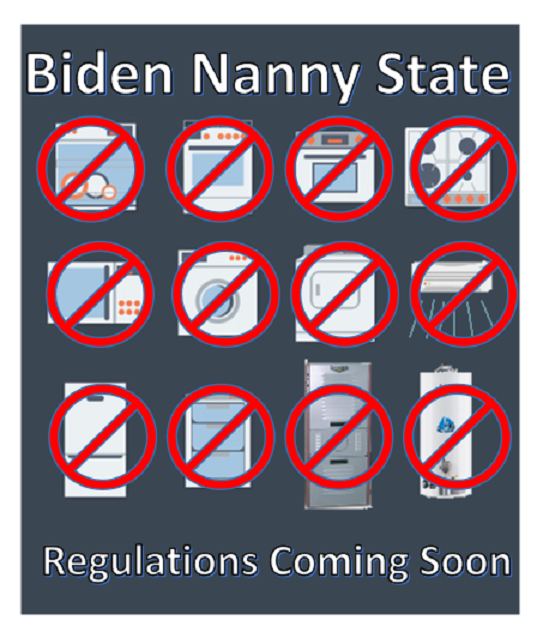
The Biden-Harris administration has embarked on a wave of anti-consumer home appliance regulations over the last several years. Each was justified in part by overblown claims of climate change benefits. And now, the Department of Energy (DOE) has proposed using a new methodology that would further inflate these hypothetical benefits to justify even worse regulations in the years ahead.

DOE is in the process of creating new energy use limits for stoves, dishwashers, furnaces, washing machines, water heaters, ceiling fans, refrigerators, and more. The agency always asserts that consumers experience net gains from these regulations, but CEI has filed comments highly critical of these rosy assumptions. In reality, such rules often raise the up-front costs of appliances more than is likely to be earned back in the form of energy savings. Some rules also compromise appliance choice, performance, and reliability.

But DOE’s fictitious consumer benefits are only part of the problem. CEI has also taken issue with the agency’s assertions that these regulations deliver quantifiable climate change benefits. For example, DOE’s costly 2023 final rule for residential furnaces was estimated by the agency to provide $16.2 billion worth of such benefits.

The agency arrives at this figure by calculating the reduced energy use attributable to the efficiency standards and then estimating the amount of greenhouse gas emissions avoided as a result – mostly carbon dioxide emitted to produce electricity at coal or natural gas-fired power plants. Then it multiplies the tons of emissions avoided by the calculated per unit dollar cost to society of such emissions.

Until now, DOE has relied upon the 2021 Interagency Working Group on the Social Cost of Greenhouse Gases (IWG 2021). IWG 2021 provides the agency with the per ton Social Cost of Greenhouse Gases (SC-GHG) values.

Relying on IWG 2021 was bad enough, but in its most recent proposed rule for commercial refrigeration equipment DOE is switching to an updated 2023 version of SC-GHG provided by the Environmental Protection Agency.

The new methodology takes several already-dubious assumptions in IWG 2021 and stretches them further. For one category of commercial refrigeration equipment covered in the proposed rule, DOE calculates the climate benefits of $48-$320 million dollars under IWG 2021 but a whopping $564-$1,713 million under the new way. That’s around 5-10 times higher.

How Did They Weaponize SC-GHG?

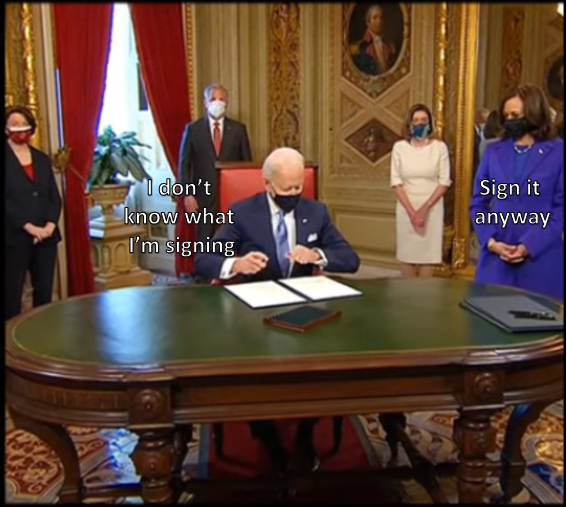
Briefly recapping, the Obama WH activist bean counters pushed numbers around and came up with $51 per ton of CO2 emitted. Then Trump WH said more realistic interest rates give an SCC of $1 per ton CO2.  Then Biden/Harris came into power with a deluge of Excutive Orders (EO), including one that reset SCC at 51$  Maybe you recall scenes like this from early 2021:
That prompted ten states to file for an injunction against Biden’s EO 13990 which was granted by the federal District Court of Louisiana February 2022.  Manhattan Contrarian commented at the time (my bolds):

On taking office, the Trump administration took steps to neutralize the SCC, so that not much has been heard from it for a while. But Biden’s EO 13990 caused the Obama-era version to get re-instated. The Biden people claim that they are working on further tweaks to the regulations, but meanwhile a large group of Republican-led states went ahead and commenced litigation.

With a regulatory initiative obviously intended to force a gigantic transformation of the economy without statutory basis, the Biden people defended against the Complaint using every shuck and jive and technicality known to man. The SCC rules were not “final” because the administration was still working on a few more tweaks (and then a few more, and then a few more); the state plaintiffs lacked “standing” because the harm was to citizens rather than the state itself; and so forth. The court was having none of it.

The heart of the court’s decision is its determination that the SCC falls under the Supreme Court’s “major questions doctrine,” under which the bureaucracy cannot on its own authority impose “new obligations of vast economic and political significance” unless Congress “speaks clearly.” The states had identified some 83 pending projects involving something in the range of $447 and $561 billion dollars as affected by the SCC rule. That impressed the court as easily within the concept of “major questions.”

However in March 2022 the Fifth Circuit Court of Appeals stopped the injunction, and in May 2022 the Supreme Court refused a request by plaintiff states to block EO 13990.

From Technical Support Document: Social Cost of Carbon, Methane, and Nitrous Oxide 2021
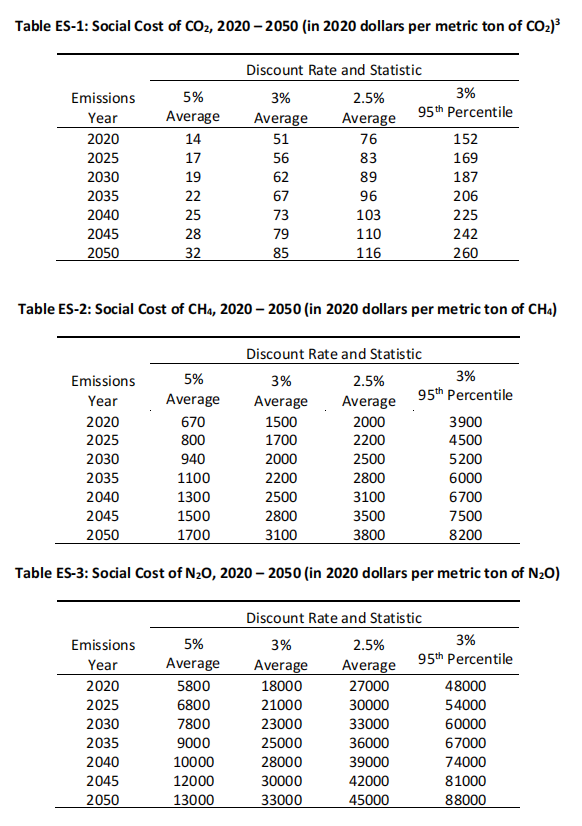
This table was the same one produced by Obama WH.  Note that at 5% discount rate, CO2 goes from $14 to $32 in 2050.  Obama era regulations presumed the 3% rate which results in $51 up to $85. Note the astronomical numbers for CH4 $1500 per ton up to $3100.  And N2O starts at $18,000 to $33,000.  Hide your cows and fertilizers!.  But that was not expensive enough for Team Biden/Harris .

From the EPA Report on the Social Cost of Greenhouse Gases: Estimates Incorporating Recent Scientific Advances 2023
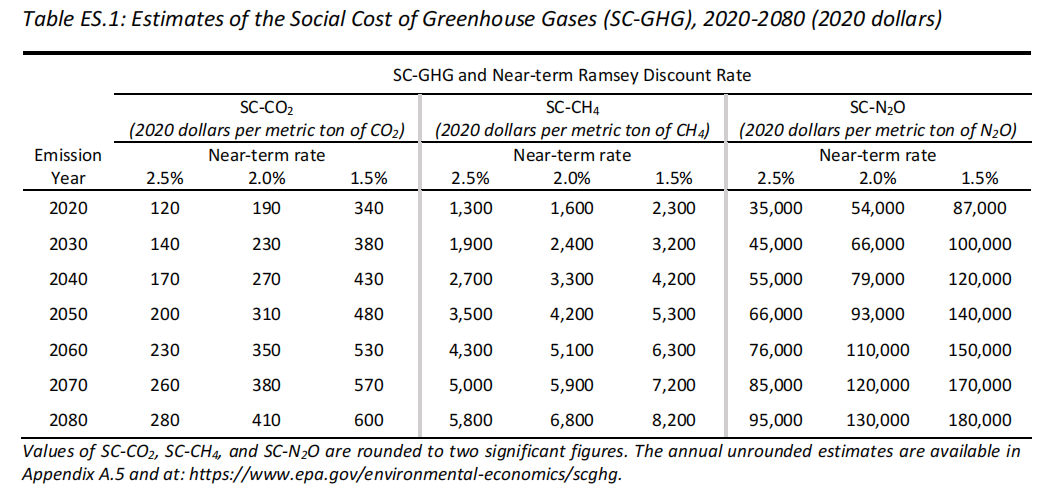
So no more 5% rate, and the middle scale is 2% rather than 2.5%.  That starts at $190 per ton of CO2 up to $310 by 2050 and $410 in 2080.  CH4 on the same basis is $1600 to $4200 in 2050 up to $6800 by 2080.  Of course a ton of N2O is unaffordable at $54,000 up to $130,000.

In other words, this regime can regulate the hell out of appliance manufacturers and agricultural operations, among others, justified by such numbers. It started with gas stoves, but won’t end there.

Will anyone put a stop to them?



via Science Matters

https://ift.tt/g6NRC3o

September 19, 2024 at 01:14PM

No, BBC–North Carolina Floods Were Not “Historic”

By Paul Homewood

The latest misinformation from the BBC:

image

A tropical rainstorm has flooded parts of North Carolina near the coast, leaving homes and vehicles underwater.

Video shows one young man paddling through high waters.

The NOAA Atlas 14 shows that 12 inches of rain fell in 12 hours, which, on average, occurs every 200 years, according to the National Weather Service of Wilmington.

https://www.bbc.co.uk/news/videos/c3e99g1d21xo

.

NOAA most certainly have not said that this sort of rainfall only occurs every 200 years on average.

This is actually what NOAA said:

image

https://www.weather.gov/ilm/2024PTC8

And the NOAA Atlas 14 referred to is clear that the 200 year frequency is based on a single location on the coast, not the region as a whole.

NOAA also state that the high rainfall totals only affected a 25-mile strip of coast:

image

The coast line from North Carolina to Florida, where these sort of storms can happen at any time, is hundreds of miles long. So the odds of such a storm occurring somewhere on the coast is not 1-in-200 years, probably more like once a decade.

And, of course, rainfall of 12 to 20 inches is nothing unusual in North Carolina. For instance Hurricane Dennis dropped 19.9 inches on Ocracoke in early September 1999, and falls of 10 inches were widespread in the State.

Just two weeks later, Hurricane Floyd arrived, with rainfall totals as high as 15 and 20 inches in eastern parts of North Carolina. 19 inches fell on Wilmington.

Certainly the floods this month were minor in comparison with the devastation wrought by Dennis and Floyd.

But the BBC would like you to believe that events like this latest one never used to happen before global warming.

via NOT A LOT OF PEOPLE KNOW THAT

https://ift.tt/hj8Ml2Q

September 19, 2024 at 12:45PM

China Bans Electric Vehicles from Underground Carparks

Essay by Eric Worrall

First published JoNova; … They explode “as if packed full of toxic dynamite” …

China bans electric vehicles from underground carparks

They explode “as if packed full of toxic dynamite” – and one nation has already started cracking down on electric vehicles as a result.

Jamie Seidel@JamieSeidel
September 14, 2024 – 2:16PM

They flare out in a jet of flame with vicious intensity. They explode as if packed full of toxic dynamite. And when lithium-ion batteries burn, nothing can extinguish them.

This is why Chinese hotels and property managers have begun to ban all electric vehicles – scooters, e-bikes, family cars or commercial vans – from their undercroft car parks.

“Hotels and other buildings in Hangzhou, Ningbo, Xiaoshan and other places in Zhejiang have banned electric vehicles from entering underground garages for safety reasons, sparking heated discussions,” Chinese online dissident “Mr Li is not your teacher” reported in a post to X (which is banned in China) in September. 

One of three photos attached to the post shows a sign in front of the Huigang Building in Ningbo, Zhejiang Province, instructing owners of electric vehicles to divert to a nearby parking lot with “wide open spaces”.

Local news reports that property owners were spurred into action after 11 intense battery fires in Zhejiang’s capital, Hangzhou, in May of this year.

For the moment, Tesla recommends that – in the event of a battery fire – it’s best to let it burn.

“Instead of snuffing out the flames, water could actually fuel the fire and cause it to intensify,” says Zhar. 

“This is because the water’s reaction with the lithium can produce flammable hydrogen gas – adding more of a hazard to an already perilous situation.”

Likewise, water on a petrol fire can simply cause the fire to spread. That’s why foam and dry powder fire extinguishers were invented to smother the flames.

Read more: https://www.news.com.au/technology/motoring/on-the-road/china-bans-electric-vehicles-from-underground-carparks/news-story/b7c07b8e942cb3076b704029e327d6cf

EVs are vehicles which if they catch fire cannot be extinguished, which burn at a similar temperature to a welding torch, melting concrete and steel in the immediate vicinity, threatening the structural integrity of any nearby supports, which emit hideously toxic fumes, and which can react with water to produce large quantities of highly explosive gas.

This ban has been a long time coming.

via Watts Up With That?

https://ift.tt/AOQx2eW

September 19, 2024 at 12:06PM

EV Sales Collapse In Germany

By Paul Homewood

h/t Paul Kolk

They don’t want the useless things in Europe either!

image

Germany has suffered a “spectacular” drop in electric car sales as the European Union faces growing calls to delay its net zero vehicle targets.

The European Automobile Manufacturers’ Association (ACEA) said sales of new battery-powered electric vehicles (EV) in Germany plunged by nearly 70pc to 27,024 in August.

In France, the EU’s second largest market for battery electric vehicles behind Germany, deliveries fell by 33pc to 13,143.

ACEA said “the spectacular drop” in both countries meant that only 92,627 battery electric vehicles were registered across Europe last month, a fall of 43.9pc compared to a year earlier. This drove a wider 18pc drop in new car sales across the EU.

The collapse in EV sales comes amid concerns about their range, high prices and the lack of charging infrastructure across the EU.

Felipe Munoz, a global automotive analyst at JATO Dynamics, said: “The reality is that whether you look at business or private, electric vehicles do not convince yet.”

Earlier this month Volkswagen warned it may have to close a factory in its home market in the face of slumping sales. The car maker has also scrapped a decades-old promise to protect workers’ jobs, with fears as many as 15,000 roles could be at risk.

The EV sales crisis prompted the ACEA to call for “urgent action” to address new EU net zero car sales rules that will leave European electric car manufacturers at risk of hefty fines.

The European Commission, which creates and enforces EU law, is preparing to introduce new rules for car and van makers designed to slash carbon emissions and encourage the adoption of electric vehicles.

The new rules require all new European cars to produce no more than 93.6g of CO2 per kilometre. Brands will be fined €95 for each gram of CO2 per kilometre over the limit, multiplied by the number of cars sold.

The ACEA said the “continual downward trajectory” of EV sales in the bloc meant manufacturers would be at risk of multi-billion euro fines and said the new rules needed a rethink. It warned that demand for EVs was still well below the level needed for the EU’s new vehicle emissions rules to work effectively.

“We are missing crucial conditions to reach the necessary boost in production and adoption of zero-emission vehicles: charging and hydrogen refilling infrastructure, as well as a competitive manufacturing environment, affordable green energy, purchase and tax incentives, and a secure supply of raw materials, hydrogen and batteries,” the ACEA said.

The Brussels-based industry body said that 902,011 battery-electric cars were registered from January to August, representing just 12.6pc of the market.

The ACEA urged the European Union to delay new carbon emissions targets and instead take “urgent and meaningful action” to reverse the sales decline.

Top carmakers including Volkswagen, BMW and Renault have already suggested pushing back the targets, which would see companies fined for failing to comply.

Meanwhile, Italy urged the EU to pause its “absurd” plans to ban petrol cars by 2035 amid concerns the policy risks triggering the automotive industry’s collapse.

https://www.telegraph.co.uk/business/2024/09/19/germany-suffers-spectacular-70pc-drop-electric-car-sales/

via NOT A LOT OF PEOPLE KNOW THAT

https://ift.tt/Br0mjtZ

September 19, 2024 at 11:58AM