Month: September 2024

Heat Pump Subsidies: Never Enough

“The Competitive Enterprise Institute is leading a coalition of free market advocates attempting to organize support to stop the IRA’s obscene and consumer abusive funding. In response, the Biden (mis)Administration is attempting to shovel IRA funding out the door as fast as it can to contractually shield it.”

Early this month, Lucas Davis, a Professor in Business and Technology at the Haas School of Business, University of California, Berkeley, published an article titled: How Do We Pump Up the Impact of Heat Pump Subsidies? In April, Professor Davis published a precursor article titled: Why Are Heat Pump Sales Decreasing?

The upshot is that despite Federal rebates of up to $8,000 per the “Inflation Reduction Act,” real-world economics of electric heat pumps are dismal.  Several commenters to the second article aptly summarized why from a consumer perspective.

Case Study One

As the owner of a 30-year-old gas furnace, I was in the market for a heat pump during all of 2023. As a low-income retiree, I also looked forward to an $8,000 subsidy from the Inflation Reduction Act passed in November of 2022. Well, as readers of this blog probably know already, the IRA subsidies did not take effect in 2023 (and are now projected to be available in California no sooner than late summer 2024).

I had gotten a bid in the summer of 2022 of $25,000 for a heat pump, but I was waiting for the IRA subsidy to take effect. Then I discovered that the bidder had failed to mention that installing a heat pump would also require new ductwork because the existing ducts were too small to handle the larger air volumes required by a heat pump. Two subsequent bids in mid- and late-2023 ranged from $30K to $40K when ductwork was included.

So when the furnace failed in December 2023 at age 31, I had to make a quick choice: a replacement gas furnace (costing $12K with an 18-month 0% loan, and a 2-day wait for installation), or $30K+ for a heat pump with a couple month wait for installation. The estimated fuel savings from the heat pump worked out to under $1000 per year, not even close to enough to outweigh the $18K capital cost differential. The fact that the estimated life for the heat pump was 15 years, versus 30 years for the gas furnace, didn’t help at all.

So there’s my anecdotal story: it wasn’t interest rates, it wasn’t tax law, it largely wasn’t fuel prices, it was mostly capital costs. Had the original bid of $25K been legit and had the $8K subsidy been available by mid-2023, I would have chosen the $17K heat pump over the $12K furnace based on environmental concerns. But at $30K versus $12K, I didn’t.

Case Study Two

I also got pricing for a 6 head mini-split heat exchange system that would be mounted in each room, and it came to $26,000 for the two pumps and 6 heads wired, installed and tested. Pricing is important.

Yes, pricing (meaning total installed cost) is important.  Total installed costs for heat pumps (as evidenced by the above commenters) can include expensive retrofit expenses that normally are avoided when not switching from a traditional gas furnace to an electric heat pump. And heaven forbid something like a motherboard failure out of warranty (that tend to be much shorter than furnace warranties).

Alas, however,, our Federal energy efficiency “experts” are also making sure that traditional/inexpensive (non-condensing gas furnaces are going to soon be illegal as a result of their abuse of regulatory authority regarding minimum appliance efficiency standards under the Energy Policy and Conservation Act of 1975 ( EPCA)  in  response to the “1973 oil crisis by creating a comprehensive approach to federal energy policy.”

The American Public Gas Association (APGA) explains:

The Office of Energy Efficiency and Renewable Energy (EERE) within DOE issued a notice of proposed rulemaking establishing a new 95% annual fuel utilization efficiency (AFUE) standard for furnaces. This proposed standard can only be met by condensing furnaces, effectively banning non-condensing furnaces that have been in millions of American homes for a generation or more.

But wait, there’s more” (in the immortal words of Ron Popeil). EPCA also states that DOE can include “any such other factors as the Administrator deems appropriate.”   The social cost of carbon SCC is a prime example of how DOE is using this nebulous authority to impose carbon reduction benefits within its cost/benefit analyses.  The Competitive Enterprise Institute’s (CEI), Ben Lieberman, explains SCC:

Junk Science Behind Federal Appliance Regs About to Get Junkier

The Biden-Harris administration has embarked on a wave of anti-consumer home appliance regulations over the last several years. Each was justified in part by overblown claims of climate change benefits. And now, the Department of Energy (DOE) has proposed using a new methodology that would further inflate these hypothetical benefits to justify even worse regulations in the years ahead.

DOE is in the process of creating new energy use limits for stovesdishwashersfurnaces,  washing machineswater heaters, ceiling fans, refrigerators, and more. The agency always asserts that consumers experience net gains from these regulations, but CEI has filed comments highly critical of these rosy assumptions. In reality, such rules often raise the up-front costs of appliances more than is likely to be earned back in the form of energy savings. Some rules also compromise appliance choice, performance, and reliability.

But DOE’s fictitious consumer benefits are only part of the problem. CEI has also taken issue with the agency’s assertions that these regulations deliver quantifiable climate change benefits. For example, DOE’s costly 2023 final rule for residential furnaces was estimated by the agency to provide $16.2 billion worth of such benefits.

The agency arrives at this figure by calculating the reduced energy use attributable to the efficiency standards and then estimating the amount of greenhouse gas emissions avoided as a result – mostly carbon dioxide emitted to produce electricity at coal or natural gas-fired power plants. Then it multiplies the tons of emissions avoided by the calculated per unit dollar cost to society of such emissions.

Until now, DOE has relied upon the 2021 Interagency Working Group on the Social Cost of Greenhouse Gases (IWG 2021). IWG 2021 provides the agency with the per ton Social Cost of Greenhouse Gases (SC-GHG) values.

Relying on IWG 2021 was bad enough, but in its most recent proposed rule for commercial refrigeration equipment DOE is switching to an updated 2023 version of SC-GHG provided by the Environmental Protection Agency.

The new methodology takes several already-dubious assumptions in IWG 2021 and stretches them further. For one category of commercial refrigeration equipment covered in the proposed rule, DOE calculates the climate benefits of $48-$320 million dollars under IWG 2021 but a whopping $564-$1,713 million under the new way. That’s around 5-10 times higher.

More Concerns

In May of 2022, I wrote an article published in Real Clear Energy titled Fallacies of Supplying American LNG and Electric Heat Pumps to Europe to Fight Putin and Global Warming. Primarily, it summarized the flawed “energy efficiency” physics behind this Biden administration plan that has since been regurgitated in the Investment Reduction Act a few months later.  This article, which I stand by, received 189 comments.

This leads to my overarching concern:  What is the fundamental motive behind all of this.  It is:

  1. Globalized social control through the establishment of an all-electric energy monoculture.
  2. The transformation and growth of energy efficiency regulations into carbon efficiency regulations.

The following graphic cogently illustrates:

“Transitioning” energy efficiency to carbon efficiency grows the regulation business
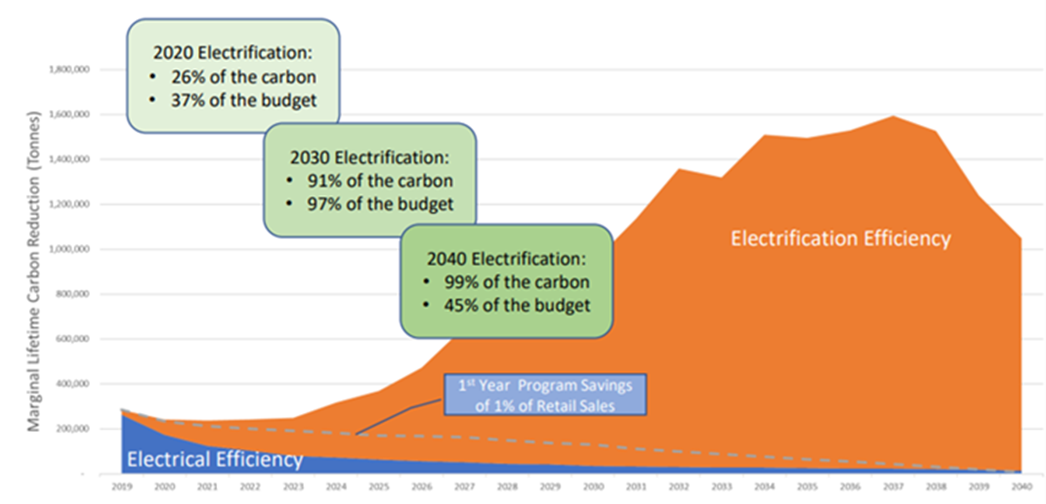
Source: “Electrification – What Does It Mean for Energy Efficiency?

In short: DOE and its minions are running out of stuff to regulate under existing energy efficiency statutes within EPCA. A move to carbon efficiency regulation vastly expands their regulatory empire. The IRA is providing obscene amounts of taxpayer funding to force-feed this anti-consumer agenda.  For more information, see Dangerous ‘Deep Decarbonization’ (Krebs PowerPoint to Cooler Heads Coalition). For the record, that presentation identified the $8,000 heat pump tax credit stated at the beginning of this article.

As Travis Fisher testified before the House Energy & Commerce Subcommittee on Energy, Climate, and Grid Security on September 11th, “ The subsidies in the IRA for wind, solar, and batteries alone could cost American taxpayers $3 trillion by 2050.” Fisher also testified: “Between the IRA subsidies and the EPA rules, I would summarize the administration’s power grid policy as this: Green the grid and brace for blackouts.”

The Competitive Enterprise Institute is leading a coalition of free market advocates attempting to organize support to stop the IRA’s obscene and consumer abusive funding. In response, the Biden (mis)Administration is attempting to shovel IRA funding out the door as fast as it can to contractually shield it.  For further information, see Dismantling the Inflation Reduction Act green Subsidies Coalition Letter

——————–

Mark Krebs, a mechanical engineer and energy policy consultant, has been involved with energy efficiency design and program evaluation for over thirty years. Mark has served as an expert witness in dozens of State energy efficiency proceedings, has been an advisor to DOE and has submitted scores of Federal energy-efficiency filings. His many MasterResource posts on natural gas vs. electricity and “Deep Decarbonization” federal policy can be found hereMark’s first article was in Public Utilities Fortnightly, titled “It’s a War Out There: A Gas Man Questions Electric Efficiency” (December 1996). Recently retired from Spire Inc., Krebs has formed an energy policy consultancy (Gas Analytic & Advocacy Services) with other veteran energy analysts.

The post Heat Pump Subsidies: Never Enough appeared first on Master Resource.

via Master Resource

https://ift.tt/USwvgD7

September 18, 2024 at 01:11AM

Banana waste for synfuels has an increasing appeal

Textiles and fuel from bananas?

via CFACT

https://ift.tt/Aiv78BL

September 18, 2024 at 12:13AM

Pope Francis’ Climate Crusade or the erosion of faith in God, a tale of two encyclicals

Press release Clintel Foundation

By uncritically embracing climate catastrophism, Pope Francis, perhaps unwittingly and most certainly unwillingly, rejects the God he clearly tries to serve wholeheartedly. That is the main conclusion of the essay Pope Francis’ Climate Crusade or the erosion of faith in God, a tale of two encyclicals, written by Jaap C. Hanekamp and William M. Briggs and published by Clintel.

Pope Francis outlined his views on climate change in two encyclicals, Laudato Si’ (2015) and Laudate Deum (2023). Concisely, the Pope fears that the world in which we live is collapsing and may be nearing the breaking point because of climate change. In fact, the Pope announced in his encyclicals that there is a “global climate crisis.”

In the essay Pope Francis’ Climate Crusade or the erosion of faith in God chemist and theologian Jaap C. Hanekamp and statistician and meteorologist William M. Briggs reflect on both encyclicals, though they do not assess the scientific information on climate change as such. Instead, they examine the Pope’s use and understanding of models, and delve deeper into the overarching philosophy that sustains both encyclicals. They conclude that the Pope, carelessly in their view, embraces scientism, and not science, which inadvertently weakens his position, and those that follow his scientistic prescriptions.

Scientism is the ideology that science alone is deemed capable of elucidating and resolving all genuine human problems, and that all human affairs can be reduced to science. Accordingly, scientism is the effort to expand science to all other fields of human affairs, even theology, and to usurp them in a reductionist fashion.

Hanekamp and Briggs conclude that the climate scientism Pope Francis peddles stands diametrically opposed to the Christian worldview. “Scientism of any stripe is incommensurable with not only the Christian faith but also with science.”

About the authors
Jaap C. Hanekamp is a chemist by trade and received his first PhD in 1992. In 2015, he defended his second dissertation: Utopia and Gospel: Unearthing the Good News in Precautionary Culture. He blogs at https://jaaphanekamp.com/. William M. Briggs holds a PhD in Mathematical Sciences and an MS in Atmospheric Physics, and has served in various roles including professor, consultant, and statistician. He blogs at https://www.wmbriggs.com/.

The essay can be downloaded here.

ABOUT CLINTEL
The Climate Intelligence foundation (Clintel) was founded in 2019 by emeritus professor of geophysics Guus Berkhout and science journalist Marcel Crok. Clintel’s main objective is to generate knowledge and understanding of the causes and effects of climate change, as well as the effects of climate policy. Clintel published the World Climate Declaration, which has now been signed by more than 1900 scientists and experts. Its central message is “there is no climate emergency”. In 2023 Clintel published the book The Frozen Climate Views of the IPCC, in which it documented serious errors and biases in the latest IPCC report.

via Watts Up With That?

https://ift.tt/iBSxFsh

September 18, 2024 at 12:03AM

Nuclear power stations can be a beautiful part of the environment.

Dr Kelvin Kemm

Over the past 25 years, the world electricity demand doubled. All indications are that it will double again over the next 25 years. In fact, the time span is likely to be much shorter. The emergence of more electricity-intensive consuming technologies such as data centres is causing electricity demand to rise more steeply. Then one must add the rising demand of developing countries in which. People are moving from cooking dinner over an open fire outdoors to acquiring an electrical stove and fridge.

The image of electricity demand is a large boulder rolling down a hill, it is not stopping or slowing. In fact it is rolling faster and faster.

Without doubt fossil fuels will continue to be the backbone of world electricity generation for decades to come. But equally certain is that nuclear power is making a rapid advance across the globe. That means not only for the traditional large, industrialised countries, but also for the less developed, or much smaller countries. Rapid development of Small Modular Reactor technology is also accelerating the options for the adoption of nuclear power on a large scale. South Africa was the first country in the world to start developing a commercial Small Modular Reactor, and has continued with the work for over 30 years.

Some years ago, South Africa announced its intention to add an additional 2500 MW of new nuclear to its existing nuclear base. Early in 2024, the energy minister confirmed the acceleration of this goal. The intention, from inception, was to build a new 2400 MW coastal nuclear plant, but also to dedicate 100 MW to the development of SMR’s for inland use. In September 2024, the energy minister gave a public address in which he stated that we must go ahead on the basis of science and facts, and not be ‘fighting in the mud’ with activists who rely more on emotion than reality.

South Africa is forging ahead with a new nuclear build. This is excellent news. The current initiative is for an additional 2500 MW of nuclear, composed of a 2400 MW new large nuclear power station on the coast, plus 100 MW dedicated to Small Modular Reactor (SMR) development.

The announcement of the continuation of the project was greeted with applause by many, but as always, the anti-nuclear lobby were frothing at the mouth about all the imagined problems associated with nuclear power.

But let us digress for a moment, to consider the macro-implications of this initiative.

Building a large nuclear plant is essentially following in the footsteps of the traditional route, that being; placing a large plant on the coastline at an ideal site. The resulting power is then transmitted over some distance to consumers.

But what of SMR’s? The crucial difference with a gas-cooled SMR, which does not need a large body of water for cooling purposes, is that you can take the reactor to the consumer. You can place the rector anywhere you like. This reality enables planners to embrace. Embark on a highly flexible. Nuclear solution across the entire country.

Think about it!

Let us now make a comparison with a cell phone system. Prior to the advent of cell phones, a telephone network consisted of major exchanges, interconnected by means of long-range connections. Then cell phones arrived. The cells are something like the honeycomb of a beehive, and each cell has its own main base station antenna. Each cell handles calls within the cell.

The emergence of Small Modular Reactor (SMR) systems onto the modern scene, essentially makes a nuclear cell system a reality. One can now place a gas-cooled SMR anywhere, and it can serve its own ‘cell.’ This ‘cell’ could be a mining complex, a municipality, a collection of factories, or an agricultural area encompassing the farm, proceeding to processing, packaging, and transport. Such a ‘cell’ does not even need to be connected to the National Grid, and can be owned by a Province, Municipality, or private company.

The SMR revolution effectively means that the fundamental planning options available for the distribution of electricity have changed significantly.

A gas-cooled SMR, such as the South African HTMR-100 is walk-away-safe. The fuel cannot suffer a meltdown under any circumstances. Such an SMR emits absolutely nothing during normal operations, no solids, no liquids, no gases. The fuel is in the form of balls, the size of a tennis ball, and each ball lasts between two and three years in the reactor. So, the amount of refuelling required is extremely small, in comparison to coal, gas, or oil plants. So no continuous refuelling structure is required, such as a conveyor belt, pipeline, or railway line.

What all this means is that small nuclear plants can be safely and effectively placed in industrial areas or agricultural areas, or near an idyllic town. One of the accusations of the extremist anti-nuclear lobby has always been that nuclear reactors are ugly industrial structures which spoil beautiful scenic coastlines

With modern SMR’s we can totally remove that accusation. Since then is a bomb, it’s nothing during operation. And what’s more? Is totally silent. It can be integrated into the Vista of any setting. With this in mind, the developers of the HTMR-100 range of reactors approached Johann Koch of Johann Koch Design Architects (JKDA) with a proposal to work together to develop SMRe complexes for a range of customers.

Stratek Global originally developed the HTMR-100 for a classic industrial setting in South Africa, such as a gold-mining complex, far inland, and far away from any large water body. However, Stratek Global has been approached by potential customers from around the world, including the Middle East, Australia, a number of African countries, and also island states.

Furthermore, site factors such as the altitude, have varied from sea level to high altitude. The prevailing weather conditions have varied from hot and dry, to cold and wet, including snow.

As a result, Stratek Global is in a position to offer any type of nuclear power complex which can be designed to fit, not only any site but which can also be skilfully designed to match the scenery or cultural nature of the people and area.

Since nuclear is completely clean and green, emitting no gasses, liquids, or anything else, during normal operations, there is no reason why nuclear power stations must be viewed as ugly industrial buildings. They can be made as attractive as a hotel complex or holiday resort.

Illustrated here or four of the designs developed as a result of customer requests. They are named; the Impala Design, Kudu Design, Oryx Design, and Sable Design.

The Kudu Design was developed for an African savanna setting. It is shown here with a single reactor of 100 MW thermal output, or 35 MW electrical output.

Kudu Design: For a temperate setting near a town or agricultural cluster

A most useful aspect of the. HTMR-100 is that an SMR complex can be designed to take up to ten reactors. All ten can be run from a single control room. Obviously, building more reactors per site reduces the unit cost, because you don’t have to duplicate the administration building, the workshops, or a variety of other facilities. Furthermore, if a site is designed for, say, ten reactors they do not all have to be constructed at the same time. An owner can add reactors, in later years, as the demand rises, or as finances become available, thereby allowing for immense planning flexibility.

The Oryx Design was developed as a result of a request from the Middle East. It also features a single reactor, but can easily be adapted for more reactors.

Oryx Design: A one reactor setup for a desert region

Computer graphic showing the interior arrangement of the reactor building. Approximately 60% of the reactor is underground. Ground-level is at the bottom of the ventilation stack.

The single reactor Impala Design is a workhorse design for an industrial setting such as a South African gold mining complex. This design was developed to fit into any existing industrial complex. It illustrates that other than the actual nuclear reactor itself, in the cylindrical concrete containment vessel, the rest of the power station consists of perfectly normal industrial buildings.

Impala Design: A basic one reactor design for an existing industrial setting

The Sable Design was developed as a result of a request from a country which experiences snow conditions. The request was for a ten-reactor complex. The reactors can be added, over a period of some years, as the customer sees fit.

Sable Design: Showing eight reactors, in a snow region


Dr Kelvin Kemm is a nuclear physicist and is Past Chairman of the South African Nuclear Energy Corporation (Necsa). He is currently Chairman of Stratek Global, a nuclear project management company based in Pretoria, South Africa. The company carries out strategy development and project planning in a wide variety of fields for diverse clients. They are working towards building an HTMR-100 nuclear reactor in Pretoria.   Kelvin.kemm@stratekglobal.com.

http://www.stratekglobal.com

via Watts Up With That?

https://ift.tt/SlzXyI7

September 17, 2024 at 08:01PM