Month: September 2024

Climate Realism: A Sane Approach – You’re The Voice Ep. 42 with Prof. Steven Koonin

From You’re The Voice | by Efrat Fenigson

Co-hosted by Tom Nelson & Efrat Fenigson

🎙️ My guest today is Prof. Steven Koonin, co-hosted with Tom Nelson – host of The Tom Nelson Podcast. Prof. Koonin is an American theoretical physicist and former director of the Center for Urban Science and Progress at NYU, as well as a professor in the Department of Civil and Urban Engineering at NYU School of Engineering. In the past he was the Chief Scientist of BP’s oil and gas division, served as Under Secretary for Science in the Department of Energy, in the Obama administration, and was the vice-president of Caltech, one of the most prestigious scientific institutes in the world.

Steven is the author of the book “Unsettled: What Climate Science Tells Us, What It Doesn’t, and Why It Matters”, where he argues that while there are some basic facts about climate change that experts agree upon, the meaning of those facts is not so settled, and mainstream scientific studies do not support the notion that there is any kind of climate crisis at all.

This conversation discusses Climate Realism – the sane approach to the “Climate Change” alarmism, and the role of media in shaping public perception. We touched on topics such as the use of the term ‘climate denier,’ bias in the energy industry, the challenges faced by young scientists who question the climate narrative, the role of journalists in spreading misinformation, and the influence of organizations like the UN and Covering Climate Now. We talked about the viral documentary ‘Climate the Movie’ and censorship attempts. Lastly we touched on the funding dynamic in climate research, and geoengineering / chemtrails. Steven emphasizes the need for open scientific discussion and the importance of prudence in considering these interventions. We end with the challenges & optimism in maintaining integrity and truth-telling in a corrupted world.

“For young scientists, speaking out against the climate narrative can be a career killer” — Prof. Steven Koonin

This episode is on TwitterSpotifyFountain and more.
Got value? please like, comment, share, subscribe & support my work!

We talked about: 

00:00 Coming Up
01:14 Introductions
03:54 Challenging the Term ‘Climate Denier’
06:43 The Climate Discussion “Silence”
09:03 Impacts on Those Speaking Out
10:53 Steven’s Evolution to Climate Realism
16:33 Misrepresentation of Facts
21:37 Organized Online Propaganda
27:34 Climate – The Movie
32:03 Geoengineering & Chemtrails
41:10 Red Team, Blue Team
44:33 Dating CO2 in Deep Ice
45:55 Playing Bongos with Richard Feynman
49:06 Message of Hope

My takeaways: 

  • The term ‘climate denier’ is offensive and misleading, as sceptics like Steven Koonin base their arguments on scientific evidence.
  • Experience in the energy industry can provide valuable insights into how to effectively change the energy system.
  • Speaking out against the climate narrative can be a career risk for young scientists due to funding and publishing challenges.
  • According to Koonin, misinformation in the media is a result of journalists not digging deeper and scientists not correcting the misrepresentations.
  • The UN’s claim to ‘own the science’ and collaboration with Google to control search results proves bias and censorship.
  • The documentary ‘Climate the Movie‘ faced attempts at cancellation but gained widespread attention and support from viewers. It has been well-received and has sparked open discussion about climate change, unlike platforms such as Facebook that label it as misinformation.
  • The funding dynamic in climate research is discussed, with the observation that adding climate speak to a project can qualify it for climate-related funding. This raises questions about the integrity of research and its bias.
  • Geoengineering, such as stratosphere aerosol injection and cloud seeding, is a topic of interest and debate. While it may be technologically feasible to lower the surface temperature of the globe, there are concerns about unintended side effects and the long-term viability of these interventions.
  • There is a need for a red team, blue team approach in climate science to encourage open and rigorous scientific discussion and challenge the consensus. However, this approach is not currently favored by the Biden administration.
  • Maintaining integrity and truth-telling in the face of corruption is a challenge, but it is essential for scientists to lay out the facts and let people decide for themselves.

Watch on YouTube:

Watch/listen on Spotify:

Follow Prof. Steven Koonin & Tom Nelson:

Prof. Koonin’s book | Tom’s Twitter | Tom’s links 

The above interview is archived on our ClimateTV page

via Watts Up With That?

https://ift.tt/TaokWGP

September 17, 2024 at 04:00PM

2024 Arctic Ice Abounds at Average Daily Minimum

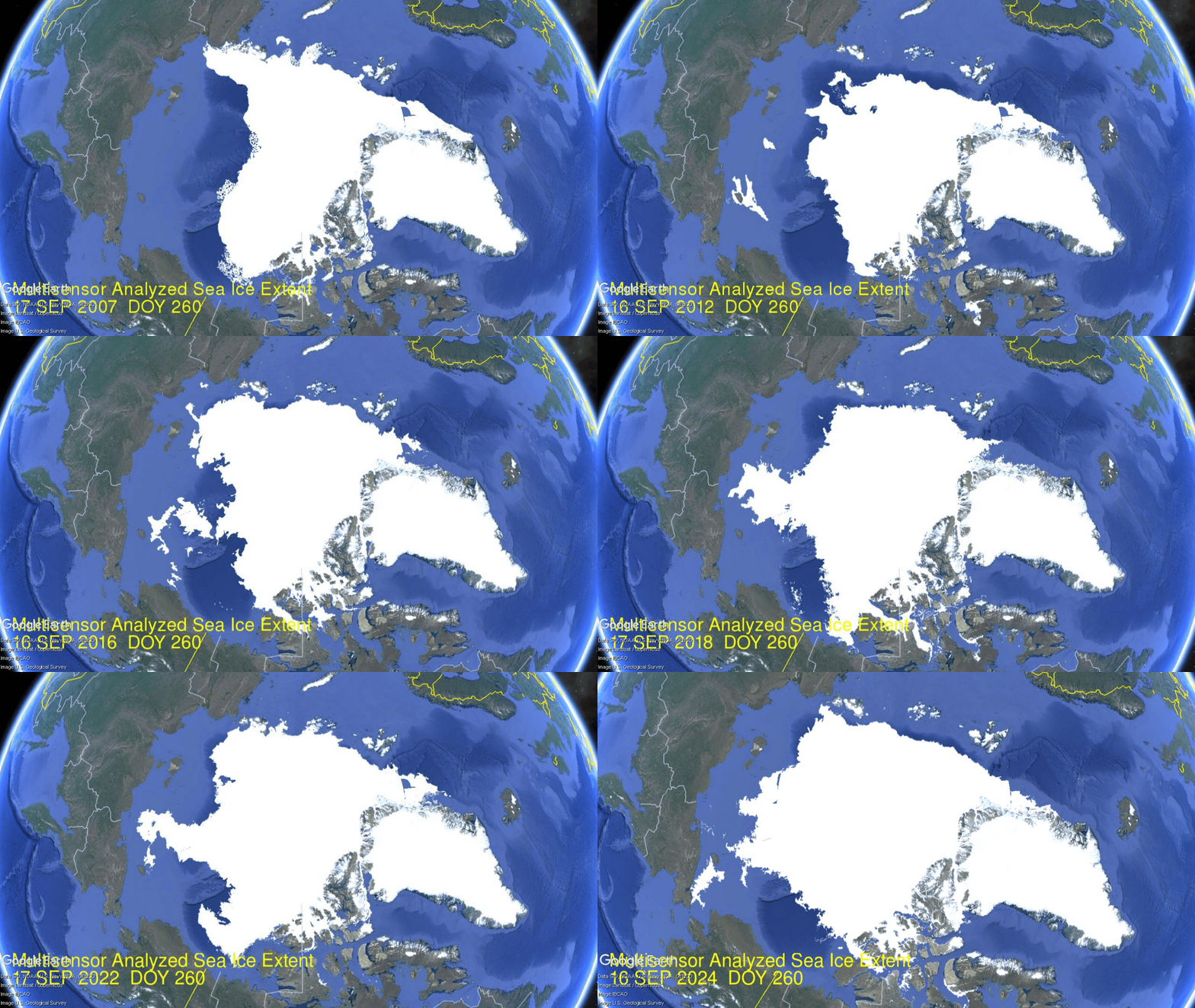
The annual competition between ice and water in the Arctic ocean has reached the maximum for water, which typically occurs mid September.  After that, diminishing energy from the slowly setting sun allows oceanic cooling causing ice to regenerate. Those interested in the dynamics of Arctic sea ice can read numerous posts here.  This post provides a look at mid September from 2007 to yesterday as a context for understanding this year’s annual minimum.

The image above shows Arctic ice extents on day 260 (lowest annual daily extent on average) from 2007 to 2024 yesterday.  Obviously, the regions vary as locations for ice, discussed in more detail later on. The animation shows the ice deficits in years 2007, 2012, 2016, 2020 and 2023, as well as surplus years like 2010, 2014, 2022 and 2024.

Note that for climate purposes the annual minimum is measured by the September monthly average ice extent, since the daily extents vary and will go briefly lowest on or about day 260. In a typical year the overall ice extent will end September slightly higher than at the beginning.  2024 September ice extent averaged 4.6M over the first 16 days, and is likely to end the month with at least that amount for the entire month. For comparison, the 17 year average for Sept. 1-16 is 4.7M.

The melting season to mid September shows 2024 tracked lower than average but ended the period slightly above.


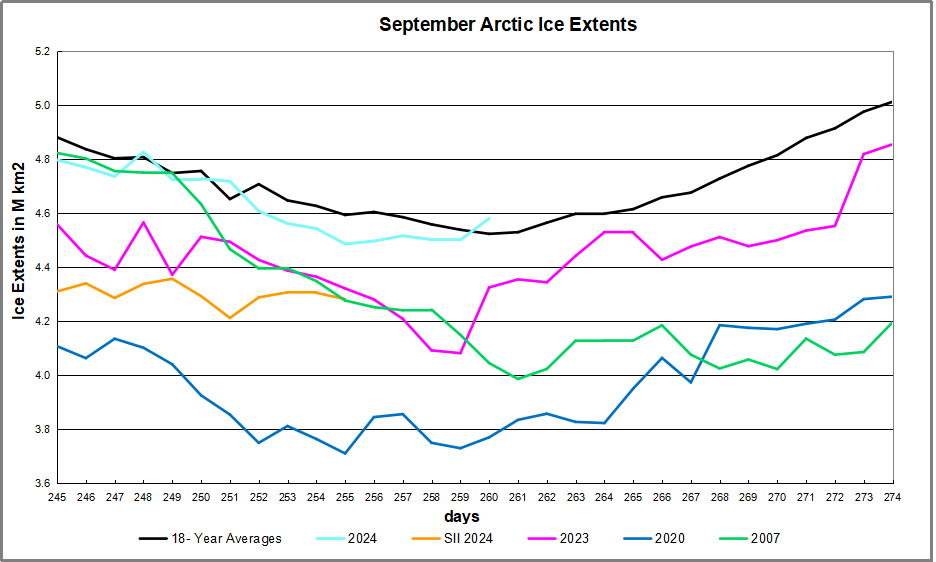
The graph above shows September daily ice extents for 2024 compared to 18 year averages, and some years of note. Day 260 has been the lowest daily ice extent on average for the last 18 years.

The black line shows on average Arctic ice extents during September decline 358k km2 down to 4.5M Km2 by day 260. The average increase from now on is 490k km2 up to 5.0M km2 end of September.  2024  tracked a little lower than the 18-year average in the second week reaching a low of 4.49M km2 on day 255, before going above average on day 260.

SII was reporting deficits as high as 0.5M km2 (half a Wadham) compared to  MASIE early in September.  For some reason, apparently data access issues, that dataset has not been updated for the last five days.  2023 bottomed out at 4.1M while 2007 daily minimum hit 4.0M, ended ~ 0.5M km2 in deficit to average and 535k km2 less than MASIE on day 260.  2020 ice on day 260 was ~740k km2 in deficit to average.

The main deficit to average is in CAA with a smaller loss in Chukchi, overcome by surpluses almost everywhere, especially in Central Arctic along with Laptev and Greenland seas. And as discussed below, the marginal basins have little ice left to lose.

The Bigger Picture 

We are close to the annual Arctic ice extent minimum, which typically occurs on or about day 260 (mid September). Some take any year’s slightly lower minimum as proof that Arctic ice is dying, but the image above shows the Arctic heart is beating clear and strong.

Over this decade, the Arctic ice minimum has not declined, but since 2007 looks like fluctuations around a plateau. By mid-September, all the peripheral seas have turned to water, and the residual ice shows up in a few places. The table below indicates where we can expect to find ice this September. Numbers are area units of Mkm2 (millions of square kilometers).

Day 260 17 year
Arctic Regions 2007 2010 2014 2016 2018 2020 2021 2022 2023 Average 2024
Central Arctic Sea 2.67 3.16 2.98 2.92 2.91 2.50 2.95 3.08 2.96 2.92 2.95
BCE 0.50 1.08 1.38 0.52 1.16 0.65 1.55 0.99 0.50 0.88 1.02
LKB 0.29 0.24 0.19 0.28 0.02 0.00 0.13 0.20 0.39 0.18 0.16
Greenland & CAA 0.56 0.41 0.55 0.45 0.41 0.59 0.50 0.43 0.44 0.47 0.39
B&H Bays 0.03 0.03 0.02 0.03 0.05 0.02 0.04 0.02 0.04 0.04 0.05
NH Total 4.05 4.91 5.13 4.20 4.56 3.76 5.17 4.73 4.33 4.49 4.58

The table includes some early years of note along with the last 4 years compared to the 17 year average for five contiguous arctic regions. BCE (Beaufort, Chukchi and East Siberian) on the Asian side are quite variable as the largest source of ice other than the Central Arctic itself.   Greenland Sea and CAA (Canadian Arctic Archipelago) together hold almost 0.5M km2 of ice at annual minimum, fairly consistently.  LKB are the European seas of Laptev, Kara and Barents, a smaller source of ice, but a difference maker some years, as Laptev was in 2016 and 2023.  Baffin and Hudson Bays are inconsequential as of day 260.

2024 extent of 4.58 is 1.3% over average, mainly due to surpluses in Chukchi and East Siberian seas.

For context, note that the average maximum has been 15M, so on average the extent shrinks to 30% of the March high (31% in 2022) before growing back the following winter.  In this context, it is foolhardy to project any summer minimum forward to proclaim the end of Arctic ice.

Resources:  Climate Compilation II Arctic Sea Ice

via Science Matters

https://ift.tt/AjrcHUs

September 17, 2024 at 03:39PM

Sheffield Weston Park DCNN 4061 – Implications.

53.38144 -1.49138 Met Office assessment CIMO Class 5 Installed 1/1/1882

A significant landmark in Sheffield, the Weston Park Observatory was constructed in 1880 and has a continuous site record from 1882. There is nothing outwardly particularly contentious about this site. The Met Office accepts it is CIMO Class 5 and unquestionably subject to significant Urban Heat warming effects. Despite this the Met Office describe the site as “Satisfactory”.

From the multiple historic A57 street view images on google maps nearly half show an ice cream van parked close by the Weather station no doubt with its engine frequently running. No longer an ideal site so why should it be of any great concern? Well there are implications…….

Think of all those weather forecasters comments “these overnight temperatures shown are for towns and cities – it will be a few degrees colder in rural areas” or “and maybe a touch of ground frost in the countryside”. Obviously nobody has set up artificial cooling devices for rural areas so it is the urban areas that are artificially several degrees warmer – the Urban Heat Island Effect. Basic stuff.

From Wikipedia, the Urban Heat Island effect elevates temperatures by

“heat trapping due to land use, the configuration and design of the built environment, including street layout and building size, the heat-absorbing properties of urban building materials, reduced ventilation, reduced greenery and water features, and domestic and industrial heat emissions generated directly from human activities”.

The temperature elevation effect is, however, known to be generally greater at night times than day times with overnight lows holding up significantly higher than elsewhere and raising daily average temperatures. So, in many respects, for city dwellers this can be a good thing – saves on the heating bills. Conversely those in rural sites will experience colder averages and consequently more expensive heating bills.

UHI and the increasing loss of rural located quality weather stations over recent years will be the topic of a separate detailed post demonstrating the effect this has had on the historic temperature record. For now this post concentrates on more social issues.

Not to be confused with “Winter Fuel Payments“, for those in the UK on most means tested benefits there are additional “Cold Weather Payments” (CWPs) which automatically pay extra money to those deemed financially and/or physically vulnerable during colder conditions. Extra considerations are given for those families with young children under 5 years old. The trigger for these payments is the average temperature measured at specific weather stations allocated to specific post code areas across the UK.

“You’ll get a payment if the average temperature in your area is recorded as, or forecast to be, zero degrees celsius or below over 7 consecutive days. {editors note: what “average” method?}

You’ll get £25 for each 7 day period of very cold weather between 1 November 2024 and 31 March 2025.”

This charity advice site below lists all the weather stations applicable to postcodes for which CWPs were made in winter 2022/3.

https://lottie.org/fees-funding/dwp-cold-weather-payment/

So what if you live in a higher altitude rural post code area surrounding Sheffield well away from the UHI experienced in Weston Park and significantly colder? The total postcodes allocated to Sheffield are:

If Weston Park doesn’t average below the trigger point it is tough luck on you however cold it may actually be if you live in any of its allocated post codes.

The Met Office must know of this issue, they surely cannot be that naive or just maybe they never gave it a thought – just drew some lines on a map. Whatever, the responsibility must lie with them as they are supposed to be the experts in this field and the DWP simply refers to them for advice.

Alarmingly, from the full allocation listing, a high proportion of triggering sites are found to be in known UHI affected areas such as Sheffield and are equally at CIMO Class 4 or 5 levels of inaccuracy.

I am raising this point with our new (allegedly) more socially responsive government for their views. It will be interesting to see who the responsible Ministers side with. I will report back any responses.

Meanwhile it is worth remembering there are more immediate implications to poor weather station siting than just corrupting the historic temperature record. I will cover these other equally surprising implications in future posts.

via Tallbloke’s Talkshop

https://ift.tt/vQbKqHD

September 17, 2024 at 03:12PM

Greens Blame President Trump for COP29 Lack of Progress

Essay by Eric Worrall

First published JoNova – Nobody wants to move until they see whether the USA will pay for their green charade?

Trump stalks global climate talks as COP29 draws near

BY NICK PERRY
Sep 16, 2024

PARIS – 

The prospect of Donald Trump returning as president is hanging over crucial U.N.-sponsored climate negotiations, with countries “holding back” their positions until they know who sits in the White House.

Veteran observers of climate diplomacy say uncertainty over the election outcome is stalking this November’s COP29 summit, which starts just six days after voters decide between Trump and Kamala Harris.

The election lands awkwardly as governments try to build global consensus in coming months not just around climate but stronger protections for the environment and a treaty to address plastic pollution.

Ali Mohamed, chair of the African Group of Negotiators, accused developed countries of navel gazing and displaying “a lack of seriousness” at the bargaining table.

“The climate change situation really doesn’t care about who is at the helm of the U.S., whether it is a Republican or a Democrat,” he told reporters.

Read more: https://www.japantimes.co.jp/environment/2024/09/16/climate-change/trump-global-climate-talks-cop29/

This is funny on so many levels.

For starters, could fake claims that renewables are cheap possibly be any deader? Renewables are hideously expensive – otherwise why would nations which have already gone big on renewables be holding back?

And then there is the funny they are still blaming Trump – even though he hasn’t been in office since the start of this decade.

Only true believers still think COP conferences have anything to do with the environment. COP28 was held in a petro-state, where the COP28 conference president allegedly spent much of his time trying to ink natural gas sales.

COP29 will be held in Azerbaijan, even more of a petro-state than the UAE. Azerbaijan is a nation which for over a century has been renowned as a major provider of oil and gas. I wonder what their environmental focus will be?

The environmental movement is dead, except in a few places which persist in clinging to the faith, their power is broken. The world will never genuinely switch to green energy. World leaders barely even bother to hide their contempt for the global environmental movement anymore – why else mock greens by holding big environmental conferences in petro-states?

The only question is, how will the petro-state organisers of the COP climate conferences top this supreme mockery of environmental causes? Will the next climate conference be held in the middle of a Texas oil field? On an ocean oil rig? It’s going to be a challenge to pick a location even more hilarious than Azerbaijan.

via Watts Up With That?

https://ift.tt/DmENq3u

September 17, 2024 at 12:07PM