
By Paul Homewood
h/t Philip Bratby
On the day that Labour’s poll rating dips below 30% in record time after an election win, we are reminded of two good reasons why.

Ed Miliband told the EnergyUK conference this morning that he wants to take on the ‘blockers, delayers and obstructionists’ who stand in the way of Britain’s energy security. Oh good, does that mean that finally he appreciates that the North Sea needs some encouragement? And that a UK fracking industry will finally be allowed to commence, after years of being blocked in the courts by environmentalists spinning false stories about how it will cause your water taps to burst into flames and cause devastating earthquakes (including those actually felt at the Earth’s surface)?
Er, sadly not. Miliband, of course, rather likes blockers and delayers when they are on his side. Indeed, the entire government does, which is why it is not challenging the High Court’s decision last week to quash planning permission for a Cumbrian coal mine. This mine would have provided coking coal for the UK’s steel industry (or at least would have done before the previous government pulled the plug on Britain’s primary steel industry, forcing us to import steel instead).
Is Lammy’s mind really on his job?
Stand in the way of oil and gas – which even the Labour party manifesto accepted is going to form part of our energy mix for decades to come – and the government will won’t lift a finger to stop you. But as for people who are a little reluctant to accept vast acres of the countryside disappearing beneath wind and solar farms, they are a threat to Britain’s energy security – and indeed ‘national security’ – and must be denounced.
Miliband isn’t alone in taking up this theme of national security to try to defend Labour’s green policy. Foreign secretary David Lammy is at it too this morning, telling us that climate change presents a ‘more fundamental’ threat to national security than terrorism does.
Is Lammy’s mind really on his job? Sure, there are all sorts of reasons why it might be desirable to shift towards cleaner energy if it is affordable. But does he seriously think that climate change deserves more of his attention as foreign secretary than the threat from terrorism? London might be a bit warmer than it was half a century ago, and a little wetter, too, while sea levels might be rising by 3 mm a year (the capital is also a little less stormy, less foggy and its population a lot less prone to hypothermia than in the past, though we rarely hear about that side of the climate change ledger). But David, what I would really love to know is what you are doing to guard against the very real possibility that a bunch of terrorists could get hold of nuclear material and explode a ‘dirty bomb’ in Trafalgar Square? Or a 9/11 style attack on Canary Wharf?
That is before we even get into the matter of what a rogue state could do to us, with the full backing of armed forces. I know there are a lot of young people who have grown up on climate paranoia and have been really quite traumatised by what they see as the threat of being ‘fried’ by slightly higher summer temperatures. But those of us who were brought up in the Cold War have a slightly different perspective: by far the greatest threat to humanity continues to be nuclear war – which really would lead to large numbers of people genuinely being fried, and to somewhat rapid and dramatic climate change.
I hope, deep down, that our foreign secretary appreciates this, and that his comments this morning are just a bit of politicking to try and defend a green energy policy which is beginning to crumble in the face of reality. The trouble is that, with Lammy, I feel we can never be quite sure.
https://www.spectator.co.uk/article/the-problem-with-labours-energy-policy/
via NOT A LOT OF PEOPLE KNOW THAT
September 17, 2024 at 12:05PM

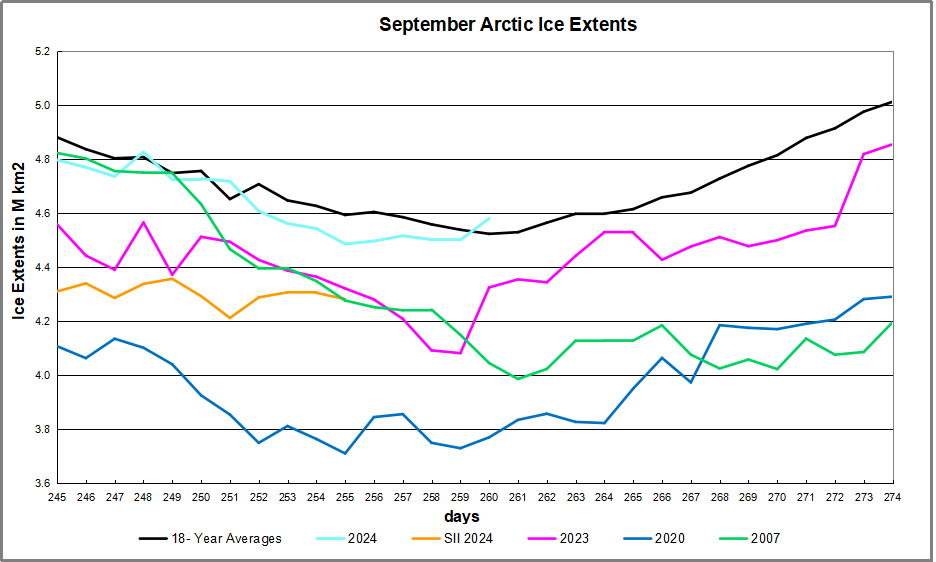
 The table below shows the distribution of Sea Ice on day 260 across the Arctic Regions, on average, this year and 2007. At this point in the year, Bering and Okhotsk seas are open water and thus dropped from the table.

 Iowa Climate Science Education