Month: September 2024

“People, Planet, Peace”: Green Party 2024

“A Jill Stein Administration will advance the ecosocialist Real Green New Deal that the Green Party made its signature issue in the 2010s.” (Green Party Platform, below)

The Green Party’s candidate Jill Stein is taking climate more seriously than Kamala Harris. In the Presidential debate, Harris did not dare pronounce the climate-change issue as an “existential threat” as done by her boss, Joe Biden. No mention of a domestic CO2 tax; border tariffs to prevent “leakage”; or global climate governance either. And certainly no reference to California, the leading climate state with gasoline prices 50 percent higher, electricity rates double, the national average.

As it was, the debate indicated that “Climate change is no longer a standalone issue in politics.” But to one candidate it is, giving a choice to climate activists a choice in the upcoming election. Back-peddling Harris or front-peddling Stein?

“Today we face a worsening global climate crisis that threatens the future of human life on Earth,” the Green Party platform reads. Continuing:

2023 was the hottest year on record. The 10 hottest years on record have all occurred in the past decade. This accelerating global heating is wreaking havoc on ecosystems, leading to bigger and deadlier fires, floods, megastorms, droughts, and heat waves. Environmental and climate injustice are disproportionately harming Black, brown, low-income, and Indigenous communities across the country and around the world.

Yet despite this existential emergency, the last few years have seen massive expansions in fossil fuel planning, infrastructure and production, with 2023 breaking the record for US oil production. The Wall Street parties, funded by corporate polluters, are driving us over the climate cliff.

Continuing:

We all have a human right to a livable planet with a stable climate, healthy food, clean air and water, and living soil. We need a real Green New Deal to transition rapidly from an economic system that is destroying our only home to a sustainable society built around human needs and protecting life on Earth. We need to act now so that our children and future generations can not only survive, but thrive.

Take this with a bag of salt. The record warming year was not predicted by climate models nor explained by greenhouse gas physics. The abrupt change is explained by natural factors that mainstream scientists are listing and trying to figure out. The “control knob” of CO2 on global climate change has, once again, fallen into uncertainty. In fact, the control knob is natural variability for weather statistics that may or may not set records.

Here is the Green Party platform in detail, and “ecosocialism” it is.

The Real Green New Deal

A Jill Stein Administration will advance the ecosocialist Real Green New Deal that the Green Party made its signature issue in the 2010s. 

It is imperative to distinguish the Real Green New Deal from the nonbinding “Green New Deal” resolution proposed in recent years. For instance, the nonbinding “Green New Deal” does not call for a ban on fracking or a prohibition of new fossil fuel infrastructure. Moreover, the inadequacy of the nonbinding “Green New Deal” to address climate and ecological crisis is further demonstrated by the following:

  • Extends the timeline for zero emissions by 15-20 years to 2050 
  • Redefines zero emissions to “net zero” to enable the continued burning of fossil fuels with false climate solutions like carbon capture and sequestration and direct air capture
  • Replaces tenet of democratic public ownership and planning in the energy, transportation, manufacturing, and housing sectors with unreliable market-based incentives featuring public subsidies for private corporations
  • Does not stipulate the phase-out of nuclear power – a scam which is dirty, dangerous, unaffordable, uninsurable and has no solution to the problem of toxic nuclear waste
  • No mention of the need for deep cuts in military spending and operations to help pay for the Green New Deal and slash emissions in the process

In short, we need the economic democracy of an ecosocialist Real Green New Deal to plan and coordinate the complicated transition to 100% clean energy and zero emissions on the rapid timescale required to save our climate. An ecosocialist approach is also necessary to fairly compensate and center people – primarily, Black, Indigenous, and the poor, who were systematically excluded from the original New Deal – as well as redress the lasting impacts of profoundly racist policies that derived from it including, but not limited to, redlining – which acted as a catalyst for the legacy of environmental racism.  

Climate and Energy

  • Declare a climate emergency utilizing presidential powers associated with the National Emergencies Act, Defense Production Act, and the Stafford Act, and issue executive actions to expedite national and international climate action. This would release $650 billion per year to support the manufacture of renewable energy and clean transportation technology, jump-starting the Green New Deal by generating millions of good-paying union jobs that green the economy – while improving the health of workers, ecosystems and communities. It also enables the reinstatement of the crude oil export ban overturned in 2015, comparable to closing 42 coal plants. It also enables suspension of the operations of all offshore leases and reduces fossil fuel exports, imports and investments in overseas fossil fuel projects.
  • Create an Office of Climate Mobilization to coordinate policy changes and other needed interventions to eliminate greenhouse gas emissions and ultimately achieve climate justice
  • Achieve 100% clean renewable energy and zero-to-negative carbon emissions by no later than 2035
  • Ensure all climate solutions are global in scope
  • Fund full climate reparations to developing nations as part of a Global Green New Deal
  • Reduce the size and budget of the military, as hyper-militarized foreign policy and military-dependent domestic economy are major contributors to the climate emergency, while also ensuring the military transitions to green energy
  • Codify and implement the 17 Principles of Environmental Justice and require all federal agencies to be trained in, and implement  the Jemez Principles for Democratic Organizing 
  • Ensure a Just Transition for workers shifting from the fossil fuel and other extractive and polluting industries to alternative work of their choosing
  • End all forms of subsidies to the fossil fuel industry
  • Prioritize disadvantaged and other environmental justice communities with 60 percent of green investments and climate justice projects
  • Take the energy industry into public ownership using a democratic federated structure, with municipal and regional utilities
  • Take all railroad systems into democratic public ownership, including freight, commuter, and high-speed rail
  • Build an electrified coast to coast high-speed rail and local Solutionary Rail
  • Provide clean baseload power using responsibly sourced energy storage technologies that capture renewable energy surpluses
  • Fully fund and strengthen the Environmental Protection Agency and the Department of the Interior and superfund site cleanup
  • Support a Constitutional Green amendment to guarantee the right of all people to clean air, land, and water
  • Invest in renewable energy infrastructure across the nation, including wind, solar, tidal, geothermal, battery and energy storage, and green hydrogen for limited uses where appropriate
  • Build a nationwide, publicly-owned smart electricity grid
  • Ban all forms of fracking, mountaintop removal, tar sands mining, and new fossil fuel infrastructure
  • Establish a moratorium on funding, constructing, and operating false climate solutions including carbon capture and sequestration, carbon offsets, cap and trade, biofuels, hydrogen combustion, “renewable natural gas”, waste incineration, and other forms of geoengineering
  • Phase out nuclear power, a dirty, dangerous, expensive, and uninsurable unneeded technology, and ensure no new nuclear energy facilities are constructed
  • Incentivize circular economies and zero-waste manufacturing 
  • Invest in geothermal energy infrastructure
  • Prioritize energy efficiency and conservation, require new buildings to demonstrate zero emissions by 2035 and retrofit existing buildings as part of a larger plan to phase out all existing gas hookups
  • Subsidize installation of heat pumps to replace fossil fuels for heating and cooling
  • Expand and transform the American Climate Corps into a public agency that employs millions for ecosystem restoration, climate damage mitigation, and renewable energy development
  • Rescind toxic provisions of the Inflation Reduction Act including those that provide subsidies, direct payments, and other forms of financial assistance to the fossil fuel industry, and provisions to fast-track the Mountain Valley Pipeline
  • Rescind permits for the Line 3, Line 5, and Dakota Access Pipelines, and implement an immediate and permanent ban on all Liquefied Natural Gas exports and infrastructure projects
  • Establish a Federal commission to deliver justice for residents of Cancer Alley, including recompense for all residents impacted by decades of environmental racism
  • Address the crisis of contaminated water supplies with national efforts to remove lead, PFAS, and other toxins from our water

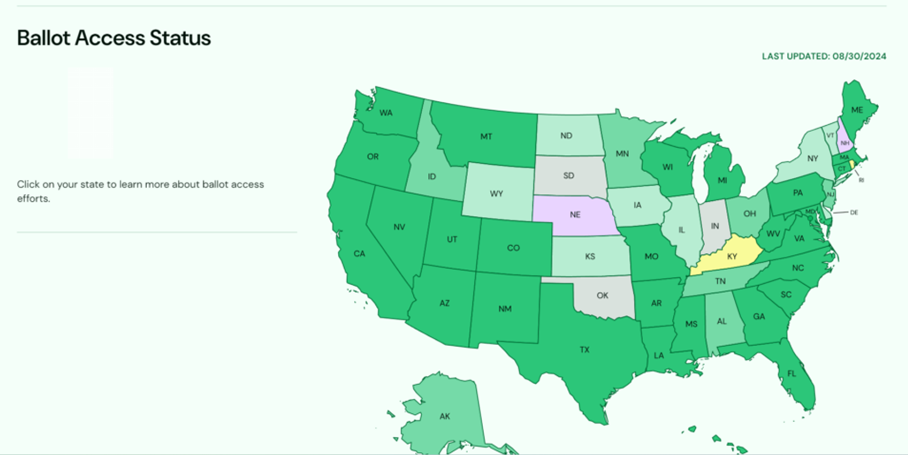
So will the Green Party figure in this year’s election? They are on the ballot (below) in most states with others expected to follow.
The post “People, Planet, Peace”: Green Party 2024 appeared first on Master Resource.

via Master Resource

https://ift.tt/YUQFgh7

September 17, 2024 at 01:12AM

Wind turbines are a blight on Rhode Island

The recent typhoon in China shows exactly what can happen in the American northeast with wind turbines. The amount of damage turbines may are already be causing to marine life ( you only see what is washing up on shore; what do you think is going on with the natural habitat below?) shows total disregard […]

via CFACT

https://ift.tt/t9p3VDQ

September 17, 2024 at 12:19AM

Stick to the Weather, World Meteorological Organization, Africa’s GDP Is Not Declining

From ClimateREALISM

By H. Sterling Burnett

The Associated Press (AP) posted a story describing a study by the World Meteorological Organization (WMO) which claims climate change is costing Africa as much as 5 percent of its GDP. Data show this is false. Extreme weather has not become more frequent or severe in Africa, and GDP in the different African regions and particular countries cited by the WMO and discussed in the AP story has grown substantially during recent period of climate change.

Monika Pronczuk, the writer of the AP story, “African nations are losing up to 5% of their GDP per year with climate change, a new report says,” uncritically parrots the WMO’s claims that “African nations are losing up to 5% of their GDP every year as they bear a heavier burden than the rest of the world from climate change.”

“‘Over the past 60 years, Africa has observed a warming trend that has become more rapid than the global average,’ said WMO Secretary-General Celeste Saulo, warning that it is affecting everything from food security to public health to peace,” wrote Pronczuck.

She should have checked the data.

As Climate Realism has discussed repeatedly, hard data from the United Nations and other government and international agencies refute any claims that climate change is making Africa’s weather worse or causing food insecurity. The latter claim has been debunked in repeated Climate Realism articles, here, here, and here, for example, which show that crop yields and production across the continent, except in areas of civil and cross border strife driven by religious and political conflicts, have regularly set records amid modest climate change.

Climate Realism has also shown that recent extreme weather events have not, in fact, been unusual in Africa’s history nor have they been more severe in recent decades, here, here, and here, for instance. In the few countries where food production has been hampered and economic growth has declined across multiple years in Africa, research shows it is consistently due to political strife, from civil wars, cross border conflicts, or political corruption. Climate change has not been a factor.

The main thrust of the WMO report is that because climate change has caused increasingly severe weather, it has also resulted in a GDP decline with African countries having to spend a disproportionate percentage of their incomes mitigating climate change. But since the former is false, the latter is as well. And, indeed, data consistently show substantial GDP growth across the period of recent climate change in the regions and countries discussed in the AP story, and one would presume the WMO report. In fact, the growth rate there has been at or above the world’s average GDP growth rate as a whole. For instance:

  • Data from the African Development Bank (ADB) shows GDP growth in the region of West Africa at or above 3 percent since 2000, topping 4 percent two of the four years. The further projects growth in each of the countries for the remainder of 2024 and through 2025, stating; “[g]reater agricultural output, expansion in the services sectors, and reforms to strengthen private sector participation in energy and mining are expected to drive growth in Benin (6.4 percent), Gambia (6.2 percent), Togo (6 percent), Mali (4.8 percent), Sierra Leone (4.6 percent), and Burkina Faso (4.1 percent).”
  • Data from the World Bank show that, excluding the high income countries in Sub-Saharan Africa, since 2000, GDP growth in the poorest countries has topped 6 percent five different years, five percent once, 4 percent five times, and only experienced negative growth in a single year, in 2020, the year of the pandemic. The poor countries in Sub-Saharan Africa experienced GDP growth rates of 4.3 percent, 3.7 percent, and 3 percent respectively in 2021, 2022, and 2023.

The AP mentioned Mali and Zambia in particular as countries suffering economic hardship due to climate change, but the data tells a different story. Over the past decade, Mali has seen its GDP grow every year but 2020, with growth topping 5 percent five of the past 10 years (spiking to 7.1 percent in 2014), and topping three percent every other year.

Zambia’s GDP history tells a similar story. Zambia’s growth in 2023 was 5.8 percent, the highest single year during the past decade, and except for the pandemic year of 2020, Zambia’s annual GDP increased, topping 3 percent growth in all but two growth years.

The WMO is a specialized agency of the United Nations whose mandate covers weather, climate, and water resources. It is staffed with meteorologists and other scientists who specialize in weather, not economists, and as such it is not known for its incisive economic acumen or analysis. No one goes to the WMO to analyze economic trends or for its forecasts of economic growth. Based on its uninformed, deeply flawed analysis climate change’s purported threat to Africa’s GDP, it might be a good idea for the WMO to stay in its lane and leave economic forecasting to economists.

Also, it might behoove the AP to do some simple fact checking (it takes just a few minutes through the magic of the internet), looking at existing hard data on trends before promoting economic analyses from organizations without apparent economic expertise. In fact, even when economists pronounce something, its would still be a good idea for the AP to check the data before uncritically parroting a claim as if it were the gospel truth.

H. Sterling Burnett

H. Sterling Burnett, Ph.D., is the Director of the Arthur B. Robinson Center on Climate and Environmental Policy and the managing editor of Environment & Climate News. In addition to directing The Heartland Institute’s Arthur B. Robinson Center on Climate and Environmental Policy, Burett puts Environment & Climate News together, is the editor of Heartland’s Climate Change Weekly email, and the host of the Environment & Climate News Podcast.

via Watts Up With That?

https://ift.tt/7cvuGBL

September 17, 2024 at 12:03AM

Why Are Renewable Equipment Companies Such Poor Investments?

By Steve Goreham

Originally published in RealClear Energy.

Headlines promote renewable energy equipment companies as part of efforts to transition to Net Zero carbon dioxide emissions by 2050. Wind and solar system providers, electric vehicle manufacturers, green hydrogen producers, and other green equipment firms form a growing share of world industry. But renewable equipment firms suffer poor market returns, so investors should beware.

The Renewable Energy Industrial Index (RENIXX) is a global stock index of the 30 largest renewable energy industrial companies in the world by stock market capitalization. Current RENIXX companies include Enphase Energy, First Solar, Orsted, Plug Power, Tesla, and Vestas.

IWR of Germany established the RENIXX on May 1, 2006, with an initial value of 1,000 points. This month, the RENIXX stood at 1,013 points, essentially zero value growth over the last 18 years. In comparison, the S&P 500 Index more than quadrupled over the same period. The RENIXX is down three years in a row from 2021, losing about half its value.

Wind turbine manufacturers faced serious financial challenges over the last three years, even with rising sales. Rising costs, high interest rates, and project delays continue to impact the profitability of wind projects and equipment suppliers. The stock of Denmark-based Vestas Wind Systems, the world’s largest supplier, rose only 7% over the last 16 years, and its stock price has fallen 58% from a high in 2021. Vestas struggled to make a profit in 2022 and 2023 and suspended dividends to shareholders.

Other major wind suppliers have also been poor investments for shareholders. The stock of Siemens Gamesa, the number two turbine maker, is down 65 percent since a peak in 2021. Gamesa reported a loss of €4.4 billion in 2023 and received a €7.5 billion bailout from the German government that same year. Other top wind suppliers suffered major stock price declines since 2021, including Goldwind of China (down 77%) and Nordex of Germany (-36%).

Eighty percent of the world’s solar panels are manufactured in China and the top six suppliers reside in China. The solar panel industry is beset by overcapacity and severe competition. Stock prices of the top seven suppliers have all declined by more than 50 percent since 2021. The stock of US firm First Solar has risen since 2021 but remains below its all-time high price reached in 2008.

Tesla, which was founded in 2003, remained the only pure-play, publicly traded EV stock until 2018. By the end of 2021, Tesla’s value had soared to over $1 Trillion, boasting a market value more than Toyota, Volkswagen, Mercedes-Benz, General Motors, Ford, BMW, and Honda combined. But Tesla is the exception.

But in most cases, electric vehicle (EV) companies have been very poor investments. Between 2020 and 2024, 31 EV companies went public on US stock exchanges. Only one of these 31 companies, the Chinese firm Li Auto, saw its price rise since the initial public offering (IPO). Thirty EV firms saw their stock prices fall, most precipitously.

EV company price declines from the IPO price include Fisker (-99%), Nikola (-94%), NIO (-50%), Lucid Group (-75%), and Rivian (-88%). Six others of the 31 companies went bankrupt. Tesla and Chinese firms BYD and Li Auto are the only EV firms profitable today.

ChargePoint is the world’s largest dedicated EV charger company (behind EV manufacturer Tesla), with over 25,000 charging stations in the US and Canada. ChargePoint went public in 2021 by merging with Switchback Energy Acquisition Corporation, valued at $2.4 billion. The firm’s value today is about $585 million, down 76% since 2021.  For fiscal year 2024, ChargePoint lost $458 million on revenue of $507 million.

It’s not clear that any charging company can make money. High-speed, 50-kilowatt EV chargers cost about five times as much as traditional gasoline pumps. Eighty percent of EV charging is done at home, reducing the demand for public charging. ChargePoint, EVgo, Wallbox, Allego, and Blink Charging are all valued today at small fractions of their original IPO price. No EV charger firm is profitable, even after continuing to receive large government subsidies.

Plug Power is a leading supplier of hydrogen energy systems, including battery-cells for hydrogen vehicles and electrolyzers to produce green hydrogen fuel. Founded in 1997, the company went public in October 1999 at a split-adjusted price of about $160 per share.

But during its 27-year history, Plug Power has never turned a profit. According to financial reports, the firm lost $1.45 billion in 2024, up from a loss of $43.8 million in 2018. Its current stock price is under two dollars per share.

Traditional established firms are finding that renewable equipment can be poor business. In 2023, Ford lost $4.7 billion on sales of 116,000 electric vehicles, or over $40,000 per vehicle. General Electric’s wind turbine business lost $1.1 billion in 2023.

The US federal government provided subsidies to renewable equipment companies of between $7 billion and $16 billion per year between 2010 and 2022. But the Cato Institute estimates that because of the passage of the Inflation Reduction Act in 2022, subsidies will skyrocket to about $80 billion in fiscal year 2025.

Without the fear of human-caused climate change and a rising level of government subsidies and mandates, many of these green companies would not exist. It’s doubtful that carbon dioxide pipelines, heavy electric trucks, offshore wind systems, green hydrogen fuel equipment, and EV charging stations would be viable businesses in unsubsidized capital markets.

During this last year, leading financial firms pulled back on their climate change pledges. Bank of America, JP Morgan, State Street, and Pimco withdrew from Climate Action 100+, which seeks to force companies and investment funds to address climate issues and adopt environmental, social, and governance (ESG) policies. But it’s difficult to invest in renewable equipment companies when they are losing money.

Steve Goreham is a speaker on energy, the environment, and public policy and author of the bestselling book Green Breakdown: The Coming Renewable Energy Failure.

via Watts Up With That?

https://ift.tt/AHrM3gO

September 16, 2024 at 08:03PM