Month: September 2024

German Trump Debate Fakecheck: “Germany’s energy system is fully operational”

Essay by Eric Worrall

“Operational” in the sense that high costs and annual winter shortages are shutting down the German economy.

German Gov’t Flops Attempting to Fact-Check Trump on Green Energy Debacle

KURT ZINDULKA
11 Sep 2024

Germany attempted to defend its disastrous energy policies in a fact-check-style response to former President Donald Trump who held up Berlin as a warning to the American public in Tuesday’s debate with Vice President Kamala Harris.

Mr Trump urged U.S. voters to reject the green agenda favoured by the Democrats and Harris, noting that even Germany has had to walk back its Energiewende transition as evidence of the foolhardy nature of the green agenda.

“You believe in things that the American people don’t believe in,” Trump said towards Harris. “You believe in things like, we’re not gonna frack. We’re not gonna take fossil fuel,” referencing her long-standing opposition to fracking, a position she has attempted to flip-flop on.

“Germany tried that and within one year, they were back to building normal energy plants,” Trump continued. “We’re not ready for it.”

Read more: https://www.breitbart.com/europe/2024/09/11/german-govt-flops-attempting-to-fact-check-trump-on-green-energy-debacle/

It’s difficult to know where to begin. The German political class is delusional if they truly believe their green energy achievements are an aspirational success.

As Volkswagen weighs its first closure of a German auto plant, workers aren’t the only ones worried

BY  DAVID MCHUGHUpdated 5:24 PM AEST, September 8, 2024Share

FRANKFURT, Germany (AP) — Volkswagen is considering closing some factories in its home country for the first time in the German automaker’s 87-year history, saying it otherwise won’t meet the cost-cutting goals it needs to remain competitive. 

Higher costs outweighed a modest 1.6% increase in sales, which reached 158.8 billion euros but were held down by sluggish demand. Blume called it “a solid performance” in a “demanding environment.” Volkswagen’s luxury brands, which include Porsche, Audi and Lamborghini, are selling better than VW models. 

Read more: https://apnews.com/article/volkwagen-germany-factory-closure-jobs-7f1877be05dae990da7f27e92cbdc3a4#

From January this year;

I suspect Germany is still feeling the pain of President Trump humiliating their green political class back in 2018, by correctly predicting that German reliance on Russian gas and failure to develop domestic fossil fuel resources would undermine their energy security.

The German political class laughed at Trump back then. The climate obsessed German bureaucrats with ring fenced government provided incomes are still trying to laugh. But no German who has to make a living in the real economy is laughing.

If Germany continues with the green madness, the entire nation is on a one way trip to Venezuelan levels of national destitution, or worse – except for the privileged bureaucrats and politicians of course.

Some Germans are trying to fight back. Parties like AFD did very well in recent elections, though likely this was more to do with AFD’s immigration policies than their climate policies. But AFD also emphatically rejects climate action, which appears to make AFD Germany’s best hope for righting Germany’s energy policy train wreck.

As for the dog eating comment, Trump as far as I know never accused Germans of eating their dogs.

But Germany has a long cultural tradition of eating dogs in times of hardship. Dog meat provided by government owned suppliers was openly served in restaurants in Munich until 1985, within living memory.

Fast forward to today, and we see that millions of Germans, an estimated 45% of Germans are currently suffering energy poverty and financial hardship, thanks to failed German green energy policies. And now it seems likely that imminent large scale job cuts are about to add to the pain of the German people.

Given that level of desperation, anything seems possible.

via Watts Up With That?

https://ift.tt/eFo7p3L

September 12, 2024 at 04:00PM

EV Misinformation Squared

As soon as I saw this headline at the Daily Mail,

Drivers of petrol and diesel cars have ‘really poor’ knowledge about EVs and it’s stopping many from going green, think tank claims

I knew fun was going to ensue. The theme is a constant one, and is as annoying as the McDonald’s chirpy whistle that seems to crop up at every ad break on commercial radio. ICE drivers are as thick as porridge, and their tiny brains have been filled up with misinformation by people with vested interests in something-or-other. [Big Oil, perhaps.] Everything they think they know about EVs is pi radians wrong.

In its recent poll, 57 per cent of 1,000 UK drivers of conventional internal combustion engine (ICE) cars answered no more than two out of 10 questions about EVs correctly.

The Energy and Climate Intelligence Unit, which commissioned the survey, blamed a ‘constant stream of EV misinformation’ for limiting drivers’ knowledge about battery-powered cars.

A quiz! I hate quizzes. But still. Let’s pray these 10 questions are provided, so that we can test how ignorant we are…

Bingo!

Let’s see if we can get more than two out of ten correct. It’s TRUE or FALSE for each. Jot your answers on the back of your packet of Silk Cut, and we’ll compare notes at the end. [The suspicion arises that we may differ from the ECIU on some of the answers; we’ll see.]

Here are the questions:

1. The total upfront costs for an EV are higher than a petrol car

2. The total lifetime CO2 emissions of an EV (from building, driving and scrapping) are no less than those of a petrol car

3. More natural resources are extracted from the earth to build and fuel an EV than are extracted to build and fuel a petrol car

4. EVs pose a threat to the structural integrity of the UK’s car parks

5. EVs are more likely to catch fire than petrol cars

6. EVs are no better for urban air quality than petrol cars

7. The UK is not on course to install the charging infrastructure it will need to make the transition to EVs

8. EV drivers currently pay more for their insurance than petrol car drivers

9. The UK’s grid will not be able to cope with the extra demand that will be created by the UK’s shift to EVs

10. Switching to EV’s will weaken the UK’s energy independence

DISCUSSION

1. The total upfront costs for an EV are higher than a petrol car

TRUE. Not even a climate alarmist engaging in motivated reasoning could come to any other conclusion.

2. The total lifetime CO2 emissions of an EV (from building, driving and scrapping) are no less than those of a petrol car

FALSE. Why did they have to put the “no less” in there when “more” would have made an easier-to-grok question? I’m saying FALSE but there is plenty of nuance. It depends on what electricity sources charge the car, and how many miles the car does before it dies. We have seen that the crossing-over point is a long way into a car’s life, and beyond the age at which many die. However, I’m prepared to grant the ECIU this one.

3. More natural resources are extracted from the earth to build and fuel an EV than are extracted to build and fuel a petrol car

TRUE. They obviously require more materials to build, and the great green future is powered by electricity, which requires more materials to build. We are trading a fossil-fuel intensive system for a materials-intensive system (as I think Mark Mills may have pointed out). But there is nuance here. Ore has to be “extracted” in vast quantities to provide the elements necessary to build an EV. But most of it ends up as spoil. Does this count as “extracted”? If you say yes, the answer is TRUE. If you only count the mass of the end product, the answer is FALSE. Remember too that extracting all this stuff requires infrastructure of its own that is far larger for battery components than drilling for oil.

4. EVs pose a threat to the structural integrity of the UK’s car parks

FALSE. A ludicrous suggestion.

5. EVs are more likely to catch fire than petrol cars

FALSE. Wait, what? Has Jit had his scepticism surgically removed? What about the famous, or infamous, auto-cremating habit of EVs? Well, again the answer needs a wealth of further detail before it can be answered properly. I am prepared to accept that the current population of EVs catches fire less frequently than the current fleet of ICE cars. Is that what the question meant? This situation arises because the average age of an ICE car on the road is far higher than that of EVs. Many more ICEs have reached the inflexion point where a failure ending in fire becomes more likely. In a situation with a stable population of both types, I do not know what the answer is. Does anyone? I do know that the consequences of an EV fire are on the average more serious than an ICE fire.

And there is another fat fly in the ointment. A large proportion of car fires are caused by arson. According to that trustworthy source the AA,

The biggest cause of vehicle fires attended by fire brigades is arson or vandalism of parked vehicles. Dublin Fire Brigade told us that most of the car fires they attended in 2020 were due to arson, echoed by James Long, an Irish lecturer and President of the Society of Automotive Forensic Engineers, who said most fires he has investigated have had a deliberate cause. Figures for the UK show that around half of all vehicle fires between 2015 and 2020 were “deliberate”, and that’s before you count accidental fires caused by human activity.

Have our lords and masters thought this through? You do have to wonder. In some places, burning cars is an annual celebration.

A total of 874 cars have been set alight during New Year’s Eve celebrations in France, police say.

6. EVs are no better for urban air quality than petrol cars

TRUE. But again there is nuance. If we are comparing new petrol cars with new EVs, as we have seen on this blog, tyre dust casts a dark shadow over EVs’ performance. But if you compare a new EV to the ICE fleet at large, the EV might win. There are certainly clunkers out there that emit clouds of noxious smoke.

7. The UK is not on course to install the charging infrastructure it will need to make the transition to EVs

I don’t know how to answer this. The charging infrastructure is, or should be, an organic development based on the demand for charging. If we build as many chargers as we “need,” then we will have hundreds of thousands of chargers standing idle most of the time. If you’re asking me are we on course for 300,000 chargers, the answer is FALSE.

8. EV drivers currently pay more for their insurance than petrol car drivers

TRUE. At least, according to news reports.

9. The UK’s grid will not be able to cope with the extra demand that will be created by the UK’s shift to EVs

FALSE. I don’t believe this. Not every EV will want to charge at once, and the authorities have nefarious means to prevent them from charging, should they need to deploy them. Sceptical talking points on this often do not account for the fact that only a small proportion of EVs will be charging at any one time.

10. Switching to EV’s will weaken the UK’s energy independence

I don’t know the answer here. Either way, our energy independence is being curtailed. On the one hand, increasing electrification necessitates the use of interconnectors, which connect to, er, countries that are not the UK. On the other hand, our oil and gas extraction industry has been destroyed, so our dependence on foreign sources for that is only going to increase. I would call this question a score draw.

I think they missed

11. EVs are cheaper to run than ICE cars

For this I was going to go for neither TRUE nor FALSE, since it heavily depends on your circumstances. Now that is an interesting angle I had not thought of before. Think of it this way: an ICE car costs everyone up and down the country exactly the same to run. Sure, there may be variable insurance costs based on where you live, and the costs of fuel varies too. But by and large everything is the same. Compare that situation to an EV. If you have the luxury to charge at home, then undoubtedly you’re winning on running costs vs an ICE. But if you’re in the unhappy situation that you are not the proud possessor of a nice crunchy gravel driveway and have to make use of those foul public chargers, all bets are off. You could well find your EV costs more.

[Out-of-date comparison here.]

And it would be remiss of me not to point out all the tax disadvantages of ICEs which are not an organic part of what it costs to run a car. There is the BIK disadvantage for company car drivers, the excise duty, the fuel duty, and the 20% VAT on the fuel (and the duty). MikeH has tentatively costed the tax foregone as £5 billion, and I have no reason to gainsay him.

Now for the answers.

1. TRUE (62% of ICE drivers answered incorrectly) Jit said: TRUE

2. FALSE (25% of ICE drivers answered incorrectly) Jit said: FALSE

3. FALSE (45% of ICE drivers answered incorrectly) Jit said: TRUE

4. FALSE (33% of ICE drivers answered incorrectly) Jit said: FALSE

5. FALSE (41% of ICE drivers answered incorrectly) Jit said: FALSE

6. FALSE (28% of ICE drivers answered incorrectly) Jit said: TRUE

7. TRUE (80% of ICE drivers answered incorrectly) Jit said: FALSE

8. FALSE (24% of ICE drivers answered incorrectly – 63% answered ‘don’t know’) Jit said: TRUE

9. FALSE (56% of ICE drivers answered incorrectly) Jit said: FALSE

10. FALSE (29% of ICE drivers answered incorrectly) Jit said: DUNNO

Looks like I got 4½ wrong. I have to admit that I’m surprised to have got question 1 right, and that 62% of ICE drivers thought EVs are cheaper to buy than ICE. A mistake here perhaps?

According to the pollsters, 57% of ICE drivers got 8/10 wrong. This may be a BS statistic, bearing in mind the percentage incorrect shown for each question.

CONCLUSION

Buy EVs, you ingrates! You may not want to, but it’s only because you’ve been getting a drip-drip-drip of misinformation from your social media echo chamber silo caves.

via Climate Scepticism

https://ift.tt/LDNQTlo

September 12, 2024 at 02:11PM

Studies That ‘Confirm’ Humans Cause Climate Rely On Imaginary-World Conditions In Their Calculations

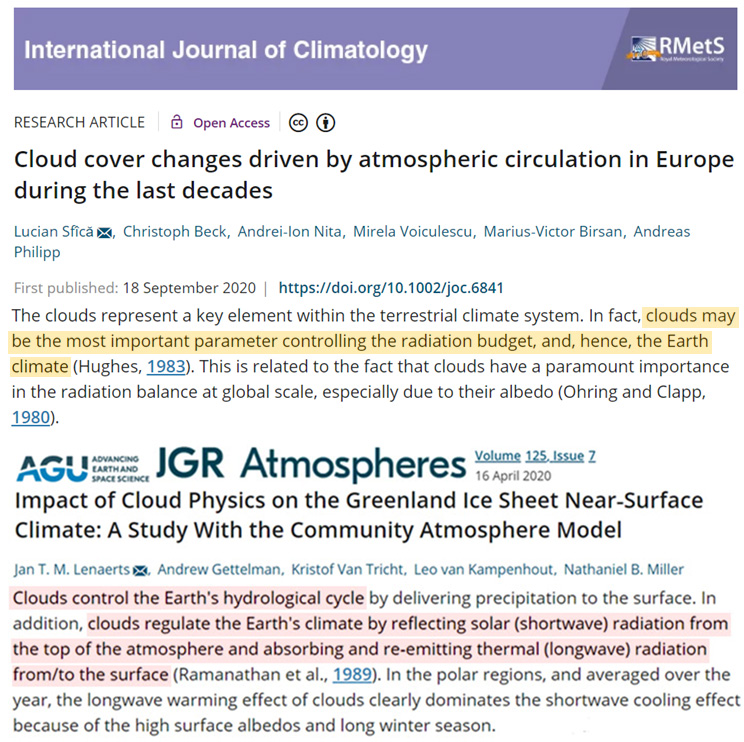
To claim that anthropogenic CO2 emissions drive global warming, radiative forcing modeling studies must assume 1) clouds do not ever change, 2) cloud albedo is constant, and/or 3) clouds do not exist. None of these are real-world conditions.

The real atmosphere is what scientists refer to as all-sky, an atmosphere where clouds not only exist but they are present 70-90% of the time.

In the real world clouds also “regulate the Earth’s climate,” as they are “the most important parameter controlling the radiation budget, and, hence, the Earth climate” (Sfîcă et al., 2020, Lenaerts et al., 2020).

Image Source: Sfîcă et al., 2020 and Lenaerts et al., 2020

Studying all the factors contributing to Earth’s Energy Imbalance (EEI) means we must consider the controlling, regulating dominance of the cloud radiative effect. Isolating selected factors like well-mixed greenhouse gases (CO2, CH4) while simultaneously excluding the cloud radiative effect only serves to advance a narrative about what is believed to occur an imaginary world where clouds are constant or do not exist.

Succinctly, an all-sky atmosphere analysis means cloud radiative effects are included in the calculations. A clear-sky analysis excludes the radiative effect of clouds.

Modeling studies purporting to isolate the radiative effect of anthropogenic emissions of CO2 and other greenhouse gases can only refer to clear-sky conditions – an Earth atmosphere that does not exist in reality.

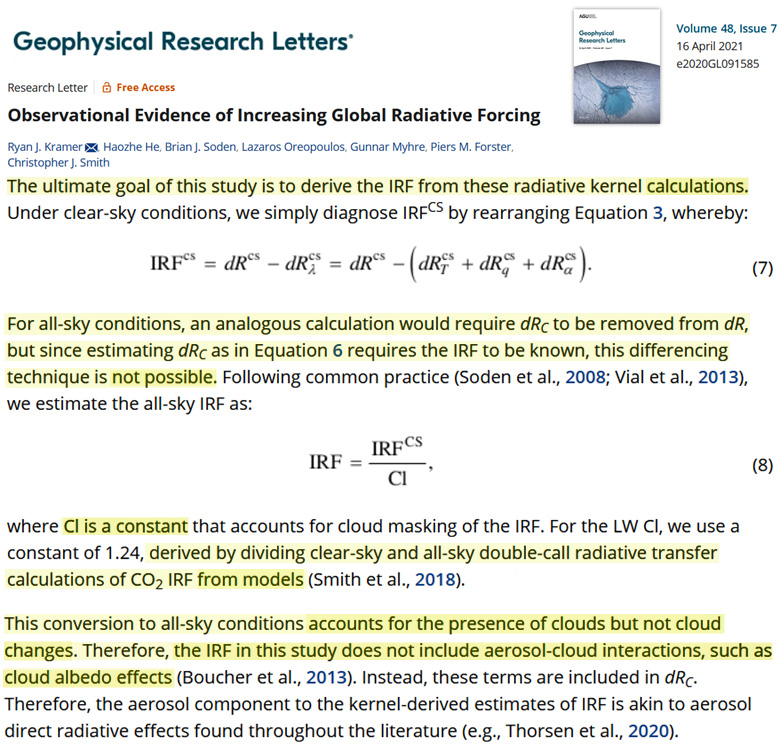
Recently, Kramer et al. (2021) has received a lot of attention as a study robustly supporting the claim we humans have been and continue to control the climate with our CO2 emissions. They use a modeling “technique” that is claimed to isolate the human contribution to the radiative forcing from the “total radiative changes” from 2003 to 2018.

“We use the radiative kernel technique to isolate radiative forcing from total radiative changes and find it has increased from 2003 to 2018, accounting for nearly all of the long-term growth in the total top-of-atmosphere radiation imbalance during this period.”

However, the authors acknowledge that to arrive at their conclusion that anthropogenic CO2 is the dominant radiative forcing factor, their modeling calculations can only apply to an imaginary-world, clear-sky-only atmosphere. They admit radiative modeling for an all-sky world is “not possible.” So they assume clouds are constant, and that cloud albedo variations neither exist or affect climate. Hence, their study does not use real-world observational evidence; it only uses modeled calculations for a world that does not exist in reality.

“For all-sky conditions, an analogous calculation…requires the [instantaneous radiative forcing from all factors affecting climate] be known, [and thus] this differencing technique is not possible.”

“…we estimate Cl [cloud cover] is a constant…”

“For the [longwave impact from clouds] we use a constant of 1.24, derived from dividing clear-sky and all-sky double-call radiative transfer calculations of CO2 [instantaneous radiative forcing] from models.”

“This conversion to all-sky conditions accounts for the presence of clouds but not cloud changes. Therefore, the [instantaneous radiative forcing] in this study does not include aerosol-cloud interactions, such as cloud albedo effects.”

Image Source: Kramer et al., 2021

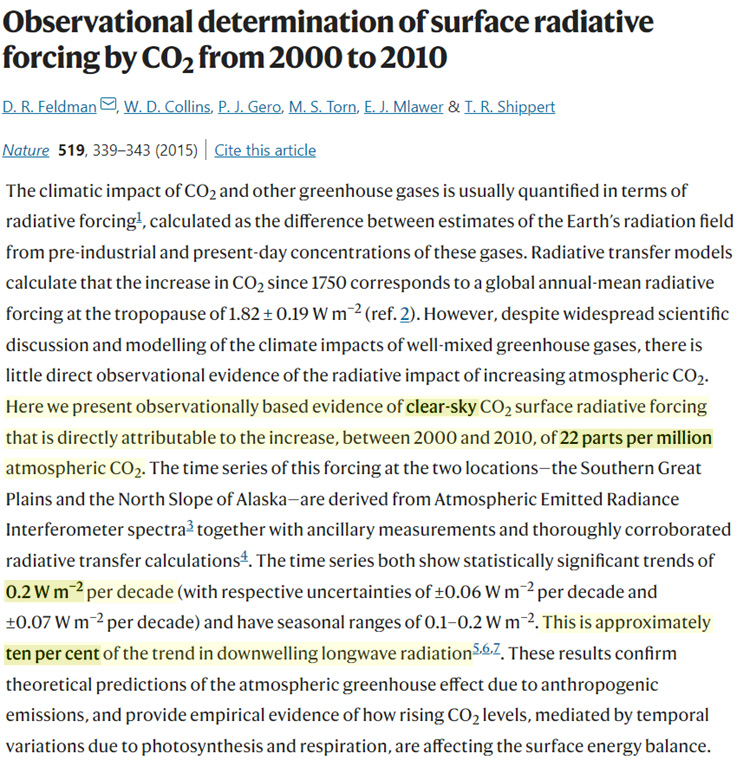
Feldman et al. (2015) is another study that anthropogenic global warming (AGW) apologists often claim provides “observational” evidence of the dominance of CO2 forcing in climate change. But, of course, this widely-heralded study also only has radiative calculations applying to an imaginary world where clouds do not exist (clear-sky). The authors even admit in the abstract that CO2’s radiative effects can only impact 10% of the longwave forcing trend in clear-sky.

Image Source: Feldman et al., 2015

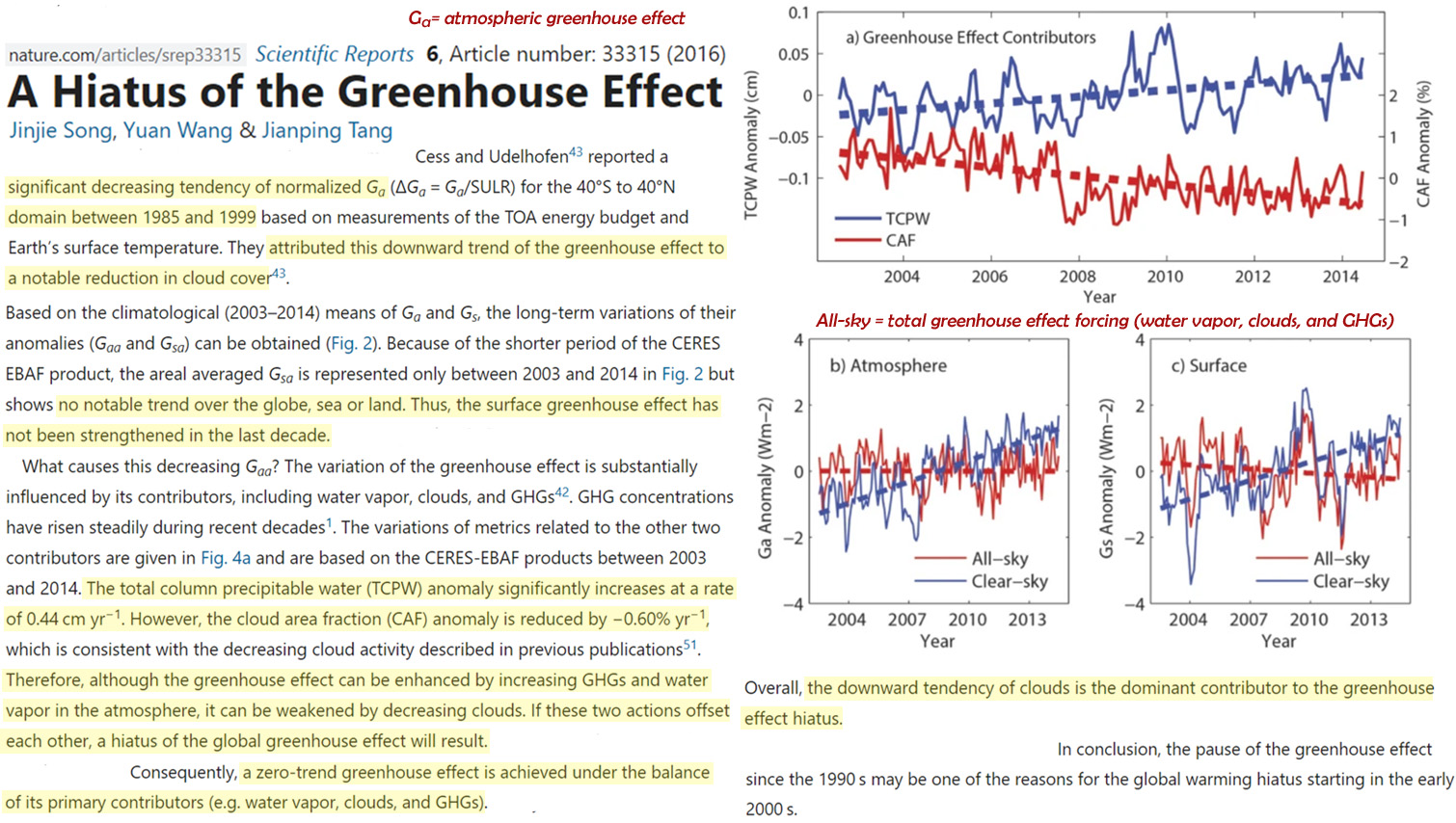
Song et al. (2016) provide an excellent illustration of the reason why AGW-promoting studies only reference imaginary-world, clear-sky conditions and simultaneously exclude real-world conditions, or all-sky.

From 2003-2014, the total greenhouse effect forcing trend can be shown to be positive (blue) – but only for clear-sky conditions where CO2 and water vapor are presented as the drivers. This supports the position that rising CO2 and other greenhouse gases are enhancing the greenhouse effect as they rise.

But clouds exist, and all-sky is reality. And, in contrast to the clear-sky trend, the all-sky greenhouse effect impact (where clouds are considered as a radiative forcing factor in climate) is negative (red). The greenhouse effect is not enhanced, but devolves to a decline or a “hiatus” when clouds are considered.

“Therefore, although the greenhouse effect can be enhanced by increasing GHGs and water vapor in the atmosphere, it can be weakened by decreasing clouds. If these two actions offset each other, a hiatus of the global greenhouse effect will result.”

Image Source: Song et al., 2016

Of course, AGW apologists do not want us to see what happens when we fail to pretend clouds do not exist, or that clouds are not variable, but constant. They know cloud radiative effects destroy the humans-did-it narrative.

via NoTricksZone

https://ift.tt/7sWApLY

September 12, 2024 at 01:44PM

Another Episode Of Cleaning The Augean Stables

Guest Post by Willis Eschenbach (@weschenbach on eX-Twitter)

Our estimable Charles the Moderator, who gets my eternal thanks for keeping the hits happening here on WUWT, asked me to take a look at a new paper yclept Multivariate Analysis Rejects the Theory of Human-caused Atmospheric Carbon Dioxide Increase:The Sea Surface Temperature Rules by Dai Ato, an independent researcher in Japan. Seems it’s been getting some play. I’ll refer to this paper as Ato2024.

I wasn’t far in before alarms went off. The study conducted a multivariate analysis using publicly available data to examine the impact of sea surface temperature (SST) and human emissions on atmospheric CO₂ levels.

It concluded that SST was the independent determinant of the annual increase in atmospheric CO₂ concentration. Human emissions were found to be irrelevant in the regression models.

And most revealingly, it says:

Furthermore, the atmospheric CO₂ concentration predicted, using the regression equation obtained for the SST derived from UK-HADLEY centre after 1960, showed an extremely high correlation with the actual CO₂ concentration (Pearson correlation coefficient r = 0.9995, P < 3e-92).

BZZZZT!! Whenever I get an r-value that high, I know for a fact that I’m doing something very wrong … I’ll get back to that.

First, let me start with one of the three variables in their analysis, which are SST, CO2, and emissions. Here are three reconstructions of SST since 1854 by three different groups.

Figure 1. Global monthly average sea surface temperatures (SSTs). Yellow area at the right is the portion of the record analyzed by Ato.

While there are some differences, overall the pattern is clear. There was SST warming from ~ 1850 to about 1870, cooling to ~ 1910, warming to ~ 1940, cooling to ~ 1965, and warming since then.

Looking at that, I can see why Ato doesn’t want to use the full record—it doesn’t support his claim that SSTs are the independent determinant of atmospheric CO2 levels. The CO2 data (Figs. 2 and 3 below) looks nothing like that.

So how does he justify the cutoff? Well, the Mauna Loa CO2 measurement data starts about 1960. However, it can be extended back beyond that using the ice core CO2 records. Here’s what that looks like.

Figure 2. Mauna Loa and ice core measurements of the background atmospheric CO2 levels, 1000-2010AD. Data: Ice Cores Mauna Loa

Ato2024 says that the ice core records are not accurate. However, this is belied by the close agreement of the ice core records with each other and with the Mauna Loa measurements as shown above.

Below is a closer view of the recent end of the data since 1850, corresponding to the time frame of the sea surface temperatures (SSTs) in Figure 1.

Figure 3. As in Figure 2, but post-1850 data only

As a result of the good agreement of the ice cores both with each other and with the Mauna Loa data, I see no problem in taking that as a good reconstruction of the post-1850 CO2 levels.

The problem, of course, is that the pre-1960 ocean temperatures do not look anything like the pre-1960 CO2 levels … and this disagreement totally falsifies Ato2024. So he is obliged to ignore it.

Next, how did he get such a great correlation, 0.9995, between SST and CO2 in the post-1960 data? In part the answer lies in what he looked at. Here’s the Mauna Loa post-1960 CO2 record he used. Note that he didn’t use the monthly data, just the annual data. Makes it easier to get a higher Pearson correlation coefficient “r”.

Figure 4. Mauna Loa Observatory CO2 observations, along with the linear trend line.

The recent increase in CO2 is a very slowly accelerating curve which is nearly a straight line. This leads to many false correlations because such a curve is easy to replicate as we’ll see below. This is a recurring problem in climate science.

But that’s just the first problem. The main problem is the procedure that he used. Here’s the description from the paper.

Note that the symbol delta (∆) in the equations means “change in”. So ∆CO2 is the change in CO2 from one year to the next.

Translated, that says:

  • Calculate the best-fit linear estimation of the annual changes in CO2 (∆CO2), based on the Hadley HadSST sea surface temperature.
  • The predicted atmospheric CO2 is then the starting atmospheric CO2 plus the cumulative sum of the estimated annual changes in CO2.

Here’s a graph of the first part of that calculation, fitting the SST to the annual change in CO2.

Figure 5. Post 1960 annual change in atmospheric CO2 (∆CO2), along with the linear trend line of ∆CO2, and the best estimation of ∆CO2 based on the Hadley HadSST4.0.1.

Now, there’s an oddity about graphing delta CO2, or ∆ anything for that matter. It involves a couple of curious changes. I’ll use graphing ∆CO2 as in Fig. 5 as my example.

First, any overall linear trend in the CO2 data is converted into an overall offset from zero (a non-zero average) in the ∆CO2 graph.

Second, any overall acceleration in the CO2 data is converted into an overall linear trend in the ∆CO2 graph.

So from looking at Figure 5, we can see that the ∆CO2 data has both a positive trend and an acceleration. We can see both of those in Figure 3 above.

And now that we’ve fitted the SST to the ∆CO2 data so we can estimate the ∆CO2, we simply sum those changes cumulatively to estimate the underlying CO2 data. Here’s that result.

Figure 6. Mauna Loa CO2 data, and Ato2024 estimation of the Mauna Loa CO2 data

At this point, I’ve replicated his results.

Now, remember that I said that a correlation coefficient of 0.999+ means there’s some fatal flaw in the logic. So … what’s not to like?

In his note asking me to take a look at this paper, Charles The Moderator included an interesting AI analysis of the paper, viz (emphasis mine):

Based on my analysis of the paper, the key issue of circular reasoning appears to be in the methodology used to predict atmospheric CO2 concentrations from sea surface temperature (SST) data. Specifically:

The author uses multiple linear regression to derive an equation relating annual CO2 increase to SST for the period 1960-2022.

This equation is then used to “predict” CO2 concentrations for the same 1960-2022 time period.

The predicted and measured CO2 concentrations are found to have an extremely high correlation (r = 0.9995).

The circular reasoning occurs because the same data is used both to derive the equation and to test its predictive power. The key equations involved are:

The regression equation (from Step 7 in the paper):

Annual CO2 increase = 2.006 × HAD-SST + 1.143 (after 1959)

The prediction equation:

[CO2]n = Σ[ΔCO2]i + Cst

Where [CO2]n is the predicted CO2 concentration, [ΔCO2]i is the annual increase calculated from the regression equation, and Cst is the actual CO2 concentration in the starting year.

By using this method, the author is essentially fitting the equation to the data and then using that same fitted equation to “predict” the data it was derived from. This guarantees an extremely high correlation that does not actually demonstrate any predictive power or causal relationship.

A proper analysis would use separate training and testing datasets, or employ techniques like cross-validation, to avoid this circularity.

The extremely high correlation reported is almost certainly an artifact of this flawed methodology rather than evidence of a genuine relationship between SST and atmospheric CO2 levels.

And the AI is right. Well, partly right. They’re right to say that the problem is not that Ato2024 fitted SST to CO2. The problem is that Ato2024 didn’t withhold half the data to verify the results. It’s easy to predict something when you already know the outcome …

HOWEVER, and it’s a big however … while that problem alone is enough to totally falsify the conclusions, there’s another really big problem. To illustrate that, I’ve used the Ato2024 method. But instead of using sea surface temperature as the input to be fitted to the ∆CO2 data as Ato2024 does, I’ve fitted a straight line to the ∆CO2 data. It’s the blue line in Figure 3 above.

And using the Ato2024 method, I’ve converted that straight line to the equivalent CO2 data shown in red in Figure 7 below.

Figure 7. As in Figure 6, plus a red line showing the result of using a simple straight line in place of the sea surface temperature (SST) used the Ato2024.

Interesting. Using the Ato2024 method of fitting a variable to ∆CO2, a straight line as input does just as as well as using the SST as input.

But that doesn’t really show the full scope of the problem. To do that, I first divided the SST, the straight line, and ∆CO2 data in two halves. I used the first half for fitting either the SST or the straight line to the ∆CO2. Then I used those results to estimate the change in CO2. Figure 8 shows that result.

Figure 8. As in Figure 7, but using only the first half of the data to fit the model, and then using the full data to see how well it performs.

This graph reveals two separate problems. First, although the fit is considerably poorer than in Figure 6, the Pearson correlation coefficient “r” is basically unchanged … meaning that it is not an appropriate measure for this particular issue.

Next, the straight line continues to perform just as well as using the SST as the independent variable … no bueno. This indicates a profound problem with the underlying Ato method.

To show the problem, I’m gonna re-show Figure 5 from above.

To recap, first, any overall linear trend in the CO2 data is converted into an overall offset from zero (a non-zero average) in the ∆CO2 graph.

Second, any overall acceleration in the CO2 data is converted into an overall linear trend in the ∆CO2 graph.

And here’s the key. When you fit the SST data (or more importantly, any data) to the ∆CO2 data, you end up with a fitted signal that has the same non-zero average and the same trend as the ∆CO2 data.

Not only that, but the fit will be balanced, with the amount above and the amount below the trend line being equal.

And all of that guarantees that if you start out trying to predict a smooth curve, when you reconstruct the signal using the method of Ato2024, you’ll get an answer that is VERY close to the smooth curve regardless of what variable you use to reconstruct the signal.

And that is why using the straight line does just as well as using the SST, or any other variable, as the basis for the estimation of CO2.

I weep for the death of honest peer-review …

My best to everyone,

w.

Yeah, you’ve heard it before: When you comment please quote the exact words you’re discussing. It avoids endless misunderstandings.

via Watts Up With That?

https://ift.tt/bnpdaC9

September 12, 2024 at 12:03PM