
Why the rush?
via CFACT
September 12, 2024 at 03:20AM
The relationship between offshore wind turbine construction noise and marine mammal fatalities is now incontrovertible: Wind Industry’s Wanton Whale Slaughter Caused by Constant Deafening Construction Noise
The underwater cacophony created during offshore construction is laid out in Michael Shellenberger’s documentary Thrown To The Wind (see the video below) and this post: US Govt Lying About Offshore Wind Industry’s Whale Slaughter
The biology we share with marine mammals, like whales, dolphins and porpoises provides the perfect point of comparison regarding the natural response to loud and terrifying noise. That cetaceans have become confused, anxious, if not terrified, by the underwater cacophony created during the construction of these things offshore should come as no surprise to human beings. At least those gifted with a sense of empathy and compassion. People like Calvin Luther Martin, that is.
In this piece, Calvin draws the obvious link that the wind industry is so desperate to avoid.
Acoustic Rape
Calvin Luther Martin
River City Malone
4 September 2024
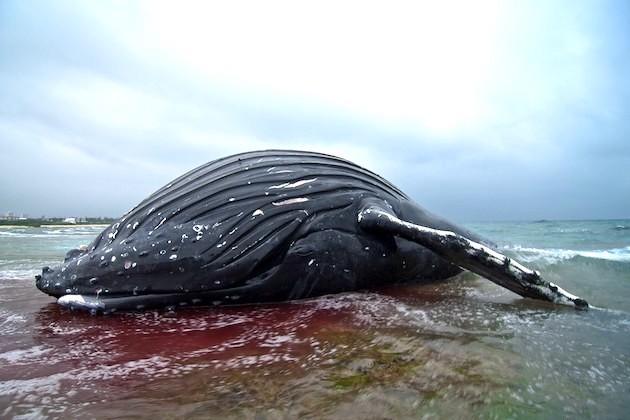
Are you aware that many whales and dolphins have washed up — dead — along the NJ coast and points north, since April 2024?
The reason is undoubtedly from the pressure-wave (also known as “acoustic”) assault on Cetus (whales and dolphins) vestibular organs of “hearing” and “behavior” by the wind companies, who use (pressure-wave) blasting to scan the ocean floor, followed by (pressure-wave) blasting for installing the turbines, followed by (pressure-wave) infrasound from operational turbines.
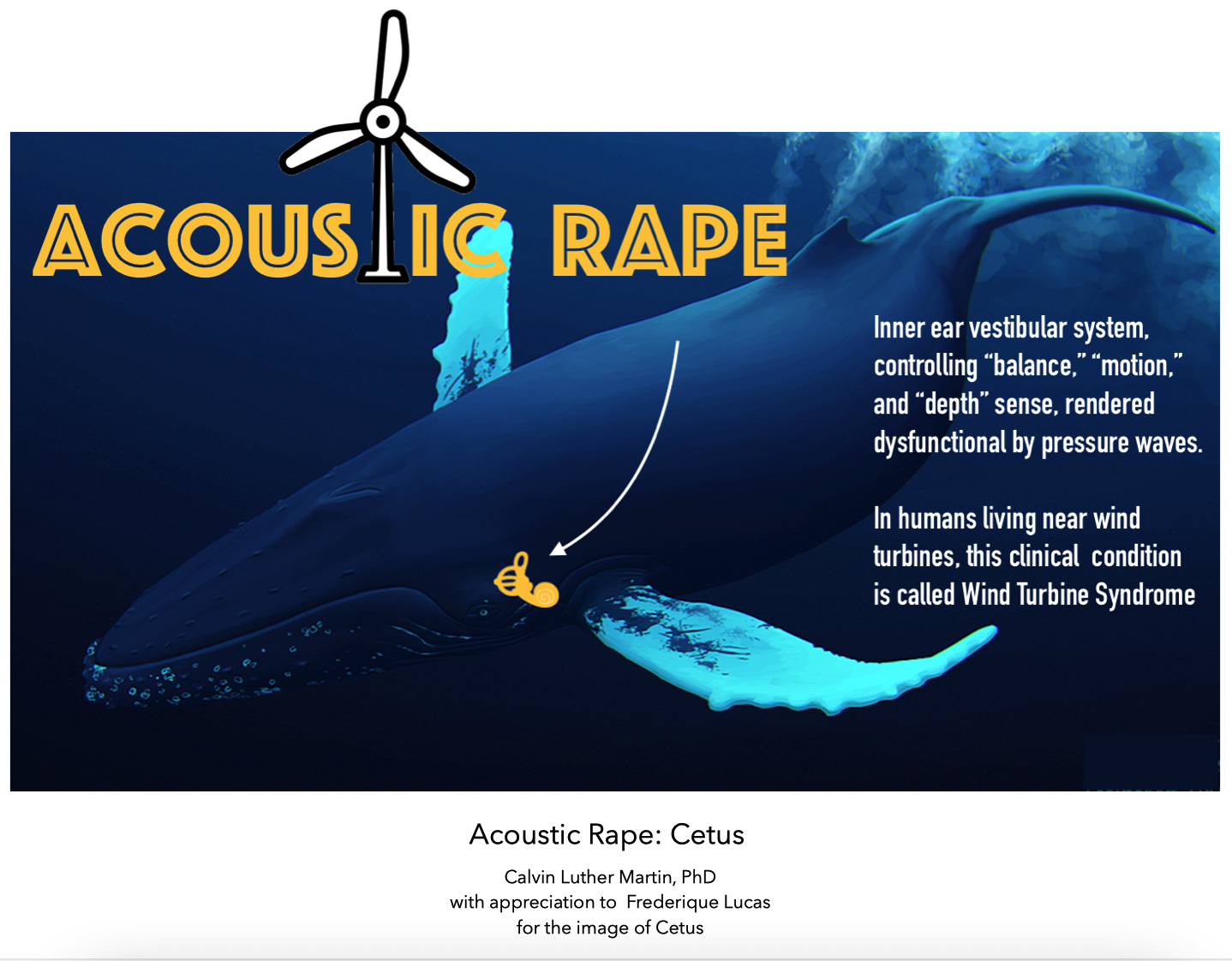
This image shows vividly what the wind companies are doing (or will do) to these creatures off the coast of NJ, Montauk NY, Nantucket and Martha’s Vineyard MA. I call it “acoustic rape.”
The image, above, combines Dr. Nina Pierpont’s research into human Wind Turbine Syndrome, with what one might now call Cetus (whale, porpoise) WTS. (Pronounced, “See-tus.”)
Cetus has the same inner ear organs we humans have. See the image to the left. (Note the inner ear, vestibular apparatus superimposed on the whale image, above, precisely where Cetus’s ear is located.) What Cetus doesn’t have is a middle ear like ours. Ours has an air space; Cetus’s middle ear does not have an air space.

Human outer, middle and inner ear structures
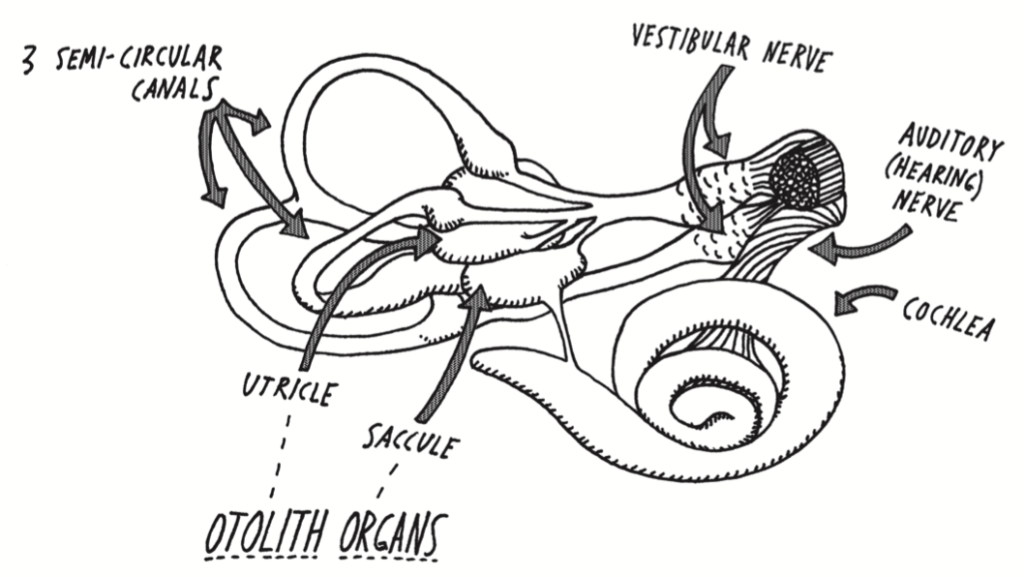
Human and whale & dolphin inner ear (vestibular) structures
The key with Cetus is this: Pressure waves affect its hearing (inner ear: cochlea) and motion/position/depth sense (inner ear: saccule and utricle). Undoubtedly, the whale’s “mood” is also affected by saccular and utricular perturbation/dysfunction.
By “mood” I mean behavior akin to “depression” and “despair” and “anxiety” and “panic” in humans. Yes, there is a well-established link in Homo between vestibular dysfunction and anxiety and panic. There’s no reason to think this doesn’t occur in Cetus with similar perturbation — as from marine “pile driving” and construction “explosions” and the infrasound from operational wind turbines. Note that the turbine infrasound penetrates the water and sea-floor itself, since the turbine is firmly embedded in the sea-floor.
Humans share these inner ear structures with loads of other species, including amphibians (frogs) and fish. This signals us that these inner ear structures are an ancient evolutionary adaptation by Mother Nature—God, if you prefer.
How does all this result in whales and dolphins winding up dead on the Atlantic seashore? It seems to have to do with their depth sense going bonkers; that is, they don’t know how deep they are as they navigate the corridors of the sea. All these sea mammals are air breathers, unlike fish who breathe through their gills. Whales and dolphins have to surface for a breath of air.
Dr. Pierpont, a PhD (Princeton) biologist, suggests that a dysfunctional vestibular system (“depth” gauge) results in their taking a gulp of air too early—thus gulping water—and literally drowning, the same way you and I (we, too, are mammals) will drown when we swallow water.
The way to confirm this, of course, is by doing autopsies on the beached whales and dolphins. Problem is, Uncle Sam isn’t revealing the autopsy reports.
Until this happens, the reasons for the mysterious deaths remain conjectural, although, as I say, a dysregulated vestibular apparatus is virtually certainly involved in something going terribly wrong. (Note that these creatures show no outward, physical signs of trauma. Nor do they show signs of being ill, as with an infection.)
It’s time for the outrage against this acoustic violence to be dialed up. This must stop! (There are numerous ad hoc groups along the Atlantic coast who are up in arms over these deaths. They know it’s from the wind companies’ blasting and turbine infrasound.)
I often ask myself how Dr. Martin Luther King would orchestrate this outrage. King remains my role model and inspiration in matters of unpopular justice.
via STOP THESE THINGS
September 12, 2024 at 02:31AM
“In areas where wind farms are being developed, invasive species can harm … industries by reducing fish populations, damaging habitats, and deterring tourists who seek intact and diverse marine environments.” – Kieran Kelly, Ocean Integrity (below)
‘It is hard being green, particularly when “green” means being one-dimensional against carbon dioxide (CO2) at the expense of virtually every other metric. Consider wind power, the onshore problems of which (failed past, government dependency, intermittency, site depletion, local warming, noise, avian mortality, health effects) are only magnified offshore (cost premium, wake effect, blade failure, industrialization, hurricanes, pile driving, political bribes).
Kieran Kelly, CEO of Ocean Integrity, “a global organization that aims to reduce ocean plastic pollution and create positive social impact,” recently reported on social media about a particular ecological issue: invasive filter feeders.
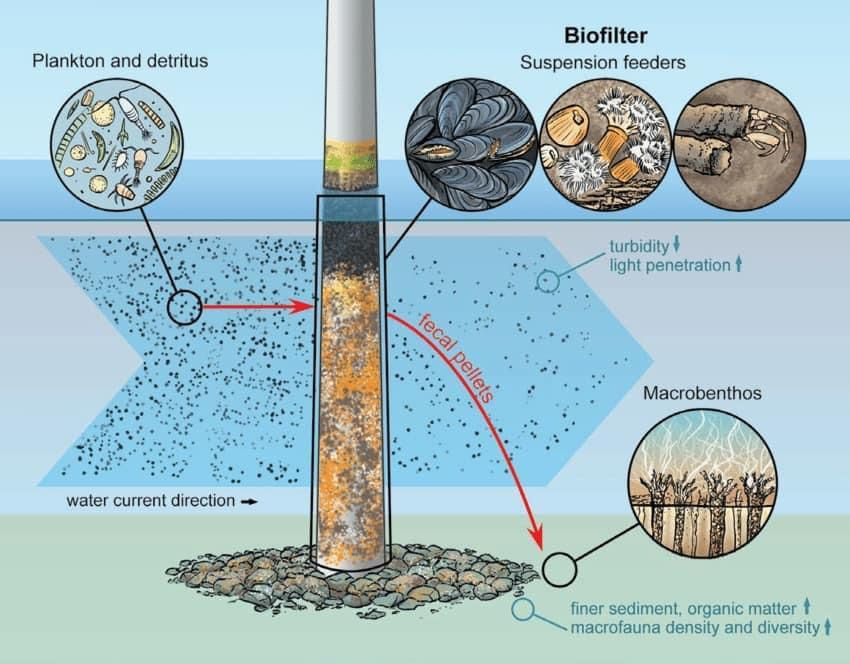
The growth of invasive filter feeders in areas where wind farms are being placed provides a compelling argument against proceeding with offshore wind farms. [Ed. Note: see picture below]
Invasive filter feeders can disrupt the delicate balance of ecosystems in which they establish themselves. These organisms often outcompete native species for resources, leading to a decline in biodiversity and altering the natural composition of communities. The introduction of invasive filter feeders can result in the displacement or extinction of native species, disrupting the intricate web of interactions that have evolved over time.
The proliferation of invasive filter feeders can have profound effects on food chains within affected ecosystems. By consuming vast amounts of plankton and other small organisms, they can deplete the food sources that native species rely on. This can lead to population declines and cascading effects throughout the food web, affecting the abundance and distribution of other species, including commercially important fish stocks.
Invasive filter feeders often modify their surroundings to suit their needs, which can have detrimental effects on native habitats. They may alter water flow patterns, disturb sediment layers, or create physical structures that disrupt the natural habitats of other species. These modifications can result in the loss of critical habitats, such as seagrass beds or coral reefs, which provide shelter, breeding grounds, and nursery areas for numerous marine organisms.
The negative impacts of invasive filter feeders extend beyond ecological consequences. In areas where wind farms are being developed, there are often economic interests tied to fisheries, tourism, and recreational activities. The proliferation of invasive species can harm these industries by reducing fish populations, damaging habitats, and deterring tourists who seek intact and diverse marine environments. The economic losses resulting from these impacts can be significant and long-lasting.
Once invasive filter feeders become established in an area, their eradication or control becomes challenging, time-consuming, and costly. Prevention should be a primary focus to avoid introducing these species in the first place. The potential risks associated with the growth of invasive filter feeders should be thoroughly evaluated through comprehensive risk assessments and environmental impact studies prior to the construction of offshore wind farms.
It is crucial to assess the potential for the establishment and spread of invasive filter feeders in areas where wind farms are proposed. Adequate safeguards and strict monitoring protocols should be implemented to prevent the introduction and proliferation of these species.
He added in a comment:
The waters around Denmark  have witnessed a complete collapse of fish stocks, a situation mirrored in Sweden. While some may choose to turn a blind eye, it’s crucial to note that no independent environmental impact studies have been conducted.
Ørsted has announced a $4 million initiative to support environmental research at Connecticut universities, raising concerns that offshore wind companies are effectively silencing academic institutions.
Later today, I’ll be sharing new evidence regarding pollution from these offshore structures. We’re gearing up for a lawsuit against these companies, and our attorneys believe we have a strong case to shut them down. As an environmentalist, my sole focus is the protection of our oceans—let’s make that clear.
Final Comment
The much needed civil war within the mainstream environmental movement (Big Green, Inc.) has been corrupted by green-as-in-money. Big Wind, Big Solar, and Big Batteries control the narrative that no ecological tradeoff is too great in the war against carbon dioxide (CO2), thus fossil fuels, thus modern industrial living.
Expect the Green Divide to increase, however, as the surface area, the living space, is increasingly taken over by politically correct, economically incorrect energies.
————–
The post OCEAN INTEGRITY vs. Offshore Wind appeared first on Master Resource.
via Master Resource
September 12, 2024 at 01:07AM
By Robert Bradley Jr.
“Modern wind farms are reliable, safe, state-of-the-art power plants with well-tested technologies that meet approved standards and hundreds of thousands of hours of operating experience,” the U.S. Department of Energy states. Except when they fail under normal conditions–or abnormal ones.
“Wind Turbines Destroyed by Typhoon Yagi,” read one recent headline. This (during peak hurricane season 2024) has wind power in the (not-so-good) news. Not only were older turbines destroyed by the 150 mile-per-hour typhoon (Category 4 in hurricane terms); new “more efficient typhoon-resistant versions” were leveled too. For multi-million dollar structures, the risk and the cost of insurance are major issues.
———
The U.S. offshore wind industry will be spared–but only because of projects that have been abandoned or delayed. But what would happen if such naked structures are built, particularly in the Gulf of Mexico or off the Atlantic Coast?
The Proceedings of the National Academy of Sciences research article, “Quantifying the Hurricane Risk to Offshore Wind Turbines” (February 13, 2012), remains relevant today to the energy policy debate. DOE’s recent confident statement, in fact, was pre-refuted by the five scholar authors.
The article’s conclusions follow:
“The U.S. Department of Energy has estimated that if the United States is to generate 20% of its electricity from wind, over 50 GW will be required from shallow offshore turbines. Hurricanes are a potential risk to these turbines. Turbine tower buckling has been observed in typhoons, but no offshore wind turbines have yet been built in the United States.”
“We present a probabilistic model to estimate the number of turbines that would be destroyed by hurricanes in an offshore wind farm. We apply this model to estimate the risk to offshore wind farms in four representative locations in the Atlantic and Gulf Coastal waters of the United States. In the most vulnerable areas now being actively considered by developers, nearly half the turbines in a farm are likely to be destroyed in a 20-y period.”
“Typically, wind turbines are designed based on engineering design codes for northern Europe and the North Sea, where nearly all the offshore and coastal wind turbines have been built. These codes specify maximum sustained wind speeds with a 50-y return period of 42.5–51.4 m/s (83–100 knots), lower than high intensity hurricanes.”
“Offshore wind turbines … will be at risk from Atlantic hurricanes…. Wind turbines are vulnerable to hurricanes because the maximum wind speeds in those storms can exceed the design limits of wind turbines. Failure modes can include loss of blades and buckling of the supporting tower.”
“In 2003, a wind farm of seven turbines in Okinawa, Japan was destroyed by typhoon Maemi, and several turbines in China were damaged by typhoon Dujuan. Here we consider only tower buckling, because blades are relatively easy to replace (although their loss can cause other structural damage).”
“There is a very substantial risk that Category 3 and higher hurricanes can destroy half or more of the turbines at some locations.”
Final Comment
Hurricane Category 4 and 5 winds are a threat to existing and even state-of-the-art industrial wind turbines. Category 3 (the baseline of the above article) is a real threat as far as is known. Category 6 (which climate alarmists predict is the future) will make all existing structures in hurricane prone waters susceptible.
The authors stay politically correct by looking to a new future:
Reasonable mitigation measures—increasing the design reference wind load, ensuring that the nacelle can be turned into rapidly changing winds, and building most wind plants in the areas with lower risk—can greatly enhance the probability that offshore wind can help to meet the United States’ electricity needs.
But such would increase cost, reduce output, and/or limit offshore wind below politically desired levels. All aggravate the already bad economics and poor prospects of offshore wind in the U.S.
via Watts Up With That?
September 12, 2024 at 12:00AM

 Iowa Climate Science Education