
In Denierland, I bemoaned the way policy makers evaluate success when it comes to climate. There is a level of abstraction in climate policy success that is not found elsewhere – or at least, not to the same degree.
How do you – or how should you – measure climate policy success? Obviously, the most direct measure is the temperature change avoided by a certain date, say 2050. No single policy can ever create a significant difference in the temperature of 2050, and unsurprisingly this metric is not used. Next down in the hierarchy is emissions avoided. This is also a stat that is hard to obtain. Then there are more abstract measures like the quantity of “green” energy generated by a scheme, or the number of “green” jobs created by a scheme, or at the sad end of things, the amount of cash “invested” in (not spent on) a scheme.
All such measures have innate problems. In particular, jobs in “green” energy are a cost, not a benefit… unless the energy is being exported. If the jobs of a hundred men with shovels can replace the work of a single machine, then destroying the machine is a great job creation scheme. (The famous remark said to have been made by Milton Friedman that if jobs were wanted from such a program, then the workers should have been issued with teaspoons rather than shovels apparently originated far earlier from an unknown source.)
Anyway, all this is a roundabout introduction to the news that the UK government gave the wink to a new carbon capture and storage scheme this week, one whose benefits could almost be calculated by the announced figures.
The Liverpool City Region Combined Authority’s (puff, puff) website has the costs and benefits of the scheme, which is called HyNet (the particulars are not given there, and are not really germane here. The CO2 could be being captured by any means and pumped anywhere for our purposes.) The BBC has somewhat different numbers, which I also provide.
The cost is given as £21.7 bn over 25 years. (LCRCA does not say when the scheme is supposed to begin operation. The BBC says 2028.)
The jobs are 6000 in construction and presumably a far smaller number in operation. (The BBC says 4000 direct jobs and supporting 50,000 in the long term.)
Reduction of emissions of CO2 are “up to” 10 million tonnes per year. (“…the equivalent to removing four million cars from the road.”) (BBC: 8.5 million tonnes.)
Let us assume that the annualised cost will be £1 bn/yr, and that the 10 million tonnes CO2 removed per year is true. However, some of that CO2 would never have been emitted, since extra energy is used to capture it. Ecosia chat says 15-30% of energy is wasted in the snaffling, so to be scrupulously fair, let’s call it 20%. That means that on net we are capturing 8 million tonnes CO2/yr, and the cost is simple to calculate at £125 per tonne of CO2. [Absent the obviously inevitable over-runs.]
Again referring to Ecosia chat, I get a range of estimates for the social cost of carbon (SCC) from $50 to $200 per tonne of CO2, and the chatbot refers to the possibility that extreme climate change outcomes might mean it is up to $400. At the present exchange rate of $1.3 = £1.0, our cost of £125/tonne is about $160/tonne, so it’s close to the higher end.
This is assuming that it all goes swimmingly.
The next issue with the scheme is an obvious one. The social cost of carbon is a cost spread across every human on the planet. The population is >8 billion. Therefore the benefits of the new scheme will be funded by the ~70 million population of the UK, but benefit everybody equally: the cost to outsiders is nil, but they stand to benefit as much as we do.
In fact, if the SCC is $200/tonne, then every tonne pumped where the sun don’t shine is worth an inconsequential amount to each human alive. 40 million times 200 = 8 billion, so quickmaths tells me that each human benefits to the tune of one 40 millionth of a dollar every tonne of CO2 we save. That includes each of us. So the UK’s total savings per tonne sequestered under the Irish Sea are ($200 * 70 million) / 8 billion = $1.75.
To recap: it’s costing us ~$160/t CO2 to bury the stuff, and the climate benefits to us are ~$1.75 using the higher end of the estimate of SCC. You could argue that the true benefits amount to 40 cents, or nothing.
Now let’s ask one final question. What will the temperature change avoided by 2050 be? Given a successful project storing 8 million tonnes of CO2 over the years from 2028-2050 (22 years), we have saved by that point 8 * 22 = 176 million tonnes.
Quoting myself from last year, I said:
1 ppm CO2 ≈ 8 Gt (billion tonnes)
So our project will have saved 176 / 8000 = 0.022 ppm CO2 by 2050.
For Denierland, I used a model that gave an atmospheric CO2 concentration at 2050 of 512.64 ppm. [It used a quantity of emissions increasing linearly by 0.1 GtC each year.] Using this figure in the standard calculation with transient climate response a generous 2 K gives a temperature change from pre-industrial in 2050 of +1.745 K. After the UK’s tremendous efforts with HyNet, the concentration of CO2, ceteris paribus, will be 512.62 ppm, and the temperature change from pre-industrial will be
+1.745 K.
No, your eyes do not deceive you. The numbers are the same. In fact, the saving from the £22 billion will be 0.0001 K, making the cost to save a single degree easy to calculate: £22 billion / 0.0001 K = £220 trillion / K. Let me just say that again, in case you didn’t hear me.
£220 trillion / K
Here I was going to excoriate some of the platitudes that various political figures have er, emitted, over this project, but I won’t bother. The soundbites of these dimbulbs are easily found, if you have the urge. I will dwell for a moment on two things. First, Mark Poynting and Justin Rowlatt yesterday asked the question at the BBC,
Will carbon capture help the UK tackle climate change?
I read it with interest, but I have to tell you, that they didn’t tell me. Singularly lacking was any context of cost vs. benefit such as I have provided here. I invite the reader to scrutinise it and tell me if there was anything there worth his or her time.
Second, at the BBC’s announcement of the scheme, comments were allowed. I was interested in the top one:
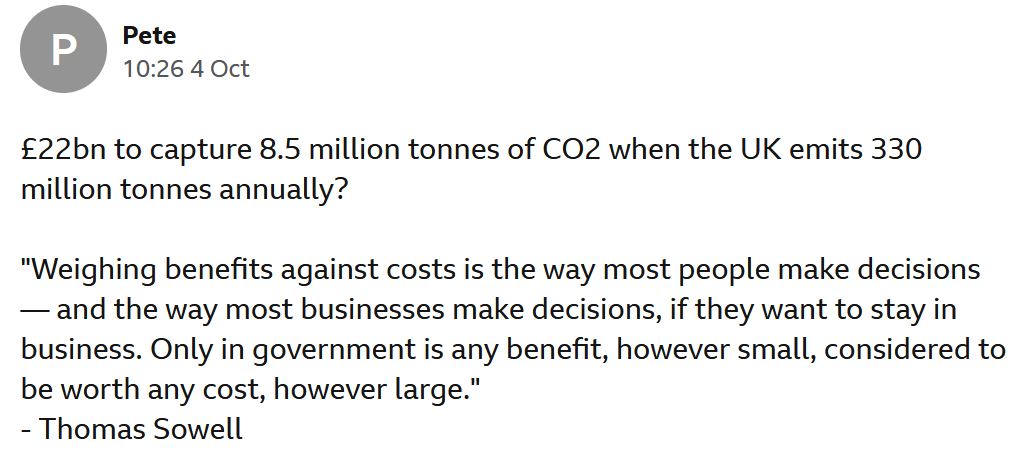
A rather important point, I would say. It is worth dipping into these comments, if you have a mo.
So a black hole is created: but is it a black hole for CO2, or cash?
via Climate Scepticism
October 5, 2024 at 12:45PM
 Iowa Climate Science Education