
Florida residents must feel like they have been taking a beating from major hurricanes in recent years, but what do the data show?
The problem with human perception of such things is that the time scale of hurricane activity fluctuations is often longer than human experience. For example, a person born in the 1950s would have no memory of the beating Florida took in the 1940s from major hurricanes (a total of 5). But they would have many memories of the hurricane lull period of the 1970s and 1980s, each decade having only one major hurricane strike in Florida. Then, when an upswing in hurricane strikes occurs, it seems very unusual to them, and they assume that “hurricanes are getting worse”.
Another problem is that any statistics for an area as small as Florida, even over 100+ years, will be pretty noisy. Landfalling hurricanes for the eastern U.S. would be a better metric. And statistics for the entire Atlantic basin would be even better, except that satellite coverage didn’t start until the 1970s and hurricane intensity in remote areas before then would be poorly measured (or not measured at all).
Finally, tropical cyclone statistics for the entire tropics would be the best (if one was trying to determine if climate change is impacting cyclone intensity or frequency). But satellite data for the global tropics is, again, limited to the period since the 1970s. Global tropical cyclone data before the 1970s is sketchy, at best.
So, keeping in mind that any trends we see for Florida are going to be strongly influenced by the “luck of the draw” and the quasi-random nature of hurricane tracks (hurricanes are steered by the large-scale flow of air in the mid-troposphere, say around 20,000 ft altitude or so), what are the statistics of Florida major hurricane intensity and frequency since 1900?
Florida Major Hurricane Intensity & Number
The following plot shows the intensity of major hurricanes (100 knots or greater maximum sustained wind speed) striking Florida since 1900, updated through recent (2024) Hurricane Helene:
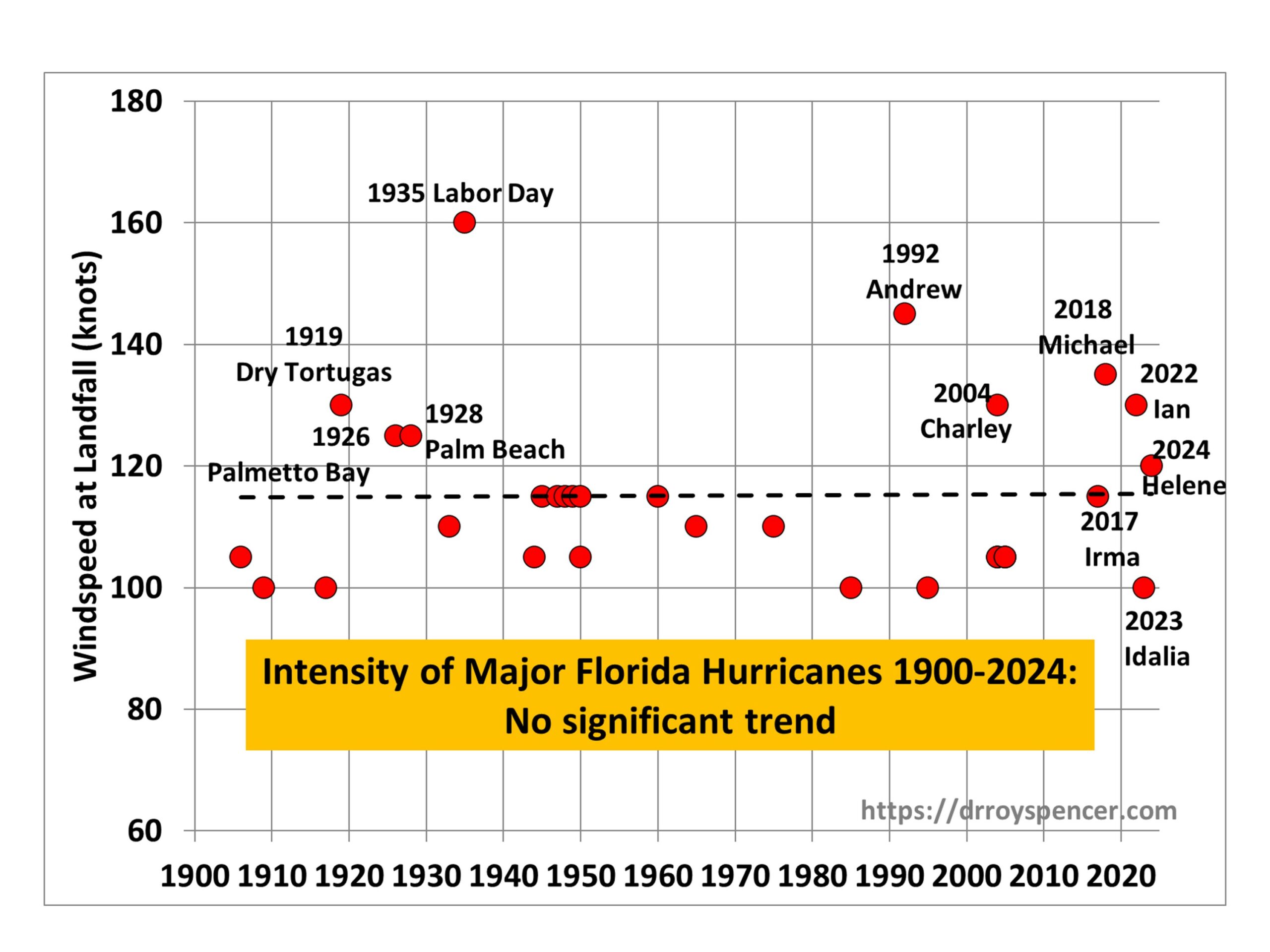
As can be seen from the linear trend line, there has been no significant trend in the intensity of major hurricanes striking Florida since 1900.
But what about the number of hurricanes? The next plot shows there has been a weak upward trend in the decadal totals of major hurricanes striking Florida since 1900:
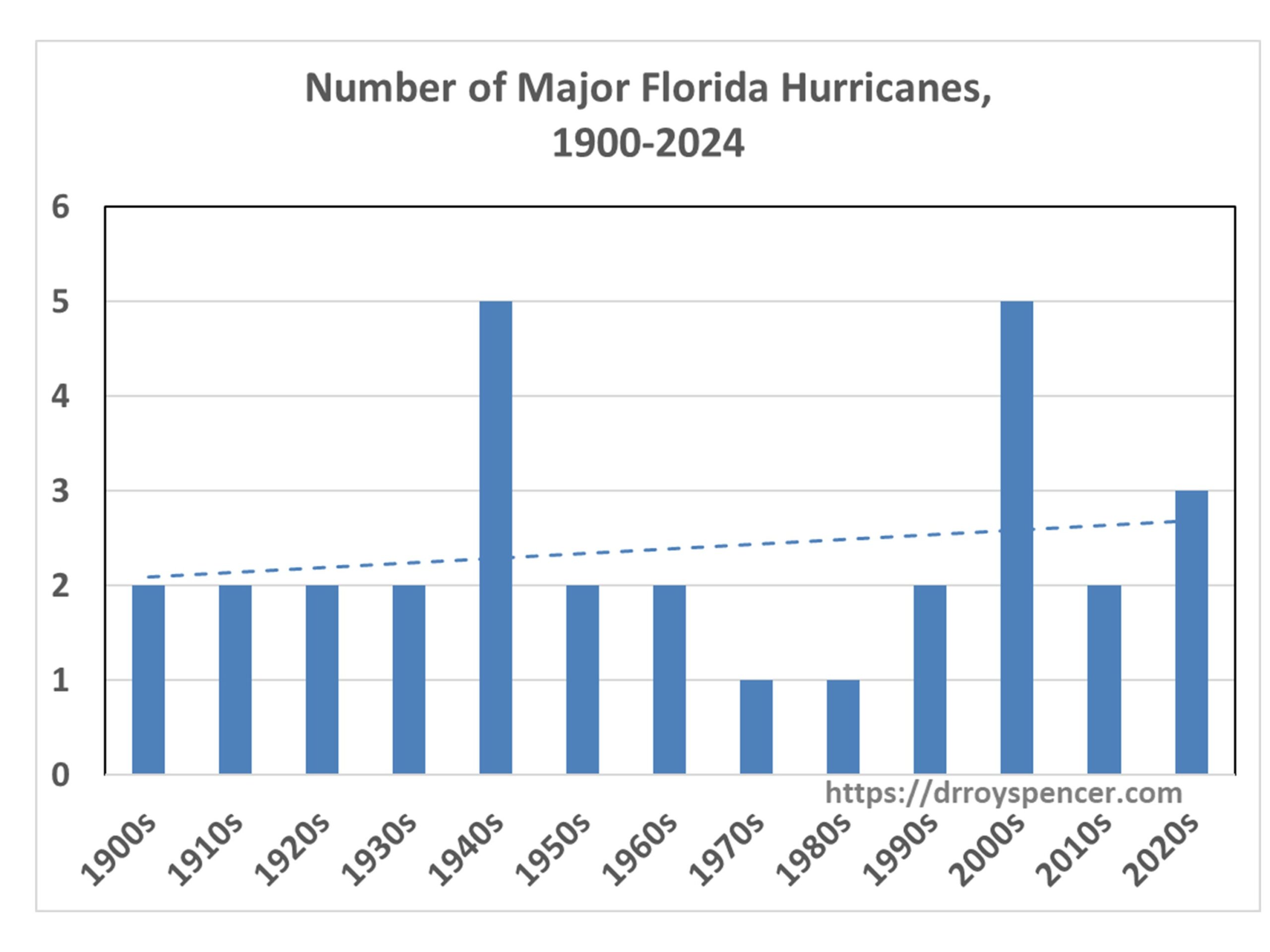
Note that the 2020s number might well increase, since the end of the current (2024) hurricane season will be only half-way through the 2020s. While Hurricane Milton has just been classified as a major hurricane, in 2 days time it is expected to be under increasing wind shear, so it is not obvious it will strike Florida as a major hurricane, and so I did not include it in the above charts.
Another feature of the second chart above shows that a native Floridian born in the 1960s or 1970s would indeed have experienced an increase in major hurricanes striking Florida during their lifetime. But their first couple of decades of personal experience would have occurred during a historic lull in hurricane activity.
It should be remembered that not long ago the U.S. experienced an “unprecedented” 11-year drought in major hurricane strikes. That significantly impacts our perception of what is “normal”. When the lull had reached 9 years, a NASA study found such an event was a once-in-177-years occurrence. As I recall, that was increased to 1-in-250 years when the lull reached 11 years.
The point is that there is a huge amount of natural decadal- to centennial-time scale variability in hurricane activity in Florida (or any other hurricane-prone state). But with increasing numbers of people thinking that the government is somehow influencing hurricane activity (I’m seeing a lot of this on Twitter), I doubt that actual data will have much influence on those people, and as I approach 70 years on this Earth I have noticed a long-term decline in critical thinking regarding weather, climate, and causation. I doubt that trend will change any time soon.
via Roy Spencer, PhD.
October 7, 2024 at 08:23AM
 Iowa Climate Science Education