
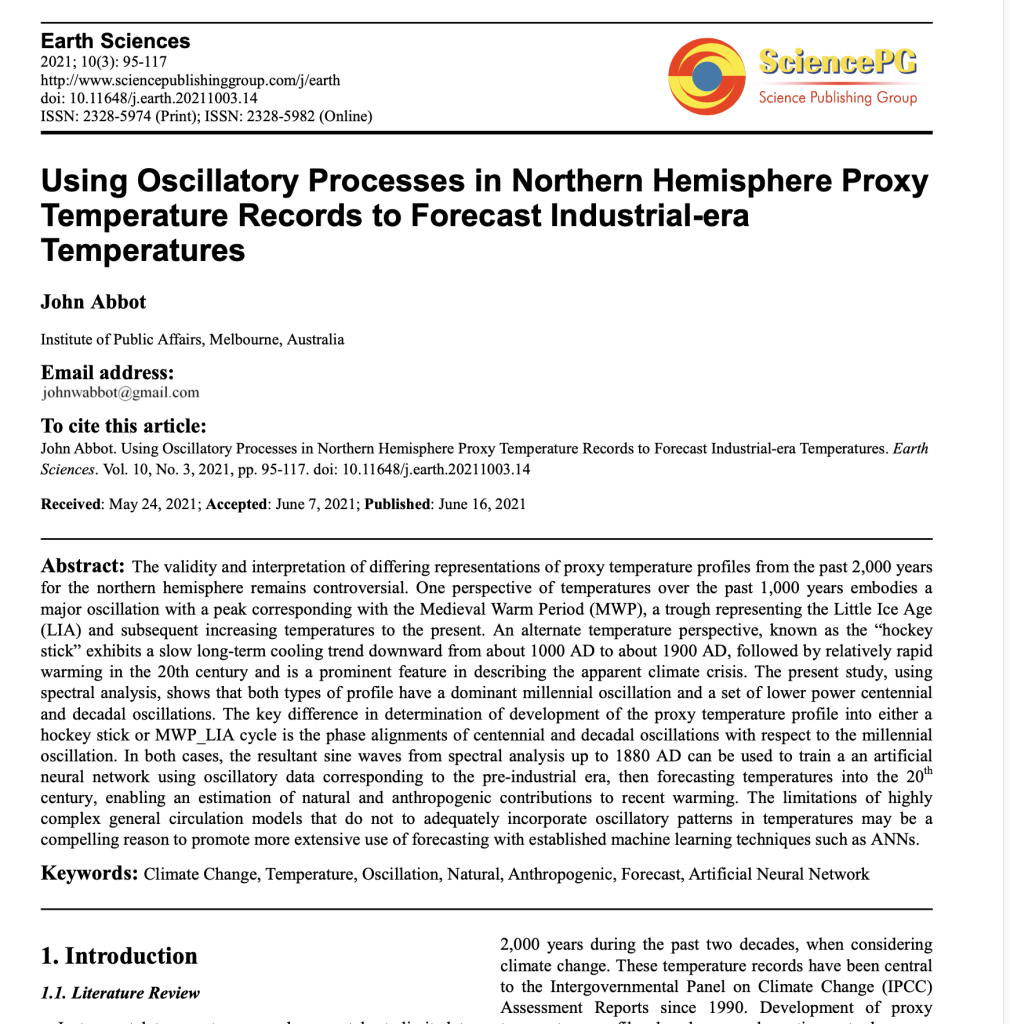
My husband, John Abbot, has kept going with research into AI and climate forecasting. One of his most important recent papers can be downloaded from Earth Sciences.
Some of the latest Nobel prizes in science, including in chemistry, have been for developments in artificial intelligence (AI). Of course, John Abbot and I began working on the application of this technology for forecasting rainfall soon after Brisbane flooded back in 2011. Back then, we had just started dating. It would be some years before we got married.
We had a first AI model developed just a couple of months later, this included some hindcasting showing that the flooding of Brisbane could have been forecast given the temperature and pressure setup across the Pacific Ocean through 2010, and natural climate cycles.
John Abbot and I published a series of papers together through until 2017, after that I lost interest in developing the temperature series that were part of the arrays that John inputted into the neural networks.
I gave-up in 2017, in part because of the hatred that was directed at me, and John, including on Twitter with what was the publication of perhaps our most important paper, newly published in the journal GeoResJ on the application of artificial intelligence, for evaluating anthropogenic versus natural climate change (GeoResJ, Vol. 14, Pgs 36-46 published in July 2017). This research was pilloried on Twitter, and we were defamed by Graham Readfearn in The Guardian. Meanwhile, the editor of the journal was under intense pressure for the paper to be retracted. And some time was expended in writing what seemed like endless letters in its defence. The paper was never retracted, but the journal was closed.
I also gave-up, because I lost confident in the integrity of the actual temperature measurements being recorded by the Australian Bureau of Meteorology. Previously I put a lot of work into ensuring that we inputted unhomogenised data. Then, when I realised the extent to which the new platinum resistance probes could be calibrated to basically measure up or down relative to a mercury thermometer and in fact, they were being recalibrated to measure hotter – well I gave up, in tears. My focus then become getting the parallel data to better understand the relationship between the two different types of temperature measuring.
I put a lot of effort into this until last April 2023, that was after the Administrative Appeals Tribunal Hearing, a front-page story in The Australian, and an understanding that not even the Conservative side of politics had any interest in holding the Bureau to account on this fraudulent remodelling.
Timing is everything they say, if one is to be successful at forcing change and it is not a secret that there is absolutely a need for reform of the Australian Bureau of Meteorology – then it will need to be a team effort, we will need to be supported.
Meanwhile, John Abbot, who tends to be less affected by the politics, and the injustices, has continued to run the AI. Instead of relying on me for long continuous temperature series, he began using much longer, and already published temperature series. And from both those who believe in the existence of Medieval Warm Period and those who dispute its existence.
He had an important paper published in 2021, further showing the application of AI for distinguishing natural from anthropogenic climate change. This research concludes:
The presence of oscillatory characteristics within proxy- temperature reconstructions across a range of time-scales, including millennial, centennial and decadal, has been reported in many investigations. The present study examines oscillations from spectral analysis applied to eight published multi-proxy temperature records, including examples representing both hockey stick [catastrophic recent warming] and MWP_LIA* cycles [it was warmer in the past during the medieval warm period].
The analysis shows that each record can be represented by a set of 4-11 sine curves from spectral analysis that include a dominant millennial oscillation and several centennial and decadal oscillations. The apparent divergence into either a hockey stick or MWP_LIA* cycles can be derived from the phase alignment of the centennial and decadal oscillations with respect to the millennial oscillation. The maximum temperature of the dominant oscillation at around 1000 AD is increased by superimposing the centennial/decadal oscillations for MWP-LIA* cycles, whereas it is reduced and the profile flattened for the hockey stick. This may explain why current temperatures may exceed any in past 1,000 years with hockey stick profile.
Forecasting through projection of pre-industrial temperature oscillatory patterns beyond 1880 AD by applying spectral analysis to generate input to train ANNs show that current atmospheric temperatures can be largely explained on basis of continuation of natural oscillations. This is the case irrespective of whether the hockey stick or MWP_LIA* cycles are operative. This process could give rise to temperatures higher that past 1000 years without major contribution from anthropogenic influences.
*Medieval Warm Period – Little Ice Age.
It is surprising that these important findings are not of more interest to those who claim to care about science and especially climate science.
Back in 2011, in fact right up until 2017, John and I were laughed at, including by our colleagues for suggesting the relevance of AI for elucidating natural climate cycles and using these same cycles to forecast monthly rainfall.
But perhaps the time is coming when it will be realised that we were just a bit ahead of the times.
Of course all our work was, and continues, to be funded by the B.Macfie Family Foundation through the Institute of Public Affairs for which we are grateful.
Relevant and related blog posts
- Fake justifications for rubbish temperature series:
https://jennifermarohasy.com/2023/05/averaging-last-seconds-versus-bureau-peer-review/
2. Holding Bureau to account:
https://jennifermarohasy.com/2016/02/rainfall-forecasts-should-be-benchmarked/
3. Confused and misguided colleagues:
https://ipa.org.au/ipa-today/cyclone-jasper-bom-forecasting-getting-to-the-truth/
via Jennifer Marohasy
October 16, 2024 at 06:52PM
 Iowa Climate Science Education