The Week That Was: 2024 12-07 (December 7, 2024)
Brought to You by SEPP (www.SEPP.org)
The Science and Environmental Policy Project
Quote of the Week: ““It can scarcely be denied that the supreme goal of all theory is to make the irreducible basic elements as simple and as few as possible without having to surrender the adequate representation of a single datum of experience.” – Albert Einstein (1933)
Number of the Week: Over 7 days
THIS WEEK:
By Ken Haapala, President, Science and Environmental Policy Project (SEPP)
Scope: Discussed in This Week is the failure of wind and solar plus a battery to deliver power needed for a small, isolated community, population 20,000, in Australia. Also discussed is the need to separate two distinct properties of water vapor when considering the greenhouse effect. An extensive list of general failures of climate models is presented. An interpretation of the failure of the recent UN COP meeting is given. Suggestions for improving US weather prediction are made. A disturbing interview, if facts are verified, is presented.
******************
The Potemkin Village: For a decade, engineers such as the late Roger Andrews have discussed the tremendous electricity storage requirements needed to supply electricity when wind and solar fail. Thus far the largest storage facilities have been pumped hydro-storage first developed in Switzerland over 100 years ago. Such facilities must be replenished on a timely basis, otherwise they fail. Timely replenishment requires reliable power, such as from hydrocarbons or nuclear. Two experiments to run exclusively on wind and solar power have failed. One was on El Hierro (population about 13,000) in the Canary Islands and the second on King Island (population about 1,500) off Tasmania – hardly complex modern cities with huge energy needs.
Commentators such as Francis Menton have called for a demonstration project showing that a modern city or community can thrive on wind and solar plus storage. In an essay on Climate, Etc. utility planning engineer Russell Schussler discusses a third experiment. He writes:
“In October of 2024, the isolated small city of Broken Hill in New South Wales, Australia with a 36 MW load (including the large nearby mines) could not be reliably served by 200 MW of wind, a 53 MW solar array, significant residential solar, and a large 50 MW battery all supplemented by diesel generators.
Many people falsely believe that wind, solar and batteries have been demonstrated to provide grid support and deliver energy independently in large real word applications. Few people realize that we are a long way away from having wind, solar and batteries support a large power system without significant amounts of conventional spinning generation (nuclear, gas, coal, hydro, geothermal) on-line to support the grid.
Broken Hill Outage – Wind, Solar and Battery Can Not Support the Grid
The recent outages occurring in Broken Hill help illustrate the inability of wind, solar and batteries to support electric grids without significant help from machines rotating in synchronism with the grid. (Note – wind power is produced by rotation but not in synchronism with the grid).
Around 20,000 people live in the Broken Hill area. Over $650 million in investment made Broken Hill home to a 200 MW wind plant, a 53 MW solar array, and a large battery that could provide 50 MW of power for 100 MWh through advanced grid forming inverters. Broken Hill is home to over 6,000 small-scale solar systems providing a per capita energy small solar production level almost twice the Australian average. The area also contains two poorly maintained diesel-powered gas turbine generators in the area, one which was off-line for maintenance.
Broken Hill became renewable energy industry’s Potemkin Village:
In 2018, Broken Hill City Council announced its goal to become Australia’s first carbon-free city by 2030. Three years ago, then mayor Darriea Turley welcomed the announcement that AGL was proceeding with plans to build a grid-scale battery, which the company claimed would be a reliable backup power source for 10,000 homes. “This is a great opportunity for Broken Hill and renewable energies,” Turley told the ABC. “What they will see is when there is an outage, the battery would click into operation.”
In October of 2024, this area was separated from the larger grid when the interconnecting transmission towers went down in a bad storm. Loads in Broken Hill are limited to about 20 MW of mining load and 17 MW that serve the local town for a combined load of 36 MW. The over 300 MWs of renewable energy from wind, solar and battery storage, along with a diesel generator were not able to provide reliable power to support the town alone.”
Schussler gives a graph of the nameplate capacity of the resources and the loads then states:
“A 25 MW gas plant or a 25 MW hydro plant would have done a much better job than the combined efforts of 200 MW of wind, 53 MW of solar, the 34 MW of distributed solar and 50 MW battery. The consequences for Broken Hill were serious. The Australian ran an article entitled: Broken Hill: Powerless and left to live like mushrooms where it described the situation:
‘The power comes on from time to time but goes out just as quickly. It gives us just enough time to power our phones and read emails from energy providers sent the day before, alerting us to the fact the power was about to go out. They also warn we don’t have much time, and to avoid using unnecessary electrical devices – air conditioners, fridges or fans that need a power point.’
In theory the area could be served, but in reality, as noted by Jo Nova, ‘The fridges in the pharmacies failed, so all medications had to be destroyed, and emergency replacements sent in. Schools have been closed. Freezers of meat are long gone… Emergency trucks are bringing in food finally.’”
Schussler discusses the big differences between theory and practice which often occur. In theory, the battery at Broken Hill should have worked, but it didn’t. Failure to recognize this difference leads to fuzzy thinking about Microgrids. Microgrids with batteries require the same battery capacity as needed to meet the longest period in which there is little or no electrical generation. These periods of time are grossly underestimated by wind and solar promoters and their political collaborators.
[For a current example, Cliff Mass reports that a formidable pool of cold, dense cloud-laden air has settled within the Columbia River Basin, resulting in virtually no power generation from all the wind turbines for a whole week. Wind power is often over 2,000 megawatts, and accounts for over 10% of the generation capacity of the Bonneville Power Administration (BPA) Balancing Authority Area. Of course, BPA relies on the largest hydro-generation system in the US, which some local politicians such as the governor of Washington State are trying to shut down.]
Schussler concludes his revealing essay with:
“Australia has been much hyped recently as a pioneer in renewables, but the cracks are showing. There are many other stories of emerging problems that could be shared. Germany was the leader before. All that hype has crumbled, showing the Energiewende as a pipe dream with a poison pill. There is a simple point that is being widely ignored: wind, solar and batteries do not support the grid much. There are many tricks employed to help proponents and policy makers overlook this simple fact but eventually reality will hammer the point home.
Many excuses for this outage will likely emerge. I’ve heard that changing the battery setting made it more effective than it was initially. Undoubtedly inverter-based technology will continue to improve and wind and solar with the proper settings and equipment will be able to contribute better. While inverter-based generation with computer control may one day provide a lot of options, such technology will also provide tremendous complexity and challenges as well. Who will know how to make so many elements with unlimited potential operating characteristics behave well together across a multitude of potential unknown and unpredictable situations? Experience with the grid has come from many decades of study and practice. As the penetration of inverter-based resources increases I suspect every outage study after the fact will continue to find that the inverter setting could have been better.
Many can argue that the grid at Broken Hill could or should have worked better (although the failure was likely beyond their worst fears). That’s typically true for any grid during any outage. To quote Nick Cater again., “If wind, solar and storage can’t keep the beer cold in a small city like Broken Hill, how will it perform when called upon to power the rest of the country?” Policy makers pushing for standalone power systems built primarily on wind, solar and batteries are lurching towards disaster and will only avoid calamity to the extent that they are unsuccessful in their goals of removing conventional rotating machinery or are able to lean on the despised conventional technology of their interconnected neighbors.”
In addition, Paul Homewood discusses that for wind power, batteries are needed to balance wind power frequency for the grid. This should not be confused with electricity storage for the grid. In National Grid & The Hornsea Battery, he writes:
“The storage will be 600 MWh and is not designed to ‘be used when needed.’ Hornsea 3 will have a capacity of 2.9 GW, so 600 MWh would only be enough to last 12 minutes when the wind stops blowing.
Its real role is to balance grid frequency, as wind output can fluctuate even on a minute-to-minute basis.”
One problem seldom mentioned by commentators pertains to re-powering the grid which for some reason has gone down. Imagine a small grid drawing (say) 100 MW normally supplied by a combination of solar, wind, and batteries, that suddenly goes down. Residents, businesses, hospitals, and small factories have lights, motors, refrigerators, computers, and instruments of all kinds turned on and waiting for power. Re-powering that location requires the sudden change from zero power to 100 MW, with all generators synchronized to within a few milliseconds. What can easily be accomplished by a single 100-MW generator becomes an impossible dream with the distributed power sources.
See links under Challenging the Orthodoxy, Changing Weather, and Alternative, Green (“Clean”) Energy – Storage.
******************
Two Processes Not One: On her blog Jennifer Marohasy posted an audio interview with William Kininmonth with summaries and slides. Kininmonth was the head of Australia’s National Climate Centre at the Bureau of Meteorology from 1986 to 1998. He asserts that oceans warm the atmosphere as opposed to the atmosphere warms the oceans as claimed by many global warming advocates. The infrared radiation given off greenhouse gases cannot penetrate beyond a few centimeters of ocean, fractions of an inch; thus, the atmosphere does not warm the ocean, while sunlight and geothermal events at the bottom do.
Unfortunately, Kininmonth combines two properties of water vapor; one property applies to water vapor alone, the other to all greenhouse gases. This has been a common problems since John Tyndall discovered that certain gases in the atmosphere absorb heat energy emitted by Earth, slowing (blocking) the release of that energy to space; thus, slowing Earth’s heat loss. This explained why the land masses of Earth stay warm enough at night to support growing plants, and life itself. With his experiments in spectroscopy beginning in 1859, Tyndall eventually identified that the dominant greenhouse gas was water vapor, giving rise to the confusion.
Water involves two distinct processes and one, the water cycle, applies to it alone. Water evaporates, creating water vapor which requires heat for the phase change. Thus, water vapor contains what is called latent heat, which is predominantly from sunlight and some geothermal energy. Convection brings it from the surface of Earth into the upper troposphere which is cooler than the surface and lower troposphere. In the upper troposphere water vapor condenses into liquid water giving off latent heat.
The second process of interest is the interaction between heat radiation (infrared, IR) and individual H2O molecules (called water vapor by chemists). Due to a plethora of vibrational and rotational modes of the H2O molecules, they can both absorb and emit IR at a very wide range of wavelengths (“colors,” for lack of a better word). Collisions with atmospheric molecules can energize H2O molecules, which can then radiate IR. Equally, collisions can remove energy, reducing the amount of IR emitted by H2O molecules.
The details of these energy-transfer processes depend on atmospheric pressure, atmospheric temperature, and the exact wavelength under consideration; and are carefully calculated by experts like van Wijngaarden and Happer. Such interactions among molecules and IR are loosely termed the greenhouse effect. However, the greenhouse effect is defined by the IPCC as the numerical difference between the amount of IR emitted by the surface and the amount of IR sent to space.
The work of van Wijngaarden and Happer recognizes the distinction between the water cycle, which is a driver of convection, and the greenhouse effect. Consequently, they are able to demonstrate how water vapor interferes with the effectiveness of other greenhouse gases such as methane and nitrous oxide, rendering them ineffective as greenhouse gases in Earth’s atmosphere.
Unfortunately, William Kininmonth fails to make the important distinction between the role of water vapor in the water cycle and the role of water vapor in the greenhouse effect. See links under Challenging the Orthodoxy – Radiation Transfer and Challenging the Orthodoxy.
******************
Global Climate Model Failure: General Circulation Models, now called Global Climate Models, fail to consider the geological prospective of Earth. We are in a brief warm period during Icehouse Earth with ice caps at both ends. We have no ability to predict when it will end, and glaciation will return. Further, the models cannot predict Dansgaard–Oeschger events (often abbreviated D–O events) and Bond cycles, rapid changes in temperatures which occur every, roughly, 1,500 years – rapid warming followed by slow cooling.
John Robson produced a video interview with Javier Vinós along with a post stating some of the many failures of Global Climate Models that Vinós uncovered. Climate change is an extremely complex topic with many uncertainties. To say that the science is settled is absurd. For that reason, TWTW prefers to focus on one of the uncertainties for which we can collect proper data and determine its influence, the role of greenhouse gases, particularly carbon dioxide. The best physical evidence indicates that adding carbon dioxide in today’s atmosphere has a minor impact on influencing temperatures. For topics on which the models fail see links under Model Issues.
******************
UN Failure: Writing in American Thinker, retired economics professor William Hawkins gives an account why the annual UN Conference of Parties (COP) to the UN Framework Convention on Climate Change (UNFCCC) have failed to produce binding agreements that have been long sought by some, despite the flashy headlines of dire outcomes if agreements are not reached. Hawkins writes:
“The United Nations has been looking for issues deemed larger than the perennial conflicts of traditional geopolitics. It created the UN Framework Convention on Climate Change in 1992 to acquire the authority to run the global economy so as to “save the planet” and “equitably” share the benefits of “sustainable” (i.e., limited) development. It holds a massive conference (over 65,000 attendees) towards the end of each year staged as if governments were adhering to UN mandates. The 29th Conference of the Parties (COP29) in the FCCC series concluded Saturday (Nov. 23) in Baku, Azerbaijan. It ran a day over the two-week schedule as compromise language was hammered out that would allow member states to do as they pleased.
As much as the UN bureaucrats hate to admit, the UN is still a member organization, with the world’s leading national governments making the real decisions as to the policies they will adopt to advance the best interests of their citizens. There are no UN mandates. This concept was formally eliminated at COP15 in Copenhagen in 2009. That meeting was the peak of the FCCC campaign with a massive buildup by activist groups around the world for the two years prior. President Barack Obama was awarded the Nobel Peace Prize to encourage him to commit to the UN climate agenda that President George W. Bush had rejected.
COP15 was supposed to adopt a “legally binding” treaty to replace the 1997 Kyoto Protocol. The plan had been to impose on the “rich” developed countries a requirement that greenhouse gas (GHG) emissions be cut by 25-to-40 percent by 2020 from 1990 levels. Such a drastic measure would have locked the developed countries into a permanent recession. Meanwhile, the developing countries, led by the BASIC (Brazil, South Africa, India, and China) coalition, would not have had any mandated restrictions on their GHG emissions because they have a sovereign “right” to economic growth. The terminology was “common but differentiated responsibilities.” All must be concerned, but only some (the West) need to do anything about it. In the last days of COP15, President Obama met directly with the BASIC delegates and told them either everyone has a mandate to act, or no one does. The frank result was no one has a mandate. Instead, each nation is simply “called upon” to report to the UN what they are doing about climate change (if anything).
The look back at COP15 is important in understanding COP29, as the division between the developed and the developing countries was at the center of the negotiations with the latter again insisting on the old, discarded Kyoto formula. The purpose of the Baku summit was much reduced from past meetings, reflecting the evolution of thought of member states against the demands of the UN bureaucrats. This was apparent in last year’s COP28 held in Dubai (a site which like Baku is based on oil production) There were commitments to triple renewables capacity and double energy efficiency by 2030 and to make progress on adapting to any climate change that occurs rather than curtail (or even reverse) energy use and other human activities in an attempt to prevent climate changes. The favored approach was incremental and cost-conscious. The final language called for “transitioning away from fossil fuels in energy systems, in a just, orderly and equitable manner” (giving plenty of wiggle room) while the term “phasing out” fossil fuels was rejected.”
Hawkins discusses that despite dire predictions, the US Energy Information Administration projections show energy use will increase by over 50% by 2050, including increases in coal, natural gas, and nuclear power. BASIC countries (which other identify as BRICS countries) will continue to demand enormous sums of money for slowing economic growth which the use of fossil fuels promotes. [Apparently, the leadership of these countries are not as easily bought off as once thought.] After reviewing the situation, Hawkins concludes:
“Even in the fantasy land of the UN, reality rears its head. President Trump’s rejection of the ‘climate emergency’ delirium will not make him an outlier, but a leader in the continuing world-wide effort to build societies in which people can lead better lives on their own terms.”
See link under Challenging the Orthodoxy.
******************
Weather Prediction: Meteorologist Cliff Mass argues that the US has fallen behind other countries, particular the EU, in weather predictions, despite spending a great sum of money. In his essay “Make American Weather Prediction Great Again!” Mass asks: “Why is U.S. Government Weather Prediction Lagging?” To which he responds:
“The reasons are fairly clear:
The U.S. numerical weather prediction effort is divided, with NOAA, the U.S. Navy, the U.S. Air Force, NASA, and the Department of Energy all funding substantial efforts. Resources are sub-optimal at each agency and uncoordinated. All substantially lag the European Center in forecast skill.
The capabilities of the large U.S. weather research community are not sufficiently applied by government efforts. This is particularly true of the university-based National Center for Atmospheric Research, which has developed an advanced global prediction model that is not used for global prediction by NOAA or other agencies.
NOAA/NWS has grown a large inefficient bureaucracy for the management and development of numerical weather prediction. Responsibilities are divided and duplication is extensive.”
To this TWTW adds: We should separate weather prediction entities from climate predictions entities. The two are incompatible and should not be under the same entity – NOAA. Let them stand alone and see how they do.
See link under Challenging the Orthodoxy.
******************
Bar Talk or Real? Project Veritas is a conservative group that uses hidden cameras to try to embarrass its subjects. It recorded a person who was under the influence of alcohol and who was described as a consultant to the EPA. That person stated that the EPA was sending billions of dollars to many small select groups to oppose the incoming Trump administration. It is not clear if these assertions are bar talk or are verifiable actions by the EPA. Certainly, the Biden administration misled many with the Inflation Reduction Act in which it allocated billions of dollars for unreliable, expensive, and unneeded wind and solar power. See links under Defending the Orthodoxy.
******************
Number of the Week: Over 7 days. Wind power in the Bonneville Power Administration (BPA) has a nameplate capacity of about 3,000 megawatts. For seven days, the wind generated virtually no power. For wind and solar nameplate capacity has little meaning. The BPA transmission system covers about 300,000 square miles primarily in the Pacific Northwest. Imagine the complexity of cold starting that system after 7 days of no power.
NEWS YOU CAN USE:
Censorship
U.K. Government Pours Big Sums into Latest UN Crackdown on Climate Dissent
By Chris Morrison, The Daily Sceptic, Dec 4, 2024
Challenging the Orthodoxy — NIPCC
Climate Change Reconsidered II: Physical Science
Idso, Carter, and Singer, Lead Authors/Editors, Nongovernmental International Panel on Climate Change (NIPCC), 2013
Summary: https://www.heartland.org/_template-assets/documents/CCR/CCR-II/Summary-for-Policymakers.pdf
Climate Change Reconsidered II: Biological Impacts
Idso, Idso, Carter, and Singer, Lead Authors/Editors, Nongovernmental International Panel on Climate Change (NIPCC), 2014
http://climatechangereconsidered.org/climate-change-reconsidered-ii-biological-impacts/
Climate Change Reconsidered II: Fossil Fuels
By Multiple Authors, Bezdek, Idso, Legates, and Singer eds., Nongovernmental International Panel on Climate Change, April 2019
http://climatechangereconsidered.org/climate-change-reconsidered-ii-fossil-fuels/
Why Scientists Disagree About Global Warming
The NIPCC Report on the Scientific Consensus
By Craig D. Idso, Robert M. Carter, and S. Fred Singer, Nongovernmental International Panel on Climate Change (NIPCC), Nov 23, 2015
http://climatechangereconsidered.org/why-scientists-disagree-about-global-warming/
Nature, Not Human Activity, Rules the Climate
S. Fred Singer, Editor, NIPCC, 2008
http://www.sepp.org/publications/nipcc_final.pdf
Challenging the Orthodoxy – Radiation Transfer
The Role of Greenhouse Gases in Energy Transfer in the Earth’s Atmosphere
By W.A. van Wijngaarden and W. Happer, Preprint, Mar 3, 2023
Dependence of Earth’s Thermal Radiation on Five Most Abundant Greenhouse Gases
By W.A. van Wijngaarden and W. Happer, Preprint, December 22, 2020
Challenging the Orthodoxy
Wind and Solar Can’t Support the Grid
By Planning Engineer (Russ Schussler), Climate Etc. Dec 5, 2024
Oceans Warm Atmosphere with Meteorologist William Kininmonth – Audio and Summaries
By Jennifer Marohasy, Her Blog, Dec 6, 2024
Climate Change over the past 4000 Years
By Andy May, WUWT, Dec 3, 2024
Climate Changes Nothing in the Real World
By William R. Hawkins, American Thinker, Nov 30, 2024
Make American Weather Prediction Great Again!
By Cliff Mass, Weather Blog, Dec 2, 2024
Why is U.S. Government Weather Prediction Lagging?
Finding Water for the San Joaquin Valley
By Edward Ring, What’s Current, Accessed Dec 5, 2024
[SEPP Comment: California politicians prefer to waste money on high-speed rail systems to nowhere or send water to the oceans; rather than to spend money to irrigate farmland that provides over half of the state’s agriculture production.]
Faddish, Ideological Energy Tries Can’t Beat Practical Tech
By Gordon J. Fulks, Newsmax, Dec 4, 2024
Grant Carbon Dioxide a Presidential Pardon
By Larry Bell, Newsmax, Dec 1, 2024
[SEPP Comment: In today’s fantasy world, even the innocent need pardons?]
Professor Ian Plimer on Climate REALITIES
Video with Ivor Cummins, Vimeo, Nov 30, 2024 [H/t Jim O’Brien]
The Green Blackout Part III: The Synthesis Report
By John Robson, Climate Discussion Nexus, Dec 4, 2024
Seriously, neither of the synthesis reports, which together total 267 pages so it’s not as if there wasn’t space for it, mentions CO2 fertilization or global greening. Each one makes a brief mention of urban greening as a means of cooling down cities, it apparently being big news that it’s cooler in the shade.
Defending the Orthodoxy
The failure of COP29: Does the “Green Agenda” have a future?
By Raphael Machado, Strategic Culture, Dec 1, 2024 [H/t Bernie Kepshire]
Meanwhile, developed countries that built their wealth through the indiscriminate exploitation of natural resources and environmental pollution now advocate environmental restrictions designed to limit the growth of emerging economies like Brazil.
How to Preserve America’s International Leadership Role on Climate Change
By Jackson Blackwell, Real Clear Energy, Dec 3, 2024
With a potential American retreat from the Paris Climate Accords looming large, it is clearer than ever: we have to make a sustained energy transition a bipartisan priority in the U.S.
To do so, philanthropists must close the gap in right-of-center climate organizing and advocacy. Amazingly, less than 1% of the climate movement’s resources go toward engaging and mobilizing conservatives and Republicans on this issue.
[SEPP Comment: The author is “a current master’s student at Princeton University’s School of Public and International Affairs.”]
Here’s What States Should Do to Fight Climate Change Under Trump
It’s not inevitable that we’ll stall or go backward on climate progress in the next four years. States can do far more to accelerate the energy transition than most people appreciate.
By Nick Tabor, New Republic, Dec 5, 2024
‘GOLD BARS’: EPA Advisor Admits ‘Insurance Policy’ Against Trump Funnels Billions to Climate Groups
By Charles Rotter, WUWT, Dec 6, 2024
Link to Video: EPA Advisor Admits ‘Insurance Policy’ Against Trump is Funneling Billions to Climate Organizations, “We’re Throwing Gold Bars off the Titanic”
By Staff, Project Veritas, Dec 3, 2024
“Over the last year we’ve given out $50 billion dollars for climate things…so to go work for one of these places would be really cool.”
Questioning the Orthodoxy
A Safe Bet: Politicized Consensus “Science” Is Wrong
By Francis Menton, Manhattan Contrarian, Dec 4, 2024
Partisan Professors
Politicization of the American University, Part 2
By Roger Pielke Jr, His Blog, Dec 2, 2024
After Paris!
Geotrendy
By John Robson, Climate Discussion Nexus, Dec 4, 2024
So suddenly, in the smouldering wake of the COP29 crash, we get an email from Heatmap Daily saying “Everybody loves geothermal”. And suddenly everyone does. After all, if you’re going to throw other peoples’ money down a hole, it might as well be a deep one.
Social Benefits of Carbon Dioxide
CO2 Not a Threat, But Greatly Benefits
By Teri Ciccone, edited by Ron Clutz on his blog, Dec 2, 2024
Percent dry weight (biomass) increases for Kentucky Bluegrass under increased CO2
By John Robson, Climate Discussion Nexus, Dec 4, 2024
From the CO2Science archive:
Problems in the Orthodoxy
Tipping points’ confuse and can distract from urgent climate action
By Robert E. Kopp, et al, Nature Climate Change, Dec 3, 2024 [H/t Bernie Kepshire]
Seeking a Common Ground
The Forest Management Conundrum in The United States
By Don Healy, WUWT, Nov 30, 2024
Science, Policy, and Evidence
Britain has a choice: amend the electric car mandate or let the industry go bust
By Paul Homewood, Not a Lot of People Know That, Dec 1, 2024
What Trump’s expected withdrawal from global climate efforts means for the environment — and the economy
By Rachel Frazi, The Hill, Nov 30, 2024
Meanwhile, Jonathan Overpeck, a climate scientist and Dean of the University of Michigan’s School for Environment and Sustainability, noted that a slowdown in U.S. efforts to cut emissions will harm not only the U.S. but also other countries due to its impact on the climate.
“If the U.S., all of a sudden, slows its efforts down to halt and stop climate change, that will have, of course, an effect on the whole planet,” he said.
[SEPP Comment: The US will no longer by a leader in committing economic suicide?]
Model Issues
Javier Vinós Challenges Climate Orthodoxy
Video with John Robson, Climate Discussion Nexus, Dec 3, 2024
One hour video interview
Model failure
By John Robson, Climate Discussion Nexus, Dec 4, 2024
Measurement Issues — Atmosphere
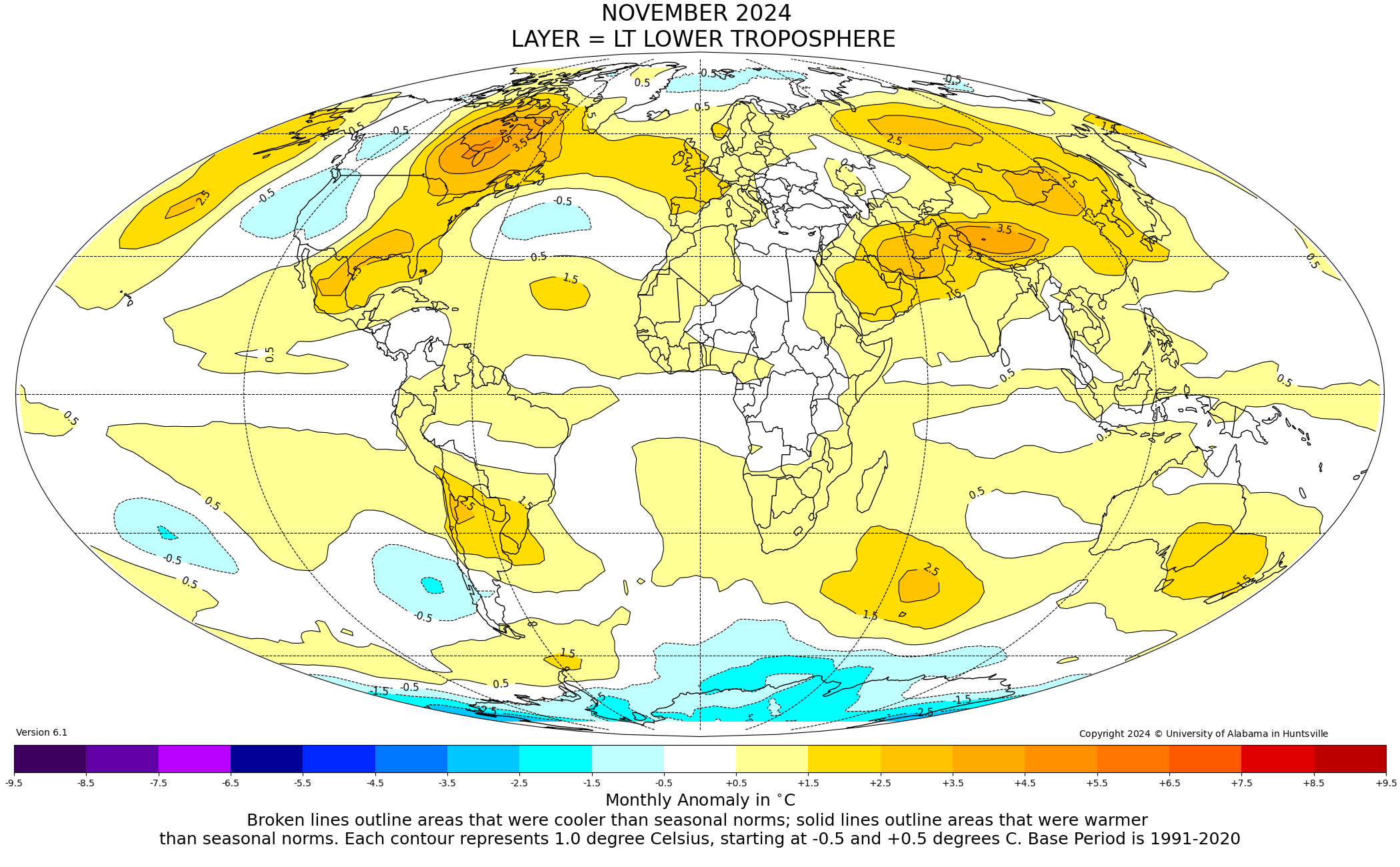
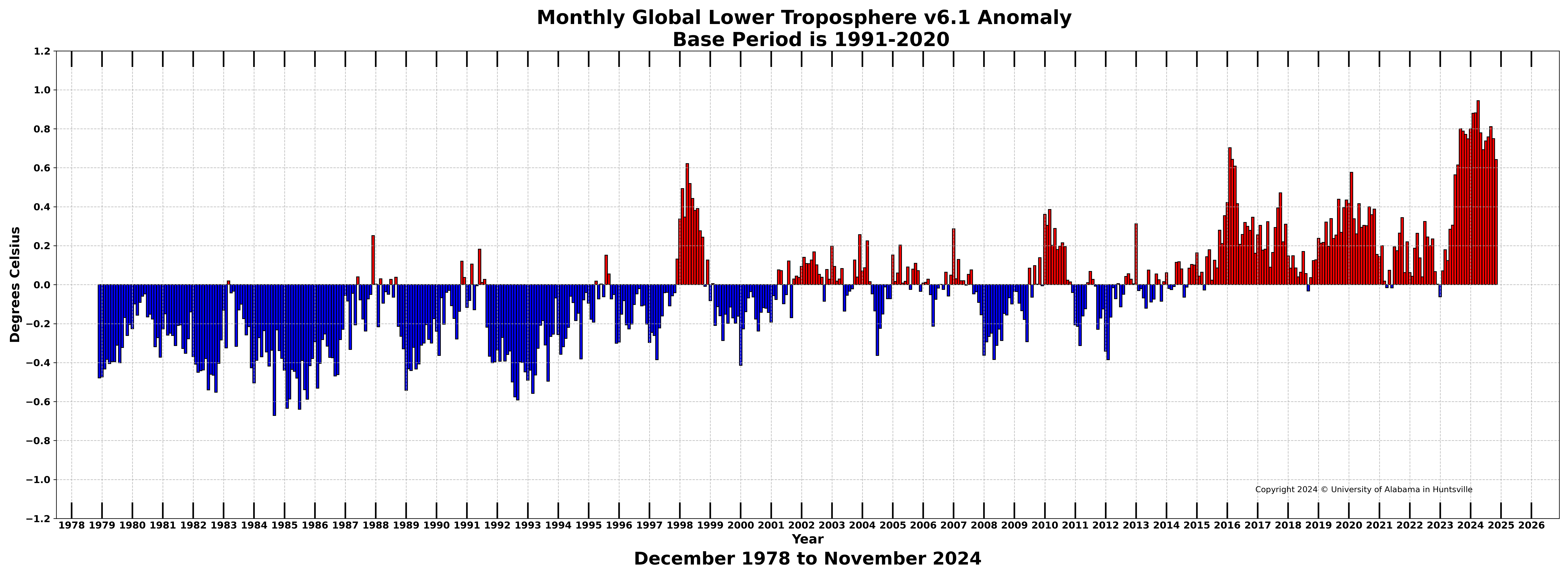
UAH v6.1 Global Temperature Update for November, 2024: +0.64 deg. C
By Roy Spencer, His Blog, Dec 3, 2024
With this update, we have added Metop-C to our processing, so along with Metop-B we are back to having two satellites in the processing stream. The Metop-C data record begins in July of 2019. Like Metop-B, Metop-C was designed to use fuel to maintain its orbital altitude and inclination, so (until fuel reserves are depleted) there is no diurnal drift adjustment needed. Metop-B is beginning to show some drift in the last year or so, but it’s too little at this point to worry about any diurnal drift correction.
The Version 6.1 global area-averaged temperature trend (January 1979 through November 2024) remains at +0.15 deg/ C/decade (+0.21 C/decade over land, +0.13 C/decade over oceans).
Global Temperature Report
By Earth System Science Center, The University of Alabama in Huntsville, November 2024
Map: https://www.nsstc.uah.edu/climate/2024/November/202411_Map.png
Graph: https://www.nsstc.uah.edu/climate/2024/November/202411_Bar.png
Text by John Christy and Roy Spencer, Dec 4, 2024
Changing Weather
Front versus Cold Pool
By Cliff Mass, Weather Blog, Dec 6, 2024
U.S. Hurricane Overview 2024
Storms, Impacts, Forecasts
By Roger Pielke, Jr., His Blog, Dec 5, 2024
Key mechanisms behind extreme weather pattern
Press Release, Climate Program Office, Climate Variability and Predictability, Nov 27, 2024 [H/t Bernie Kepshire]
Link to one study: Widening of wind-stress anomalies amplifies ENSO in a warming climate
By Jacob Stuivenvolt, et al., Journal of Climate, Nov 4, 2024
Link to second study: Tropical Indian Ocean drives Hadley circulation change in a warming climate
By Yong Sun, et al., National Science Review, October 2024
[SEPP Comment: The second study is a modeling exercise based on assumptions from the Paris agreement.]
A Wet November?
By Paul Homewood, Not a Lot of People Know That, Dec 2, 2024
Changing Climate
Recent Paper Shows Little Ice Age, Climate Driven By A Number Of Natural Driving Factors
By P Gosselin, No Tricks Zone, Nov 30, 2024
Translated from German
The Barents Sea Was Seasonally Ice Free For Much Of The Holocene…Today It’s Ice-Covered Year-Round
By Kenneth Richard, No Tricks Zone, Dec 2, 2024
Link to paper: A late response of the sea-ice cover to Neoglacial cooling in the western Barents Sea
By Maciej M. Telesiński, et al., The Holocene, 2024
Changing Seas
Climate Change: Climate, Ecosystems, and Fisheries
Press Release, NOAA Fisheries, Accessed Dec 5, 2024
Actionable Information for Climate-Ready Decision Making
Rapidly warming oceans, rising seas, increasing acidification, and extreme events (such as marine heatwaves) are transforming the structure and function of marine ecosystems. What is the CEFI Decision Support System?
The CEFI Decision Support System will provide decision-makers with early warnings, longer term projections, and actionable information to reduce risks and increase resilience of our valuable marine life and resource-dependent communities in a changing climate.
[SEPP Comment: Where is the physical evidence showing increasing acidification?]
Changing Cryosphere – Land / Sea Ice
Another New Study Reports A Lack Of A Long-Term Warming Trend Across Antarctica
By Kenneth Richard, No Tricks Zone, Dec 5, 2024
Lin to paper: Warmer Antarctic summers in recent decades linked to earlier stratospheric final warming occurrences
By Hyesun Choi, et al., Nature, Communications, Earth & Environment, 2024
Climate Change, Sea Ice and Engineering New Trade in the Artic
By Vijay Jayaraj, WUWT, Dec 6, 2024
Agriculture Issues & Fear of Famine
An Incredibly Stupid Idea
By Paul Homewood, Not a Lot of People Know That, Dec 4, 2024
Video – A dairy farmer thanking the public for objecting to a feed additive to reduce methane.]
Lowering Standards
Gosh, Really? NASA data reveals role of green spaces in cooling cities
By Anthony Watts, WUWT, Nov 30, 2024
Link to paper: Green spaces provide substantial but unequal urban cooling globally
By Yuxiang Li, et al., Nature Communications, Sep 2, 2024
Communicating Better to the Public – Use Yellow (Green) Journalism?
Quit Fearmongering, The Nation, Climate Change is Not a National Security Threat
By Linnea Lueken and H. Sterling Burnett, Climate Realism, Dec 2, 2024
Global Warming is Not Making Record Typhoons, South China Morning Post
By Linnea Lueken, Climate Realism, Nov 27, 2024
No, BBC, Atlantic Hurricane Season Did Not Break Records
By Paul Homewood, Not a Lot of People Know That, Dec 1, 2024
Ice-Free Arctic Warning
By Tony Heller, His Blog, Dec 4, 2024
Tidbits
By John Robson, Climate Discussion Nexus, Dec 4, 2024
The rule with rhetorical questions in headlines is that the answer is always “No.” Hence Euronews.green asks breathlessly: “Could China’s CO2 emissions peak by 2025? Experts optimistic about the superpower’s green transition”. Thank goodness for experts, or we’d have to rely on the evidence of our own eyes.
Wrong, The Conversation, Extreme Weather Isn’t Worsening and Deaths Are Declining
By Anthony Watts, WUWT, Dec 5, 2024
Communicating Better to the Public – Make things up.
Arctic could see its first ice-free day before the end of the decade: Study
By Sharon Udasin, The Hill, Dec 12, 2024
link to paper: The first ice-free day in the Arctic Ocean could occur before 2030
By Céline Heuzé & Alexandra Jahn, Nature Communications, Dec 3, 2024 [H/t Bernie Kepshire]
From abstract: Projections of a sea ice-free Arctic have so far focused on monthly-mean ice-free conditions. We here provide the first projections of when we could see the first ice-free day in the Arctic Ocean, using daily output from multiple CMIP6 models.
From The Hill: To draw these conclusions, an international team of researchers from CU Boulder and Sweden’s University of Gothenburg used more than 300 computer simulations to predict when that first ice-free day would occur.
Scientists generally consider the Arctic to be ice free when the ocean has less than a million square kilometers of ice, according to the authors.
[SEPP Comment: Based on 1 out of 300 simulations of models that fail basic testing and use unrealistic assumptions?]
DESNZ Admit Heat Pumps Are Not Cheaper To Run
By Paul Homewood, Not a Lot of People Know That, Dec 2, 2024
For years we have been fed the lie that heat pumps are cheaper to run. Finally, though they admit that at best costs are similar to a gas boiler, and often higher.
[SEPP Comment: DESNZ is the Department for Energy Security & Net Zero.]
German Scientists Using Generative AI to Hallucinate Fake Climate Records
By Eric Worrall, WUWT, Dec 2, 2024
“AI reveals hidden climate extremes in Europe”
Worrall: Climate scientists have been repeatedly criticized for treating their model output as data. Using a tool which is known for its tendency to produce false or misleading data, to generate climate “records” which cannot be properly checked in my opinion is an exercise in scientific fantasy – a complete waste of time and money.
Enough blame to go around twice
By John Robson, Climate Discussion Nexus, Dec 4, 2024
At which point you realize the other trick is that we’re collectively responsible for 110% of collective annual emissions before we even get to things like the oil and gas sector. No wonder there’s a crisis… of credibility.
Communicating Better to the Public – Use Propaganda
“Minoritize” This: Paternalistic Woke Academic Climate Change Preening
By Charles Rotter, WUWT, Dec 3, 2024
Link to paper: Localizing (or Not) Climate Change in Spanish-Language Newspapers in the United States
By Bruno Takahashi & María Fernanda Salas, Environmental Communication, Nov 13, 2024
Why Are BBC Verify Spreading Disinformation About Methane?
By Paul Homewood, Not a Lot of People Know That, Dec 4, 2024
Homewood: Given that methane breaks down in the atmosphere after ten years or so, it is irrelevant as far as climate change is concerned. (This is even before we consider the fact that the wavelengths affected by methane are already nearly fully saturated).
The article goes on to assure us that the additive is perfectly safe. But the real issue is that we simply don’t know. So why even take the risk of using additives which have absolutely no benefit?
US blasts countries that ‘stood in the way of progress to protect their profits’ over collapsed plastic talks
By Rachel Frazin, The Hill, Dec 3, 2024
The White House criticized a group of oil-rich countries as well as corporations who make money from plastic production in a new statement after global talks for a treaty to reduce plastic waste collapsed.
UN chief defends plastic pollution talks after collapse
By Sara Hussein, Busan, South Korea (AFP) Dec 2, 2024
Communicating Better to the Public – Protest
Climate Disobedience Ahead? Be Ready
By Robert Bradley Jr, Master Resource, Dec 5, 2024
“By the next election, I believe the climate movement will be a major political force in US politics, as the Trump administration’s anti-climate policies galvanize millions more people to the climate cause. And I predict we will see mass protests and mobilizations beyond anything we’ve seen before.” – Michael Mezzatesta “self-described “economics & climate educator…”
Questioning European Green
Why Are UK Electricity Prices So High?
By Paul Homewood, Not a Lot of People Know That, Dec 6, 2024
The only thing that has changed since 2019 is the rapid decarbonisation of the grid.
[SEPP Comment: Leading the pack of countries in the International Energy Agency.]
Angela Merkel’s Biography Flops. Amazon Even Suspends Reader Reviews
By P Gosselin, No Tricks Zone, Dec 4, 2024
Though her policies and those of her successor government have made Germany the sick old economic man of Europe, she has become the darling of the media for it.
High Energy Costs Continue to Plague European Industry
By Paul Homewood, Not a Lot of People Know That, Nov 29, 2024
‘Spray foam insulation ruined our house sale’
By Paul Homewood, Not a Lot of People Know That, Dec 5, 2024
It’s another reminder that the obsession with Net Zero often has unintended effects.
The Political Games Continue
Biden proposes raising acceptable threshold for common agricultural pesticide
By Rachel Frazin, The Hill, Dec 6, w0wr
Trump Taps Chris Rufo To Help De-Wokify Ivy Leagues Receiving Federal Funding
By Tyler Durden, Zero Hedge, Nov 29, 2024
Litigation Issues
Bang! 11 US states sue BlackRock, StateStreet and Vanguard for working as a cartel to reduce coal and increase electricity prices
By Jo Nova, Her Blog, Nov 30, 2024
Vanuatu blasts US, China for asking Hague to continue status quo for climate change harms
By Zack Budryk, The Hill, Dec 4, 2024
Cap-and-Trade and Carbon Taxes
2025 Will Bring More Energy Pain For Germans As CO2 Tax Set To Rise Again!
By P Gosselin, No Tricks Zone, Dec 1, 2024
Subsidies and Mandates Forever
Bankers plot ways to get paid carbon credits for emissions they might have emitted, but didn’t
By Jo Nova, Her Blog, Dec 5, 2024
The carbon market is the perfect scam-quasi-tax currency for our banker overlords. They were always trading reductions in an invisible gas, now they’re trading reductions from an imaginary increase that may never have occurred.
EPA and other Regulators on the March
Trump 45’s Environmental Reset: 112 Rule Changes
By Robert Bradley Jr., Master Resource, Dec 4, 2024
[SEPP Comment: Includes claims by New York Times reporter of damages from environmental rule rollbacks compared with a graph of the Declining National Air Pollutant Concentration Averages.]
Energy Issues – Non-US
November’s Energy Earthquake: A World Reshaped by Politics, Power, and Pragmatism
By Vijay Jayaraj, CO2 Coalition, Dec 2, 2024
Cost of switching off UK wind farms soars to ‘absurd’ £1bn
By Paul Homewood, Not a Lot of People Know That, Dec 3, 2024
From newspaper article: “According to the National Energy System Operator (Neso), curtailment costs are on course to surge to £6bn by 2030 if the status quo continues”
How civil servants deceived us
By Andrew Montford, Net Zero Watch, Dec 2, 2024
There is nothing of any substance on the capital or operating costs, but fortunately she [the official in charge of preparing the calculations] does address the question of why DESNZ assumes a lifetime average load factor of 61% for windfarms commissioning in 2025, when recent offshore windfarms open at 45% and then decline from there.
[SEPP Comment: A government novice in energy lecturing long-term authorities in energy who know how to examine the evidence.]
How the Rush to Net Zero is Accelerating Britain’s Industrial Decline
By Sallust, The Daily Sceptic, Dec 1, 2024
In 1970, U.K. industry consumed the equivalent of 62 million tonnes of oil each year, making most of what the nation needed including energy intensive products like steel, cement and petrochemicals. Manufacturing was by far the largest sector of the economy, contributing 30.1% of total output.
Last year, manufacturing accounted for just 9% of the U.K.’s economy.
MPs Worried About Chinese Tomatoes– (But Not Solar Panels!)
By Paul Homewood, Not a Lot of People Know That, Dec 4, 2024
[SEPP Comment: According to a chart presented by Homewood, Chinese firms are 9 out of the top 10 leading solar PV manufacturers worldwide in 2023, based on shipment. A Canadian firm came in 6th.)
Vietnam’s Bustling Economy Requires Fossil Fuels
By Ananya Bhatia and Vijay Jayaraj, CO2 Coalition, Dec 3, 2024
Following concerns raised by Korean, Japanese and American chambers of commerce about unstable electricity supply affecting their manufacturing operations, Vietnam Prime Minister Pham Minh Chinh assured business groups that he would prevent power outages.
Energy Issues – Australia
Power Down Blunder
Australians are asked to forego their dishwashers for the sake of the grid.
By Doomberg, Dec 3, 2024
Link to: Statistical Review of World Energy
By Staff, Energy Institute, 2024
If there is a place on Earth where wind and solar technologies should work, it is Australia. The country’s vast coastline and diverse geography bestow nearly ideal conditions for wind energy turbines, and the sun shines brightly and consistently. According to a detailed country-by-country analysis by the World Bank Group, Australia ranks near the top in global solar potential, and some of its largest commercial solar farms can achieve capacity factors in excess of 40%—roughly four times Germany’s average annual performance. By further comparison, similar facilities in the US average about 25%.
It didn’t work, mate
By John Robson, Climate Discussion Nexus, Dec 4, 2024
Out of Australia we bring you some of the least startling news in some time. Excessive faith in and subsidies into alternative energy have produced an alternative to energy, namely shortages and blackouts. No, wait. That’s not the big unsurprise. The big unsurprise is that the politicians responded by blaming the conventional energy sources they got rid of for the problem and touted the renewables that aren’t working as the solution.
Solar power is so good the govt needs emergency powers to switch your panels off in case they crash the national grid
By Jo Nova, Her Blog, Dec 3, 2024
Shh. The Renewable Crash Test Dummy Nation is at work.
Renewables Star state “urgently” wants to force two diesel plants back to stop blackouts
By Jo Nova, Her Blog, Dec 4, 2024
Back in February, South Australia was the Renewables Wonderland basking in the thrill of driving two diesel plants out of business. The remarkable transition had claimed two new fossil fuel scalps. But the farce of last week’s near blackout in Sydney must have scared the management in South Australia. Suddenly this week, the government announced it wants to change the rules and force those mothballed diesel plants back into action.
Energy Issues — US
Abusive DOE Energy Efficiency Policy Archives (60+ articles)
By Mark Krebs and Tom Tanton, WUWT, Dec 6, 2024
U.S. “Energy Dominance:” A Key to Trump’s Peace Bid
By Matthew Roy, WUWT, Dec 4, 2024
Nevada’s Embrace of Solar Power: An Imaginary Solution for an Imaginary Problem
By Norman Rogers, Real Clear Energy, Dec 3, 2024
The principal electric utility in Nevada, NV Energy, is owned by a Warren Buffet company. Warren Buffet is in business to make money, not to save the planet from an imaginary catastrophe, as easy that may be. For NV Energy solar energy is a financial bonanza. For example, NV Energy is building a $4 billion “Greenlink” power line made necessary by increasing use of solar energy. That capital investment becomes part of NV Energy’s regulatory rate base, greatly increasing profits and cash flow.
Hardening the Texas Grid: Why Regulators Should Look to Florida for Answers
By Ron Brisé, Real Clear Energy, Dec 4, 2024
Energy Policy Needs to Hit the Ground Running for Trump’s Second Term
By Kristen Walker, Real Clear Energy, Dec 3, 2024
Washington’s Control of Energy
Biden Admin Bans Future Leasing In Top Coal Mining Region On Thanksgiving Eve
By Nick Pope, Daily Caller, Nov 28, 2024
[Todd Yeager, the field manager for the Buffalo office of the Bureau of Land Management] added that the decision will take about 48 billion short tons of coal off the table for mining and development.
[SEPP Comment: President Carter considered coal the fuel to take the US out of the 1970s energy crisis, when Biden was a Senator!]
House Hearing Explores GAO “Scandal-pause” Revelations
By Staff, Government Accountability & Oversight, Dec 5, 2024
DoE’s representative Brad Crabtree avoided providing any answers to the crucial questions regarding how the “pause” came about, and the invited White House aide, John Podesta, was not there at all. Notably, Crabtree couched his denial of the existence of a buried LNG export study— proof of which GAO has uncovered—by slipping in the weasel word “final” and claiming that studies DoE buried were mere drafts
Nuclear Energy and Fears
Nuclear SMR welding breakthrough: A year’s work now takes a day
By David Szondy, New Atlas, Feb 20, 2024 [H/t Jim Karlock]
Plasma compression breakthrough: General Fusion hits 600 million neutrons per second
By Prabhat Ranjan Mishra, Yahoo News, Dec 1, 2024 [H/T Bernie Kepshire]
How the Trump Administration Can Make Nuclear Energy Popular With Women
By Gabriella Hoffman, Real Clear Energy, Dec 5, 2024
Nuclear energy is the most efficient power source available today. 94 nuclear reactors already supply 18.6% of current U.S. electricity generation. Nuclear, like natural gas, will be essential to meet rising global electricity demand. Unlike intermittent energy sources, like wind and solar, nuclear operates nearly 24/7. It produces near zero emissions while boasting a small environmental footprint compared to utility-scale solar and wind facilities, requiring just a mere square mile of land to accommodate a 1,000-megawatt (MW) power station operating 93% of the year.
Seven Reasons To Be Skeptical About SMRs (With Four Charts)
Small modular reactors are promising. But commercializing them will be difficult and require staggering amounts of money. Only a few SMR companies will survive.
By Robert Bryce, His Blog, Dec 1, 20224
Alternative, Green (“Clean”) Solar and Wind
Wind and Solar Are Fragile
By Steve Goreham, Master Resource, Dec 2, 2024
Nobody Wants To Build Wind Farms In The North Sea
By Paul Homewood, Not a Lot of People Know That, Dec 6, 2024
The California offshore wind environmental impact statement is full of holes
By David Wojick, CFACT, Dec 2, 2024
BOEM is taking comments on a draft Programmatic Environmental Impact Statement (PEIS) for its five floating wind offshore leases off the California coast. I am doing research prior to commenting, and this is my first report which other commenters might find useful.
Alternative, Green (“Clean”) Energy — Other
Reigniting the American Hearth: The Conservative Case for Modernizing Wood Stoves
By Ronald Beaty, Real Clear Energy, Dec 04, 2024
Alternative, Green (“Clean”) Energy — Storage
National Grid & The Hornsea Battery
By Paul Homewood, Not a Lot of People Know That, Dec 1, 2024
This is not just dishonest; it is dangerously so!
Alternative, Green (“Clean”) Vehicles
Carmageddon
By Paul Homewood, Not a Lot of People Know That, Dec 6, 2024
Video: How China has come to dominate the EV industry:
From Homewood: Sky, however, miss a couple of crucial points:
The threat to the European car industry is self-inflicted. Most drivers don’t want EVs, and it is only the ban on ICE cars that is opening the door to the Chinese threat
Chinese EVs need an awful lot of coal power to build them and their batteries.
EV Sales Still Well Below Target
By Paul Homewood, Not a Lot of People Know That, Dec 5, 2024
California Dreaming
California Dreamin’: Newsom’s Energy Fiasco
By Charles Rotter, WUWT, Nov 30, 2024
California can’t use all its solar power. That’s a huge problem.
As residents see sky-high bills, California’s solar plants don’t even operate at full capacity
By Stephen Council, SFGate, Dec 2, 2024 [H/t Bernie Kepshire]
[SEPP Comment: Yet it produces no power at midnight.]
Elon Musk: CA Gov. Newsom’s Plan to Exclude Tesla From Rebate Program is “Insane”
A governor targeting one of the most popular entrepreneurs in the country and hurting his citizens to do so is unappealing to Americans in today’s environment. It will be even less appealing in 2028.
By Leslie Eastman, Legal Insurrection, Nov 28, 2024
“It’s one of the reasons guys like Elon Musk and others have become so damn successful,’ Newsom said in October. ‘It’s because we’ve set price signals, we’ve created markets, we’ve created opportunities for investments. We’re the number one manufacturer for a reason. We continue to be the envy of the world.”
Musk had a pithy response to the move: “This is insane “.
Musk, whose company is the only one that actually manufactures EVs in the Golden State, clearly felt singled out and slammed Newsom’s proposal.
California cuts back on water deliveries, anticipating dry year ahead
By Sharon Udasin, The Hill, Dec 3, 2024
“Based on long-range forecasts and the possibility of a La Nina year, the State Water Project is planning for a dry 2025 punctuated by extreme storms like we’ve seen in late November,” said Karla Nemeth, director of the Department of Water Resources, in a statement.
California ‘purifies’ its little air bubble at the expense of its residents
By Ronald Stein, America Out Loud, Dec 2, 2024
Health, Energy, and Climate
Extreme heat-related deaths may be affecting the young more than the old: Study
By Sharon Udasin, The Hill, Dec 6, 2024
Link to paper: Heat disproportionately kills young people: Evidence from wet-bulb temperature in Mexico
By Andrew J. Wilson, et al., AAAS Science Advances, Dec 6, 2024
From abstract: Combining detailed measurements of wet-bulb temperature with age-specific mortality data, we find that younger people who are particularly vulnerable to heat: People under 35 years old account for 75% of recent heat-related deaths and 87% of heat-related lost life years, while those 50 and older account for 96% of cold-related deaths and 80% of cold-related lost life years.
[SEPP Comment: Does not consider the occupations of those who die such as office workers compared with field hands.]
Global, regional, and national mortality burden attributable to air pollution from landscape fires: a health impact assessment study
By Rongbin Xu, et al., The Lancet, Nov 27, 2024
We obtained the relative risks (RRs) for both short-term and long-term impact of LFS PM2·5 and O3 on all-cause, cardiovascular, and respiratory mortality.
[SEPP Comment: What is the source of actual physical evidence of the relative risk of PM2.5?]
Other Scientific News
Interesting
By Anthony Watts, WUWT, Dec 3, 2024
Link to paper: Understanding heavy precipitation events in southern Israel through atmospheric electric field observations
By Roy Yaniv, Yoav Yair, and Assaf Hochman, Atmospheric Research, January 2025
Trump Picks Billionaire Entrepreneur and “Polaris Dawn” Hero Jared Isaacman to Head NASA
By Leslie Eastman, WUWT, Dec 6, 2024
BELOW THE BOTTOM LINE
12 Irrefutable Proofs That Climate Change Is Real
Video, The Babylon Bee, Via WUWT, Dec 5, 2024
Link to: The Babylon Bee Guide to the Apocalypse (Babylon Bee Guides)
Vaia Amazon, Nov 12, 2024
Experts agree you need to listen to the expert
By John Robson, Climate Discussion Nexus, Dec 4, 2024
Nothing Nuclear Winter Can’t Fix
By Tony Heller, His Blog, Dec 6, 2024
From a New York Times article: “Climate science has been stymied as Russia continues its war in Ukraine. The stalled work threatens to leave the West without a clear picture of how fast the Earth is heating up.”
Monday Mirthiness: Imagine the Global Impact on Temperature!
By Anthony Watts, WUWT, Dec 2, 2024
[SEPP Comment: An image of half of the globe centered on the UK.]
The United States is paralyzed…and it’s not going to get any better
By Staff, MSN News, Dec 4, 2024
In the future, climate change could have a major impact on both the frequency and intensity of snowstorms associated with the lake effect.
Shorter winters and longer periods of ice could help intensify the phenomenon. In the long term, if temperatures continue to rise, the snow could turn to rain, threatening the regions concerned with major flooding. [Boldface added]
[SEPP Comment: Did anyone proofread this?]
Vice-chancellor who wanted climate change lessons for all claimed £16,000 expenses for flights
By Paul Homewood, Not a Lot of People Know That, Dec 6, 2024
Sheffield University
ARTICLES
1. Climate-Change Colonialism Keeps Poor Countries Impoverished
Development agencies fund green projects when people need jobs, food and energy.
By Bjorn Lomborg, WSJ, Dec. 2, 2024
TWTW Summary: The president of the Copenhagen Consensus writes:
“At the latest United Nations climate summit, developing nations slammed rich countries’ pledge to spend $300 billion annually on climate reparations as ‘crumbs.’ The reality is much worse. Wealthy nations likely won’t conjure up $300 billion in new spending. Europe has been roiled by protests against radical climate policies and the 2024 U.S. election was an indictment of, among other things, aggressive climate regulations. Instead, wealthy nations will do what they’ve done before: raid development funds to the detriment of the people they claim to help.
Members of the Organization for Economic Cooperation and Development currently spend $223.7 billion a year trying to do good in poor countries through bilateral and multilateral aid and development spending. It is politically much easier for politicians intent on green spending to shift this money to climate purposes than try to get voters to go along with fresh outlays. Rich nations have diverted much of this funding to climate-change initiatives. OECD members spent one-third of their direct development aid on climate in fiscal 2021-22, the most recent year for which data are available. Development banks have twisted their purpose even further: The World Bank last year sent 44% of its lending to climate causes, the African Development Bank 55% and the European Investment Bank 60%.
This charade needs to stop. As part of President-elect Trump’s reforms to wasteful government, he should return development aid to policies that make a real difference.
Advocates of green aid are right that climate change will hurt poor countries, but almost every other challenge these nations face—from hunger and poverty to disease and poor education—hurts them more. Typically, climate aid is the worst way to improve quality of life or prevent deaths. Some adaptations to extreme weather are prudent. Early-warning systems for hurricanes and dikes can deliver excellent benefits for each dollar spent. But most climate aid does little to help the developing world. What feeble returns it does bring are dwarfed by the good that could have been done if governments spent that money on direct development efforts such as expanding childhood vaccines or improving crops.
This is especially true for climate aid that goes toward emission cuts. The very poorest countries in the world are responsible for less than 0.5% of emissions. They don’t need decarbonization. They need growth, which requires access to copious, reliable energy. Given solar and wind power’s unreliability—and consequent reliance on expensive backup power—this will mostly have to come from fossil fuels. Denying these countries access to cheap and reliable energy is equivalent to condemning them to poverty.
Perversely, multilateral development banks spend two-thirds of their climate financing—a massive $50 billion a year—on ‘mitigation’ policies, helping poor countries cut carbon emissions and pushing them only to adopt unreliable power sources.
When people need jobs and food, it is immoral to give them solar panels instead. Poverty kills nearly 10 million people annually through related problems such as infectious diseases and hunger. By comparison, the climate-change toll is tiny. Extreme weather took an average of 9,000 lives each year over the past decade. There are many core development priorities wealthy nations could fund that would quickly and efficiently save lives and create economic growth. These include reducing the scourges of malaria and tuberculosis, improving learning outcomes and cutting maternal and neonatal deaths. Carbon mitigation in poorer countries, on the other hand, will generate only a minuscule temperature reduction about a century from now.”
Mr. Lomborg states that “climate aid” money is lost and that actual development, not green policy, is needed in poorer nations.
via Watts Up With That?
December 9, 2024 at 04:02AM
 Iowa Climate Science Education