
Ofgem, 22 November 2024:
From 1 January to 31 March 2025 the price for energy for a typical household who use electricity and gas and pay by Direct Debit will go up by 1.2% to £1,738 per year. This is because wholesale prices remain high due to global factors.
Ha! Those will be the global factors, which have a singular ability to turn their beady eyes on the UK?
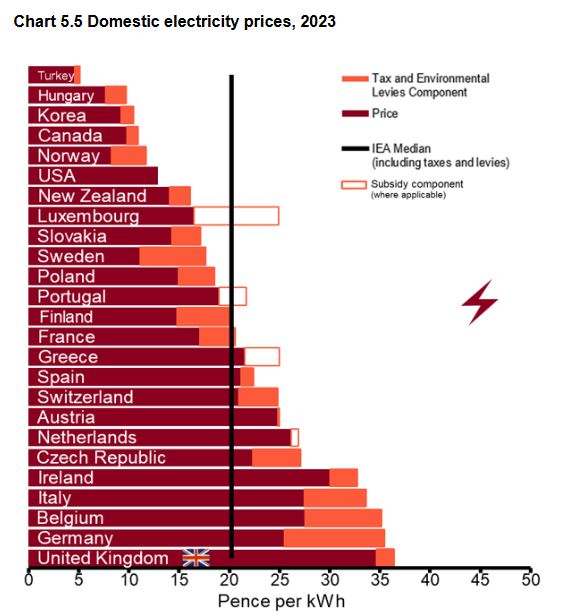
In reality, as sceptics know well, prices are high because of the best part of two decades of wanton and furious destruction of our energy system. And the malignant force at the heart of decision making is gleefully knocking a cold chisel into it. (Notice how small our “tax and environmental levies component” is. True dat, or…? (compare to head image.))
A point about the Energy Price Cap which is not I think widely publicised is the recent drop in the benchmark amount of energy a household uses, the TDCV or “Typical Domestic Consumption Value,” to which the goblins at Ofgem often append the word “value” for good measure:
Given our assessment and stakeholder feedback which supports amending the TDCV values, we intend to reflect the updated TDCVs in how we communicate the level of the price cap from the implementation date of 1 Oct 2023. We will ensure this change is communicated clearly and appropriately to all stakeholders. We will make clear that the revised TDCVs (all else held equal) will result in a lower level of the price cap that is being communicated, which is due to a downward revision of the underlying consumption assumptions, rather than a reduction in underlying costs.
To what extent people are aware that the price cap now relates to a lower energy consumption than prior to October 2023, I do not know. The annual gas usage of the “typical” home has dropped from 12 MWh to 11.5 MWh, and leccy usage is down from 2.9 MWh to 2.7 MWh, so that the price cap is automagically lower.
The upcoming price cap has the following characteristics:
Leccy: standing charge 60.97p/d; 24.86p/kWh ~ £223/yr + £671 (£721)
Gas: standing charge 31.65p/d; 6.34p/kWh ~ £116/yr + £729 (£761)
Total: £1,739 (slight variation owing to rounding).
The figures in parentheses show what the price cap would have been before October 2023, all else kept equal. It is ~£82 lower than it would have been, but for the downward revision of TDCV.
Asterisk: the TDCV has already been reduced, back in 2020, although that might only have affected leccy. I lack the will to look it up.
Interestingly of course there is more than one reason for reducing consumption. One is that you no longer need as much of the product. The other is that you can no longer afford as much of the product. Here’s what National Energy Action says (22nd August, 2023):
There are two main reasons why the TDCV has been reduced.
Firstly, because there have been legitimate efficiency gains in UK households, through making the fabric of homes more energy efficient, and through white goods becoming more efficient over time.
Secondly, and more worryingly, demand has reduced over the last two years as households have rationed their energy in response to high energy prices. For example, polling conducted by National Energy Action (NEA) and Birmingham University found that 81% said they rationed energy that winter, while 55% rationed hot water and 13% had reduced the use of powered medical equipment at home in response to high prices.
The “typical” home is probably an estimate of the median. The DESNZ stats I have looked at (not shown here) use the average, which is higher than the median. [The average used by DESNZ has also been revised downwards.]
When pitching to be elected, Labour and its very earnest former leader promised to reduce consumer energy bills by £300. My interpretation of M. Miliband’s promise is that the energy price cap should be £300 less than it was in the last quarter before the election: April to June 2024. At this point it was £1,690.
That would mean Ed’s promise could be considered kept if at some future point during this parliament the cap came down to £1,390. (They have refused to put a timetable on things, against which they may be judged.) Of course, the figure of £1390 would not account for inflation, & would make the SoS’s task harder. What would make it easier would be if we ration our energy use some more, and also if the price cap drops anyway because Ofgem revises the TDCV down (also if we improve our energy efficiency, of course).
Some might argue that the July to October 2024 price cap should be Ed’s baseline, since it was announced on 24th May 2024, in advance of the election, i.e. it was based on the previous government’s efforts. This was lower at £1,568, which would make the job of shaving £300 off it more difficult.
So far, things are trending in the wrong direction: the January-March 2025 price cap is £1,738, as mentioned. Discounting inflation, we’re either £170 in the wrong direction, or £48, depending on when the start line is. And that’s not to mention the Winter Fuel Allowance.
On TV last week, Ed was seen to redefine his promise of £300 savings as “up to £300”. A saving up to £300 could be a saving of £1, as Naga Munchetty pointed out to him on BBC breakfast. (Good for her, because the breakfast presenters are usually too credulous. I gave up watching it at some point, when the proportion of actual news dropped so low as to make the whole unbearable.)
Here’s where I saw the clip with Naga: Mike Graham showed it when talking to the Bish on TalkTV.
Prediction: it seems to me quite obvious that the price cap can only go one way – north – unless M. Miliband is allowed to offload some of the costs onto general taxation. His failure will be waved away with several excuses, including that we are the cusp of a breakthrough when the critical level of weather-dependent generation is reached. In fact, the critical level is that at which we cease to grow, and start to retract. And to make a bolder prediction, we will begin to see cracks once the sugar rush of spending in the Budget has worn off. Twelve months from now will see the truth of it. For the UK, it’s either the golden era of growth of Starmer, Reeves and Miliband’s Milestones, or it’s the slow spiral into decay of Jit’s augurs of doom. Of course, there’s still time to change the road we’re on, as the man said.
Glossary for posterity
Default Tariff Cap
What Ofgem used to call the Energy Price Cap. Everyone else called it the Energy Price Cap, and Ofgem seems to have caved in in 2023.
Energy Price Cap
A default tariff – hey ho – introduced at the start of 2019. Back then, it was £1137. The idea was that people who had never switched provider, and were therefore getting ripped off compared to those who had, would save money. In practice, it seems that the tariffs all migrated to the capped price.
A notable side effect occurred in the escape from Covid lockdown in 2021. At this point, gas wholesale prices surged, but the small suppliers, who were not able to raise prices above the EPC, fell over like a row of dominoes. [And it’s worth noting that this happened before the rise in gas price associated with the Russian invasion of Ukraine in February 2022.]
Energy Price Guarantee
After the 2022 invasion, gas prices rocketed yet more. In September 2022, Liz Truss, the much-ridiculed ephemeral PM, decided to, in effect, cap the price cap. This was at a level of £2,500 for the typical home, when Ofgem wanted a price cap of £3,549. [They later wanted to hoik it to over £4 grand.] Truss also ordered that fracking be commenced, in order that the UK might have resilience against such events in future. Alas, we all know what happened to Truss, and to fracking, once the technocrats got the man they always wanted.
Let me offer you a choice: in one hand, you’ll have Starmer. In the other, Truss. You can only keep one. Which do you choose?
Energy Grant / Energy Bills Discount
A payment of £400, split I seem to remember into three tranches of £133, that Rishi Sunak (then Chancellor) announced in the wake of the Russian invasion. By the time it came to pass, he was probably PM.
Winter Fuel Payment
A payment to all pensioners, which I think was up to £300, which was canned by our new Chancellor, Rachel Reeves, once she had discovered a black hole at the centre of the Milky Way, I mean in the public finances. Now only the poorest get it, who have applied for pension credit.
Bonus image – Where domestic energy bill data is filed:

via Climate Scepticism
December 17, 2024 at 10:47AM
 Iowa Climate Science Education