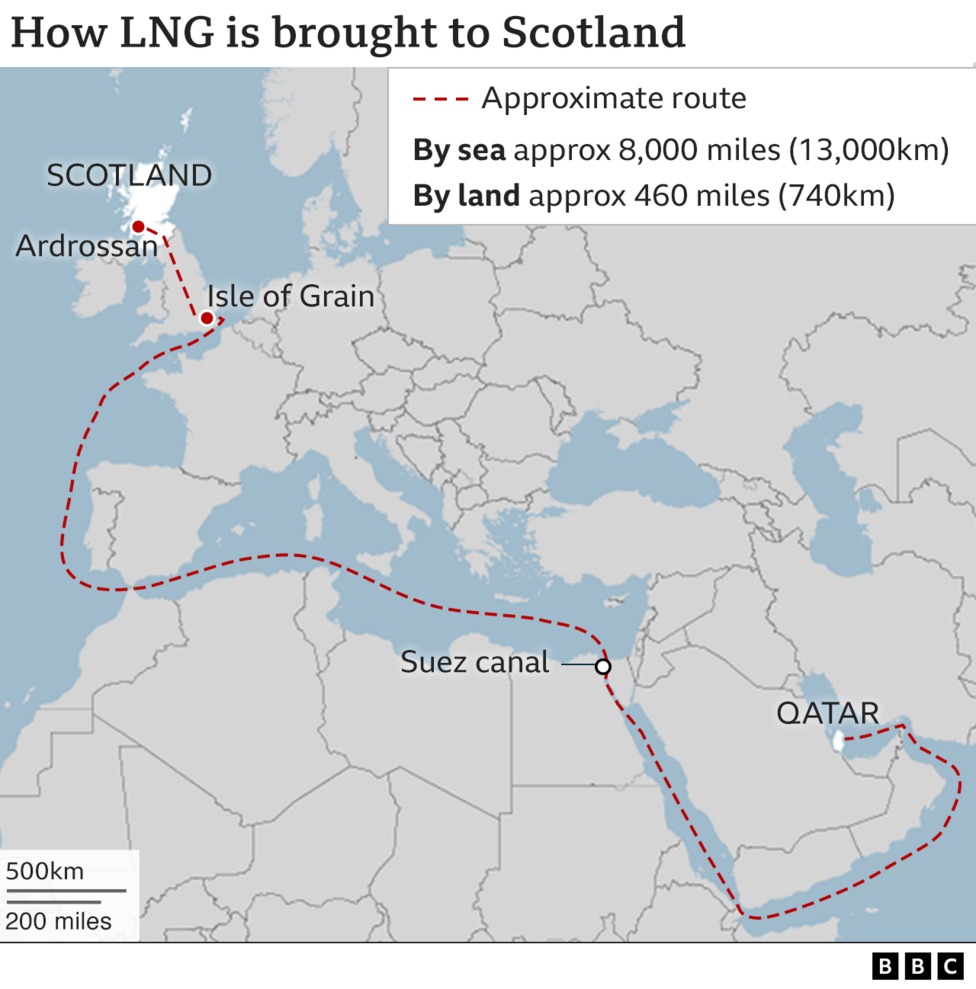
It’s a bigger boat than its predecessor, but there were other ways of powering its engines than imported gas (LNG), which then has to be transported 460 miles by road from Kent. It must have seemed like a good idea at the time to the climate-obsessed Scottish government, but a catamaran design would have been more efficient, as this article explains.
– – –
The carbon footprint of a long-delayed new “green” ferry will be far larger than the 31-year-old diesel ship that usually serves the route between the Scottish mainland and the island of Arran, says BBC News.
An emissions analysis by CalMac has calculated MV Glen Sannox will emit 10,391 equivalent tonnes of CO2 a year compared with 7,732 for MV Caledonian Isles.
The dual-fuel ferry has more car capacity but requires larger engines which also emit methane, a greenhouse gas with a far greater global warming effect than CO2. [Talkshop comment – according to one disputed theory].
Ferries procurement agency CMAL, which owns the ship, said the comparison was “inaccurate” as Glen Sannox is a larger vessel.
The size of Glen Sannox is a factor in its carbon footprint, but so too is the liquified natural gas (LNG) fuel which is less climate-friendly than previously claimed.
One expert on transport emissions told BBC News that if the “upstream” carbon cost of importing LNG from Qatar is included in the emissions calculation, it might be better to run the new ship on diesel.
Prof Tristan Smith, from University College London’s Energy Institute, said: “In a best case scenario there’s a negligible benefit of using LNG, and at worst there would be a deterioration.”
. . .
An alternative option would be to consider catamarans, which are far more fuel-efficient than single-hulled ships.
The chartered catamaran Alfred, which can carry 98 cars and cost only £14.5m to build, has been operating successfully on the Arran route for the past 20 months.
Its owner describes it as the most environmentally-friendly large ferry in Scotland because of its low fuel consumption.
CalMac believes advances in battery technology mean about 90% of its routes could potentially be serviced by all-electric ferries, rising to 100% if fast charging were available. [Talkshop comment – ‘potentially’].
Prof Smith says this is the most climate-friendly option at the present time – although it would require significant upgrades to electricity infrastructure.
“Many other countries are putting battery electric vessels into routes similar to those serviced by these vessels,” he said.
Full article here.
via Tallbloke’s Talkshop
December 30, 2024 at 05:11AM
 Iowa Climate Science Education